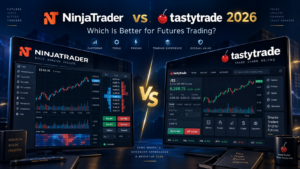
NinjaTrader vs tastytrade 2026: Which Is Better for Futures Trading?
NinjaTrader vs tastytrade is an increasingly important comparison for active futures traders in 2026. Both platforms provide futures trading, Micro contracts, advanced desktop tools, mobile access, ladder-based execution and developer technology, but they are built around very different trading philosophies.
NinjaTrader is a futures-first ecosystem combining specialized futures brokerage, NinjaTrader Desktop, Web and Mobile, SuperDOM, Market Replay, Order Flow+, strategy backtesting and C#-based NinjaScript automation.
tastytrade takes a broader active-trader approach. Its ecosystem supports stocks, options, futures, futures options and other products, with particular strength in options analysis, portfolio risk tools, Active Trader execution and an increasingly powerful Open API.
This detailed NinjaTrader vs tastytrade 2026 comparison examines futures commissions, Micro futures costs, intraday margin, platform fees, Active Trader versus SuperDOM, APIs, automated trading, backtesting, futures options, mobile access and ease of use to determine which platform better fits different traders.
Quick Answer
Choose NinjaTrader if futures are your primary market and you want low published Micro commissions, low fixed day-trading margins on selected contracts, SuperDOM, Market Replay, Order Flow+, NinjaScript automation and integrated futures backtesting.
Choose tastytrade if you actively trade futures together with options, want strong portfolio-risk analysis, prefer a subscription-free multi-asset platform, value futures options and want a modern REST/JSON API for building external trading applications.
TradeboticsAI Verdict: NinjaTrader remains our preferred choice for dedicated futures-first traders. tastytrade is particularly compelling for active options traders who also use futures for directional trades, hedging or portfolio diversification.
Explore NinjaTrader and Free Simulated Futures Trading →
Affiliate disclosure: TradeboticsAI may receive compensation when visitors complete qualifying actions through certain links. Futures and futures options involve substantial risk. Simulated and backtested results are hypothetical. Exchange, regulatory, clearing and other fees may apply.
Table of Contents
- NinjaTrader vs tastytrade Overview
- Quick Comparison
- Futures Specialist vs Multi-Asset Broker
- Futures Commissions
- Micro Futures
- Intraday Futures Margin
- Platform Costs and Plans
- Markets and Futures Products
- Options on Futures
- Trading Platforms
- SuperDOM vs Active Trader
- Risk Analysis
- Automated Trading
- NinjaScript vs tastytrade Open API
- AI and MCP Trading Infrastructure
- Backtesting and Research
- Simulation
- Web and Mobile Trading
- Trading Hours
- Additional Costs
- Ease of Use
- Pros and Cons
- Which Platform Should You Choose?
- Related Comparisons
- FAQ
- Final Verdict
NinjaTrader vs tastytrade 2026: Overview
The fundamental difference in NinjaTrader vs tastytrade is specialization versus multi-asset active trading.
NinjaTrader is designed primarily around futures.
Its ecosystem includes:
- Futures brokerage through NinjaTrader Clearing
- NinjaTrader Desktop
- NinjaTrader Web
- NinjaTrader Mobile
- SuperDOM
- Market Replay
- Order Flow+
- NinjaScript
- Strategy Analyzer
- Simulated trading
- Advanced futures charting
tastytrade serves a broader active-trader audience.
Its platform supports products including:
- Stocks
- ETFs
- Equity options
- Index options
- Futures
- Micro futures
- Options on futures
- Options on Micro futures
- Cryptocurrency where available
This difference matters because many tastytrade customers use futures as part of a larger options or portfolio strategy.
A NinjaTrader customer is more likely to select the platform specifically because futures trading is the primary activity.
NinjaTrader vs tastytrade: Quick Comparison
| Category | NinjaTrader | tastytrade |
|---|---|---|
| Primary Strength | Dedicated futures ecosystem | Options + futures active trading |
| Standard Futures Commission | From $0.59 per side | $1 per contract to open and $1 to close |
| Micro Futures Commission | From $0.09 per side | $0.75 per contract to open and $0.75 to close |
| Platform Subscription | Free, $99 Monthly or $1,499 Lifetime plans | No platform subscription required |
| Intraday Margin | Fixed published day margins starting around $50 | Eligible accounts can use 1/4 of overnight requirement during intraday window |
| Desktop | NinjaTrader Desktop | tastytrade Desktop |
| Web | Yes | Yes |
| Mobile | iPhone and Android | iOS and Android |
| Ladder Trading | SuperDOM | Active Trader ladder |
| Native Strategy Coding | NinjaScript / C# | External development through Open API |
| Open API | NinjaTrader ecosystem integrations | REST/JSON Open API with futures support |
| Options on Futures | Not primary platform advantage | Major strength |
| Portfolio Risk Tools | Futures-focused analysis | SPAN scenarios, allocation and portfolio analysis |
| Best For | Dedicated futures traders | Active options and multi-asset traders |
Futures Specialist vs Multi-Asset Active Trader
The central strategic difference in NinjaTrader vs tastytrade is what happens after the futures trade.
With NinjaTrader, almost the entire environment remains centered on futures execution and futures analytics.
This creates a highly focused workflow for:
- Micro futures scalping
- Index futures
- Energy futures
- Metals
- Order-flow trading
- Algorithmic futures systems
- Historical replay
tastytrade is fundamentally more portfolio-oriented.
A trader can use options for defined-risk exposure, futures for directional exposure, futures options for derivatives strategies and stocks or ETFs for longer-term positions.
That makes tastytrade particularly relevant to sophisticated options traders who also want futures access without maintaining a completely separate platform ecosystem.
Pure futures specialization: NinjaTrader.
Multi-product active trading: tastytrade.
NinjaTrader vs tastytrade Futures Commissions
Commission structure can materially affect the final NinjaTrader vs tastytrade decision.
NinjaTrader Pricing
| Plan | Plan Cost | Micro / e-Nano | Standard |
|---|---|---|---|
| Free | $0/month | $0.39 per side | $1.29 per side |
| Monthly | $99/month | $0.29 per side | $0.99 per side |
| Lifetime | $1,499 one-time | $0.09 per side | $0.59 per side |
Exchange, clearing and NFA fees apply in addition to NinjaTrader commissions.
Verify the latest rates on the official NinjaTrader pricing page.
tastytrade Futures Pricing
| Product | Opening Commission | Closing Commission |
|---|---|---|
| Standard Futures | $1.00 / contract | $1.00 / contract |
| Micro / Mini Futures | $0.75 / contract | $0.75 / contract |
| Options on Futures | $1.25 / contract | $1.25 / contract |
| Options on Micro Futures | $0.75 / contract | $0.75 / contract |
Other exchange, regulatory and clearing-related fees can apply.
Check the official tastytrade pricing page before opening a live trade.
Which Has Lower Futures Commissions?
For frequent Micro futures trading, NinjaTrader currently has the lower headline commission at every published plan tier.
The largest difference appears with NinjaTrader Lifetime at $0.09 per Micro contract per side versus tastytrade’s $0.75 opening and closing commission.
However, NinjaTrader Lifetime requires a $1,499 upfront payment.
A low-volume trader should therefore calculate how long it would take for commission savings to recover that plan cost.
tastytrade does not require a platform subscription to access its standard futures commission schedule.
That simpler pricing model may appeal to traders who use futures less frequently.
NinjaTrader vs tastytrade for Micro Futures
Micro futures are particularly important in the NinjaTrader vs tastytrade comparison.
Both platforms support popular equity-index Micro contracts including:
- /MES — Micro E-mini S&P 500
- /MNQ — Micro E-mini Nasdaq-100
- /MYM — Micro E-mini Dow
- /M2K — Micro E-mini Russell 2000
Both also provide access to additional Micro products across metals, energy and other supported futures categories.
NinjaTrader’s advantage is pricing and futures specialization.
tastytrade’s advantage is the ability to combine Micro futures with equity options, index options and futures options within a broader active-trading portfolio.
For a pure MES or MNQ scalper, NinjaTrader generally provides the more purpose-built environment.
For an options trader who occasionally uses MES or MNQ for hedging, tastytrade can be more convenient.
NinjaTrader vs tastytrade Intraday Futures Margin
Margin is another major difference.
NinjaTrader Day Margin
NinjaTrader publishes fixed intraday margin figures for many contracts.
Its current pricing proposition includes day-trading margins starting around $50 for selected Micro futures.
This model is especially easy for active futures traders to understand.
tastytrade Intraday Margin
tastytrade uses a different model.
Eligible non-IRA margin accounts can use intraday futures margin between approximately 8:30 AM and 3:00 PM Central Time.
During that eligible period, the requirement is generally one-quarter of the contract’s overnight requirement.
For example, if a futures contract has a $10,000 overnight requirement, the eligible intraday requirement would be approximately $2,500.
Positions carried after the intraday window revert to the full overnight requirement.
This can create a major buying-power change near the end of the session.
Traders must therefore monitor account equity carefully.
Lower fixed retail day-margin structure: NinjaTrader.
SPAN/overnight-derived intraday structure: tastytrade.
Greater leverage does not make a trade safer. Reduced margin can magnify losses as rapidly as gains.
NinjaTrader Plans vs tastytrade Platform Cost
NinjaTrader uses plan-based futures pricing.
The three plans are:
- Free: $0/month
- Monthly: $99/month
- Lifetime: $1,499 one-time
Higher-cost plans reduce per-contract commissions.
tastytrade takes a different approach.
The broker advertises transparent product pricing without a required platform subscription.
Its Desktop, Web and Mobile trading environments are part of the brokerage ecosystem rather than separate pricing tiers designed to lower futures commissions.
This creates a clear strategic choice.
NinjaTrader: pay more for the plan if lower long-term commissions justify it.
tastytrade: use the standard brokerage platform without needing to select a monthly or Lifetime futures plan.
NinjaTrader vs tastytrade Futures Markets
Both platforms provide access to major futures categories.
tastytrade currently lists futures covering:
- Equity indexes
- Energy
- Metals
- Currencies
- Interest rates
- Agriculture
- Cryptocurrency futures
- Livestock
- Volatility products
Examples include /ES, /MES, /NQ, /MNQ, /YM, /MYM, /RTY and /M2K.
NinjaTrader similarly provides broad futures access across major U.S. and international venues, including CME Group, Eurex, ICE and Coinbase Derivatives.
For most U.S. index-futures traders, both provide substantial product coverage.
NinjaTrader has the stronger futures-only identity, while tastytrade adds greater value when futures options and securities markets are part of the strategy.
NinjaTrader vs tastytrade for Options on Futures
This category strongly favors tastytrade.
tastytrade’s brand and platform architecture have historically been centered on options trading.
That expertise extends to options on futures.
Its futures product tables identify which underlying futures contracts have options available, and the brokerage publishes separate pricing for both regular and Micro futures options.
This can be valuable for strategies involving:
- Defined-risk directional trades
- Premium selling
- Futures hedging
- Volatility strategies
- Calendar exposure
- Portfolio-risk management
For traders who actively combine futures and futures options, tastytrade’s integrated options workflow is a major competitive strength.
Futures-options winner: tastytrade.
NinjaTrader vs tastytrade Trading Platforms
NinjaTrader Platforms
- NinjaTrader Desktop
- NinjaTrader Web
- NinjaTrader Mobile
NinjaTrader Desktop provides the deepest functionality, especially for custom strategy development and advanced futures execution.
tastytrade Platforms
- tastytrade Desktop
- tastytrade Web
- tastytrade Mobile
The tastytrade interface is designed to support multiple asset classes while maintaining an active-trader orientation.
Desktop provides the broadest workspace functionality, while Web and Mobile provide easier access away from the main workstation.
For advanced futures specialists, NinjaTrader Desktop offers more futures-specific customization.
For active options and futures traders who want one interface for multiple asset classes, tastytrade has a strong advantage.
NinjaTrader SuperDOM vs tastytrade Active Trader
Both platforms provide ladder-style execution, but they approach it differently.
NinjaTrader SuperDOM
SuperDOM is a mature futures depth-of-market interface designed for fast order placement and position management.
It integrates with:
- ATM strategies
- Stop and target management
- Custom NinjaScript extensions
- Futures market depth
- Position management
- Advanced execution workflows
tastytrade Active Trader
tastytrade’s Active Trader interface is purpose-built for active futures execution.
The futures platform allows traders to view charts and a ladder side by side and place orders rapidly from the trading interface.
Active Trader is easier to integrate into a multi-asset portfolio workflow.
SuperDOM provides deeper customization for dedicated futures traders.
Professional futures DOM customization: NinjaTrader.
Integrated multi-asset active-trading workflow: tastytrade.
Risk Analysis: tastytrade’s Major Advantage
Risk visualization is one of tastytrade’s strongest differentiators.
The current futures platform includes tools such as:
- SPAN scenarios
- Allocation views
- Capital requirement analysis
- Portfolio buying power
- Theoretical P/L visualization
- Cross-portfolio analytics
This is particularly useful for traders managing futures alongside options and other positions.
NinjaTrader provides strong trade-level and futures-specific analysis, but tastytrade’s broader portfolio-risk philosophy can be more useful for multi-asset derivatives traders.
Portfolio risk-analysis winner: tastytrade.
NinjaTrader vs tastytrade for Automated Trading
Automation is one of the most technically interesting parts of NinjaTrader vs tastytrade.
NinjaTrader Automation
NinjaTrader uses NinjaScript, its C#-based native development framework.
Developers can build:
- Automated strategies
- Custom indicators
- Custom order-management systems
- SuperDOM extensions
- Platform add-ons
- Optimization logic
- Custom analytical tools
Strategy code runs inside NinjaTrader Desktop and integrates directly with its charts, market data and brokerage workflow.
tastytrade Automation
tastytrade provides an official Open API designed for external applications.
The API supports products including:
- Equities
- Options
- Futures
- Futures options
- Cryptocurrency
Developers can access accounts, balances, positions, instruments, market data and order functionality programmatically.
This architecture is better suited to traders who want the strategy engine to exist outside the brokerage platform itself.
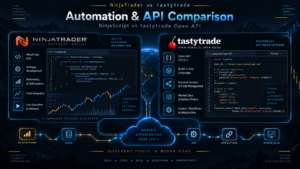
NinjaScript vs tastytrade Open API
The choice between NinjaScript and tastytrade’s Open API depends heavily on development architecture.
Choose NinjaScript If You Want:
- Native C# strategy development
- Indicators integrated directly into charts
- Backtesting inside the same trading platform
- Custom SuperDOM tools
- Integrated strategy optimization
- A futures-specific development ecosystem
Choose tastytrade Open API If You Want:
- REST/JSON brokerage connectivity
- An external quantitative engine
- Custom web applications
- Custom dashboards
- Account and balance APIs
- Futures and options instruments through one API
- Real-time and historical market data access
- Programmatic order management
The tastytrade API includes both production and sandbox environments.
This allows developers to validate workflows before interacting with a live brokerage environment.
See the official tastytrade Open API documentation.
Native futures development: NinjaTrader.
External multi-asset API development: tastytrade.
tastytrade AI and MCP Infrastructure
A notable 2026 development is tastytrade’s expansion into AI-connected brokerage infrastructure.
tastytrade has introduced Model Context Protocol connectivity through its Open API architecture.
The system is designed to let compatible AI assistants interact with permitted brokerage functionality while users retain control over actions and permissions.
Its coverage includes instruments such as:
- Stocks
- Options
- Futures
- Futures options
- Cryptocurrency
This does not mean an AI system should be allowed to trade autonomously without appropriate safeguards.
Production trading systems should use strict permissions, dry-run validation, risk limits, human approval for sensitive actions and comprehensive audit logs.
For developers building AI-assisted brokerage tools, however, tastytrade’s API direction is technologically significant.
NinjaTrader vs tastytrade Backtesting
NinjaTrader has the clearer advantage for native futures strategy backtesting.
NinjaTrader Desktop provides:
- Strategy Analyzer
- Historical backtesting
- Optimization
- Walk-forward workflows
- Market Replay
- NinjaScript development
tastytrade has expanded its research and backtesting tools, particularly for options strategies.
However, systematic futures developers using tastytrade’s Open API will often build the historical research layer externally.
That may involve Python, custom databases, independent backtesting engines or other quantitative infrastructure.
This provides more architectural freedom but requires more development work.
Integrated futures backtesting winner: NinjaTrader.
Simulation and Practice Trading
NinjaTrader is particularly strong for futures simulation.
Its platform is free to use for advanced charting, strategy backtesting and simulated trading without a time limit.
Market Replay can reproduce historical sessions tick by tick.
This is valuable for discretionary traders who want to practice specific market periods or strategy developers testing execution logic.
tastytrade provides sandbox infrastructure for API development and analytical tools for evaluating strategies, but its core futures proposition is not centered around a Market Replay product equivalent to NinjaTrader’s tick-by-tick replay environment.
Futures simulation and replay winner: NinjaTrader.
NinjaTrader vs tastytrade Mobile and Web Trading
Both competitors now offer strong multi-device access.
NinjaTrader
- Windows Desktop
- Browser-based Web
- iPhone
- Android
tastytrade
- Desktop
- Web
- iOS
- Android
tastytrade Mobile supports stocks, options, futures and crypto in one broader interface.
NinjaTrader Mobile is more tightly focused around futures.
The winner therefore depends on whether you prefer specialization or multi-asset account management.
Futures Trading Hours
Most futures products trade for nearly 24 hours during the business week.
tastytrade states that many supported futures products can be traded approximately 23 hours per day.
Trading generally begins Sunday evening and continues until Friday afternoon, with daily maintenance breaks depending on the product and exchange.
NinjaTrader similarly supports extended futures trading according to exchange session schedules.
Both platforms are therefore suitable for traders who need access outside regular U.S. stock-market hours.
NinjaTrader vs tastytrade Additional Costs
Base commission is only one component of the total cost.
Potential NinjaTrader Costs
- Base commission
- Exchange fees
- NFA fees
- Clearing fees
- Market-data subscriptions
- Monthly or Lifetime plan
- Third-party add-ons
Potential tastytrade Costs
- Futures commission
- Exchange fees
- Regulatory fees
- Clearing-related fees
- Market-data-related charges where applicable
- Other service or account charges where applicable
There is no required tastytrade platform subscription comparable to NinjaTrader’s Monthly or Lifetime pricing tiers.
However, total cost must still be calculated using the exact futures contracts and services you intend to use.
Which Platform Is Easier to Use?
The answer depends on the trader’s background.
tastytrade can be easier for an active options trader because futures appear inside a familiar multi-asset derivatives environment.
NinjaTrader can be easier for a futures specialist because almost every major component is designed specifically around futures.
NinjaTrader May Be Better If:
- You primarily trade futures
- You use a DOM constantly
- You trade Micro contracts frequently
- You need Market Replay
- You develop C# strategies
- You want integrated historical testing
- You use order-flow tools
tastytrade May Be Better If:
- You primarily trade options
- You use futures for portfolio hedging
- You trade futures options
- You want portfolio risk visualization
- You want a multi-asset brokerage interface
- You prefer an external API architecture
- You do not want a paid futures platform plan
NinjaTrader vs tastytrade Pros and Cons
NinjaTrader Pros
- Dedicated futures ecosystem
- Commissions as low as $0.09 per Micro contract per side
- $50 day-trading margins on selected Micro futures
- Free plan
- Desktop, Web and Mobile
- SuperDOM
- Order Flow+
- Market Replay
- Free simulated trading
- NinjaScript C# automation
- Strategy Analyzer
- Integrated backtesting
- Large futures-focused add-on ecosystem
NinjaTrader Cons
- Lowest commission rates require Lifetime plan
- Lifetime costs $1,499 upfront
- Primarily futures-focused
- Desktop development has a learning curve
- Less naturally suited to complex equity-options portfolios
tastytrade Pros
- No required platform subscription
- $1 standard futures commission per contract per side
- $0.75 Micro/Mini futures commission per side
- Desktop, Web and Mobile
- Active Trader ladder
- Strong futures-options support
- Excellent options ecosystem
- SPAN and portfolio-risk tools
- Stocks, options and futures in one ecosystem
- Official Open API
- Futures API support
- Real-time and historical market-data APIs
- Sandbox environment
- Modern MCP/AI integration infrastructure
- Intraday futures margin available to eligible accounts
tastytrade Cons
- Higher Micro futures headline commissions than NinjaTrader
- Intraday margin is based on a percentage of overnight requirements rather than ultra-low fixed retail day margins
- Less futures-specialized than NinjaTrader
- No native C# futures strategy framework equivalent to NinjaScript
- External systematic trading requires more development infrastructure
- Integrated futures historical replay is less central to the platform
NinjaTrader vs tastytrade: Which Should You Choose?
Choose NinjaTrader If You:
- Primarily trade futures
- Trade MES, MNQ, MYM or M2K actively
- Need very low Micro commissions
- Want low fixed day-trading margins
- Use SuperDOM
- Use Order Flow+
- Need Market Replay
- Develop in C#
- Want native NinjaScript automation
- Need integrated strategy testing
Choose tastytrade If You:
- Trade options and futures together
- Trade options on futures
- Use futures to hedge a broader portfolio
- Want Active Trader ladder execution
- Need portfolio-level risk analysis
- Want Desktop, Web and Mobile without a platform subscription
- Prefer building against a REST API
- Need external automation infrastructure
- Want one account environment for multiple active-trading products
Futures Are Your Main Market?
Explore NinjaTrader’s low published futures commissions, SuperDOM, Market Replay, strategy backtesting, Order Flow+ and free simulated-trading environment.
Simulated trading differs from live futures trading. Futures involve substantial leverage and risk. Applicable exchange, regulatory and clearing fees may apply.

Related NinjaTrader Comparisons
- NinjaTrader vs Robinhood 2026
- NinjaTrader vs Webull 2026
- NinjaTrader vs Optimus Futures 2026
- NinjaTrader vs AMP Futures 2026
- NinjaTrader vs Interactive Brokers 2026
- NinjaTrader vs TradeStation 2026
- NinjaTrader vs TradingView 2026
- NinjaTrader vs Thinkorswim 2026
- NinjaTrader vs Tradovate 2026
- NinjaTrader vs Sierra Chart 2026
- NinjaTrader vs Quantower 2026
- NinjaTrader vs Bookmap 2026
- NinjaTrader vs ATAS 2026
- NinjaTrader vs MotiveWave 2026
- NinjaTrader vs MultiCharts 2026
- NinjaTrader vs MetaTrader 5 2026
NinjaTrader vs tastytrade FAQ
Is NinjaTrader better than tastytrade for futures?
NinjaTrader is generally better for dedicated futures traders who prioritize low Micro commissions, low fixed intraday margins, SuperDOM, Market Replay, NinjaScript and integrated futures backtesting. tastytrade may be better for traders who combine futures with options and need broader portfolio-risk tools.
How much does tastytrade charge for futures?
tastytrade currently charges $1 per standard futures contract to open and $1 to close. Micro and Mini futures currently cost $0.75 per contract to open and $0.75 to close. Additional fees may apply.
How much does NinjaTrader charge for futures?
NinjaTrader currently charges Micro commissions of $0.39 per side on Free, $0.29 on Monthly and $0.09 on Lifetime. Standard commissions are $1.29, $0.99 and $0.59 respectively, before additional exchange, clearing and NFA fees.
Does tastytrade charge a platform fee?
tastytrade does not currently require a recurring platform subscription to use its standard Desktop, Web and Mobile brokerage platforms.
Does tastytrade offer intraday futures margin?
Yes. Eligible non-IRA margin accounts can use intraday futures margin during the defined intraday window. The requirement is generally one-quarter of the standard overnight futures requirement.
What time does tastytrade intraday futures margin apply?
tastytrade currently describes the intraday futures margin window as approximately 8:30 AM to 3:00 PM Central Time on eligible trading days.
Does NinjaTrader offer intraday futures margin?
Yes. NinjaTrader publishes reduced day-trading margins starting around $50 for selected Micro futures contracts.
Which is cheaper for Micro futures?
NinjaTrader currently has lower published base Micro commissions. tastytrade charges $0.75 per Micro contract on opening and closing transactions, while NinjaTrader’s published rates range from $0.39 to $0.09 per side depending on plan.
Does tastytrade support MES and MNQ?
Yes. tastytrade supports /MES and /MNQ along with many other major Micro and standard futures contracts.
Does tastytrade support futures options?
Yes. Options on futures are a major component of tastytrade’s derivatives offering, including options on selected Micro futures products.
Which is better for futures options?
tastytrade generally has the advantage because its platform and risk-analysis tools are strongly designed around options and multi-leg derivatives workflows.
Does tastytrade have a futures ladder?
Yes. tastytrade’s Active Trader interface provides ladder-based execution for active futures trading.
Which has the better ladder, NinjaTrader or tastytrade?
NinjaTrader SuperDOM is generally more customizable and specialized for dedicated futures execution. tastytrade Active Trader is highly useful for traders who want ladder trading inside a broader options and futures platform.
Does tastytrade have an API?
Yes. tastytrade provides an official Open API supporting equities, options, futures, futures options, account information, market data and trading functionality.
Does the tastytrade API support futures?
Yes. The official API includes futures instruments and futures order functionality.
Does tastytrade provide an API sandbox?
Yes. tastytrade provides separate sandbox and production environments so developers can test API workflows before interacting with live brokerage infrastructure.
Does NinjaTrader support automated trading?
Yes. NinjaTrader provides NinjaScript, a C#-based development environment for automated trading strategies, indicators and platform extensions.
Which is better for automated futures trading?
NinjaTrader is generally better for native platform automation and integrated backtesting. tastytrade may be better for developers who want to build an independent external trading system through a brokerage API.
Does NinjaTrader have Market Replay?
Yes. NinjaTrader Market Replay can replay historical futures data tick by tick for practice, testing and research.
Does tastytrade have Market Replay?
tastytrade does not center its futures offering around a tick-by-tick replay environment directly comparable to NinjaTrader Market Replay.
Can I trade futures on tastytrade mobile?
Yes. tastytrade supports futures trading through its mobile platform as well as Desktop and Web.
Can I trade futures on NinjaTrader mobile?
Yes. NinjaTrader provides dedicated iPhone and Android applications together with its Web and Desktop platforms.
Which is better for options traders?
tastytrade is generally the stronger option for traders whose primary focus is equity options, index options or futures options and who use futures as part of a larger derivatives portfolio.
Which is better for dedicated futures scalpers?
NinjaTrader is generally stronger for dedicated futures scalpers because of its lower commission tiers, low published day margins, SuperDOM and futures-specific ecosystem.
Final Verdict: NinjaTrader vs tastytrade 2026
The final NinjaTrader vs tastytrade 2026 decision depends primarily on whether you identify as a futures specialist or a broader derivatives trader.
NinjaTrader remains our preferred option for dedicated futures traders.
Its combination of low Micro commissions, $50-class day margins on selected contracts, SuperDOM, Market Replay, Order Flow+, NinjaScript and integrated backtesting creates one of the most specialized retail futures environments available.
tastytrade is the stronger choice for traders who combine futures and options.
Its standard futures pricing is simple, its platform does not require a recurring subscription, and its futures environment integrates naturally with sophisticated options and portfolio-risk tools.
tastytrade also has a major technology advantage for developers who prefer open brokerage infrastructure.
Its official REST/JSON Open API supports futures, futures options, market data, balances, positions and trading workflows.
The 2026 addition of MCP-oriented AI connectivity further strengthens tastytrade’s position for developers building modern AI-assisted trading infrastructure.
NinjaTrader approaches automation differently.
Rather than functioning primarily as an API-connected broker, it provides a native C# development ecosystem directly inside NinjaTrader Desktop.
This means the development decision is architectural:
NinjaTrader = build the trading system inside the futures platform.
tastytrade = connect an external trading system to the brokerage API.
For frequent Micro futures traders, NinjaTrader’s commission advantage can become substantial.
For traders using futures selectively alongside options, tastytrade’s broader platform can reduce operational fragmentation.
The final strategic distinction is:
NinjaTrader = futures-first execution, low commissions, low day margins and native automation.
tastytrade = options-first active trading, futures integration, portfolio risk tools and open API infrastructure.
Before funding either account, verify current commissions, intraday and overnight margin requirements, exchange fees, market-data costs and account eligibility directly with the provider because futures conditions can change.
Affiliate Disclosure: TradeboticsAI may receive compensation when visitors click certain affiliate links or complete qualifying actions. This does not increase the user’s cost and does not determine our editorial conclusions.
Risk Disclosure: Futures, futures options and other leveraged derivatives involve substantial risk and are not suitable for every investor. Reduced intraday margin increases leverage and can magnify losses rapidly. Losses may be substantial and can exceed the amount initially committed depending on market conditions. Simulated, backtested and replayed results are hypothetical and do not guarantee future live-trading performance. This content is provided for informational and educational purposes only and is not financial, investment, tax or legal advice.