CME Market Data Fees 2026: Level 1 vs Level 2 Costs
CME market data fees are only one part of a futures trading bill. The exchange entitlement, distributor subscription, platform license and execution charges can appear as separate items. Choosing the right package starts with your contracts, required data and subscriber classification—not the largest bundle available.
This guide separates published exchange amounts from a broker’s customer-facing prices, explains Top of Book versus Depth of Market, and provides a practical subscription checklist. Prices below are monthly USD amounts unless stated otherwise.
Quick answer: Use the official fee table below as a licensing reference, then check the actual subscription price in your provider’s portal. ES, MES, NQ and MNQ share the CME exchange entitlement. A full-depth DOM needs market-depth data; a standard candlestick chart may not. Confirm software requirements before choosing the cheaper package.
Affiliate disclosure: TradeboticsAI may receive compensation when readers complete qualifying actions through the NinjaTrader links on this page. These are affiliate links. Compensation does not determine the published fee figures or our subscription framework.
Explore NinjaTrader for Futures Trading

CME Market Data Fees: Official 2026 Schedule
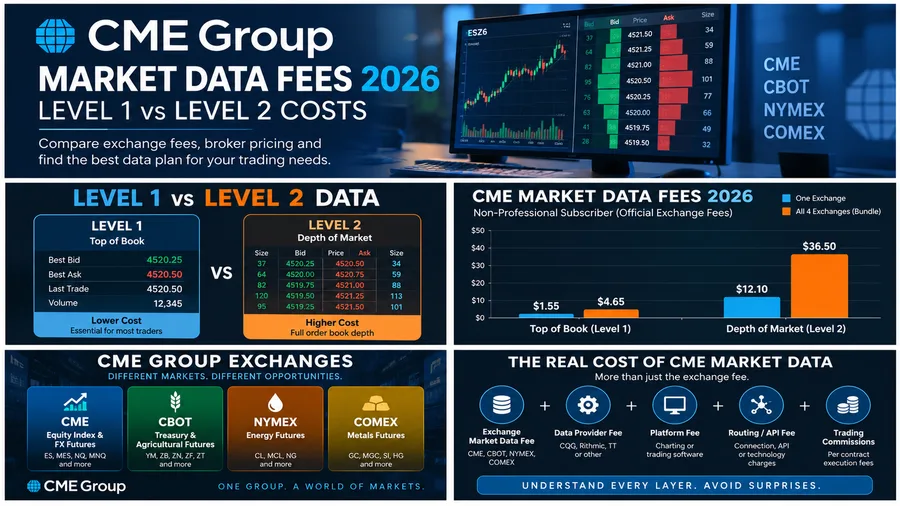
The reference is CME Group’s fee list effective June 1, 2026. Its non-professional amounts are assessed per display device and exchange. The discounted bundle applies when all four exchanges are entitled to the same qualifying subscriber.
| Display entitlement | One exchange/month | Four-exchange bundle/month |
|---|---|---|
| Non-professional Top of Book | $1.55 | $4.65 |
| Non-professional Depth of Market | $12.10 | $36.50 |
| Standard real-time display device | $134.50 | No equivalent bundle quoted here |
CME market data fees in this table are not automatically the final amount on a brokerage statement. Other licensing options exist, and a provider may use its own retail subscription prices.
Read the official June 2026 CME Group fee list, including its footnotes, before applying these amounts to a particular setup.
CME Market Data Fees 2027: Confirmed Changes From January
Important 2027 update, verified October 24, 2026: CME Group has already published its market-data fee schedule effective January 1, 2027. The 2026 rates above remain the reference for the current year. Do not mix these two schedules when reviewing CME market data fees or projecting next year’s subscription costs.
| Non-professional entitlement | 2026 reference | From Jan 2027 | Monthly change |
|---|---|---|---|
| Single-exchange Top of Book | $1.55 | $1.60 | +$0.05 |
| Four-exchange Top of Book bundle | $4.65 | $4.80 | +$0.15 |
| Single-exchange Depth of Market | $12.10 | $12.50 | +$0.40 |
| Four-exchange Depth of Market bundle | $36.50 | $37.75 | +$1.25 |
| Standard real-time display device* | $134.50 | $139.20 | +$4.70 |
*A separate CME license category; not a substitute quote for a professional trader’s entire broker subscription. Reference amounts may be assessed per device or qualifying entitlement. No 2027 AMP retail prices have been inferred from the exchange changes.
Sources: CME Group June 2026 fee list and CME Group January 2027 fee list. CME market data fees published by the exchange are licensing references, while what a subscriber pays to AMP or another provider depends on the provider’s current retail schedule.
CME Market Data Fees: Level 1 vs Level 2
Retail providers commonly use “Level 1” for Top of Book and “Level 2” for Depth of Market. Check the actual package description: these labels do not guarantee identical history, granularity or platform features across vendors.
Top of Book: quotes and chart-based workflows
Top of Book focuses on the best bid and ask. A package can also deliver last trades and the information used to construct charts. It may satisfy a strategy using candles, indicators and best-price quotes, provided the platform receives the required trade updates and history.
Lower CME market data fees are useful only if the subscription supplies every input your system consumes. Ask whether the selected connection supports your intended chart type and live workflow.
Depth of Market: resting liquidity beyond the best price
A full-depth DOM or liquidity heatmap needs updates beyond the best bid and ask. Displayed depth describes resting orders; it is different from executed volume. Orders can change or disappear before a trade occurs.
Market depth does not guarantee execution at a displayed price. Queue position, cancellations, market conditions and your order type still matter.
Footprint charts: check execution data separately
A footprint built from trades at bid and ask does not automatically require the entire resting order book. Its requirements depend on the software, trade classification and feed. Historical bid/ask volume can also be a separate limitation.
Before increasing CME market data fees, identify whether your tool needs executed trades, aggregated depth or individual-order information. Market by Order support must be checked across the feed and software; the “Level 2” label alone does not establish it.
For connection architecture, see our Futures Data Feeds guide.

Which Exchange Entitlement Do You Need?
“CME” can mean CME Group or the individual CME exchange. That distinction matters when selecting CME market data fees: subscriptions can cover individual exchanges or a group bundle.
| Exchange | Common contracts | Subscription question |
|---|---|---|
| CME | ES, MES, NQ, MNQ | Do these cover your entire watchlist? |
| CBOT | YM, MYM, ZB, ZN, ZF, ZT | Do you also need Dow or Treasury contracts? |
| NYMEX | CL, MCL, NG | Do you need energy-market information? |
| COMEX | GC, MGC, SI, HG | Do you need metals-market information? |
Micro contracts do not create a fifth exchange subscription. For example, MES and MNQ belong to the same exchange entitlement as ES and NQ. However, an existing account or software license does not automatically establish real-time data access.
Build the watchlist first. Then choose CME market data fees according to the contracts and tools you actually use.
Single Exchanges vs the CME Group Bundle
Compare the bundle against the number of exchanges needed, using the same provider, subscriber class and data depth. Do not compare a wholesale reference with a retail checkout price.
Depth arithmetic: Three individual exchange entitlements at the published reference rate total $36.30. The four-exchange bundle is $36.50: it adds the fourth exchange for $0.20, rather than reducing the price of three.
Four individual depth entitlements total $48.40, so the bundle reduces that reference total by $11.90.
This distinction prevents a misleading claim that three exchanges always make the bundle cheaper. Retail packages may have different break-even points. Use the prices actually available to your account when comparing CME market data fees.
If you need depth on one exchange and only best-price quotes on another, ask whether mixed entitlements are supported. A uniform bundle may be convenient, but convenience and lowest cost are separate criteria.
Why Broker CME Market Data Fees Differ
An exchange publishes licensing amounts. A broker sells a customer-facing service. The difference does not, by itself, identify how much is administration, technology, distribution or commercial margin.
For a brokerage-specific example, see our NinjaTrader fees breakdown. It distinguishes plan pricing, commissions, CME data subscriptions and account-related charges so readers can compare the full cost stack without treating exchange reference rates as a broker quote.
AMP Futures provides a concrete retail comparison. Its published schedule effective June 1, 2026 shows the following non-professional packages:
| AMP retail package | CQG / Rithmic | TT |
|---|---|---|
| One exchange Top of Book | $5/month | Not offered in this table |
| One exchange Depth of Market | $17/month | $17/month |
| Four-exchange Top of Book | $15/month | Not offered in this table |
| Four-exchange Depth of Market | $45/month | $45/month |
Source: AMP’s exchange-data subscription table. These are AMP prices, not NinjaTrader prices or universal prices for every broker.
Compare CME market data fees at checkout with a separate list of platform and connection charges. Avoid counting the exchange reference amount again when it is already incorporated into the retail subscription.

Professional vs Non-Professional CME Market Data Fees
Subscriber classification can change the applicable price substantially. The official table’s standard real-time device amount is a reference category, not a complete quote for every professional arrangement.
Non-professional status is determined through the applicable criteria and certification. It is not simply a synonym for “individual,” “beginner” or “small account.” Account structure and intended use must be disclosed accurately.
Before approving CME market data fees, complete the provider’s classification process and ask for clarification if an answer does not fit your situation. Do not choose an inaccurate classification to obtain a lower rate.
Consult the CME policy education center for the relevant definitions and agreements.
CQG, Rithmic and TT: Compare the Entire Connection
A feed name identifies infrastructure, not a complete subscription. Confirm supported software, exchange entitlements, historical coverage, concurrent sessions and execution connectivity for your specific account.
The AMP table illustrates why CME market data fees alone do not settle provider selection: its depth subscription amount is the same across the three listed connections, while the available Top of Book packages differ.
- CQG: confirm the exact broker-supported connection and the chart, history and routing services included.
- Rithmic: confirm connection charges and any additional API permissions or costs before budgeting.
- TT: check the actual service and software arrangement rather than assuming the cheapest quote package is available.
Choose the supported connection that meets your requirements. This page focuses on subscription economics; our data-feed comparison covers the broader infrastructure decision.
Explore NinjaTrader Futures Trading Options

CME Market Data Fees: Practical Budget Examples
Chart trader using ES and MES
Both contracts use the CME exchange entitlement. If the software and strategy require only trades and best-price quotes, check the single-exchange Top of Book package first. Add any platform, history and connection charges to the retail subscription.
DOM trader using ES and NQ
The contracts still share one exchange entitlement. Full-depth analysis requires the appropriate depth package, but adding NQ does not itself require all four exchanges. Confirm that the platform actually receives and displays the depth purchased.
Trader following ES, gold and crude oil
Map the watchlist to CME, COMEX and NYMEX. Compare three individual subscriptions with the bundle using the provider’s retail prices. The official depth reference arithmetic above shows why “three exchanges” is not a universal bundle-saving rule.
Multi-market trader with two separate services
A charting subscription and a brokerage connection can have different billing and entitlement arrangements. Ask whether either service recognizes the other’s entitlement; do not assume that one payment covers both.
Budget formula: Monthly fixed cost = retail data subscription + connection + platform + separately purchased history + other recurring services.
Illustrative calculation: If those quoted inputs are $20, $10, $30 and $15, the fixed total is $75/month or $900/year. These are hypothetical inputs, not a broker price quote. Add trading-related charges separately.
Calculate CME market data fees within this full budget, without adding the exchange reference amount twice. Use actual invoices to check whether the expected cost matches the first full billing month.
How to Avoid Overpaying for CME Market Data Fees
- List contracts: include products used for analysis as well as execution.
- Map exchanges: separate CME, CBOT, NYMEX and COMEX.
- List required inputs: trades, best bid/ask, depth, individual-order data and history.
- Check compatibility: ask whether the selected connection supplies those inputs to your software.
- Confirm classification: complete the subscriber certification accurately.
- Compare retail packages: individual exchanges, bundles and supported mixed entitlements.
- Check billing: activation dates, renewal, cancellation, additional users and overlaps.
- Audit the statement: reconcile the first invoice with the expected subscription.
Saving on CME market data fees should remove unused services, not inputs needed to operate the strategy. A tool that appears to work while silently lacking history or depth is not a successful cost reduction.
For software centered on the order book, see our DOM platform guide.
Automation, APIs and Market-Data Licensing
An API connection and a market-data license answer different questions. API access describes how software communicates; licensing determines permitted use of the information.
Personal display, non-display processing and redistribution are distinct licensing considerations. Do not assume a retail screen subscription covers a commercial dashboard, a multi-user service or automated processing of every kind.
For an automated setup, document who receives the information, where it is processed, whether it is displayed and whether it is redistributed. Ask the provider which permissions apply to that architecture.
Review CME market data fees and permissions together through the CME information policies. Obtain a use-case-specific answer rather than applying institutional categories automatically to every personal trading script.
CME Market Data Fees FAQ
How much are CME market data fees in 2026?
The official reference amounts appear in the first table. Your payable retail price depends on the provider, package, classification and additional services. Use the subscription portal for the final quote.
Is “CME fee schedule” the same as market-data pricing?
No. A trading or clearing fee schedule concerns transaction charges. Market-data access concerns information subscriptions. Exchange membership pricing is another separate subject.
Do ES, MES, NQ and MNQ need separate exchange subscriptions?
They share the CME exchange entitlement. Your provider may still impose user, connection or software-specific charges.
Does every footprint chart need Level 2?
No. Execution-based footprints and resting-depth tools use different inputs. Check the software’s trade-data, classification and historical requirements instead of relying on a general label.
Are three exchanges always cheaper through the bundle?
No. Compare the arithmetic using the applicable retail price list. The official depth reference rates make three individual entitlements slightly cheaper than the four-exchange bundle.
Why are my broker’s CME market data fees higher?
The broker sells a retail service rather than simply reproducing every exchange reference amount. Check what is included and which charges are billed separately.
Does buying depth guarantee Market by Order?
No. Verify the specific data representation, entitlement, connection and platform support. Aggregated price-level depth and individual-order information are different requirements.
Can I use one subscription on every platform?
That depends on the provider’s entitlement, connection and login arrangements. A second independent service or user can require additional payments.
Can I cancel for a partial-month refund?
Do not assume so. Check the provider’s written policy before activating or cancelling. AMP’s cited schedule states that its relevant monthly subscriptions are not prorated.
Does a retail subscription cover commercial redistribution?
Do not assume it does. Confirm the permitted use and required agreements for the actual product and users.
Final Verdict: Choose Data by Requirement
The correct CME market data fees are the ones attached to a subscription that supports your contracts, software and permitted use. Compare the exchange reference with the retail checkout price, then add only the other services actually billed.
Use Top of Book when it satisfies the workflow; use depth when the order book is an input. Verify footprint and historical-data requirements separately. Compare bundles mathematically, certify your classification correctly and audit the first invoice.
That process produces a defensible subscription decision without assuming that more exchanges or deeper data automatically improve trading results.
Explore NinjaTrader for Futures Trading
Official Sources and Review Scope
- CME Group fee list effective June 1, 2026 — exchange reference amounts and licensing categories.
- AMP Futures exchange-data fees — retail subscription example, feed availability and billing terms.
- CME market-data policy education center — classification and policy resources.
- CME information policies — permitted-use and licensing resources.
Review scope: Published CME reference prices and AMP retail examples were checked on October 8, 2026. This is a document-based comparison, not a personal account test or a quote covering every broker.
Risk disclosure: Futures trading involves substantial risk of loss. Leverage can magnify losses. Additional data does not guarantee profitable trading or better execution. This material is educational.
Pricing disclaimer: Fees, eligibility, availability and billing policies can change. Confirm the current package and permitted use with your provider before subscribing.
Last reviewed: October 8, 2026.
Before choosing a trading setup: Get the free Trading Tools Checklist to review costs, testing, execution and risk controls. The checklist and newsletter are delivered by email; you can unsubscribe at any time.