Best Futures Backtesting Platforms 2026: Top 10 for Strategy Testing
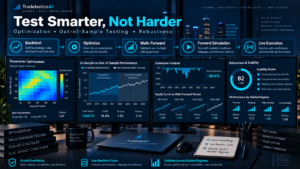



The Best Futures Backtesting Platforms in 2026 allow traders to test systematic futures strategies against historical market data before exposing real capital. The strongest platforms go beyond a simple profit curve by supporting realistic commissions, slippage assumptions, optimization, out-of-sample testing, portfolio analysis and eventually simulated or live automation.
Our #1 overall choice among the Best Futures Backtesting Platforms is NinjaTrader. Its Strategy Analyzer combines historical backtesting, parameter optimization, genetic optimization, walk-forward optimization, basket testing, Monte Carlo analysis and NinjaScript C# strategy development inside the same futures-focused ecosystem used for simulation and live execution.
Other Best Futures Backtesting Platforms can be stronger for specialized users. TradeStation combines EasyLanguage with mature strategy reports and optimization. MultiCharts provides strong portfolio-level testing and PowerLanguage. Sierra Chart offers detailed bar-based and replay-based backtesting. QuantConnect is particularly attractive to Python and C# developers who want cloud infrastructure and institutional-style research workflows.
This guide compares the Best Futures Backtesting Platforms by historical data handling, strategy development, optimization, walk-forward analysis, multi-symbol testing, commissions, slippage, futures support, automation and the transition from research to simulation and live execution.
Quick Answer: Best Futures Backtesting Platforms 2026
- NinjaTrader — Best Overall Futures Backtesting Platform
- TradeStation — Best EasyLanguage Backtesting Ecosystem
- MultiCharts — Best Portfolio-Level Futures Backtesting
- Sierra Chart — Best High-Precision Replay Backtesting
- QuantConnect — Best Cloud Quant Backtesting Platform
- MotiveWave — Best Built-In Walk-Forward Analysis
- TradingView — Best Browser-Based Strategy Backtesting
- Quantower — Best Modern C# Backtesting Environment
- MetaTrader 5 — Best Free Multi-Threaded Strategy Tester
- AmiBroker — Best High-Speed Portfolio & Walk-Forward Research
TradeboticsAI Top Pick: NinjaTrader provides the strongest overall path from futures strategy research to historical testing, optimization, simulation and eventual automated execution.
Explore NinjaTrader and Start Backtesting Futures Strategies →
Affiliate Disclosure: TradeboticsAI may receive compensation when visitors complete qualifying actions through certain links. Affiliate relationships do not determine our rankings. Backtested, simulated and optimized results are hypothetical and do not guarantee future performance.
Table of Contents
- Best Futures Backtesting Platforms Comparison
- What Is Futures Backtesting?
- How We Ranked the Platforms
- 1. NinjaTrader
- 2. TradeStation
- 3. MultiCharts
- 4. Sierra Chart
- 5. QuantConnect
- 6. MotiveWave
- 7. TradingView
- 8. Quantower
- 9. MetaTrader 5
- 10. AmiBroker
- Best Platforms for Optimization
- Best Platforms for Walk-Forward Testing
- Portfolio & Multi-Instrument Backtesting
- Tick vs Bar-Based Backtesting
- Commissions & Slippage
- Avoiding Overfitting
- Backtesting to Automation
- MES & MNQ Backtesting
- How to Choose
- Scientific Backtesting Protocol
- 9 Backtesting Errors
- Validation Metrics
- FAQ
- Final Verdict
Best Futures Backtesting Platforms 2026: Comparison Table
| Rank | Platform | Strategy Language | Optimization | Advanced Validation | Best For |
|---|---|---|---|---|---|
| 1 | NinjaTrader | NinjaScript / C# | Standard + Genetic + custom | Walk-forward, basket tests, Monte Carlo | Active futures traders |
| 2 | TradeStation | EasyLanguage | Strategy Optimization | Walk-forward / portfolio tools | Systematic traders |
| 3 | MultiCharts | PowerLanguage | Exhaustive + Genetic | Portfolio-level analysis | Multi-market systematic trading |
| 4 | Sierra Chart | ACSIL / C++ | Custom workflow | Bar + detailed Replay Back Test | Precision-focused futures developers |
| 5 | QuantConnect | Python / C# | Cloud optimization available | Event-driven LEAN engine | Quant developers |
| 6 | MotiveWave | Java SDK | Exhaustive + Genetic | Walk-Forward | Integrated analysis + testing |
| 7 | TradingView | Pine Script | Primarily manual/script parameter workflow | Deep Backtesting | Browser-based strategy research |
| 8 | Quantower | C# | Backtest & Optimize panel | Multi-symbol testing + fees | Modern C# traders |
| 9 | MetaTrader 5 | MQL5 | Multi-threaded optimization | Forward testing + visual testing | Broker-dependent futures/CFD systems |
| 10 | AmiBroker | AFL | Exhaustive + evolutionary methods | Portfolio + Walk-Forward | High-speed research |
Capabilities depend on platform edition, historical data provider and brokerage configuration. Backtest results are hypothetical and should never be interpreted as guaranteed future trading performance.
What Is Futures Backtesting?
Before selecting among the Best Futures Backtesting Platforms, it is important to understand what backtesting actually does.
Backtesting applies predefined trading rules to historical market data and records how the strategy would have behaved according to the assumptions used by the test engine.
A futures backtest can model:
- Entries and exits
- Long and short positions
- Contract quantities
- Stop losses
- Profit targets
- Commissions
- Slippage
- Margin assumptions
- Position sizing
- Multiple instruments
- Strategy parameters
The Best Futures Backtesting Platforms then produce statistics such as net profit, drawdown, win rate, average trade, profit factor and other risk-adjusted metrics.
These numbers are only as reliable as the historical data, strategy logic and execution assumptions behind them.
How We Ranked the Best Futures Backtesting Platforms
Our Best Futures Backtesting Platforms methodology prioritizes features relevant to systematic futures traders rather than generic investment research.
We evaluated:
- Historical futures data support
- Tick and intraday testing
- Strategy coding environment
- Optimization
- Walk-forward validation
- Multi-symbol testing
- Portfolio-level testing
- Commission modeling
- Slippage modeling
- Replay-based testing
- Performance reports
- Monte Carlo or robustness tools
- Forward simulation
- Automation
- Transition to live futures execution
The Best Futures Backtesting Platforms should help traders discover when a strategy is weak—not merely produce the most attractive historical equity curve.
1. NinjaTrader — Best Overall Futures Backtesting Platform
NinjaTrader ranks #1 among our Best Futures Backtesting Platforms for 2026.
NinjaTrader’s Strategy Analyzer is specifically designed to perform historical analysis on NinjaScript strategies.
NinjaScript uses the C# programming language and gives developers access to a mature environment for creating systematic futures strategies.
NinjaTrader Strategy Analyzer
The Strategy Analyzer supports:
- Historical strategy backtesting
- Single-instrument testing
- Instrument-list testing
- Optimization
- Genetic optimization
- Custom optimization fitness metrics
- Multi-objective optimization
- Walk-forward optimization
- Anchored walk-forward optimization
- Basket testing
- Monte Carlo analysis
- Detailed performance reports
This breadth is a major reason NinjaTrader leads our Best Futures Backtesting Platforms ranking.
NinjaTrader Optimization
Strategy Analyzer can repeatedly test ranges of input values to identify how different parameter combinations performed historically.
NinjaTrader includes both a standard optimizer and a genetic optimizer. Advanced users can also develop custom optimization logic through NinjaScript.
NinjaTrader Walk-Forward Optimization
Walk-forward analysis separates optimization data from subsequent out-of-sample data.
Instead of optimizing parameters across an entire historical period and reporting the same data, NinjaTrader can optimize on one segment and test those parameters on unseen subsequent data.
This process can be repeated through multiple historical windows.
NinjaTrader Basket Testing
A strategy can also be tested across an instrument list.
For futures researchers this can help answer an important question:
Does the strategy logic work only on one contract, or does the underlying behavior generalize across multiple markets?
NinjaTrader Monte Carlo Analysis
Monte Carlo functionality can randomize historical trade results repeatedly to examine a distribution of possible outcomes.
This can provide additional context around drawdowns and variability that one chronological backtest cannot show.
Free Backtesting Access
NinjaTrader currently states that advanced charting, strategy backtesting and simulated trading can be used without a time limit or account funding requirement.
Historical data availability still depends on the relevant data source and configuration.
Best for: active futures traders, MES/MNQ systems, C# developers and traders wanting one environment for backtesting, simulation and execution.
View official NinjaTrader Strategy Analyzer guide →
2. TradeStation — Best EasyLanguage Futures Backtesting Platform
TradeStation is one of the most established Best Futures Backtesting Platforms for systematic traders.
Its major differentiator is EasyLanguage, a programming language designed specifically around trading strategies and indicators.
When a strategy is applied to historical data, TradeStation can evaluate historical entry and exit signals and produce detailed performance reports.
TradeStation Backtesting Features
- EasyLanguage strategy development
- Historical strategy testing
- Strategy Performance Reports
- Parameter optimization
- Commission assumptions
- Slippage assumptions
- Portfolio-level testing through supported tools
- Walk-forward analysis tools
- Automated strategy execution
The Strategy Performance Report can be particularly useful when comparing historical behavior beyond total net profit.
TradeStation documentation also emphasizes the need to incorporate commissions, slippage and margin assumptions when evaluating results.
Why TradeStation Ranks Highly
Among the Best Futures Backtesting Platforms, TradeStation provides one of the shortest learning paths from a trading idea to coded strategy logic.
EasyLanguage is generally easier for non-software engineers to read than lower-level programming environments.
Best for: systematic futures traders who want mature strategy development without starting from a general-purpose programming framework.
View official TradeStation Strategy Testing documentation →
Read NinjaTrader vs TradeStation 2026 →
3. MultiCharts — Best Portfolio-Level Futures Backtesting Platform
MultiCharts earns a top-three position among the Best Futures Backtesting Platforms because of its strategy-testing and portfolio capabilities.
MultiCharts uses PowerLanguage, which is designed to be compatible with the general EasyLanguage style familiar to many systematic traders.
MultiCharts Backtesting Strengths
- Strategy backtesting
- Intrabar price-movement simulation
- Intrabar order generation
- Commission modeling
- Slippage modeling
- Portfolio-level backtesting
- Scaling in and out
- Portfolio money management
- Exhaustive optimization
- Genetic optimization
- Custom optimization fitness logic
- Detailed performance reports
MultiCharts documentation describes true portfolio-level testing rather than merely adding together the results of unrelated individual backtests.
This can matter when multiple futures systems compete for the same capital.
Why Portfolio Testing Matters
A strategy that looks excellent on ES alone may behave very differently when ES, NQ, CL, GC and other systems share one portfolio.
Capital limits, simultaneous positions and correlated drawdowns can materially alter portfolio performance.
This is where MultiCharts separates itself from simpler Best Futures Backtesting Platforms.
Explore official MultiCharts →
Read NinjaTrader vs MultiCharts 2026 →
4. Sierra Chart — Best for High-Precision Replay Backtesting
Sierra Chart takes a highly technical approach to futures system testing and deserves a strong position among the Best Futures Backtesting Platforms.
Automated systems can be developed through ACSIL, Sierra Chart’s C++-based custom-study interface.
Sierra Chart provides two important approaches to backtesting.
Bar-Based Backtesting
Bar-based testing uses Open, High, Low and Close information from loaded chart bars.
It is faster but provides less detailed intrabar simulation.
Replay-Based Backtesting
Replay Back Testing uses more detailed underlying intraday records.
Sierra Chart explicitly describes Replay Back Testing as slower but potentially more precise than basic bar-based testing.
Historical records can range from tick data to larger time units depending on the available source data and settings.
Sierra Chart Strengths
- Bar-based testing
- Replay-based testing
- Tick-level historical workflows
- Multi-chart replay
- Trade Simulation Mode
- Detailed Trade Statistics
- ACSIL C++ strategy development
- Actual bid/ask handling under supported configurations
- Historical market-depth workflows
For technically sophisticated traders concerned about the limitations of coarse OHLC tests, Sierra Chart is one of the strongest Best Futures Backtesting Platforms.
View official Sierra Chart Backtesting documentation →
Read NinjaTrader vs Sierra Chart 2026 →
5. QuantConnect — Best Cloud Quant Futures Backtesting Platform
QuantConnect is one of the most technically scalable Best Futures Backtesting Platforms for developers comfortable with Python or C#.
Its open-source LEAN engine uses an event-driven architecture.
Instead of loading the entire future history into a strategy at once, the backtesting engine advances through historical information over a simulated time frontier.
This architecture helps reduce accidental future-data access when strategies are correctly implemented.
QuantConnect Futures Research
QuantConnect supports futures backtesting across major markets and provides futures trade, quote and open-interest datasets through supported arrangements.
Its platform currently supports futures alongside:
- Equities
- Options
- Forex
- Crypto
- Additional datasets
QuantConnect Backtesting Infrastructure
Current capabilities include:
- Python
- C#
- Cloud backtesting
- Local development on qualifying plans
- Futures historical data
- Research notebooks
- Algorithm reports
- Cloud parameter optimization
- Multiple compute-node options
- Transition from backtest to live deployment
The free plan currently includes futures data and unlimited backtesting subject to compute, data-resolution and resource limits.
For professional quant workflows, QuantConnect can outperform many graphical Best Futures Backtesting Platforms in flexibility.
The disadvantage is complexity: users need meaningful programming and data-engineering skills.
Explore QuantConnect Backtesting →
6. MotiveWave — Best Built-In Walk-Forward Futures Testing
MotiveWave ranks highly among the Best Futures Backtesting Platforms because its Strategy Optimizer provides three clearly separated analysis modes:
- Back Test
- Optimize
- Walk Forward
Back Test
Strategies can be tested with defined settings across historical instruments and timeframes.
Optimization
MotiveWave can test combinations of strategy settings to search for stronger historical parameter sets.
It supports exhaustive and genetic optimization algorithms.
Walk Forward
Walk-forward analysis repeatedly optimizes on one window and evaluates the resulting parameters on a subsequent period.
This makes MotiveWave one of the more complete Best Futures Backtesting Platforms for users who want robust validation without building their own testing framework.
Realistic Assumptions
The Strategy Optimizer can incorporate commissions and configurable slippage assumptions.
MotiveWave also recommends forward testing because historical optimization cannot replicate live fills perfectly.
Best for: traders wanting advanced backtesting and walk-forward functionality inside a professional graphical trading platform.
View MotiveWave Strategy Back Testing →
Read NinjaTrader vs MotiveWave 2026 →
7. TradingView — Best Browser-Based Futures Backtesting Platform
TradingView is one of the easiest Best Futures Backtesting Platforms to access because strategy development takes place within its familiar charting environment.
Strategies are written using Pine Script.
Once a strategy is applied, the Strategy Report evaluates historical performance.
TradingView Deep Backtesting
Deep Backtesting allows qualifying users to test a strategy across more historical information than is currently displayed on the active chart.
TradingView currently makes Deep Backtesting available to Premium and higher-tier users.
The current maximum calculation limit is up to approximately 2 million historical bars, subject to actual symbol and timeframe data availability.
TradingView Strengths
- Browser-based environment
- Pine Script
- Large market coverage
- Strategy reports
- Deep Backtesting
- Easy visual inspection
- Futures charting
- Fast strategy iteration
TradingView is less sophisticated than some of the Best Futures Backtesting Platforms for automated parameter optimization or complex portfolio simulation.
Its advantage is accessibility and speed of strategy prototyping.
View official TradingView Deep Backtesting guide →
Read NinjaTrader vs TradingView 2026 →
8. Quantower — Best Modern C# Futures Backtesting Platform
Quantower has developed a dedicated Backtest & Optimize panel, making it increasingly relevant among the Best Futures Backtesting Platforms.
Strategies can be developed through Quantower Algo using C#.
The backtesting environment allows users to configure:
- Historical start and end dates
- One or multiple symbols
- Starting balance
- Fees
- Position/netting behavior
- Strategy parameters
- Optimization targets
Optimization can automatically create multiple backtesting tasks with different parameter values.
Quantower also supports tick-based historical workflows where the connected provider has sufficient data.
This gives Quantower one of the more modern interfaces among the Best Futures Backtesting Platforms.
Its All-in-One software license is currently advertised around $70 per month before longer-term discounts, while third-party market data remains separate.
View Quantower Backtest & Optimize →
Read NinjaTrader vs Quantower 2026 →
9. MetaTrader 5 — Best Free Multi-Threaded Strategy Tester
MetaTrader 5 deserves a position among the Best Futures Backtesting Platforms because its Strategy Tester is mature, free with the platform and highly optimized for automated-strategy testing.
Strategies are developed as Expert Advisors using MQL5.
MetaTrader 5 Strategy Tester
Current functionality includes:
- Historical backtesting
- Multi-currency strategies
- Multi-threaded optimization
- Visual testing
- Forward testing
- 2D optimization visualization
- 3D optimization visualization
- Parallel computing agents
Forward testing separates part of the historical dataset and uses it to validate optimized parameters against data not used for optimization.
The main limitation in a futures-focused ranking is market structure.
MetaTrader 5 access to exchange-traded futures depends on the broker and available symbol/data configuration. Many MT5 users instead trade CFDs or forex products.
That makes MT5 less universally suited to U.S. CME futures than higher-ranked Best Futures Backtesting Platforms.
View official MetaTrader 5 Strategy Tester →
Read NinjaTrader vs MetaTrader 5 2026 →
10. AmiBroker — Best High-Speed Portfolio and Walk-Forward Research
AmiBroker completes our Best Futures Backtesting Platforms ranking as a powerful research-oriented environment.
Trading systems are developed using AFL, the AmiBroker Formula Language.
AmiBroker Backtesting Features
- Portfolio-level backtesting
- Futures mode
- Margin and point-value handling
- Position sizing
- Optimization
- Multiple-symbol optimization
- Automatic Walk-Forward testing
- Custom backtester interface
- Custom performance metrics
- Monte Carlo workflows
AmiBroker’s automatic Walk-Forward mode separates in-sample optimization from subsequent out-of-sample testing and repeats this process through time.
Its portfolio backtester also enables strategies to make position-sizing decisions using portfolio-level equity and available capital.
These features make AmiBroker one of the most research-intensive Best Futures Backtesting Platforms.
The main limitation is integration. Futures data, continuous-contract construction and live execution workflows require more setup than a futures-native platform such as NinjaTrader.
View AmiBroker Walk-Forward documentation →
Best Futures Backtesting Platforms for Strategy Optimization
Optimization is an important differentiator among the Best Futures Backtesting Platforms.
Optimization repeatedly backtests different parameter combinations.
Examples include:
- Moving-average lengths
- Stop distances
- Profit targets
- Trading-session filters
- Volatility thresholds
- Position-sizing rules
NinjaTrader supports standard, genetic and custom optimization methods.
MultiCharts supports exhaustive and genetic algorithms.
MotiveWave provides exhaustive and genetic optimization.
MetaTrader 5 uses a multi-threaded Strategy Tester for large optimization workloads.
AmiBroker supports exhaustive and several advanced optimization engines.
Optimization does not automatically improve a strategy. Excessive optimization can simply fit historical noise.
Best Futures Backtesting Platforms for Walk-Forward Testing
Walk-forward validation is one of the most valuable features of the Best Futures Backtesting Platforms.
A typical process works like this:
- Optimize parameters using an in-sample period.
- Select the resulting parameter set.
- Test it on a later out-of-sample period.
- Move both windows forward.
- Repeat the process.
- Evaluate the combined out-of-sample results.
NinjaTrader provides both conventional and anchored walk-forward optimization.
MotiveWave has a dedicated Walk Forward analysis mode.
TradeStation has walk-forward testing tools in its strategy-testing ecosystem.
MetaTrader 5 provides forward testing of optimized parameters.
AmiBroker provides automatic Walk-Forward testing.
Among the Best Futures Backtesting Platforms, these tools can help expose systems whose historical performance depends too heavily on one optimized sample.
Best Futures Backtesting Platforms for Portfolio Testing
A futures portfolio can contain several strategies operating at the same time.
Testing each system independently may underestimate portfolio-level risk.
The Best Futures Backtesting Platforms for portfolio research should consider:
- Shared capital
- Simultaneous positions
- Margin usage
- Portfolio equity
- Position priority
- Correlated drawdowns
- Risk limits
MultiCharts is especially strong in this category through portfolio-level backtesting.
TradeStation’s Portfolio Maestro environment provides additional portfolio-oriented testing capabilities.
AmiBroker has a powerful portfolio backtester.
QuantConnect’s algorithm framework can also support multi-asset portfolio logic programmatically.
NinjaTrader provides basket testing across instrument lists, although its workflow differs from a dedicated portfolio allocation engine.
Tick vs Bar-Based Futures Backtesting
Data granularity can materially affect results from the Best Futures Backtesting Platforms.
Bar-Based Backtesting
A basic OHLC bar tells the test engine the open, high, low and close but may not reveal the exact sequence of intrabar price movement.
This creates ambiguity when both a stop and profit target occur inside the same historical bar.
Tick-Based Backtesting
More granular trade or quote data can provide a more detailed historical sequence.
This is particularly important for:
- Scalping strategies
- Tight stops
- High-frequency entries
- Intrabar signals
- Order-flow systems
Sierra Chart explicitly distinguishes its faster bar-based test from its more detailed replay-based test.
Quantower can use tick data for higher-detail backtesting when available.
MotiveWave recommends historical tick data when possible for closer approximation.
Even tick-based testing cannot perfectly reproduce live queue position or latency.
Best Futures Backtesting Platforms: Commissions, Fees and Slippage
A strategy that looks profitable before costs can become unprofitable after realistic expenses.
The Best Futures Backtesting Platforms should therefore let traders model transaction friction.
A realistic futures backtest should consider:
- Broker commission
- Exchange fees
- NFA fees
- Clearing fees
- Routing fees
- Bid/ask spread
- Slippage
For an MES scalping strategy generating hundreds of trades per month, ignoring even a small per-side cost can substantially distort historical results.
TradeStation supports commission and slippage assumptions.
MultiCharts includes commission and slippage parameters.
MotiveWave can incorporate commissions and slippage.
Quantower allows testing fees to be configured.
AmiBroker’s custom backtesting environment can model complex transaction assumptions.
Avoiding Overfitting With the Best Futures Backtesting Platforms
Overfitting occurs when a strategy is optimized so closely to historical data that it captures noise instead of a repeatable market behavior.
This is one of the largest risks when using the Best Futures Backtesting Platforms.
Warning signs include:
- Dozens of optimized parameters
- Extremely narrow parameter sweet spots
- Exceptional in-sample performance but weak out-of-sample results
- Very small trade samples
- One contract producing nearly all profits
- Performance collapsing after realistic fees
- Large differences between backtest and simulation
A stronger validation process can include:
- Out-of-sample testing
- Walk-forward analysis
- Parameter sensitivity tests
- Multiple contracts
- Multiple market regimes
- Monte Carlo analysis
- Forward simulation
The goal is not to find the most profitable historical parameter combination.
The goal is to determine whether the strategy remains reasonably stable when assumptions change.
From Backtesting to Automated Futures Trading
The Best Futures Backtesting Platforms become more valuable when the same strategy logic can eventually move into simulation and live execution without being completely rewritten.
NinjaTrader
NinjaScript strategies can move from Strategy Analyzer into simulation and then live execution under appropriate controls.
TradeStation
EasyLanguage strategies can progress from historical testing to automated strategy orders.
MultiCharts
PowerLanguage strategies can connect to supported brokers for automated trading.
Sierra Chart
ACSIL systems can be used for both historical testing and automated execution.
QuantConnect
LEAN is explicitly designed so algorithm logic can operate across backtest and live modes with minimal architecture changes.
MetaTrader 5
MQL5 Expert Advisors can move from Strategy Tester into broker-supported execution.
Regardless of platform, TradeboticsAI recommends separating trading signals from independent risk controls.
Automated systems should include hard limits for:
- Maximum position size
- Maximum daily loss
- Duplicate orders
- Stale data
- Connectivity failures
- Unexpected positions
- Emergency shutdown
Read Best Automated Futures Trading Platforms 2026 →
Best Futures Backtesting Platforms for MES and MNQ Strategies
MES and MNQ are especially popular markets for users researching the Best Futures Backtesting Platforms.
These Micro E-mini contracts provide smaller contract multipliers than ES and NQ, but strategy research still needs realistic data and costs.
A strong MES or MNQ backtest should model:
- Correct contract tick size
- Correct tick value
- Contract rollover
- Commission per side
- Exchange and regulatory fees
- Intraday volatility
- Session filters
- Slippage
Continuous futures charts can simplify long historical studies but can also introduce issues around contract rollover and adjusted prices.
NinjaTrader is our preferred overall MES/MNQ environment because traders can research the strategy in Strategy Analyzer and then continue into simulation and futures execution inside the same ecosystem.
Backtest → Validate → Simulate → Live: Recommended Workflow
The Best Futures Backtesting Platforms should be used as one stage in a wider validation process.
Step 1 — Define the strategy before looking at results.
Specify entries, exits, position size and trading hours.
Step 2 — Run an initial historical backtest.
Check whether the basic logic works as intended.
Step 3 — Add realistic transaction costs.
Include commissions and conservative slippage assumptions.
Step 4 — Perform robustness testing.
Change parameters slightly and test multiple historical regimes.
Step 5 — Use out-of-sample or walk-forward validation.
Avoid evaluating only the same period used for optimization.
Step 6 — Forward test in simulation.
Observe behavior against incoming market data.
Step 7 — Only then consider limited live deployment.
Live trading should begin with independent risk controls and conservative exposure.
Our #1 Futures Backtesting Platform for 2026
NinjaTrader combines Strategy Analyzer, C# NinjaScript, optimization, walk-forward testing, basket analysis, Monte Carlo, simulation and futures execution in one ecosystem.
Backtesting is hypothetical. Validate strategies with out-of-sample analysis and simulation before considering live futures trading.
How to Choose Among the Best Futures Backtesting Platforms
Use this framework before selecting one of the Best Futures Backtesting Platforms.
Choose NinjaTrader If…
You want an integrated futures-first environment for C# strategy development, backtesting, optimization, walk-forward testing, simulation and live execution.
Choose TradeStation If…
You want mature systematic trading tools and an approachable trading-specific programming language.
Choose MultiCharts If…
Portfolio-level futures testing and multiple broker/data-feed configurations are major priorities.
Choose Sierra Chart If…
You need highly detailed replay-based testing and are comfortable with technical configuration or C++ development.
Choose QuantConnect If…
You are a Python or C# quant developer who wants cloud research, large-scale backtesting and programmatic infrastructure.
Choose MotiveWave If…
You want Back Test, Optimization and Walk Forward functionality in one graphical platform.
Choose TradingView If…
You prioritize rapid Pine Script development and browser-based accessibility.
Choose Quantower If…
You want a modern C# environment with integrated Backtest & Optimize functionality.
Choose MetaTrader 5 If…
Your broker provides the futures or derivative markets you need and you want a free, mature MQL5 Strategy Tester.
Choose AmiBroker If…
Your priority is fast research, portfolio testing and advanced walk-forward analysis rather than integrated futures brokerage.
Beyond the platform ranking: A backtest is useful only if the research process survives realistic costs, independent data, parameter sensitivity and forward simulation. The following scientific protocol helps evaluate strategies produced by the best futures backtesting platforms compared above.
TradeboticsAI Scientific Futures Backtesting Protocol
Selecting the best futures backtesting platforms is only the beginning. The software cannot compensate for a poorly designed experiment.
| Stage | Research Question | Minimum Requirement |
|---|---|---|
| 1. Hypothesis | Why might the edge exist? | Define the market behavior before optimization |
| 2. Objective Rules | Can another researcher reproduce it? | Exact entries, exits, sizing and session rules |
| 3. Data Audit | Is the historical information appropriate? | Understand contracts, rollovers, sessions and missing data |
| 4. Cost Model | Does the edge survive friction? | Include commissions, fees and realistic slippage |
| 5. In-Sample Test | Does the hypothesis initially survive? | Adequate trade count and economically plausible results |
| 6. Parameter Sensitivity | Does nearby parameter space work? | Prefer stable regions over isolated optimums |
| 7. Out-of-Sample Test | Does the strategy survive unseen data? | Independent validation not used for tuning |
| 8. Walk-Forward Test | Can it survive repeated revalidation? | Evaluate multiple optimization/test windows |
| 9. Monte Carlo Stress | How dependent are results on trade sequence? | Study alternate drawdown and losing-streak paths |
| 10. Forward Simulation | Does the system operate correctly now? | Paper or simulated execution before real capital |
1. Define the Hypothesis Before Running the Test
Do not ask the best futures backtesting platforms to search randomly for indicators that generated the highest historical profit. Begin with a market hypothesis that can potentially be rejected.
For example, a hypothesis might state that a breakout following volatility compression has positive expectancy only when volume expands during a defined liquid session. That statement can be translated into measurable rules.
2. Define Every Rule Objectively
The strategy should specify entries, exits, stop placement, target logic, position sizing, trading session, maximum concurrent positions and any conditions that invalidate the setup.
If two researchers could interpret a rule differently, it is not sufficiently objective for reliable backtesting.
3. Audit the Futures Data
Futures are not perpetual securities. Individual contracts expire and trading activity migrates to newer contracts.
The best futures backtesting platforms should therefore make it possible to understand whether research is using individual contracts, continuous futures data, adjusted series or a defined rollover methodology.
4. Include Trading Costs
Gross historical expectancy is not enough.
Net Expectancy = (Win Rate × Average Win) − (Loss Rate × Average Loss) − Average Trading Costs
For high-turnover intraday strategies, commissions, exchange-related costs and slippage can materially change the result.
5. Test Parameter Sensitivity
A strategy that is profitable only at one exact parameter value is suspicious. Robust systems normally show a broader region of acceptable performance.
If a 20-period input produces exceptional results while 19 and 21 both collapse, further investigation is required before treating the historical result as evidence of a durable edge.
6. Protect the Out-of-Sample Data
Do not repeatedly examine the holdout sample and then modify the strategy to improve it. Once this happens, the supposed out-of-sample period has effectively become part of development.
The best futures backtesting platforms should support a workflow where model development and independent validation remain clearly separated.
7. Run Walk-Forward Analysis
Walk-forward analysis repeatedly optimizes on historical data and tests the selected parameters on later unseen observations.
This does not eliminate overfitting, but it is a stronger challenge than optimizing and evaluating a strategy on the exact same historical sample.
8. Stress the Trade Sequence
A historical equity curve represents only one sequence of wins and losses. Monte Carlo analysis can reshuffle or resample results to study how different sequences may affect drawdown, losing streaks and terminal outcomes.
The purpose is not to predict the exact future path. It is to understand whether the original historical sequence may have been unusually favorable.
9. Forward-Test Before Live Deployment
After historical validation, move the strategy into simulation.
Our Best Futures Trading Simulators 2026 comparison covers platforms for this next stage.
9 Futures Backtesting Errors That Can Create Fake Edges
Even the best futures backtesting platforms can generate misleading results if the experiment contains structural errors.
- Look-ahead bias: the strategy uses information that would not have been available at the decision time.
- Overfitting: too many parameters are adjusted to maximize one historical period.
- Data snooping: many strategies are tested and only the winner is reported.
- Unrealistic fills: the model assumes executions that would be difficult or impossible live.
- Zero-cost assumptions: commissions, fees and slippage are ignored.
- Contract-roll errors: a continuous futures series is treated as though it were one permanently tradable contract.
- Insufficient regime coverage: the strategy is tested only during favorable market conditions.
- Parameter cliffs: profitability disappears immediately when inputs change slightly.
- Repeated holdout optimization: the researcher repeatedly modifies the strategy after examining supposedly unseen data.
Backtesting vs Market Replay vs Paper Trading
The best futures backtesting platforms answers a different question from a simulator or replay environment.
| Method | Main Question | Strength | Limitation |
|---|---|---|---|
| Backtesting | How did objective rules behave historically? | Fast, repeatable and statistically measurable | Dependent on historical assumptions and data quality |
| Market Replay | How does the process behave through a historical session? | Useful for execution practice and detailed observation | Still simulated and slower than automated testing |
| Paper Trading | How does the process operate under current market conditions? | Forward observation without risking capital | Simulated executions can differ from live trading |
A stronger research sequence is:
Hypothesis → Historical Backtest → Sensitivity Test → Out-of-Sample Test → Walk-Forward → Monte Carlo → Replay/Simulation → Forward Observation → Controlled Live Evaluation
If the objective is eventual automation rather than historical validation, continue with Best Automated Futures Trading Software 2026.
Metrics the Best Futures Backtesting Platforms Should Measure
The best futures backtesting platforms should expose enough information to judge risk and robustness, not merely total profit.
- Total number of trades
- Win rate
- Average winning trade
- Average losing trade
- Payoff ratio
- Profit factor
- Expectancy per trade
- Maximum drawdown
- Longest losing streak
- Average trade duration
- Exposure or time in market
- Performance after commissions
- Performance after slippage
- In-sample performance
- Out-of-sample performance
- Walk-forward performance
- Parameter sensitivity
- Performance across market regimes
Why Profit Factor Alone Is Not Enough
A high historical profit factor can result from a small number of unusually large winners, favorable execution assumptions or parameter selection.
Always inspect the distribution of returns and the number of independent observations behind the metric.
Why Maximum Drawdown Can Be Underestimated
The largest historical drawdown is only the worst drawdown observed in that particular sample and trade sequence. Future drawdowns can be larger.
This is one reason Monte Carlo and sequence stress tests are useful even after choosing the best futures backtesting platforms.
Best Futures Backtesting Platforms for ES, NQ, MES and MNQ
For ES, NQ, MES and MNQ, the best futures backtesting platforms should allow traders to pay close attention to session definitions, contract rolls, costs and intrabar execution assumptions.
These markets may be highly liquid during major sessions, but liquidity does not eliminate backtesting error.
A one-minute strategy can still misrepresent the order in which the high and low occurred inside a historical candle. A limit-order system can still assume a fill simply because the market touched the specified price.
NinjaTrader and Sierra Chart are particularly compelling when futures-specific research and execution behavior matter. QuantConnect is stronger when the strategy forms part of a larger quantitative codebase.
Best Futures Backtesting Platforms for No-Code and Low-Code Traders
For traders who do not want to begin with Python or C#, NinjaTrader is our preferred best futures backtesting platforms choice because Strategy Builder can assist with the creation of rule-based strategies without requiring every supported rule to be manually coded from scratch.
No-code does not mean no methodology.
A visually created strategy can still suffer from overfitting, look-ahead bias, unrealistic fills, poor cost assumptions and insufficient out-of-sample testing.
Best Futures Backtesting Platforms for Quant Developers
For code-first researchers, the best futures backtesting platforms decision becomes more architectural.
QuantConnect is attractive when Python/C#, reproducible code, futures mapping and broader portfolio research are priorities.
NinjaTrader is stronger when the final strategy is intended to remain close to a futures-specific desktop execution environment.
Sierra Chart becomes highly relevant for advanced developers who value detailed replay behavior and its technical ecosystem.
Related Futures Strategy & Automation Guides
- Best Futures Trading Simulators 2026
- Best Automated Futures Trading Platforms 2026
- Best Futures Trading Platforms 2026
- Best Futures Brokers 2026
- Best Order Flow Trading Platforms 2026
- Best Footprint Chart Platforms 2026
- Best DOM Trading Platforms 2026
- NinjaTrader vs TradeStation 2026
- NinjaTrader vs MultiCharts 2026
- NinjaTrader vs Sierra Chart 2026
- NinjaTrader vs Quantower 2026
- NinjaTrader vs MotiveWave 2026
- NinjaTrader vs TradingView 2026
- NinjaTrader vs MetaTrader 5 2026
Best Futures Backtesting Platforms FAQ
What are the Best Futures Backtesting Platforms in 2026?
Our Best Futures Backtesting Platforms ranking places NinjaTrader first overall, followed by TradeStation, MultiCharts, Sierra Chart, QuantConnect, MotiveWave, TradingView, Quantower, MetaTrader 5 and AmiBroker.
What is the best futures backtesting platform overall?
NinjaTrader is our overall winner because Strategy Analyzer combines historical backtesting, optimization, walk-forward analysis, basket testing and Monte Carlo with NinjaScript and futures execution.
Is NinjaTrader good for futures backtesting?
Yes. NinjaTrader ranks first among our Best Futures Backtesting Platforms because it combines C# strategy development with a mature Strategy Analyzer and an integrated futures ecosystem.
Is NinjaTrader backtesting free?
NinjaTrader currently states that strategy backtesting, advanced charting and simulated trading can be used without a time limit or account funding requirement. Historical data access still depends on the available data source.
What is NinjaTrader Strategy Analyzer?
Strategy Analyzer is NinjaTrader’s environment for historically analyzing NinjaScript strategies, running backtests, optimizations, walk-forward tests and reviewing performance results.
Does NinjaTrader support optimization?
Yes. NinjaTrader supports standard optimization, genetic optimization, custom optimization algorithms and multiple optimization fitness metrics.
Does NinjaTrader support walk-forward testing?
Yes. NinjaTrader supports both conventional Walk Forward Optimization and Anchored Walk Forward Optimization.
Does NinjaTrader support Monte Carlo analysis?
Yes. Monte Carlo Simulation can be run on trade results after backtests and related Strategy Analyzer tests.
Can NinjaTrader test multiple futures markets?
Yes. Strategy Analyzer can use instrument lists and provides basket-testing functionality for multi-instrument historical analysis.
Is TradeStation good for futures backtesting?
Yes. TradeStation combines EasyLanguage strategy development, historical testing, optimization and detailed performance reporting.
What programming language does TradeStation use?
TradeStation uses EasyLanguage, a programming environment designed specifically for trading strategies and technical studies.
Is MultiCharts good for portfolio backtesting?
Yes. MultiCharts supports portfolio-level backtesting with shared capital, position sizing and portfolio-oriented performance calculations.
What language does MultiCharts use?
MultiCharts uses PowerLanguage, a strategy language designed around the EasyLanguage style.
Is Sierra Chart good for futures backtesting?
Yes. Sierra Chart provides both fast bar-based backtesting and more detailed replay-based backtesting using underlying intraday historical records.
What is the difference between Sierra Chart bar and replay backtesting?
Bar-based testing primarily processes OHLC bar values and is faster. Replay-based testing processes more granular underlying intraday records and can provide greater historical execution detail.
Is QuantConnect good for futures backtesting?
Yes. QuantConnect is particularly strong for Python and C# developers who want event-driven backtesting, futures historical data and scalable cloud infrastructure.
Does QuantConnect have a free backtesting plan?
QuantConnect currently provides a free plan with futures data access and backtesting subject to resource, resolution and compute restrictions.
Does MotiveWave support walk-forward testing?
Yes. MotiveWave’s Strategy Optimizer supports Back Test, Optimize and Walk Forward analysis modes.
Does TradingView support deep futures backtesting?
TradingView provides Deep Backtesting for qualifying Premium and higher users, with historical availability depending on the symbol and timeframe.
How many bars can TradingView Deep Backtesting use?
TradingView currently states that Deep Backtesting calculations can use up to approximately two million historical bars, subject to data availability.
Does Quantower support strategy backtesting?
Yes. Quantower provides a dedicated Backtest & Optimize panel for C# strategies developed through Quantower Algo.
Does MetaTrader 5 support futures backtesting?
MetaTrader 5 can test instruments made available by the connected broker. Exchange-traded futures availability therefore depends on the specific broker and data configuration.
Does MetaTrader 5 have forward testing?
Yes. MT5 Strategy Tester can divide historical data into optimization and forward periods to evaluate optimized parameters against a separate sample.
Is AmiBroker good for futures systems?
Yes. AmiBroker includes a dedicated Futures Mode, portfolio-level backtesting, optimization and automatic Walk-Forward testing, although data and brokerage integration require more setup.
What is walk-forward backtesting?
Walk-forward testing optimizes strategy parameters on one historical period and evaluates them on subsequent unseen data, then repeats that process over multiple windows.
What is out-of-sample testing?
Out-of-sample testing evaluates a strategy on historical data that was not used to design or optimize the strategy.
What is overfitting in futures backtesting?
Overfitting occurs when strategy rules or parameters are tuned too closely to historical noise, producing strong historical results that fail to generalize to new market data.
Should futures backtests include commissions?
Yes. Commission, exchange, regulatory, clearing and realistic slippage assumptions can materially change the profitability of active futures strategies.
Is tick backtesting more accurate than OHLC backtesting?
Tick data can provide more information about the historical sequence inside each bar, which can improve execution modeling for some short-term strategies. It still cannot perfectly reproduce live queue position, latency or liquidity.
What is the best futures backtesting platform for MES and MNQ?
NinjaTrader is our preferred overall choice for MES and MNQ because strategy research, simulation and futures execution can remain within the same platform ecosystem.
What is the best futures backtesting platform for Python?
QuantConnect is our preferred Python-focused option because its LEAN engine and cloud infrastructure support futures research, historical backtests and deployment.
What is the best futures backtesting platform for C#?
NinjaTrader is our preferred futures-first C# environment through NinjaScript. QuantConnect and Quantower also provide strong C# alternatives.
What is the best futures backtesting platform for beginners?
TradingView can be easier for basic strategy prototyping, while NinjaTrader provides a stronger long-term progression for traders intending to trade or automate futures directly.
Can profitable backtests guarantee profitable live trading?
No. Backtests are hypothetical. Live results can differ because of market regime changes, liquidity, commissions, slippage, latency, execution, data quality and behavioral factors.
What should I compare among the Best Futures Backtesting Platforms?
Compare historical data quality, strategy language, optimization, walk-forward testing, portfolio support, cost modeling, simulation, automation, brokerage connectivity and the ability to reproduce your intended live execution process.
Final Verdict: Best Futures Backtesting Platforms 2026
The Best Futures Backtesting Platforms in 2026 range from browser-based strategy testers to institutional-style quantitative research engines.
NinjaTrader is our #1 overall choice.
Strategy Analyzer provides far more than a basic historical equity curve.
Users can run traditional backtests, optimize parameters, perform genetic optimization, evaluate strategies through walk-forward analysis, test instrument baskets and apply Monte Carlo analysis.
NinjaScript then connects that research environment to C# strategy development, simulation and futures execution.
This complete lifecycle is why NinjaTrader leads our Best Futures Backtesting Platforms ranking.
TradeStation ranks second because EasyLanguage, Strategy Performance Reports and optimization provide one of the most mature systematic trading workflows available to retail futures traders.
MultiCharts ranks third because its portfolio-level backtesting, PowerLanguage, optimization and detailed performance analysis are particularly valuable when multiple strategies share capital.
Sierra Chart is one of the strongest choices for technically demanding users who care about granular replay-based testing.
QuantConnect provides the most scalable cloud-oriented environment in this ranking for Python and C# quantitative developers.
MotiveWave offers a particularly clean Back Test → Optimize → Walk Forward workflow.
TradingView remains one of the easiest ways to prototype strategies in a browser and now provides substantial Deep Backtesting capability.
Quantower combines modern C# development with a dedicated Backtest & Optimize panel.
MetaTrader 5 provides a highly capable free Strategy Tester with multi-threading, optimization and forward testing, although futures availability depends on the broker.
AmiBroker remains exceptionally powerful for portfolio research, optimization and walk-forward testing when traders are prepared to configure their own data and execution infrastructure.
The central lesson from our Best Futures Backtesting Platforms research is simple:
A backtest should try to disprove a strategy—not merely make it look profitable.
Use realistic fees, conservative slippage, multiple market regimes, out-of-sample data and forward simulation.
For TradeboticsAI readers who want the strongest overall progression from historical futures research to simulation and automation, our final winner is:
NinjaTrader — Best Overall Futures Backtesting Platform for 2026.
Explore NinjaTrader and Start Backtesting →
Affiliate Disclosure: TradeboticsAI may receive compensation when visitors click certain affiliate links or complete qualifying actions. This does not increase the user’s cost and does not determine our editorial rankings.
Risk Disclosure: Futures and options on futures involve substantial risk and are not suitable for every investor. Historical backtests, optimization results, Monte Carlo simulations, walk-forward tests, paper trading and forward simulation are hypothetical and do not guarantee future performance. Results can be materially affected by historical-data quality, contract rollover, commissions, exchange fees, slippage, liquidity, latency, queue position, software assumptions and market-regime changes. Over-optimized strategies may perform poorly on unseen data. Verify current platform functionality, historical-data availability and pricing directly with each provider. This material is educational only and is not financial, investment, legal or tax advice.