Rithmic vs CQG 2026: Which Futures Data Feed Is Better?
Rithmic vs CQG is one of the most important infrastructure comparisons for active futures traders because both providers can sit underneath charting, DOM, order-flow and automated trading workflows. In 2026, the better choice depends less on brand reputation and more on what you actually need: Market by Order, full depth, historical data, API access, broker compatibility, platform support, multi-market coverage, execution routing or institutional connectivity.
This Rithmic vs CQG comparison focuses on practical U.S. futures use cases rather than unsupported claims that one provider is universally “faster.” Rithmic emphasizes un-throttled exchange data, Market by Order, full depth, microsecond timestamps and specialized futures infrastructure. CQG offers a broader multi-asset and multi-broker ecosystem, extensive exchange connectivity, real-time and historical data, client APIs, enterprise Web API and FIX options.
Affiliate Disclosure: TradeboticsAI may receive compensation when readers complete qualifying actions through certain links. NinjaTrader buttons on this page are affiliate links. Compensation does not determine this comparison or its conclusions.
Explore NinjaTrader for Futures Trading
Rithmic vs CQG 2026 Comparison
The first thing to understand about Rithmic vs CQG is that neither is merely a chart feed. Both companies provide infrastructure that can connect market data and trading systems to futures markets, although their product portfolios and target users differ.
| Category | Rithmic | CQG |
|---|---|---|
| Core Strength | Futures-focused market data, routing and order-flow infrastructure | Broad professional market data, routing, analytics and multi-market connectivity |
| CME Group | CME, CBOT, NYMEX, COMEX connectivity | CME Group plus broad global exchange connectivity |
| Top of Book | Yes | Yes |
| Depth of Market | Full exchange depth where available | Level 2 / DOM available by product and entitlement |
| Market by Order | Yes for supported CME Group data | Detailed DOM capabilities exist, but verify the exact CQG service and entitlement |
| Historical Data | Tick, bar and aggregated history; Rithmic states history back to December 2011 | Historical tick, intraday bar and daily bar services |
| Developer Access | R | API+, Protocol API and Diamond API | Client APIs, enterprise Web API, FIX and other services |
| Typical Fit | Order flow, DOM, prop workflows, futures automation | Multi-market professional trading, broker connectivity, enterprise/API workflows |
There is no single winner in every Rithmic vs CQG category. The better option is the one that matches the broker, platform, data granularity and execution architecture you actually use.
What Is Rithmic?
Rithmic is a futures-focused market-data, order-management and risk-management infrastructure provider. Its current exchange-connectivity documentation lists full connectivity to CME Group’s four major U.S. exchanges: CME, CBOT, NYMEX and COMEX. For CME Group markets, Rithmic lists Top of Book, Market Depth, Market by Order and historical data as available data types.
Rithmic also states that its feed is delivered without artificial throttling or aggregation and that exchange-native microsecond timestamps are preserved. Its historical-data service includes tick data, bars and aggregated data dating back to December 2011, subject to Rithmic’s current usage limits and account permissions.
This makes Rithmic especially relevant when Rithmic vs CQG is being evaluated by an NQ or ES scalper, footprint trader, DOM user or developer whose strategy depends on granular order-book information.
Rithmic Platform Ecosystem
Rithmic publishes connection guides for platforms including ATAS, Bookmap, MotiveWave, MultiCharts, NinjaTrader, Quantower, Sierra Chart and other specialized trading front ends. Availability can still depend on the broker or FCM. Rithmic currently notes that NinjaTrader is no longer onboarding new Rithmic connections, while existing NinjaTrader users can continue using supported Rithmic connections.
That current limitation matters when comparing Rithmic vs CQG for a new NinjaTrader setup: do not assume that an integration historically supported by a platform can still be newly activated today.
Rithmic official exchange connectivity and market-data information

What Is CQG?
CQG is a broader trading-technology and market-data ecosystem serving individual traders, brokers, FCMs, hedge funds, CTAs and enterprise applications. CQG currently states that its infrastructure connects to more than 85 market-data sources, more than 45 tradable exchanges and 139 broker environments.
CQG’s product set includes market data, historical data, desktop platforms, APIs and order routing. Its Client APIs can provide real-time last trade, best bid/offer, DOM data and historical information. Its enterprise Web API uses secure WebSockets and Protocol Buffers for streaming Level 1 and Level 2 data, historical data, account information and trading on configured markets.
In a Rithmic vs CQG decision, CQG becomes particularly compelling when a trader or firm wants one infrastructure relationship to support more markets, brokers and enterprise workflows rather than optimizing primarily for futures-specific order-flow tooling.
CQG Is Not One Single Connection
“CQG” can refer to several different products and connection models. Client APIs, CQG Integrated Client, Web API, FIX Connect and broker-supplied CQG connectivity are not identical products. Features, pricing and production requirements can therefore differ.
When evaluating Rithmic vs CQG, compare the exact service offered by your broker or software provider rather than comparing two brand names in the abstract.
Rithmic vs CQG for Market Data and Depth
Market-data granularity is one of the strongest reasons traders compare Rithmic vs CQG. Both can deliver professional-grade futures data, but their positioning is different.
Rithmic explicitly markets un-throttled, non-filtered exchange data and full market depth, including all price levels the exchange sends for supported products. It also emphasizes microsecond timestamps and Market by Order for CME Group markets.
CQG’s APIs provide best bid/offer, trade information and depth-of-market data. Its enterprise Web API supports streaming Level 1 and Level 2 data without filtering, compression or consolidation according to CQG’s current documentation.
For a normal chart trader, either infrastructure can provide far more information than the strategy actually needs. For a DOM or order-flow trader, the exact depth model and what the front-end platform can display become much more important.
See our Futures Data Feeds 2026 guide for a broader comparison and our CME Market Data Fees 2026 guide for exchange entitlement costs.
Rithmic vs CQG for Market by Order
Market by Order is one of the clearest differentiators in many Rithmic vs CQG discussions. Standard market depth aggregates visible quantity at each price level. MBO can expose individual order information within that price level, giving compatible tools a more granular picture of the order book.
Rithmic explicitly lists MBO for CME Group connectivity and makes it a central part of its data-quality positioning. Traders using Bookmap, advanced DOM tools or order-flow analytics may therefore prioritize Rithmic when their software can consume the additional information.
CQG supports detailed DOM structures and Level 2 streaming, but users should verify whether the exact CQG service, exchange entitlement and platform deliver the individual order-level granularity required by their method. Do not assume that every “Level 2” product is identical.
If your trading decisions do not use individual order information, MBO should not decide the entire Rithmic vs CQG comparison. More granular data only helps when your software and strategy know what to do with it.
Rithmic vs CQG: Which Is Faster?
There is no responsible universal answer to “Which is faster, Rithmic vs CQG?” because end-to-end latency depends on your location, broker or FCM route, platform, server location, internet provider, exchange gateway, software processing and the specific API or connection type.
Rithmic publicly emphasizes low-latency and ultra-low-latency infrastructure. Its current developer documentation lists different expected latency profiles across R | API+, R | Protocol API and the co-located Linux-only R | Diamond API. CQG also markets low-latency direct market access through hosted exchange gateways positioned close to exchanges.
Those vendor specifications are useful for architecture planning, but they are not a guarantee of what your personal PC will measure. A trader in Europe on home Wi-Fi can have a very different experience from a colocated server in Chicago.
The correct Rithmic vs CQG latency test is to measure the exact production path you intend to use. Record timestamps, reconnect behavior, order acknowledgements and data gaps under normal and volatile conditions.
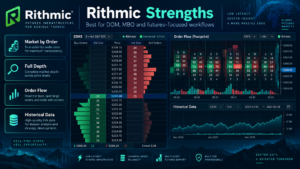
Rithmic vs CQG Platform Compatibility
Platform compatibility often decides Rithmic vs CQG before latency or feature comparisons even begin. A data feed has little value if your preferred platform cannot connect to it under your current brokerage arrangement.
Rithmic’s published integration ecosystem includes many futures-focused front ends such as ATAS, Bookmap, MotiveWave, MultiCharts, Quantower and others. It also supports its own R | Trader Pro and browser/mobile tools.
CQG is integrated across a broad network of brokers, FCMs, third-party platforms and its own CQG products. Its wider multi-market ecosystem can be useful to traders who do not want their infrastructure limited to one futures-centric workflow.
For NinjaTrader users, check current onboarding carefully. Rithmic’s own site currently states that NinjaTrader is not onboarding new Rithmic connections. Existing supported users may continue. Do not build a new account plan around an old tutorial without verifying current connection eligibility.
For platform-level comparisons, see Best Order Flow Trading Platforms 2026 and Best DOM Trading Platforms 2026.
Rithmic vs CQG APIs for Automated Trading
Developers looking at Rithmic vs CQG should compare specific APIs rather than the providers as a whole.
Rithmic APIs
Rithmic currently offers three primary developer paths. R | API+ targets C++ and .NET desktop/algo applications. R | Protocol API uses WebSockets and Protocol Buffers and is designed to work across languages and operating systems. R | Diamond API is a specialized Linux/C/C++ route intended for ultra-low-latency colocated deployments.
CQG APIs
CQG offers Client APIs for individual users, enterprise Web API, FIX and additional institutional interfaces. Its Web API uses secure WebSockets and Protocol Buffers and includes market data, historical data, accounts and order execution. CQG also publishes Python basic samples for its Web API environment.
For cloud or language-neutral application development, both providers now have viable protocol-based routes. For specialized C++ performance work, Rithmic’s product segmentation is particularly explicit. For broader enterprise integration and FIX workflows, CQG has a mature family of interfaces.
Read our Futures Trading APIs 2026 guide before choosing a production architecture.
Rithmic vs CQG Historical Data
Historical data is easy to overlook in a Rithmic vs CQG decision until a chart needs backfill or a strategy must be tested across years of futures contracts.
Rithmic states that tick data, time-based bars and aggregated/compressed bars are available from its history plant back to December 2011, with a current weekly download allowance described on its site. The exact data available to a user can still depend on account and exchange permissions.
CQG provides historical tick data plus intraday and daily bars through its data and API products. CQG’s ecosystem is especially relevant to firms that want historical data alongside multi-market analytics and execution.
For backtesting, the provider name is not enough. Verify session templates, timestamps, bid/ask history, contract roll methodology and whether the data is actual individual contracts or a continuous series. Our Best Futures Backtesting Platforms 2026 guide covers the software side of that process.
Explore NinjaTrader Futures Trading Options
Rithmic vs CQG for Order Routing and Risk Management
Rithmic vs CQG is also an execution-infrastructure comparison. Both ecosystems can support order routing, but the actual behavior experienced by the trader is determined by the provider, FCM, platform and order type.
Rithmic’s current platform architecture combines a Market Data Hub, Order Management Hub and Risk Management Hub. Its developer material describes server-side risk controls and server-side features such as brackets, OCO and trailing stops through its API infrastructure.
CQG’s APIs provide access to hosted exchange gateways for direct market access, and its enterprise products support order execution, accounts, order history and post-trade workflows. CQG also emphasizes redundancy and globally distributed infrastructure.
Never infer from this that every front-end implementation behaves identically. An OCO order submitted by one platform can be managed differently from the same conceptual order submitted through another API. Test the exact workflow and confirm where working orders reside before trading live.
Rithmic vs CQG Costs and Hidden Fees
There is no single universal monthly price for Rithmic vs CQG. Retail traders often receive either connection through a broker, FCM or prop firm, and the total can include several separate cost layers.
| Cost Layer | What to Check |
|---|---|
| Exchange Market Data | CME, CBOT, NYMEX, COMEX entitlements and Level 1 vs Level 2 |
| Connection / Technology | Provider or broker connectivity charge |
| Routing | Per-contract or transaction technology fee if applicable |
| Platform | Monthly, annual or lifetime software cost |
| API | Developer access, certification or production fees |
| Additional Logins | Concurrent-session or extra credential costs |
Exchange data is a separate cost from the technology provider. This means the cheapest-looking Rithmic vs CQG connection can become more expensive after adding depth, platform, API or extra-login fees.
Use our CME Market Data Fees 2026 guide to separate exchange entitlements from provider pricing, and Futures Commission Calculator 2026 to estimate execution-related costs.
Rithmic vs CQG for Prop-Firm Trading
Prop traders often encounter Rithmic vs CQG because the evaluation company or funded-account provider chooses the supported backend. In that situation, the trader may have little or no ability to select an alternative feed independently.
Rithmic has a strong presence across futures-focused trading and order-flow ecosystems. CQG and CQG-derived connections are also widely used in brokerage and trading technology. The correct choice for a prop account is therefore determined first by the firm’s supported infrastructure and second by the front end you want to use.
Do not purchase a third-party platform before confirming that the specific prop account can connect to it. Also verify rules for trade copiers, API automation, multiple simultaneous connections and account sharing.
If multiple accounts are part of your workflow, see our Best Futures Trade Copiers 2026 guide.
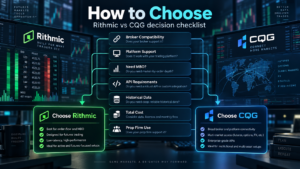
Rithmic vs CQG: Best Choice by Use Case
Best for Market by Order: Rithmic
Rithmic is the clearer fit when MBO is a defined requirement because it explicitly markets CME Group Market by Order as part of its data offering.
Best for Futures Order-Flow Platforms: Rithmic
Its integration list contains multiple specialist order-flow, DOM and volume-analysis platforms. Confirm that your broker or FCM supports the connection before choosing software.
Best for Broad Global Connectivity: CQG
CQG’s current infrastructure spans many data sources, tradable exchanges and broker environments, making it attractive for traders or firms that require broader market reach.
Best for Enterprise API and FIX Options: CQG
CQG offers client, Web API and FIX pathways and can support professional systems beyond a single desktop trading application.
Best for Specialized Low-Latency Developer Paths: Rithmic
Rithmic explicitly separates desktop/algo, protocol and colocated ultra-low-latency APIs, giving technical teams a clear performance-oriented upgrade path.
Best for a Typical Retail Trader: Depends on Broker and Platform
For most retail users, Rithmic vs CQG should be decided by compatibility, stability, total cost and required data—not by theoretical infrastructure features the trader will never use.
Rithmic vs CQG Pros and Cons
| Provider | Pros | Cons / Limitations |
|---|---|---|
| Rithmic | Futures specialization, un-throttled data positioning, full depth, MBO, dedicated API paths, order-flow ecosystem | Availability depends on broker/FCM; some platform onboarding changes; specialized features can be unnecessary for simple chart trading |
| CQG | Broad exchange and broker ecosystem, mature APIs, historical data, Web API, FIX, multi-market infrastructure | “CQG” covers multiple products; exact features and fees vary by service; enterprise paths can be more complex than retail users need |
The most important lesson from the Rithmic vs CQG pros and cons is that both are infrastructure choices. Neither provider can compensate for a poorly configured platform, unsuitable broker relationship or unreliable local network.
How to Choose Between Rithmic and CQG
Use a requirements-first process for Rithmic vs CQG. Start with the exact futures contracts you trade, then determine the data type required: Top of Book, full depth or Market by Order. If the strategy never consumes depth, do not let MBO drive the decision.
Next, confirm platform support with both the software vendor and broker or FCM. Platform compatibility pages can change, and a connection that exists for legacy users may not be available to new accounts.
Third, define the execution architecture. Manual DOM trading, NinjaScript-style platform automation, a Python service, C++ engine and institutional FIX system have very different requirements. Compare the specific API or gateway, not just the provider.
Fourth, calculate total monthly cost. Include exchange data, provider technology, routing, platform license, API fees and any extra login. A few dollars of headline difference can disappear once the full stack is priced.
Fifth, test reconnects and failure states. Disconnect the platform in simulation, restart it, verify open orders, test contract rollover and confirm that your application reconciles positions correctly.
Finally, choose the simplest stack that satisfies your requirements. The “more professional” connection is not automatically the better Rithmic vs CQG choice for your account.

Who Should Choose Rithmic?
Rithmic is a strong candidate for active futures traders who explicitly need CME MBO, detailed depth, specialized order-flow platforms, server-side infrastructure features or one of Rithmic’s developer interfaces. It can also make sense when a broker or prop environment is already standardized on Rithmic.
It is less compelling when your strategy uses only basic charts, your preferred platform does not support a new Rithmic connection, or you require the broader multi-asset and institutional ecosystem offered elsewhere.
Who Should Choose CQG?
CQG is a strong candidate for traders and firms that value broad exchange connectivity, multiple broker environments, historical data, established professional infrastructure, Web API or FIX options. It can also be the simplest choice when your brokerage already delivers a stable CQG connection integrated with your preferred platform.
CQG can be more infrastructure than a simple retail strategy requires, especially when an enterprise API is being considered for a problem that a normal broker/platform connection already solves.
Rithmic vs CQG FAQ
Is Rithmic better than CQG?
Not universally. Rithmic is particularly strong for futures-focused depth, MBO and specialized order-flow workflows, while CQG offers broader market, broker and enterprise connectivity. The better option depends on your platform, broker and data requirements.
Is Rithmic faster than CQG?
There is no universal end-to-end winner. Both providers offer low-latency infrastructure. Real latency depends on the exact connection, FCM, location, platform, network and application.
Does Rithmic provide Market by Order?
Yes. Rithmic currently lists MBO as available for its CME Group connectivity and describes individual order-level granularity as a core market-data feature.
Does CQG provide Level 2 data?
Yes. CQG’s Client APIs and Web API support depth or Level 2 market data, subject to the relevant product, market and exchange entitlement.
Which is better for Bookmap, Rithmic or CQG?
The answer depends on the supported Bookmap package and brokerage connection. Rithmic publishes Bookmap as a compatible platform and emphasizes full-depth/MBO workflows. Verify current Bookmap and broker requirements before subscribing.
Which is better for algorithmic trading?
Both can support algorithmic trading. Rithmic has multiple performance-oriented API paths, while CQG offers client APIs, Web API and FIX. Choose based on language, deployment model, required markets and production-access requirements.
Can I use Rithmic with NinjaTrader in 2026?
Rithmic currently states that NinjaTrader is no longer onboarding new Rithmic connections, while existing supported NinjaTrader users can continue connecting. Verify your specific account before planning a new setup.
Does CQG support Python?
CQG’s language-neutral Web API uses Protocol Buffers and secure WebSockets, and CQG publishes Python basic samples for that API environment. Production access can require formal onboarding and conformance testing.
Which is better for historical futures data?
Both offer historical data. Rithmic publishes tick and bar history back to December 2011, while CQG offers historical tick, intraday and daily data services. Backtesting needs should be compared at the exact data-set level.
Are Rithmic and CQG market-data fees the same?
Not necessarily. CME exchange entitlements are one cost layer, while brokers and technology providers can add different connection, routing, platform or API charges.
Can I connect multiple platforms to one Rithmic login?
Rithmic warns that connecting two applications directly to the same data feed can disconnect the first connection. Its documentation describes Plugin Mode through R | Trader Pro for supported multi-platform use. Verify current account rules.
Which one should a beginner choose?
A beginner should generally choose the stable connection already supported by the broker and platform they intend to use. Advanced MBO, API and institutional features are not automatically useful to a new trader.
Final Verdict: Rithmic vs CQG in 2026
The Rithmic vs CQG decision is ultimately about fit. Rithmic stands out for futures specialization, un-throttled data positioning, full depth, Market by Order and a clearly segmented developer API stack. CQG stands out for breadth: a large market-data network, extensive tradable-exchange and broker connectivity, historical services, client APIs, Web API and FIX infrastructure.
For an order-flow trader who specifically wants CME MBO or a Rithmic-native ecosystem, Rithmic is the stronger starting point. For a professional or multi-market workflow that values broad connectivity and multiple enterprise integration options, CQG may be the better architecture.
For most retail traders, however, Rithmic vs CQG should be decided only after confirming broker support, platform eligibility and total cost. Do not pay for infrastructure features you will never use, and do not assume an old connection guide proves that new accounts can still be onboarded.
Whichever provider you choose, test market data, order routing, reconnect behavior, contract rollover and risk controls in simulation before relying on the connection live.
Explore NinjaTrader for Futures Trading
Official Sources
Affiliate Disclosure: TradeboticsAI may receive compensation when readers complete qualifying actions through affiliate links. Affiliate relationships do not determine the technical conclusions or ranking on this page.
Risk Disclosure: Futures trading involves substantial risk of loss and is not suitable for every investor. Leverage can magnify losses. Faster data, deeper order books and professional routing infrastructure do not guarantee better fills or profitable trading.
Technology Disclaimer: Provider features, supported platforms, broker relationships, exchange entitlements, pricing and onboarding policies can change. Verify the current configuration directly with Rithmic, CQG, your broker or FCM and your trading platform before purchasing or changing a connection.
Last reviewed: September 10, 2026.