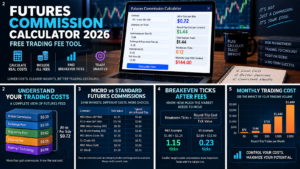
Futures Commission Calculator 2026: Free Trading Fee Tool
Use this futures commission calculator to estimate the real cost of opening and closing futures positions. Enter the commission charged per side, exchange and regulatory fees, clearing costs, optional routing charges, number of contracts and monthly trading volume. The tool calculates round-trip cost per contract, cost per trade, monthly variable costs, fixed platform or data costs, breakeven ticks and the share of a target consumed by fees.
A futures commission calculator is useful because a headline commission is rarely the entire trading cost. U.S. futures accounts can include brokerage commission, exchange fees, clearing charges, NFA-related fees, data subscriptions and optional technology or routing costs. Small targets and high turnover make those costs especially important for scalpers, Micro futures traders and automated strategies.
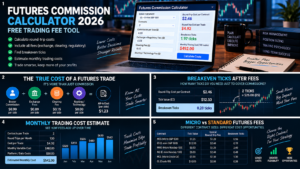
Quick Answer
A futures commission calculator should add every variable fee charged when a contract is opened and closed. If the total per-side cost is $1.20, the round-trip cost is $2.40 per contract. Trading three contracts makes the estimated cost $7.20 for that completed trade. Dividing round-trip cost by the contract’s tick value also shows how many ticks are needed just to offset fees before any net profit is produced.
Affiliate Disclosure: TradeboticsAI may receive compensation when readers complete qualifying actions through certain links. NinjaTrader buttons on this page are affiliate links. Calculator results are determined only by the values entered.
Futures Commission Calculator
This interactive futures commission calculator keeps the fee fields editable because exchange, clearing, regulatory and technology charges can vary by contract, brokerage plan and routing setup. The NinjaTrader presets populate only the currently published base brokerage commission and plan price. Add the current exchange, clearing and other per-side costs for the contract you actually trade.
Calculate Your Futures Trading Costs
—
—
—
—
—
—
—
—
—
Educational estimate only. Presets use NinjaTrader base commission pricing reviewed in September 2026. Exchange, regulatory, clearing, routing, technology, market-data and other charges can vary. Verify the current all-in rate for the exact contract, exchange, account plan and routing configuration before trading.
How Futures Trading Fees Work
A futures commission calculator needs to distinguish brokerage commission from all-in trading cost. Brokerage commission compensates the broker for execution and account services. Exchange, clearing and regulatory charges can sit on top of that rate, and some configurations add order-routing or technology fees.
Most futures commission schedules quote costs per contract and per side. Opening one contract is one side. Closing it is another side. Therefore a completed one-contract trade normally generates two sides of variable charges. If the same strategy trades five contracts at entry and five at exit, the cost scales across ten contract-sides.
Fixed monthly expenses are different. A data subscription or monthly commission plan does not increase every time an order is filled, but it still changes the economic cost of running the strategy. The calculator keeps variable and fixed costs separate so high-volume and low-volume traders can compare them more intelligently.

Futures Commission Calculator Formula
The main futures commission calculator formulas are:
All-in variable cost per side = brokerage commission + exchange/regulatory fees + clearing fee + routing/technology fee
Round-trip cost per contract = all-in per-side cost × 2
Round-trip cost per trade = round-trip cost per contract × number of contracts
Monthly variable cost = round-trip cost per trade × monthly round trips
Estimated monthly cost = monthly variable cost + monthly plan fee + market-data/fixed costs + optional amortized upfront cost
Breakeven ticks from fees = round-trip cost per contract ÷ dollar tick value
The breakeven-tick result does not include bid/ask spread, market impact or slippage unless you manually incorporate those costs into the input. It answers a narrow question: how much favorable movement per contract is needed to offset the explicit variable fees entered into the tool.
NinjaTrader Commissions in 2026
NinjaTrader’s current U.S. pricing provides a clear example of why a futures commission calculator is useful. The Free plan currently lists base commissions of $0.39 per side for Micro and E-nano contracts and $1.29 per side for Standard contracts. The Monthly plan is currently $99 per month with base commissions of $0.29 per side for Micro/E-nano and $0.99 for Standard contracts.
The Lifetime plan is currently listed at a $1,499 one-time payment with base commissions of $0.09 per side for Micro/E-nano contracts and $0.59 per side for Standard contracts. NinjaTrader states that exchange, clearing and NFA fees apply in addition to the headline commission rates.
NinjaTrader also currently lists a $0.15 clearing fee per contract on its account-fees page, while optional technology integrations and routing choices can create additional charges. Because those extras depend on the configuration, our calculator leaves them editable rather than pretending every trader has one universal all-in rate.
See
NinjaTrader’s official futures pricing
and verify the current all-in commission schedule before placing live trades.

Per-Side vs Round-Trip Futures Commissions
A futures commission calculator is especially useful here because commission tables often show one side while traders think in completed trades.
One of the easiest ways to underestimate trading costs is to confuse a per-side commission with a round-trip cost. If the broker advertises $0.39 per side, the brokerage commission alone is $0.78 for one contract opened and later closed. Exchange, clearing and regulatory costs can increase the actual round trip.
The futures commission calculator performs this doubling automatically. It then multiplies the result by the number of contracts in the trade. This is especially important for Micro futures because traders often use several contracts to create finer position sizing.
Partial exits do not necessarily reduce the number of contract-sides. If you enter four contracts and later exit two plus two, you still opened four contract-sides and closed four contract-sides. The order count changed, but the completed contract turnover remains four round trips.
Breakeven Ticks After Futures Commissions
The futures commission calculator converts explicit round-trip cost into ticks by dividing the fee by the contract’s dollar tick value. This makes cost easier to compare across products.
Suppose one Micro E-mini S&P 500 contract has $2.50 of entered round-trip fees and a $1.25 tick value. The explicit cost equals two MES ticks. A strategy targeting only four ticks would therefore surrender half of its gross target to those explicit fees before slippage.
For ES, a larger tick value means the same dollar fee consumes a smaller fraction of one tick. That does not automatically make ES cheaper to trade in risk terms, because the contract itself is ten times the size of MES. Fee efficiency and position-size flexibility are separate questions.
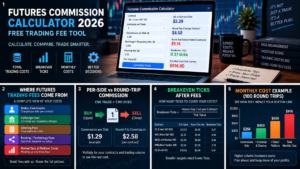
Micro vs Standard Futures Trading Costs
Use the futures commission calculator to compare the fee burden at the exact number of Micro or Standard contracts you plan to trade.
Micro futures reduce contract size, but a smaller contract can make commissions and exchange fees larger relative to the dollar value of each tick. That is why a futures commission calculator should compare cost as a percentage of the intended target, not only absolute dollars.
Ten MES contracts approximate the directional size of one ES contract. However, ten Micro contracts generate ten times as many contract-sides as one E-mini contract. Depending on the broker’s rate structure, the smaller-contract portfolio can therefore cost more in commissions even though it provides much finer sizing flexibility.
This trade-off is not automatically bad. Micros can help traders size risk more precisely, scale positions gradually and avoid forcing exposure into a larger contract. The relevant question is whether the extra flexibility justifies the additional turnover cost for the strategy.
Use our
Futures Position Size Calculator 2026
to compare contract quantity from risk budget and stop distance.
Monthly Cost in a Futures Commission Calculator
The futures commission calculator becomes more informative when monthly turnover is entered instead of judging a broker from one isolated trade.
A day trader should evaluate trading cost over a realistic month. The futures commission calculator multiplies cost per completed trade by your expected monthly round trips, then adds fixed expenses such as a commission plan and market data.
For example, a trader paying $3.00 all-in per round trip and completing 200 one-contract trades generates $600 of variable cost before data subscriptions or platform-plan fees. If average gross strategy expectancy is only a few dollars per trade, that cost can determine whether the strategy remains viable after execution expenses.
Volume also changes the economics of paid commission plans. A $99 monthly plan can make sense for one trader and be uneconomic for another because the commission savings must first recover the fixed subscription cost.
For post-trade analysis, see our
Futures Profit Calculator 2026
and
Best Futures Trading Journals 2026
.
When Can a Lower-Commission Plan Pay Off?
A futures commission calculator can also estimate when lower per-contract pricing begins to offset a recurring or upfront plan cost.
The current NinjaTrader pricing creates a simple example. Moving from the Free plan to the Monthly plan reduces the base Micro/E-nano commission from $0.39 to $0.29 per side, a $0.10 per-side saving or $0.20 per round-trip contract. Ignoring all other benefits and costs, approximately 495 completed Micro contract round trips per month would save $99 in base commission.
For Standard contracts, the current difference between $1.29 and $0.99 is $0.30 per side, or $0.60 per round trip. On commission difference alone, 165 Standard round-trip contracts in a month equal $99 of savings.
The Lifetime plan comparison is different because the current $1,499 cost is upfront rather than monthly. Compared with the Free plan, the base commission difference is currently $0.30 per side for Micro/E-nano contracts and $0.70 per side for Standard contracts. That means roughly 2,499 Micro round-trip contracts or 1,071 Standard round-trip contracts would equal $1,499 of base commission savings, ignoring the time value of money, policy changes and other plan features.
These examples are not recommendations to trade more. A futures commission calculator should help decide which cost structure fits existing volume, not encourage additional turnover just to justify a plan.
Futures Commissions for Scalping and Automated Trading
For high-turnover systems, a futures commission calculator can reveal whether transaction costs are large enough to change the strategy’s practical economics.
Scalping and automated systems can be unusually sensitive to transaction costs because they may generate many trades with relatively small average targets. A strategy that looks profitable in a backtest before fees can become weak or negative after realistic commissions, exchange costs and slippage are added.
The futures commission calculator helps convert trading frequency into a monthly expense estimate. Automated traders should then include the same cost assumptions in backtesting and forward simulation rather than evaluating the calculator separately from the strategy model.
Infrastructure can create additional fixed or variable costs. VPS hosting, third-party integrations, data feeds, APIs and routing technology can all affect total operating expense.
For infrastructure comparisons, see
Best Futures Trading VPS 2026
and
Best Automated Futures Trading Software 2026
.
Common Futures Commission Calculator Mistakes
Using Only the Advertised Commission
A headline broker commission can exclude exchange, clearing and regulatory fees. Enter the complete current fee stack when evaluating actual cost.
Forgetting to Double Per-Side Rates
If a rate is quoted per side, one completed trade generally pays it at entry and again at exit. The futures commission calculator converts per-side inputs into round-trip values automatically.
Ignoring Contract Quantity
Trading five contracts creates five times the per-contract variable fee of trading one contract.
Ignoring Fixed Monthly Costs
A lower per-contract rate can come with a monthly subscription. Compare monthly total cost at your actual turnover.
Comparing Micro and E-mini Fees Without Exposure
One Micro contract and one E-mini contract do not represent the same market exposure. Cost comparisons should consider both fees and contract size.
Leaving Fees Out of Backtests
A gross backtest can materially overstate performance for frequent strategies. Include realistic commission and slippage assumptions.
Treating Current Rates as Permanent
Broker plans, exchange fees and regulatory charges can change. Recheck the current schedule before relying on an old calculation.
Futures Commission Calculator FAQ
What is a futures commission calculator?
A futures commission calculator estimates explicit trading costs by combining brokerage commission, exchange/regulatory charges, clearing and optional routing or technology fees, then multiplying those costs by contract quantity and turnover.
What does “per side” mean in futures commissions?
Per side means the fee applies to one transaction side: either opening or closing the contract. A completed round trip normally includes two sides.
What is a round-turn or round-trip commission?
It is the total cost associated with opening and later closing the same contract position, before considering slippage or spread unless those costs are explicitly included.
Does NinjaTrader charge only the advertised commission?
No. NinjaTrader’s current pricing states that exchange, clearing and NFA fees apply in addition to its listed base commissions.
What are NinjaTrader’s current base commissions?
As reviewed in September 2026, NinjaTrader lists Free-plan base commissions of $0.39 per side for Micro/E-nano and $1.29 for Standard contracts; Monthly-plan rates of $0.29 and $0.99; and Lifetime rates of $0.09 and $0.59. Verify the official page for current pricing.
How do I calculate breakeven ticks from commission?
Divide the explicit round-trip fee per contract by that contract’s dollar tick value. A $2.50 round-trip fee on a $1.25 tick-value contract equals two ticks.
Are commissions more important for scalping?
They can be because frequent trades and small targets make explicit costs a larger percentage of gross profit. Strategy-specific results still depend on execution and win/loss distribution.
Does this calculator include slippage?
No. The futures commission calculator focuses on explicit entered fees. Slippage depends on actual or assumed execution and should be modeled separately in P&L and backtesting.
Does market data count as a commission?
No. Market data is a fixed or recurring operating expense rather than a per-trade commission, but the calculator lets you include it when estimating monthly trading cost.
Should I choose a paid plan just to reduce commission?
Compare the expected savings at your existing trading volume with the plan cost and other included features. Do not increase trading frequency merely to reach a commission break-even point.
Final Verdict: Futures Commission Calculator for 2026
A useful futures commission calculator should turn an advertised per-side rate into the number that actually matters: estimated round-trip cost for the size and frequency you trade. It should also separate variable execution fees from fixed expenses and show how much of a typical target is consumed before slippage.
For 2026, NinjaTrader provides a useful three-plan example because its current Free, Monthly and Lifetime plans trade a higher fixed plan cost for lower base commissions. The right structure depends on real contract turnover, not the lowest number shown in an advertisement.
Use the calculator with current contract-specific exchange and regulatory fees, current broker commission, current clearing and routing costs, and realistic monthly volume. Then feed those costs into your backtests, journals and P&L analysis so strategy results are evaluated after expenses rather than before them.
The futures commission calculator is an educational planning tool. It does not predict fills, guarantee future fee schedules, recommend a broker plan or determine whether any trading strategy will be profitable.