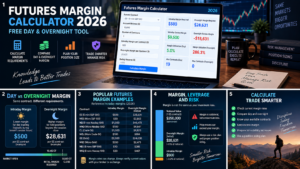
Futures Margin Calculator 2026: Free Day & Overnight Tool
Use this futures margin calculator to estimate how much account equity is required to carry a futures position under an intraday margin rate or a higher overnight/initial margin rate. Enter your account balance, contracts and current margin requirements, and the tool calculates required margin, excess margin, margin utilization and the maximum whole-contract quantity your account could support under the values entered.
A futures margin calculator is useful because margin is not the same as trade risk. A broker may require only a fraction of a contract’s notional value during the trading session, while the exchange-linked initial requirement for holding the position into the next session can be much larger. Having enough margin to open a position does not mean the position is appropriately sized for your risk plan.

Quick Answer
A futures margin calculator multiplies the applicable per-contract margin requirement by your number of contracts. Intraday margin normally applies only during the broker’s permitted day-trading window, while initial or overnight margin is required when a position is held beyond the intraday cutoff. Margin rates can change with volatility and broker policy, so the safest calculator uses the current value shown by your broker or exchange rather than relying permanently on an old table.
Affiliate Disclosure: TradeboticsAI may receive compensation when readers complete qualifying actions through certain links. NinjaTrader buttons on this page are affiliate links. Calculator outputs are based only on the values entered into the tool.
Futures Margin Calculator
This interactive futures margin calculator deliberately lets you edit every rate. Margin is dynamic: exchanges can revise initial and maintenance requirements and brokers can change intraday requirements. The preset values below are reference examples reviewed in 2026, not permanent promises. Before a live trade, replace them with the current numbers shown by your broker.
Calculate Intraday and Overnight Margin
—
—
—
—
—
—
—
—
—
Reference presets are educational examples and can become outdated. Broker intraday rates, exchange initial margin, maintenance margin, news-event adjustments, position limits and liquidation rules can change without notice. Always verify the current margin shown by your broker before trading.
How a Futures Margin Calculator Works
A futures margin calculator does not calculate the purchase price of a futures contract. Futures are leveraged derivatives, so traders post margin rather than paying the full notional value of the underlying exposure. The applicable requirement is normally quoted as a dollar amount per contract.
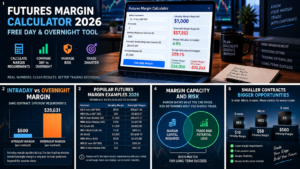
If a broker requires $500 of intraday margin for one contract, two contracts require $1,000 under that rate. If the exchange-linked initial requirement is $28,000 per contract, two contracts would require $56,000 to carry under that initial-margin assumption. The large difference is why a position that is easy to open intraday may be impossible to hold through the session cutoff in a smaller account.
The calculator also reports excess margin. This is the amount of entered account equity remaining above the calculated requirement. It should not be confused with money that is automatically safe to lose. Market losses reduce account equity while margin requirements can simultaneously change.
Futures Margin Calculator Formula
The basic futures margin calculator formulas are simple:
Intraday margin required = intraday margin per contract × number of contracts
Initial margin required = initial margin per contract × number of contracts
Excess margin = account equity − required margin
Margin utilization = required margin ÷ account equity × 100
Maximum contracts = floor(available equity ÷ margin per contract)
Our tool optionally subtracts a personal safety reserve before showing maximum-contract capacity. This reserve is not a broker rule. It is a planning field that helps illustrate the difference between theoretical maximum leverage and a user-selected buffer.
The maximum-contract output should never be interpreted as a recommendation. A futures margin calculator can show what the entered margin rate mathematically permits; it cannot determine how many contracts are financially appropriate for a particular trader.
Intraday vs Overnight Futures Margin
Intraday margin is a broker-defined requirement that can apply while a futures position is opened and closed inside the broker's permitted day-trading window. Initial margin is generally the higher exchange-linked requirement needed to establish or carry a position beyond that window.
NinjaTrader currently states that its intraday rates remain effective from the product open until 15 minutes before the session close, when initial margin is required. For CME ES and MES, its published cutoff is 15:45 CT ahead of the 16:00 CT session close. The same page notes that initial margin is set by the exchange and is the amount required to hold a position into the next trading session.
This timing is why the futures margin calculator reports the two requirements side by side. A trader who looks only at day margin can underestimate the capital needed if the position remains open as the broker switches to the initial-margin requirement.
NinjaTrader Margin Examples in 2026
NinjaTrader's current U.S. pricing page highlights low intraday margins for several popular products. It lists $50 intraday margins for Micro E-mini S&P, Micro E-mini Dow and Micro E-mini Russell 2000; $500 for the corresponding popular E-mini contracts; and $1,000 for crude oil, gold and natural gas. It also currently lists E-nano index margins in the $10–$20 range.
Those headline values make NinjaTrader a useful example for this futures margin calculator, but they should not be treated as permanent rates. NinjaTrader explicitly says its risk team can adjust intraday margins in response to market volatility and may make temporary changes without prior notice.
For live brokerage terms and current rates, see
NinjaTrader's official U.S. pricing and margin page
.
CME Margin, SPAN and Exchange Requirements
Broker day-trading margin is only one layer. CME Group calculates futures and options margin through its risk frameworks, including SPAN and SPAN 2 for eligible products. CME CORE provides an interactive margin environment for cleared or hypothetical futures and options portfolios.
This matters because a retail futures margin calculator that uses one fixed number cannot reproduce a full portfolio risk engine. Spread positions, options, portfolio offsets and changes in volatility can alter requirements. Our calculator intentionally handles the simpler single-rate-per-contract planning problem.
For exchange-level margin analysis, see
CME Group Margin Services and CME CORE
.
If you trade a complex portfolio rather than one directional futures contract, the official exchange and clearing tools are more appropriate for portfolio-level calculations.
Futures Margin Calculator Examples
Example 1: One ES Contract Intraday
Assume the broker's current ES intraday requirement is $500 and the account has $10,000 of equity. One contract uses $500 of margin, which equals 5% of the account. The futures margin calculator shows $9,500 of excess equity above that requirement before trading losses, fees or other positions.
Example 2: Four ES Contracts
At the same $500 intraday rate, four ES contracts require $2,000. A $10,000 account would therefore show 20% margin utilization. This arithmetic does not say that four ES contracts are safe: a relatively small adverse price move can create a dollar loss far larger than the margin posted.
Example 3: MES vs ES
If a broker requires $50 intraday for MES and $500 for ES, ten MES contracts and one ES contract require the same $500 of intraday margin under those specific rates. The market exposure of ten MES contracts is also broadly comparable to one ES because the Micro contract is one-tenth the size of the E-mini. Execution costs and flexibility can still differ.
Example 4: Intraday Position That Cannot Be Held Overnight
Suppose a $10,000 account trades one contract with a $500 intraday requirement and a $28,000 initial requirement. The position fits during the day but does not meet the overnight requirement. A futures margin calculator makes that mismatch visible before the cutoff arrives.
Futures Margin vs Trade Risk
Margin is collateral, not a predefined maximum loss. This is one of the most important concepts on the page. If an ES contract requires $500 of intraday margin, the trader is not limited to losing $500. The contract's P&L continues to move according to its tick and point value until the position is closed or liquidated.
This is why this margin tool should be used beside—not instead of—a position-size calculator. Margin asks whether the account can support the position under broker rules. Position sizing asks whether the loss to a planned stop fits a defined dollar-risk budget.
Use our
Futures Position Size Calculator 2026
to calculate contracts from stop distance and risk budget.
For target and stop geometry, use the
Futures Risk Reward Calculator 2026
.

Why Excess Margin Matters
Excess margin is the equity remaining above the minimum margin requirement. NinjaTrader warns against trading at full leverage with no excess margin because even a small adverse move can push an account toward forced liquidation. Its current guidance defines excess margin as equity above minimum requirements and notes that insufficient excess can result in liquidation and fees.
A futures margin calculator can help visualize this buffer. If a $5,000 account uses $4,500 of required margin, 90% of the account is tied to the requirement and only $500 remains above it. That situation is very different from using $500 of required margin in the same account.
The safety-reserve field in our calculator is designed to make that distinction obvious. It reduces the theoretical maximum-contract count by preserving a chosen amount of equity. The field is educational and is not a substitute for broker risk controls or personalized financial planning.
E-nano and Micro Futures Margin in 2026
Contract size changes both market exposure and margin requirements. Micro E-mini contracts are one-tenth the size of their corresponding E-mini contracts. In 2026, CME also introduced E-nano equity-index futures that are smaller again, adding another sizing tier for S&P 500, Nasdaq-100, Russell 2000 and Dow exposure.
NinjaTrader's current U.S. page advertises intraday margins of $10–$20 for its E-nano index products and $50 for several popular Micro equity-index contracts. The futures margin calculator includes reference presets for NES and NNQ to illustrate how a smaller contract can reduce the required collateral per unit.
Smaller margin does not mean no risk. Multiple micro or nano contracts can recreate the exposure of a larger contract, and fees can become significant when many contracts are used.

Why Futures Margin Can Change Around Volatility
Margin is a risk-control mechanism, so it is not surprising that requirements can rise when volatility increases. A static screenshot from six months ago should never be treated as a permanent broker promise.
NinjaTrader's current margin policy states that intraday margins can be adjusted in real time and that temporary margin increases may occur. Its published policy also says intraday margins can be set to four times standard rates shortly before selected key economic news announcements, with the elevated requirement remaining temporarily after the release while volatility is assessed.
That is another reason our futures margin calculator keeps the margin fields editable. If the broker increases a $500 requirement to $2,000 for a specific event window, entering the revised rate immediately updates the required equity and maximum-contract calculations.
Traders running automated strategies should account for these time-dependent rules in their operational plan rather than assuming an algorithm can always open the same quantity throughout the session.
Brokerage Margin vs Prop-Firm Account Limits
A retail brokerage futures margin calculator should not be confused with a prop-firm drawdown calculator. Prop evaluations and simulated funded programs often use maximum-contract limits, daily loss limits, trailing drawdown and consistency requirements that are different from the margin rules applied to a normal brokerage account.
An evaluation may permit a certain number of contracts without asking the trader to post exchange-style margin in the same way as a self-funded account. The real constraint may instead be the program's drawdown threshold or contract cap.
For those account rules, use our
Prop Firm Drawdown Calculator 2026
and
Prop Firm Consistency Rule Calculator 2026
.
Keep brokerage margin, prop-account rules and personal risk limits as three separate layers. Combining them into one number can hide which rule is actually closest to being breached.
Common Futures Margin Mistakes
Assuming Intraday Margin Is the Maximum Loss
It is not. Margin is collateral required to maintain the position under the broker's rules. Market loss can exceed the margin amount.
Ignoring the Intraday Cutoff
A position that fits a low day-trading requirement can require dramatically more equity shortly before the session close. The futures margin calculator shows both values so the difference is visible.
Using Old Margin Tables
Rates can change with market conditions. Always verify live broker or exchange values before placing a trade.
Trading at the Mathematical Maximum
The maximum-contract output is not a recommendation. Using every available dollar of margin leaves little or no buffer for losses or changes in requirements.
Confusing Initial and Maintenance Margin
Initial margin and maintenance margin are related but distinct exchange risk requirements. Broker policies determine how those values interact with account management and liquidation procedures.
Ignoring Other Open Positions
This calculator models one entered requirement. A real account may contain multiple positions whose combined margin consumes more equity.
Assuming Every Broker Uses the Same Intraday Margin
Exchange initial requirements may provide a common baseline, but retail day-trading margins can vary significantly by broker. Compare the current rules of the broker you actually use.
Futures Margin Calculator FAQ
What is a futures margin calculator?
A futures margin calculator estimates how much account equity is required for a selected number of futures contracts based on the margin-per-contract value entered by the user.
How do I calculate futures margin?
Multiply the current margin requirement per contract by the number of contracts. For example, a $500 intraday margin multiplied by three contracts equals $1,500 of required intraday margin.
What is intraday futures margin?
Intraday margin is the broker-defined minimum account requirement per contract during the broker's permitted day-trading period. It can be substantially lower than the amount needed to hold the position overnight.
What is initial margin?
Initial margin is an exchange-linked requirement associated with establishing or carrying a futures position. NinjaTrader currently requires initial margin 15 minutes before the session close for positions intended to remain open into the next session.
Is futures margin the amount I can lose?
No. A futures margin calculator estimates required collateral, not maximum loss. Dollar trade risk depends on contract value, price movement, quantity, execution and whether a planned stop fills as expected.
Can margin requirements change?
Yes. Exchange and broker requirements can change as market conditions change. NinjaTrader explicitly reserves the right to adjust intraday margins in response to volatility.
Why is overnight margin higher than day margin?
Holding through session transitions creates additional risk, including price moves when the trader may have less ability to react. Brokers therefore require the applicable higher exchange-linked initial margin for overnight positions.
Does the futures margin calculator recommend a number of contracts?
No. Maximum contracts is a mathematical capacity based on entered margin and account equity. It is not a recommendation or a substitute for risk-based position sizing.
Can I use it for ES, MES, NQ and MNQ?
Yes. The calculator includes editable reference presets for ES, MES, NQ, MNQ, CL, MCL, GC, MGC and selected E-nano products. Verify current rates before live use.
What happens if my account falls below required margin?
Broker procedures vary, but insufficient margin can result in a margin call, forced liquidation and applicable fees. Review your broker's current policy before trading.
Final Verdict: Futures Margin Calculator for 2026
A useful futures margin calculator should answer more than “how much margin do I need?” It should show the difference between intraday and overnight requirements, how much equity remains above each threshold, how much of the account is being consumed by margin and why a theoretical maximum-contract number is not the same as a sensible risk limit.
For 2026, that distinction matters even more because brokers can change intraday rates in response to volatility and new smaller products such as E-nano futures create additional choices between contract size, required collateral and execution costs.
Use the calculator with the current rates shown by your broker, leave room above minimum requirements, and then use a separate position-size process to determine how much you are actually prepared to lose if the market moves against the trade.
The futures margin calculator is an educational planning tool. It does not guarantee that an order will be accepted, prevent liquidation, predict future margin changes or determine whether a specific futures position is suitable.