Best Futures Trading APIs 2026: 7 Platforms Compared for Automation
The best futures trading APIs let developers connect custom applications, automated strategies, dashboards or execution systems to futures market data, brokerage accounts and order-routing infrastructure without manually operating a trading platform for every action.
But “API” can mean very different things. A REST interface designed for account queries is not equivalent to a low-latency C++ SDK. A WebSocket market-data stream serves a different purpose from FIX order routing. Some providers are accessible to individual retail developers, while others require broker relationships, application approval, conformance testing or institutional onboarding.
For 2026, our overall choice among the best futures trading APIs for an active retail or independent futures developer is NinjaTrader because its current developer stack combines a REST Trade API, WebSocket market-data API, NinjaScript/C# desktop development and a futures-focused trading ecosystem.
- NinjaTrader — Best Overall Futures API Ecosystem
- TradeStation — Best REST API for Futures + Multi-Asset Trading
- Interactive Brokers — Best for Global Multi-Asset API Trading
- Tradovate — Best Web-Native Futures API
- Rithmic — Best for Low-Latency Futures Infrastructure
- CQG — Best for Broad Professional Market Connectivity
- Trading Technologies — Best Institutional Futures API Stack
TradeboticsAI Top Pick: NinjaTrader provides the strongest overall combination of futures specialization, trading API access, real-time market data, C# strategy development and simulation-oriented workflow for many independent developers.
Evaluate NinjaTrader’s futures ecosystem, simulation tools and developer infrastructure before connecting a strategy to live capital.
Affiliate Disclosure: TradeboticsAI may receive compensation when an eligible user completes a qualifying action through certain affiliate links. Affiliate relationships do not determine our rankings or technical conclusions.
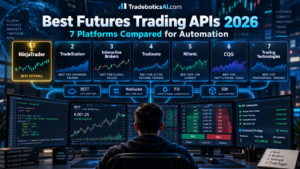
Best Futures Trading APIs 2026 Ranking
| Rank | API / Provider | Primary Interface | Best For | Access Profile |
|---|---|---|---|---|
| 1 | NinjaTrader | REST, WebSocket, C# / NinjaScript | Independent futures developers | Futures-focused ecosystem |
| 2 | TradeStation | REST/JSON, streaming, FIX | Web apps and multi-asset automation | Retail + developer/business access |
| 3 | Interactive Brokers | Web API, TWS socket API, FIX | Global multi-asset systems | Broad brokerage ecosystem |
| 4 | Tradovate | Web / REST API | Web-native futures applications | Futures-specific brokerage technology |
| 5 | Rithmic | C++, .NET, WebSocket/protobuf | Low-latency futures applications | Dev kit + conformance / broker relationship |
| 6 | CQG | Client APIs, Web API, FIX | Professional market data and execution | Retail client + enterprise options |
| 7 | Trading Technologies | REST, .NET SDK, Core SDK, FIX | Professional and institutional infrastructure | More specialized onboarding |
These rankings are not claims that one provider executes every strategy faster or more profitably. The best futures trading APIs solve different technical problems and operate under different access, broker, exchange-data and deployment constraints.
How We Ranked the Best Futures Trading APIs
TradeboticsAI evaluated the best futures trading APIs using eight practical dimensions rather than ranking providers solely by theoretical latency.
- Futures coverage: whether futures trading is a core supported use case.
- Order functionality: ability to submit, modify and cancel supported orders.
- Market data: availability of real-time or streaming data interfaces.
- Protocols: REST, WebSocket, socket APIs, FIX or native SDK availability.
- Developer accessibility: difficulty of gaining development and production access.
- Simulation: availability of test, paper or certification environments.
- Documentation: quality of technical references and onboarding material.
- Deployment fit: whether the solution is appropriate for retail, cloud, desktop, server-side or professional low-latency systems.
We deliberately do not assign a universal “fastest” score. End-to-end latency depends on more than the public API specification: network path, broker configuration, exchange gateway, hosting location, application architecture, market-data path and order-routing infrastructure all matter.
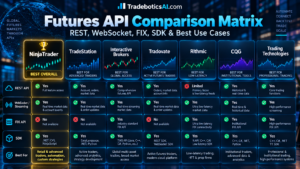
Best Futures Trading APIs: Quick Feature Comparison
| Provider | REST | Streaming / Socket | Native SDK | FIX | Futures Focus |
|---|---|---|---|---|---|
| NinjaTrader | Yes | WebSocket market data | NinjaScript / C# + web SDK tools | Use-case dependent | Very High |
| TradeStation | Yes | HTTP streaming | API-driven application stack | Institutional connectivity | High |
| Interactive Brokers | Web API | TWS TCP socket | Python, Java, C++, C#, VB interfaces | Available for eligible use cases | Medium / Multi-Asset |
| Tradovate | Yes | Web-oriented services | JavaScript-friendly ecosystem | Not primary retail interface | Very High |
| Rithmic | Not its primary positioning | WebSocket + protobuf | C++, .NET, C/C++ low-latency | Infrastructure dependent | Very High |
| CQG | Enterprise Web API options | Professional data interfaces | Client API products | Yes | Very High |
| Trading Technologies | REST API 2.0 | SDK streaming interfaces | .NET SDK + Core SDK | Yes | Very High |
1. NinjaTrader — Best Overall Futures Trading API Ecosystem
#1
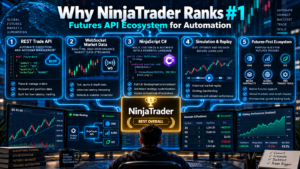
NinjaTrader ranks first among our best futures trading APIs because its current developer environment covers several layers of futures development instead of forcing every application into one interface.
NinjaTrader’s current developer documentation describes:
- a REST Trade API for authentication, orders, positions, accounting and risk;
- a WebSocket Market Data API for real-time quotes, market depth, charts and related streaming events;
- NinjaScript, its C#-based development environment for NinjaTrader Desktop;
- web development and ecosystem tools for building integrations and extensions.
This separation is useful. A strategy developer may use NinjaScript when the logic belongs inside NinjaTrader Desktop, while an external application can use HTTP-based trading interfaces and streamed market information.
See the official NinjaTrader Developer Documentation for current access and API specifications.
NinjaTrader API Pros
- Futures-first ecosystem.
- REST trading interface.
- Real-time WebSocket market data.
- C# NinjaScript development.
- Strategy and indicator ecosystem.
- Strong connection between API development and futures execution tools.
- Relevant for both custom applications and platform-native automation.
NinjaTrader API Limitations
- Different development layers solve different problems.
- Developers still need to understand account permissions and market-data access.
- Desktop NinjaScript and external APIs are not identical deployment models.
- Live automation introduces execution and infrastructure risk.
For a dedicated platform-level analysis, see our NinjaTrader API 2026 guide.
Explore NinjaTrader’s futures platform and simulation environment before moving an automated system into live execution.
2. TradeStation — Best REST API for Futures + Multi-Asset Trading
#2
TradeStation is one of the strongest best futures trading APIs candidates for developers who prefer a conventional web-services architecture and also want stocks and options available through the same broader API ecosystem.
TradeStation documents its API as a collection of RESTful brokerage and market-data services. Its current API documentation explicitly supports futures alongside equities and options.
TradeStation also documents REST/JSON, streaming data and FIX connectivity for appropriate use cases.
See the official TradeStation API documentation.
Why TradeStation Ranks #2
- Clear REST-oriented architecture.
- Futures, stocks and options under one broader integration.
- Real-time streaming capabilities.
- Suitable for browser, service and application development.
- Strong fit for developers who do not want a futures-only ecosystem.
Main Limitation
TradeStation is less futures-specialized than NinjaTrader or Rithmic. That can be an advantage for multi-asset developers but a disadvantage for a project built solely around futures microstructure or low-latency professional infrastructure.
Compare both platforms in NinjaTrader vs TradeStation 2026.
3. Interactive Brokers — Best Global Multi-Asset Futures API
#3
Interactive Brokers is one of the best futures trading APIs for developers who need much broader international and multi-asset coverage than a dedicated U.S. futures platform normally provides.
IBKR provides multiple API approaches, including its Web API and the long-established TWS API.
The TWS API is a TCP socket-based interface that can be used through languages including Python, Java, C++, C# and Visual Basic. Developers can retrieve data and send instructions through Trader Workstation or IB Gateway.
IBKR’s documentation also specifically supports locating and working with futures contracts through its API environment.
See the official IBKR API documentation.
Best For
- global futures developers;
- multi-asset trading systems;
- Python-based systematic workflows;
- developers needing stocks, options and futures in one brokerage architecture;
- applications requiring extensive brokerage-account functionality.
Limitations
The breadth creates complexity. Contract identifiers, market-data permissions, gateway architecture, session behavior and account configuration require careful implementation.
See NinjaTrader vs Interactive Brokers 2026 for the platform-level comparison.
4. Tradovate — Best Web-Native Futures Trading API
#4
Tradovate remains relevant in a ranking of the best futures trading APIs because its architecture was built around modern web-based futures trading rather than a legacy desktop-only model.
Its official API documentation describes a REST interface exposing trading functionality to client applications. Supported operations include order placement and modification plus queries for positions, contracts, products, prices and maturities.
See the official Tradovate API documentation.
Best For
- web-first futures applications;
- developers who prefer HTTP-oriented architectures;
- custom dashboards and futures interfaces;
- projects centered exclusively on futures.
Important Distinction
A web-native interface does not make a strategy inherently faster or safer. Network architecture, request handling, risk logic and brokerage permissions remain relevant to production deployment.
For the platform comparison, see NinjaTrader vs Tradovate 2026.
5. Rithmic — Best Low-Latency Futures API Infrastructure
#5
Rithmic occupies a different category from most retail-friendly best futures trading APIs. Its API suite is built around professional futures market data, order management and execution infrastructure.
Rithmic currently documents three principal API paths:
- R | API+: C++ and .NET interfaces;
- R | Protocol API: language-independent WebSocket / Protocol Buffers architecture;
- R | Diamond API: specialized ultra-low-latency Linux / co-location architecture.
Rithmic states that production deployment requires conformance testing and that developers normally obtain live credentials through the appropriate FCM or broker relationship.
See the official Rithmic API Suite.
Why Rithmic Is Different
Rithmic is attractive when latency, granular data, direct futures infrastructure and professional order management matter more than having the simplest REST onboarding process.
Best For
- professional futures applications;
- algorithmic trading platforms;
- custom order-management systems;
- advanced market-data consumers;
- developers willing to complete conformance and broker onboarding.
6. CQG — Best Futures API for Broad Professional Connectivity
#6
CQG has been a major futures connectivity provider for years and remains one of the best futures trading APIs for developers who prioritize market data, exchange breadth and professional execution infrastructure.
CQG’s official API portfolio includes client APIs, enterprise Web API options and FIX connectivity.
CQG states that its infrastructure provides direct market access to more than 45 exchanges and market data from more than 85 sources.
Its client API products can provide real-time and historical data, best bid/offer information and Depth of Market data.
See the official CQG API products.
Best For
- professional futures software;
- market-data applications;
- multi-exchange systems;
- applications already operating inside the CQG ecosystem;
- developers needing both execution and data services.
Limitation
CQG offers several API products aimed at different customer classes. Developers should confirm which interface is available to their specific account or commercial use case rather than assuming every API is a self-service retail endpoint.
7. Trading Technologies — Best Institutional Futures API Stack
#7
Trading Technologies is one of the most sophisticated providers in this best futures trading APIs comparison, but its professional focus makes it less straightforward for an ordinary independent retail developer.
TT currently provides multiple development paths:
- TT REST API 2.0;
- TT .NET SDK;
- TT Core SDK for server-side Linux applications;
- FIX interfaces for professional market data and order routing.
TT’s documentation explicitly separates interfaces according to latency sensitivity and deployment model. That is the right engineering approach: an administrative REST call and a latency-sensitive execution application should not use identical architecture simply for convenience.
See the official TT API documentation.
Best For
- professional trading firms;
- institutional futures applications;
- server-side systems;
- risk and administrative integrations;
- developers requiring FIX or professional SDK access.
Best Futures Trading APIs: REST vs WebSocket vs FIX vs Native SDK
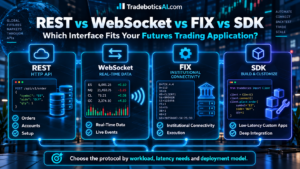
The biggest technical mistake when comparing the best futures trading APIs is asking which protocol is “best” without defining the workload.
| Interface | Strongest Use | Advantages | Limitations |
|---|---|---|---|
| REST | Orders, accounts, positions, configuration | Simple, widely supported, easy to debug | Request/response architecture may not suit every low-latency event stream |
| WebSocket | Real-time quotes and asynchronous events | Persistent bidirectional connection | Requires reconnection and state-handling logic |
| FIX | Professional order routing and institutional integration | Mature financial messaging standard | More complex onboarding and implementation |
| Native SDK | Performance-sensitive custom software | Deeper integration and performance control | Language/platform constraints and higher engineering complexity |
A robust trading architecture can use more than one interface. For example, REST may handle account queries while a persistent streaming connection handles real-time market events.
Latency: What Actually Matters in a Futures Trading API?
Latency is frequently abused in comparisons of the best futures trading APIs. The public interface is only one component of the complete path.
A simplified order path can include:
strategy → local application → operating system → network → API gateway → broker / execution infrastructure → exchange gateway → matching engine.
The response travels back through another path.
Therefore, evaluate:
- application location;
- internet versus colocated infrastructure;
- serialization overhead;
- API gateway location;
- broker routing architecture;
- exchange proximity;
- market-data latency;
- order acknowledgment latency;
- jitter;
- failure and reconnection behavior.
A strategy trading on multi-minute signals may not benefit economically from a complex colocated SDK. A professional market-making system has very different requirements.
Market Data Requirements for the Best Futures Trading APIs
API access does not automatically include unrestricted real-time exchange data.
Futures market data can involve:
- exchange entitlements;
- professional versus non-professional classification;
- Top of Book versus Depth of Market;
- separate exchange subscriptions;
- redistribution restrictions;
- historical-data limits;
- vendor-specific data charges.
A system using only bar-close signals may need very different data from a DOM or order-flow engine processing full depth.
For a broader infrastructure explanation, see our Futures Data Feeds 2026 guide.
Before selecting an API or market-data plan, distinguish the exchange entitlement from broker or vendor subscription charges. Our CME market data fees comparison explains Level 1 versus Level 2, exchange bundles, subscriber classification and retail-provider costs. Check the current provider schedule and any separate API permission before committing to recurring fees.
For order-book applications, also see Futures Level 2 Data 2026.
Simulation, Sandbox and Testing for Futures APIs
The best futures trading APIs should be evaluated in a non-live environment before an automated application is trusted with actual capital.
A serious testing process should include:
- authentication failures;
- connection loss;
- market-data interruption;
- duplicate events;
- rejected orders;
- partial fills;
- cancel/replace races;
- position reconciliation;
- unexpected process restart;
- daily session transitions;
- contract rollover;
- maximum-loss controls.
Simulation is not proof of live profitability. It is primarily a way to validate application behavior and trading logic under controlled conditions.
Use NinjaTrader Market Replay 2026 for a detailed replay workflow.
Risk Controls Every Futures Trading API System Needs
Automated futures trading can create losses far faster than manual trading if software behaves incorrectly.
At minimum, consider independent controls for:
- maximum position size;
- maximum daily loss;
- maximum order frequency;
- duplicate-order prevention;
- stale market-data detection;
- disconnect handling;
- unexpected-position reconciliation;
- contract-expiration validation;
- kill switch;
- manual emergency intervention.
How to Choose the Best Futures Trading API
| Your Priority | Best Starting Point | Why |
|---|---|---|
| Futures-first retail automation | NinjaTrader | REST, WebSocket, C# and futures ecosystem |
| REST + futures + stocks/options | TradeStation | Multi-asset REST architecture |
| Global multi-asset brokerage | Interactive Brokers | Broad instruments and API ecosystem |
| Web-native futures development | Tradovate | Futures-focused web API approach |
| Low-latency professional futures stack | Rithmic | Specialized futures execution infrastructure |
| Broad professional data connectivity | CQG | Extensive exchange and data ecosystem |
| Institutional SDK / FIX architecture | Trading Technologies | Professional SDK, REST and FIX stack |
For traders who want automation without extensive programming, an API may be unnecessary. Compare simpler tools in Best No-Code Algorithmic Trading Platforms 2026.
For broader systematic platforms, see Best Algorithmic Trading Platforms 2026.
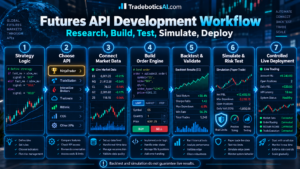
TradeboticsAI Futures API Development Workflow
Use this sequence before moving any application built on the best futures trading APIs into production:
- Define the strategy independently of the API. The API is infrastructure, not an edge.
- Select the instrument universe. ES/MES, NQ/MNQ, CL, GC and other contracts have different liquidity and data requirements.
- Choose the interface. REST, streaming, FIX or native SDK according to the workload.
- Build authentication and token renewal correctly.
- Implement market-data state management.
- Implement order submission and acknowledgment tracking.
- Reconcile orders, fills and positions.
- Add server-independent risk limits.
- Test disconnects and failure conditions.
- Backtest the trading logic separately.
- Paper trade or simulate.
- Run walk-forward and out-of-sample testing.
- Start live only with limited risk.
- Monitor slippage, fills, latency and operational errors.
Futures Trading API Pros and Cons
Pros
- Automates repeatable execution logic.
- Integrates custom analytics and data.
- Can reduce manual order-entry steps.
- Supports systematic risk controls.
- Allows custom dashboards and workflows.
- Enables continuous monitoring without manually operating every screen.
- Can integrate external research infrastructure.
Limitations
- Software bugs can create real financial losses.
- API access and permissions differ by provider.
- Exchange data can cost extra.
- Network failures affect live systems.
- Simulation differs from live execution.
- Latency depends on complete infrastructure.
- More automation creates more operational responsibility.
Best For
The best futures trading APIs are most useful for developers, quantitative traders, systematic traders, fintech applications and advanced users who need programmatic access to data, orders or account information.
Not For
An API is unnecessary complexity for traders who only place a few discretionary orders manually or who do not have the engineering resources to test, monitor and maintain production trading software.
Best Futures Trading APIs FAQ
What are the best futures trading APIs in 2026?
Our top seven are NinjaTrader, TradeStation, Interactive Brokers, Tradovate, Rithmic, CQG and Trading Technologies. The best choice depends on whether you prioritize retail accessibility, REST development, global markets, low latency or professional infrastructure.
What is the best futures API overall?
TradeboticsAI ranks NinjaTrader first overall for many independent futures developers because its current ecosystem includes REST trading functionality, WebSocket market data and C# NinjaScript development within a futures-focused environment.
Does NinjaTrader have a REST API?
Yes. NinjaTrader’s current developer documentation describes a REST Trade API for functions including authentication, orders, positions, accounting and risk.
Does NinjaTrader have WebSocket market data?
Yes. NinjaTrader documents a WebSocket Market Data API for real-time market information such as quotes and depth-related streams.
Does TradeStation support futures through its API?
Yes. TradeStation’s current API documentation explicitly lists futures alongside stocks and options.
Can Interactive Brokers API trade futures?
Yes. IBKR’s API documentation supports futures contracts and multiple programmatic interfaces including its Web API and TWS API.
Is Tradovate API suitable for futures?
Yes. Tradovate is futures-focused and its API documentation exposes order, position, contract and related trading functionality.
Is Rithmic better than REST APIs for low latency?
Rithmic provides specialized SDK and protocol interfaces designed for professional futures infrastructure. Whether it is materially better for a specific strategy depends on the entire deployment and execution path, not the API name alone.
Does CQG have a futures API?
Yes. CQG provides client and enterprise API products for market data and order execution, plus FIX connectivity for appropriate use cases.
Does Trading Technologies have an API?
Yes. TT currently provides REST API 2.0, .NET SDK, Core SDK and FIX interfaces for different development and latency requirements.
What is better for trading APIs: REST or WebSocket?
Neither is universally better. REST is convenient for request/response operations. WebSocket-style connections are more appropriate for persistent asynchronous streams such as live market data.
What is FIX?
FIX is a widely used financial messaging protocol commonly used for professional trading and order-routing integrations. Access and onboarding are usually more involved than a simple retail REST API.
Do I need Level 2 data for automated futures trading?
Not necessarily. Strategies using bars or top-of-book prices may not need full depth. DOM, order-book and liquidity strategies may require deeper data.
Can an API guarantee faster fills?
No. Fill quality depends on market conditions, order type, queue position, routing, broker infrastructure, network latency and available liquidity.
Can I make an automated futures bot with an API?
Yes, provided the selected API supports the required data and trading functions. The strategy should be backtested, validated out of sample, simulated and protected by independent risk controls before live deployment.
Are futures APIs free?
Access models vary. API access, brokerage accounts, software plans, exchange market data, professional classification, certification or connectivity can all affect total cost.
Which API is best for Python futures trading?
Interactive Brokers is a common choice for Python developers because its TWS API supports Python. Other providers can also be integrated through language-agnostic protocols or HTTP interfaces.
Which API is best for C# futures trading?
NinjaTrader is especially relevant because NinjaScript is C#-based. Rithmic and other professional providers also offer .NET-related development paths.
Final Verdict: Best Futures Trading APIs 2026
The best futures trading APIs should be selected according to architecture, not marketing claims.
NinjaTrader is our #1 overall choice for many independent futures developers because its current development stack combines futures specialization, REST trading, WebSocket market data and C# NinjaScript development.
TradeStation is particularly strong for REST-oriented developers who also want equities and options.
Interactive Brokers is the strongest fit when global and multi-asset breadth matters.
Tradovate remains attractive for web-native futures development.
Rithmic moves into a more specialized professional category where low-latency futures infrastructure matters.
CQG offers broad professional connectivity and data infrastructure.
Trading Technologies provides one of the deepest professional API stacks for institutional-grade integration, SDK development, FIX and risk infrastructure.
The correct decision therefore follows this sequence:
strategy requirements → markets → latency sensitivity → data depth → protocol → broker access → test environment → risk controls → production deployment.
An API does not create profitable trading logic. It only provides a programmable bridge between the logic and the market.
Evaluate NinjaTrader’s development and futures environment while keeping simulation, backtesting and live execution clearly separated.
Related TradeboticsAI Guides
- NinjaTrader API 2026
- Best Algorithmic Trading Platforms 2026
- Best No-Code Algorithmic Trading Platforms 2026
- NinjaTrader Strategy Builder 2026
- NinjaTrader Strategy Analyzer 2026
- Best Futures Trading Platforms 2026
- Futures Data Feeds 2026
- Futures Level 2 Data 2026
- NinjaTrader Market Replay 2026
- NinjaTrader vs Interactive Brokers 2026
- NinjaTrader vs TradeStation 2026
Risk, Automation, Simulation & Affiliate Disclosure
Risk Disclosure: Futures trading involves substantial risk of loss and is not suitable for every investor. Leverage can magnify losses rapidly. Automated execution, APIs, algorithmic trading systems and software integrations do not guarantee profitable results.
Technology Risk: API applications can fail because of software defects, connectivity loss, stale data, incorrect state management, authentication errors, duplicate orders, unexpected broker responses and infrastructure outages. Production trading systems require independent controls and continuous monitoring.
Simulation Disclosure: Simulated, replayed, paper-trading and backtested results are hypothetical. Live execution can differ because of slippage, queue position, liquidity, market impact, commissions, latency, rejected orders and partial fills.
Affiliate Disclosure: TradeboticsAI may receive compensation when eligible users complete qualifying actions through certain affiliate links. Affiliate relationships do not determine our rankings or editorial conclusions.
Educational Use: Nothing on this page constitutes individualized financial, investment, tax, legal or trading advice.