TradeboticsAI Independent Research • Updated September 2026
Best Algorithmic Trading Platforms 2026: 10 Compared for Retail Traders
The best algorithmic trading platforms are not interchangeable. Some are complete quantitative research environments, some are broker APIs, some specialize in futures or forex, while others provide visual strategy development or webhook execution. TradeboticsAI compared 10 major platforms by backtesting depth, coding requirements, market coverage, broker connectivity, paper trading, live deployment, monitoring, costs and risk controls.
Quick Answer:
Among the best algorithmic trading platforms, QuantConnect is our overall research pick for developers who want an integrated multi-asset environment for strategy research, backtesting and supported live deployment.
NinjaTrader is especially relevant for futures algorithms.
Interactive Brokers provides broad programmable brokerage infrastructure.
TrendSpider offers a more visual machine-learning and systematic-strategy workflow.
TradeStation provides EasyLanguage automation.
Quantower offers C# algorithm development.
TradersPost specializes in signal-to-broker execution.
Choose the Platform That Matches Your Architecture
The correct platform depends on whether you need futures automation, machine-learning strategy development, broker routing or a code-first quantitative research environment.
Affiliate Disclosure:
TradeboticsAI may receive compensation when readers use selected links on this page. This does not increase your purchase price. Affiliate relationships do not automatically determine inclusion, placement or editorial conclusions.
Trading Risk Disclosure:
Algorithmic trading does not remove financial risk. Backtests, simulations and paper trading can differ materially from live results because of slippage, latency, changing liquidity, rejected orders, software failures and regime changes. Leveraged products such as futures can produce rapid losses.
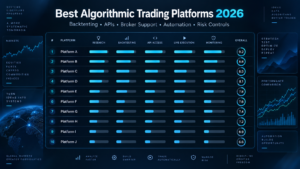
Best Algorithmic Trading Platforms 2026: Quick Comparison
A meaningful comparison of the best algorithmic trading platforms must separate research environments, trading terminals, brokerage APIs and execution bridges. A platform may be excellent at historical research but require another provider to execute orders. A brokerage API may execute directly but require the trader to build the strategy, data and monitoring infrastructure independently.
| # | Platform | Best For | Development | Markets | Live Path |
|---|---|---|---|---|---|
| 1 | QuantConnect | Quant research | Python / C# | Multi-asset | Multiple broker integrations |
| 2 | NinjaTrader | Futures algorithms | NinjaScript / builders | Futures-focused | Platform strategy execution |
| 3 | Interactive Brokers | Broad broker API | Web API / TWS API / FIX | Global multi-asset | Direct brokerage API |
| 4 | TrendSpider | Visual systematic research | No-code / low-code | Multi-asset research | Strategy bots / integrations |
| 5 | TradeStation | EasyLanguage strategies | EasyLanguage / API | Stocks, options, futures | Brokerage environment |
| 6 | Quantower | C# algo development | C# / Visual Studio | Connection-dependent | Connected provider |
| 7 | TradersPost | Signal routing | Webhooks | Multi-asset | Connected brokers |
| 8 | MetaTrader 5 | Expert Advisors | MQL5 | Broker-dependent | Broker terminal |
| 9 | TradingView | Strategy signals | Pine Script | Multi-asset | Webhooks / integrations |
| 10 | Alpaca | API-first development | REST / SDKs | Supported brokerage products | Direct Trading API |
This comparison evaluates platform architecture, research capabilities, validation, execution and operational control. It does not rank expected investment returns.
What Type of Algorithmic Trading Platform Do You Need?
The best algorithmic trading platforms solve different parts of the trading stack. Understanding the architecture before choosing software prevents paying for tools that do not solve your actual bottleneck.
Quant Research
Research-to-Live Platforms
QuantConnect combines strategy code, historical data, backtesting and supported brokerage deployment through its LEAN engine.
Native Automation
Trading Platform Strategies
NinjaTrader, TradeStation, Quantower and MetaTrader run automated strategy logic inside or closely alongside the trading platform.
Broker API
Execution Infrastructure
Interactive Brokers and Alpaca expose brokerage operations programmatically while users develop their own strategy and monitoring stack.
Visual Automation
Lower-Code Strategy Development
TrendSpider provides systematic research and automation without requiring traders to maintain a complete application codebase.
Signal Bridge
Webhook Execution
TradersPost receives strategy signals from external applications and forwards compatible instructions to connected brokerage accounts.
Signal Layer
Chart Strategies
TradingView strategies and alerts can act as the decision layer while another service handles brokerage execution.
How TradeboticsAI Evaluated the Best Algorithmic Trading Platforms
Our best algorithmic trading platforms research evaluates documented functionality and technical architecture. We do not claim live-account testing when it was not performed.
Strategy Development
We examine supported programming languages, visual builders, APIs and how much control the trader has over strategy logic.
Backtesting
Historical testing, optimization, forward testing and transaction assumptions matter before live deployment.
Paper Trading
Simulation provides an intermediate operational test between historical research and real-money execution.
Broker Connectivity
We distinguish direct brokerage APIs, platform-native execution and external signal-routing architectures.
Operational Control
Logging, error handling, monitoring and position reconciliation become critical after an algorithm moves live.
Risk Controls
A serious platform must support a workflow where position sizing, loss thresholds and shutdown procedures can be enforced.
Best Algorithmic Trading Platforms: Detailed Reviews
Overall Research Pick
1. QuantConnect — Best Overall for Quantitative Strategy Development
QuantConnect takes our overall research position among the best algorithmic trading platforms because the LEAN engine covers research, historical backtesting and supported live trading inside one extensible architecture.
LEAN is open source and supports strategies written in Python and C#. The platform integrates with multiple brokerages and data providers, allowing quantitative developers to move from research toward live deployment without rebuilding the entire execution engine.
Pros
- Python and C# support.
- Open-source LEAN engine.
- Historical backtesting.
- Multi-asset architecture.
- Multiple supported brokerages.
- Cloud and local workflows.
Cons
- Requires genuine programming knowledge.
- More complex than visual bot builders.
- Production infrastructure still requires monitoring.
Best for: quantitative developers who want control over research, strategy logic, testing and deployment.
2. NinjaTrader — Best Algorithmic Trading Platform for Futures
NinjaTrader is one of the best algorithmic trading platforms for futures traders because automated strategies can be developed inside its NinjaScript ecosystem and evaluated before live use.
The platform supports strategy-building and analysis workflows designed specifically for systematic futures traders. Its futures specialization makes it particularly relevant when the user does not need a broad multi-asset quantitative research cloud.
Best for: futures traders who want a deep platform-native automation environment.
3. Interactive Brokers — Best Broad Multi-Asset Broker API
Interactive Brokers is particularly relevant to developers comparing the best algorithmic trading platforms because IBKR provides several programmable interfaces rather than forcing every system through one application.
Its developer documentation covers Web API, Trader Workstation API and FIX connectivity. These interfaces provide programmatic access to brokerage functionality, account information, market data and order workflows.
The trade-off is that IBKR is primarily execution infrastructure. Strategy research and backtesting may be handled by a separate framework such as QuantConnect or a custom application.
Best for: advanced developers seeking programmable access to a broad brokerage environment.
4. TrendSpider — Best Visual Machine-Learning Automation Platform
TrendSpider is a strong candidate among the best algorithmic trading platforms for traders who want systematic research without maintaining a full software-development stack.
Its workflow combines technical research, strategy testing, machine-learning tools, alerts and automated bots. This makes it substantially more accessible than raw broker APIs while still supporting systematic strategy development.
Best for: traders who want machine-learning-assisted research and automation with less coding.
5. TradeStation — Best EasyLanguage Automation Environment
TradeStation has a long-established algorithmic ecosystem built around EasyLanguage. Traders can create rule-based strategies without working directly with a lower-level brokerage API.
TradeStation is therefore relevant among the best algorithmic trading platforms for users who want strategy development, historical evaluation and brokerage execution within a closely integrated ecosystem.
Best for: systematic traders who prefer a trading-specific language to a general-purpose development framework.
6. Quantower — Best C# Multi-Connection Trading Platform
Quantower Algo provides a C# API that allows developers to create indicators, automated strategies and other extensions while using familiar development tools such as Visual Studio.
This makes Quantower particularly interesting among the best algorithmic trading platforms for C# developers who prefer a trading terminal capable of working with multiple supported connections rather than a single proprietary broker.
Best for: C# developers who value terminal flexibility and direct strategy customization.
7. TradersPost — Best Signal-to-Broker Automation Bridge
TradersPost solves a different problem from most best algorithmic trading platforms. It does not need to be the strategy-research environment. Instead, it can receive compatible strategy instructions from an external system and route automation toward supported broker connections.
This modular architecture is useful when strategy generation and brokerage execution should remain separate.
Best for: traders who already have a signal engine and need an execution bridge.
8. MetaTrader 5 — Best Expert Advisor Strategy Tester Ecosystem
MetaTrader 5 remains a major algorithmic trading environment through Expert Advisors and MQL5.
Its Strategy Tester can test and optimize Expert Advisors using historical data and supports multi-instrument testing, multiple processing agents and forward-testing workflows.
Exact products, spreads, execution and trading conditions depend on the broker connected to MetaTrader 5.
Best for: traders working in broker environments centered on Expert Advisors, forex and related products.
9. TradingView — Best Pine Script Strategy and Signal Layer
TradingView is not a complete standalone broker-neutral execution engine, but it plays an important role in the best algorithmic trading platforms ecosystem.
Pine Script strategies can create alerts, while webhook functionality allows alert events to be sent to compatible external systems. This enables traders to separate chart logic from brokerage execution.
Best for: traders who want chart-based strategy logic and external automation.
10. Alpaca — Best API-First Platform for Developers
Alpaca provides API-first brokerage infrastructure for developers who want to construct their own automated trading applications.
Its TradingClient supports both paper and live modes. Paper credentials can therefore be used during development before a strategy is connected to live brokerage activity.
Alpaca belongs among the best algorithmic trading platforms for developers even though the trader must provide most of the actual strategy intelligence.
Best for: developers building custom automated trading systems.
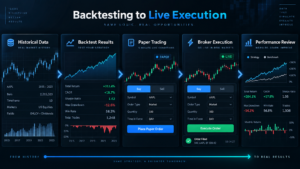
Best Algorithmic Trading Platforms: Backtesting vs Live Execution
One of the most important differences between the best algorithmic trading platforms is how realistically they bridge historical testing and real-world execution.
A backtest works on historical data and modeled fills. Live markets add spread, slippage, queue position, latency, rejected orders, partial fills, changing liquidity and infrastructure failures.
| Stage | Purpose | Main Risk |
|---|---|---|
| Historical data | Develop the hypothesis | Bad or biased data |
| Backtest | Measure historical behavior | Overfitting |
| Out-of-sample | Test unseen history | Regime mismatch |
| Paper trading | Validate operational behavior | Unrealistic simulated fills |
| Live execution | Trade real liquidity | Slippage and infrastructure failures |
| Monitoring | Compare expected and actual behavior | Undetected drift or position mismatch |

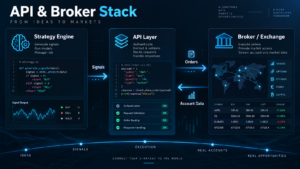
API and Broker Architecture for Algorithmic Trading
The best algorithmic trading platforms make the boundary between strategy logic and brokerage execution clear.
- Market data:
prices and other information enter the system. - Strategy engine:
rules or models generate a desired action. - Risk layer:
position sizing and account limits approve or reject the action. - API layer:
the order is authenticated, formatted and routed. - Broker or exchange:
the order interacts with the real market. - Position reconciliation:
the system compares intended and actual positions. - Monitoring:
logs, errors, latency and strategy health are supervised.
This modular separation makes failures easier to diagnose and reduces the risk of strategy logic being confused with execution infrastructure.
Best Algorithmic Trading Platforms: Real Costs
The subscription price rarely represents the full cost of the best algorithmic trading platforms.
| Cost | Where It Appears | Why It Matters |
|---|---|---|
| Platform subscription | Commercial software | Recurring fixed cost |
| Market data | Exchange / data provider | Professional and real-time feeds may cost extra |
| Broker commissions | Execution | High turnover increases transaction cost |
| Spread and slippage | Live orders | Can reduce historical edge |
| Compute | Backtesting and optimization | Large research workloads need more resources |
| VPS / server | 24/7 systems | Can improve reliability of always-on automation |
| Execution bridge | Webhook architectures | May require a separate subscription |
Risk Management for Algorithmic Trading
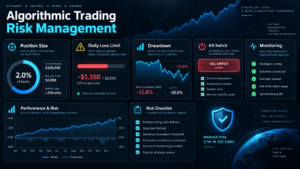
Even the best algorithmic trading platforms can execute a flawed strategy efficiently. Automation increases consistency, but it can also increase the speed of losses when assumptions fail.
Position Sizing
Limit exposure per trade, asset and strategy instead of allowing an algorithm unrestricted use of buying power.
Daily Loss Limits
Define account-level thresholds that stop new trading after abnormal losses.
Drawdown Controls
Measure deterioration and determine when a strategy must be paused for investigation.
Kill Switch
Maintain a procedure for stopping new entries and managing outstanding orders immediately.
Position Reconciliation
Compare what the algorithm believes it owns with actual broker orders and positions.
System Monitoring
Monitor data freshness, connectivity, API failures, execution latency and abnormal strategy behavior.
Related:
Futures Risk Management 2026
.
Safer Algorithmic Deployment Workflow
- Define the strategy hypothesis and exact rules.
- Validate historical data quality.
- Backtest using realistic trading costs.
- Separate development and validation data where appropriate.
- Use out-of-sample or walk-forward testing.
- Paper trade before exposing real capital.
- Test rejected orders and connectivity failures.
- Define position and account-level risk limits.
- Start live with reduced exposure.
- Reconcile algorithm positions against broker positions.
- Maintain detailed logs.
- Maintain a documented kill switch.
The best algorithmic trading platforms should make disciplined testing and risk control easier rather than encourage traders to skip validation.
Best Algorithmic Trading Platforms FAQ
What are the best algorithmic trading platforms in 2026?
Our best algorithmic trading platforms comparison covers QuantConnect, NinjaTrader, Interactive Brokers, TrendSpider, TradeStation, Quantower, TradersPost, MetaTrader 5, TradingView and Alpaca. The correct choice depends on whether the user needs quantitative research, futures automation, brokerage APIs, visual strategy development or webhook execution.
What is the best algorithmic trading platform for Python?
QuantConnect is particularly relevant because LEAN supports Python and C# for strategy research, backtesting and supported live brokerage deployment. Alpaca is also useful when the primary requirement is an API-first brokerage environment.
What is the best algorithmic trading platform for futures?
NinjaTrader is particularly relevant to retail futures automation because it provides a futures-focused ecosystem for strategy development and automated execution.
What is the best no-code algorithmic trading platform?
TrendSpider is one of the more accessible options among the best algorithmic trading platforms for traders who want systematic research, testing and automation without maintaining a full software project.
Is Interactive Brokers an algorithmic trading platform?
Interactive Brokers provides extensive programmable brokerage APIs. It is often used as the execution layer of an algorithmic system rather than as the entire research and backtesting environment.
Is TradingView an algorithmic trading platform?
TradingView can run Pine Script strategies and generate alerts. Webhooks can send those alerts to external systems, but complete automated brokerage execution generally requires another compatible execution layer.
Can I algorithmically trade without coding?
Yes. Visual strategy builders and webhook automation can reduce coding requirements, although deeper customization generally requires programming.
Is backtesting enough before live algorithmic trading?
No. Backtesting cannot perfectly reproduce live spread, slippage, latency, partial fills, order rejection or connectivity failures.
Can algorithmic trading guarantee profits?
No. The best algorithmic trading platforms provide strategy-development and execution infrastructure. They cannot guarantee that the underlying trading strategy will remain profitable.
What programming languages are used for algorithmic trading?
Python and C# are widely used. Other common environments include MQL5 for MetaTrader, Pine Script for TradingView, EasyLanguage for TradeStation and NinjaScript for NinjaTrader.
Final Verdict: Best Algorithmic Trading Platforms for 2026
The best algorithmic trading platforms should be selected according to architecture, not marketing claims.
QuantConnect is our overall research choice for developers who want an integrated quantitative workflow spanning research, backtesting and supported brokerage deployment.
NinjaTrader is particularly relevant to futures traders. Interactive Brokers offers broad API-based brokerage infrastructure. TrendSpider provides a more accessible visual path to systematic and machine-learning-assisted automation.
TradeStation remains a mature strategy environment. Quantower is particularly relevant to C# developers. TradersPost solves the signal-routing problem. MetaTrader 5 provides an established Expert Advisor ecosystem, while TradingView and Alpaca are strong components for signal-layer and API-first architectures.
When comparing the best algorithmic trading platforms, prioritize testability, execution transparency, broker compatibility, monitoring and the ability to stop the system immediately when live behavior diverges from expectations.
Explore Four Different Automation Paths
Continue with:
Best AI Trading Bots 2026
,
Best Crypto Trading Bots 2026
and
Best AI Stock Trading Bots 2026
.
Primary Sources & Verification
TradeboticsAI verifies major claims about the best algorithmic trading platforms using primary product and developer documentation whenever possible.