Futures Risk Management 2026: Position Sizing, Stops & Drawdown
Futures Risk Management 2026 is the foundation of any serious futures trading process. Futures are leveraged instruments, so a relatively small amount of margin can control a much larger notional position. That efficiency can magnify gains, but it can magnify losses just as quickly. A durable risk plan therefore defines position size, stop placement, maximum loss per trade, daily loss limits, drawdown rules and emergency procedures before an order is sent. This guide explains how to build those controls around actual contract specifications and account risk rather than emotion or maximum available buying power.
Quick Answer: Futures Risk Management 2026
A practical Futures Risk Management 2026 framework starts with five controls: know the contract’s tick value, define the invalidation level before entry, convert that stop distance into dollars, size the position from a predetermined risk budget, and stop trading when a daily or account-level loss threshold is reached. Margin tells you whether a broker may allow a position; it does not tell you whether that position is appropriate for your account.
Practice Risk-Controlled Futures Trading with NinjaTrader
Affiliate Disclosure: TradeboticsAI may earn compensation when a qualifying action is completed through an affiliate link, at no extra cost to you. This does not affect our editorial analysis.
Why Futures Risk Management 2026 Matters
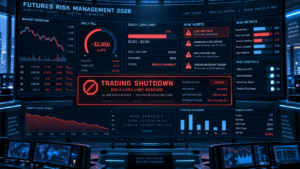
Futures Risk Management 2026 matters because leverage changes how quickly a normal market move can affect account equity. Futures traders post margin rather than paying the full notional value of the contract. If price moves against the position, losses are still calculated from the contract’s full tick or point value, not from the percentage of margin posted.
The CFTC advises speculative traders to use only risk capital—money they can afford to lose without affecting basic living expenses, emergency savings or long-term financial needs. CME Group’s education material similarly emphasizes that traders should decide which contract to trade, how much capital to risk and where the trade will be exited before taking the position.
That makes risk management more than a stop-loss order. It is a complete decision system covering market selection, quantity, leverage, maximum loss, correlation, event exposure and what happens when normal assumptions fail.
For official education, review CME Group’s Trade and Risk Management course and the CFTC’s customer advisory on leveraged commodity trading.
The Core Futures Risk Management 2026 Framework
A useful Futures Risk Management 2026 framework answers six questions before the trade is opened. What market are you trading? What exact condition invalidates the setup? How many dollars are at risk per contract? How many contracts fit the account risk limit? What is the maximum acceptable loss for the day? What happens if the platform, data feed or connection fails?
| Control | Question | Purpose |
|---|---|---|
| Contract selection | Is the tick value and volatility suitable? | Avoid oversized exposure |
| Stop level | Where is the trade thesis invalid? | Define risk before entry |
| Position size | How many contracts fit the dollar limit? | Control loss magnitude |
| Daily stop | When does trading stop for the session? | Prevent loss escalation |
| Drawdown rule | When should size be reduced? | Protect remaining equity |
| Emergency control | How will positions be flattened if systems fail? | Contain operational risk |
The objective is not to eliminate losing trades. That is impossible. The objective is to make the size of a routine loss predictable enough that one trade, one session or one technical problem does not dominate the account.
Futures Risk Management 2026 Position Sizing Formula
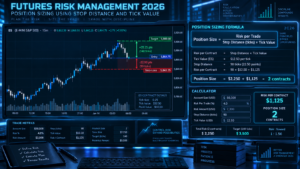
Position sizing is the most practical part of Futures Risk Management 2026. CME’s educational framework starts with the stop location and the amount of account capital the trader is willing to risk. Once the stop distance is known, the trader can convert that distance into dollars using the contract’s tick value.
Dollar Risk Per Contract = Stop Distance in Ticks × Tick Value
Position Size = Maximum Dollar Risk ÷ Dollar Risk Per Contract
Assume a Micro E-mini S&P 500 setup has a stop 20 ticks away. MES has a $1.25 minimum tick value, so the price risk is $25 per contract before commissions and slippage. If the trader’s predefined risk budget is $75, the theoretical maximum is three contracts. If the risk budget is only $40, one contract fits while two contracts do not.
Always round down to a whole contract and leave room for slippage and transaction costs. If one contract already exceeds the risk budget, the correct position size is zero. Moving the stop to an arbitrary closer level merely to force the trade into the account can damage the original strategy logic.
For smaller contracts, see our Micro Futures Trading 2026 guide.
Stop-Loss Placement in Futures Risk Management 2026
A stop should be connected to the reason the trade is wrong. In Futures Risk Management 2026, that means setting the invalidation level first and calculating the position size second—not choosing a fixed number of contracts and then squeezing the stop into the remaining risk budget.
CME Group notes that stop placement should be logical rather than random and should avoid levels likely to be triggered by ordinary market noise. A breakout strategy might use a failed return into the prior range as invalidation. A trend setup might use a structural swing, channel break or volatility measure.
Stops also have execution risk. A stop order does not guarantee the exact stop price. During gaps, fast markets or sudden liquidity changes, the actual fill can be worse than the trigger level. This is why the planned dollar loss should include a reasonable slippage buffer rather than assuming perfect execution.
Traders should also understand the difference between stop-market and stop-limit orders. A stop-market prioritizes execution after activation, while a stop-limit imposes a limit price and therefore can remain unfilled if the market moves through it too quickly.
Our Futures Order Types 2026 guide explains market, limit, stop and OCO mechanics in more detail.
Daily Loss Limits
A daily stop is a second layer of Futures Risk Management 2026. A disciplined Futures Risk Management 2026 plan treats the daily cap as a hard operating boundary, not a suggestion. Per-trade risk controls one position. A daily limit controls the accumulation of several losing positions, slippage, overtrading and poor decision-making during the same session.
The limit can be expressed as a fixed dollar amount, a percentage of account equity or a multiple of normal trade risk. There is no universal number appropriate for every strategy. A high-frequency system and a low-frequency swing strategy can have very different normal loss distributions.
The key rule is behavioral: once the threshold is reached, new trading stops. The limit loses its purpose if the trader responds to losses by increasing size or manually resetting the threshold. Automated systems can enforce this more reliably by rejecting new entries after the daily cap is hit.
A separate trade-count limit can also be useful. If a strategy normally produces only two or three high-quality setups in a session, taking ten additional trades after early losses may indicate that the process has changed from strategy execution to loss chasing.
Futures Risk Management 2026 Drawdown Control
Drawdown measures the decline from a previous account-equity peak. Futures Risk Management 2026 should define what happens as drawdown increases rather than waiting until the account is already severely impaired.
One approach is tiered risk reduction. Normal size is used while the strategy remains inside its expected drawdown range. At a predefined threshold, per-trade risk is reduced. At a deeper threshold, live trading is paused while the strategy and execution records are reviewed.
This matters because recovery mathematics become harder as losses grow. A 10% decline requires approximately an 11.1% gain on the reduced capital to recover. A 20% decline requires 25%. A 50% decline requires 100%. Preventing deep drawdowns is therefore materially different from simply trying to win the money back later.
Drawdown rules should be based on the strategy’s historical and simulated behavior, with conservative allowances for worse-than-backtest conditions. A system that has never experienced a losing streak in testing is more likely under-tested than risk-free.
Margin vs Risk in Futures Risk Management 2026
Confusing margin with risk is one of the most dangerous mistakes in Futures Risk Management 2026. In practice, Futures Risk Management 2026 separates broker collateral requirements from the trader’s own maximum-loss rules. The exchange and broker use margin requirements to help control credit and market risk. Traders use stop distance and position size to control their own planned account risk. These are related but different functions.
CME explains that initial and maintenance margin requirements apply to futures positions and that brokers can require additional capital, particularly for positions held beyond the intraday session. Brokers may also liquidate positions when an account is no longer margin compliant.
A broker may advertise low intraday margin on a contract, but the tick value does not shrink with the margin requirement. If the market moves 40 ticks against the position, the loss is still 40 times the tick value per contract.
Use excess margin as a safety buffer rather than trading at the maximum theoretical contract count. Volatility can increase quickly, margin policies can change and forced liquidation can occur at unfavorable prices.
Volatility-Adjusted Futures Risk Management 2026
Fixed stops can create inconsistent risk when volatility changes. A Futures Risk Management 2026 process should consider whether the market’s normal movement has expanded or contracted before using the same stop distance and contract quantity.
Average True Range, recent session range or another volatility measure can help define a stop that scales with current conditions. If volatility doubles and the valid stop must become twice as wide, position size should generally decrease if the trader wants to keep dollar risk approximately constant.
This produces a useful principle: wider stop, smaller size; narrower valid stop, potentially larger size within the same risk budget. The stop remains tied to market structure while quantity absorbs the volatility adjustment.
Do not use volatility mechanically. Major economic releases can create discontinuous price movement that historical ATR does not fully anticipate. Event risk needs its own rules.
Correlation and Portfolio Risk
Managing one trade at a time is not enough when several positions move together. Futures Risk Management 2026 should calculate portfolio exposure across correlated contracts.
For example, simultaneous long positions in ES, NQ and RTY are three separate contracts but can represent a concentrated bullish U.S. equity-index view. Similarly, several energy or Treasury positions can respond to the same macroeconomic driver.
If each trade independently risks the full normal amount, the combined portfolio risk can become much larger than intended when a single event moves all positions in the same direction. Traders can address this by setting a total open-risk cap, grouping correlated markets or reducing position size when several related trades are active.
Correlation itself changes over time, so the goal is not to assign one permanent coefficient to every pair of markets. The objective is simply to recognize when multiple positions are expressions of the same underlying risk.
Event, Gap and Overnight Risk
Economic releases, central-bank decisions, geopolitical events and unexpected news can overwhelm normal intraday assumptions. A robust Futures Risk Management 2026 plan therefore defines whether positions may be held through scheduled events and how overnight exposure is handled.
Futures trade for extended hours, but liquidity is not identical at every time of day. Thin conditions can produce wider spreads and greater slippage. Overnight positions may also require more margin than trades opened and closed within a broker’s intraday window.
Before major events, traders can reduce size, close positions, avoid new entries or deliberately accept event risk under a predefined plan. What matters is that the decision happens before volatility arrives.
Never assume a protective stop guarantees a fixed maximum loss across a gap. The market can move from one tradable price to another without filling every intermediate level.
Automation, Risk Guards and Kill Switches
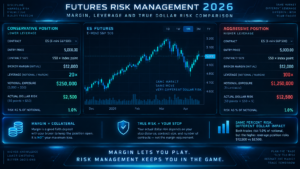
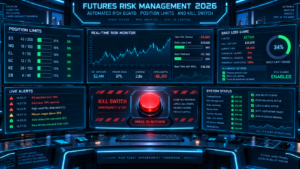
Automation can strengthen Futures Risk Management 2026 when risk checks operate independently from the strategy signal. Before an automated order reaches the market, a risk layer can validate account, instrument, quantity, current position, open orders, maximum daily loss and total portfolio exposure.
Useful controls include maximum contracts per instrument, maximum gross exposure, maximum daily realized plus unrealized loss, duplicate-order protection, stale-market-data detection and a kill switch that blocks new entries or attempts to flatten positions when predefined conditions are breached.
The system also needs reconciliation. A strategy may believe it owns one contract while the brokerage account actually owns zero or two because of rejected, duplicated or partial orders. Account state should therefore be treated as authoritative and checked continuously where the platform supports it.
For platform-specific development, see our NinjaTrader API 2026 and NinjaTrader Strategy Builder guides.
Simulation and Stress Testing
Simulation is where Futures Risk Management 2026 rules should be tested before live capital is exposed. A simulator can verify whether position-size calculations, bracket orders, daily stops and automated risk controls behave as expected during normal sessions.
Stress testing should deliberately include abnormal scenarios. Test a rejected stop, disconnected data feed, duplicate signal, partial fill, contract rollover, sudden volatility increase and strategy restart while a position already exists. The objective is to discover failure modes while the financial consequence is still virtual.
Historical backtesting should also include realistic commissions and slippage. A strategy with a small gross edge may become unprofitable after costs, and that changes how much risk is rational to allocate to it.
For practice workflows, use our NinjaTrader Demo Account 2026 guide and Futures Trading Strategies 2026.
Futures Risk Management 2026 Pre-Trade Checklist
A short checklist makes Futures Risk Management 2026 operational rather than theoretical. Before every trade, confirm the following:
- The correct futures contract and active expiration month are selected.
- The contract’s tick size and tick value are known.
- The setup has a precise invalidation level.
- Stop distance has been converted into dollar risk per contract.
- Quantity fits the predefined maximum trade risk.
- Total open portfolio risk remains below the account cap.
- Scheduled economic or market-moving events have been checked.
- The selected account is correct—simulation or live.
- Protective orders are configured correctly.
- The daily loss limit has not already been reached.
If any item cannot be answered clearly, the trade is not fully defined. Skipping one opportunity is usually less damaging than entering a leveraged position whose downside has not been calculated.
Common Futures Risk Management Mistakes
The first Futures Risk Management 2026 mistake is using broker buying power as the position-sizing formula. Effective Futures Risk Management 2026 starts from acceptable loss, not available leverage. Maximum permissible size is not recommended size. A broker’s risk system is designed to protect the account and intermediary from margin violations, not to optimize the trader’s long-term survival.
The second mistake is moving a stop farther away after entry because the trader does not want to realize a loss. If the original invalidation level no longer matters, the trade has changed into an unplanned position with unknown risk.
The third mistake is increasing size after losses to recover quickly. This creates a feedback loop in which account equity decreases while exposure increases. A drawdown plan should normally do the opposite: reduce risk until performance stabilizes.
The fourth mistake is ignoring correlated exposure. Three separate trades can behave like one oversized trade when they share the same market driver.
Finally, traders often test entry rules extensively while barely testing failure handling. Connection loss, partial fills and rejected orders deserve the same attention as indicators and signals.
Futures Risk Management 2026: Benefits and Limitations
| Benefits | Limitations |
|---|---|
|
|
Futures Risk Management 2026 FAQ
What is futures risk management?
Futures Risk Management 2026 is the process of controlling how much account equity is exposed through contract selection, position sizing, stops, daily limits, drawdown rules, margin buffers and operational safeguards.
How do I calculate futures position size?
Determine the logical stop distance, convert it to dollars using the contract’s tick value, then divide your maximum dollar risk by the dollar risk per contract. Round down to a whole contract and allow for slippage and fees.
How much should I risk on one futures trade?
There is no universal percentage suitable for every trader. The amount should be small enough that a normal losing streak does not threaten the account or cause you to abandon the strategy. CME educational material uses modest account-percentage examples, but the correct limit depends on strategy, volatility, account size and financial circumstances.
Is futures margin the same as maximum risk?
No. Margin is collateral required to support the position. The actual trading loss depends on price movement, contract size and quantity and can exceed the margin initially posted.
Do stop losses guarantee my maximum loss?
No. Stops can help control risk, but fast markets, gaps and low liquidity can cause fills at worse prices than the trigger. Stop-limit orders can also remain unfilled.
What is a daily loss limit?
A daily loss limit is a predefined threshold after which new trading stops for the session. It is designed to prevent multiple normal losses, slippage or emotional overtrading from becoming a much larger drawdown.
Should I reduce position size during a drawdown?
Many risk frameworks reduce size when drawdown crosses predefined thresholds. The exact rule should be designed from the strategy’s expected loss distribution rather than improvised after losses occur.
How does volatility affect futures position sizing?
If higher volatility requires a wider valid stop, fewer contracts may be needed to keep dollar risk constant. Volatility-adjusted sizing helps prevent the same contract quantity from creating very different risk across market regimes.
Can automated trading improve risk management?
Automation can enforce limits consistently, but it also creates operational risks. Independent checks for position size, daily loss, account state, duplicate orders and emergency shutdown are essential.
Should beginners practice risk management in simulation?
Yes. Simulation allows traders to practice order entry, stop placement, position sizing and failure procedures without risking real capital. Simulated fills still differ from live execution, so results should not be treated as guaranteed live performance.
What is the most important Futures Risk Management 2026 rule?
The most important rule is to know the dollar amount that can be lost before entering the position. If stop distance, tick value and quantity have not been converted into account risk, the trade is not fully planned.
Final Verdict: Futures Risk Management 2026
Futures Risk Management 2026 should be treated as the operating system behind every futures strategy. The entry determines when you participate; risk management determines whether a normal sequence of losses remains survivable.
Start with the contract’s tick value and a logical invalidation point. Convert the stop distance into dollars, choose quantity from a predefined account-risk limit and maintain enough excess capital that a margin change or volatile move does not immediately threaten the account. Then add daily loss, drawdown, correlation and event-risk controls.
For systematic traders, these rules should eventually become independent risk checks rather than optional strategy settings. For discretionary traders, a written checklist can serve the same purpose. The objective is consistent exposure control—not eliminating losses, predicting every market move or maximizing leverage.