Futures Trading Strategies 2026: 7 Practical Setups & Risk Rules
Futures Trading Strategies 2026 should be built around market behavior, risk limits and repeatable rules rather than promises of guaranteed returns. A useful futures strategy defines the market, setup, entry, invalidation point, position size and exit before the trade begins. This guide compares seven widely used approaches—trend following, breakout trading, mean reversion, VWAP pullbacks, momentum, scalping and spread trading—then shows how to test them in simulation and backtesting before risking real capital.
Quick Answer: Futures Trading Strategies 2026
The most useful Futures Trading Strategies 2026 are not universal “winning systems.” They are rule-based approaches matched to a market regime and a clearly defined risk budget. Trend and breakout methods usually seek directional expansion, mean-reversion methods look for moves back toward a reference value, VWAP setups combine location with intraday structure, momentum strategies focus on persistent price strength, scalping targets small short-term moves, and spreads trade relative value between related contracts.
Practice Futures Strategies with NinjaTrader
Affiliate Disclosure: TradeboticsAI may earn compensation when a qualifying action is completed through an affiliate link, at no extra cost to you. This does not affect our editorial analysis.
How to Evaluate Futures Trading Strategies 2026
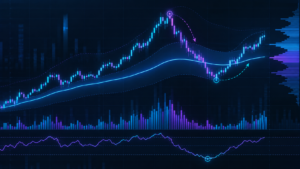
Futures Trading Strategies 2026 should be evaluated as complete processes, not as entry signals. A moving-average crossover, VWAP touch or breakout level is only one component. The full strategy also needs a market selection rule, session window, position-sizing model, stop logic, profit-taking method and conditions that tell you when not to trade.
The first question is market regime. Trend-following systems generally need sustained directional movement. Mean-reversion systems generally need a market that repeatedly returns toward a reference area. Breakout strategies need enough expansion to move beyond the opening or consolidation range. A setup can therefore work well in one environment and fail repeatedly in another without the underlying logic necessarily being broken.
The second question is execution cost. Commissions, exchange fees, bid-ask spread and slippage can turn a small theoretical edge into a negative result. This matters most for high-frequency or scalping approaches because the expected profit per trade can be small relative to transaction costs.
The third question is risk. The CFTC warns that speculative futures trading is risky and that leverage can amplify losses. Use only risk capital and define the maximum acceptable loss before entering a position. For official risk guidance, review the CFTC customer advisory on leveraged commodity trading.
Futures Trading Strategies 2026: 7 Setups Compared
| Strategy | Best-Suited Regime | Typical Holding Time | Complexity | Automation Fit |
|---|---|---|---|---|
| Trend Following | Directional trend | Minutes to weeks | Medium | High |
| Breakout | Expansion after compression | Minutes to hours | Medium | High |
| Mean Reversion | Range / balanced market | Minutes to hours | Medium | High |
| VWAP Pullback | Intraday trend or rotation | Minutes to hours | Medium | Medium-High |
| Momentum | Strong participation | Minutes to days | Medium | High |
| Scalping | Highly liquid short-term market | Seconds to minutes | High | Medium-High |
| Spread Trading | Relative-value opportunity | Hours to weeks | High | High |
The strongest Futures Trading Strategies 2026 process is usually the one you can define, test and execute consistently. Complexity should be added only when it improves a measurable part of the system. A disciplined Futures Trading Strategies 2026 framework also records when the setup should stay inactive.
1. Trend Following Strategy

Trend following is one of the most established families within Futures Trading Strategies 2026. The objective is not to predict a turning point. The trader waits for evidence that price is already moving directionally and then uses a rule to participate while the trend remains intact.
Common trend filters include moving averages, channel breakouts, higher highs and higher lows, lower highs and lower lows, momentum measures or combinations of price and volatility. A basic example could require price to trade above a longer-term moving average before long entries are allowed. The stop then sits at a predefined structural or volatility-based level.
The main weakness is whipsaw. When price oscillates without a sustained trend, trend systems can generate multiple small losses before a larger move develops. Position sizing and loss limits therefore matter more than trying to eliminate every false signal.
CME research on managed futures describes trend following as a major systematic strategy family and notes that momentum and breakout approaches are commonly used to capture directional moves. Historical research does not guarantee future results, but it shows why trend following remains an important framework rather than a short-lived indicator trick.
2. Breakout Futures Strategy
A breakout strategy in Futures Trading Strategies 2026 enters when price moves beyond a defined range or reference level. Traders may use the opening range, previous session high or low, consolidation boundaries, Donchian-style channels or volatility compression zones.
An opening-range breakout is easy to describe. Define a fixed period after the session opens, mark the high and low, and wait for price to move outside the range under predetermined conditions. The strategy becomes more robust only when you specify filters such as minimum volume, trend alignment, maximum chase distance and the exact failure level.
The biggest risk is the false breakout. Price can move outside a range, trigger entries and immediately reverse. Stops must therefore be planned before the breakout occurs. Chasing a move after it has already traveled far beyond the original level can also destroy the intended risk-to-reward profile.
3. Mean Reversion Futures Strategy
Mean reversion is the opposite philosophy from trend following. Within Futures Trading Strategies 2026, a mean-reversion setup assumes that an unusually extended move may rotate back toward a reference area rather than continue indefinitely.
Potential reference points include VWAP, a moving average, the center of a well-defined range, prior value areas or statistically measured deviations. A trader might look for price to stretch away from a reference while momentum weakens, then require confirmation before taking a trade back toward the mean.
The danger is trying to fade a genuine trend. A market can remain “overextended” much longer than expected. Mean-reversion systems need a regime filter and a hard invalidation point. Averaging into a losing position simply because price is farther from the mean is not the same as a controlled mean-reversion strategy.
4. VWAP Pullback and Reclaim Strategy

VWAP-based setups are common in Futures Trading Strategies 2026 because they combine price with volume-weighted intraday location. VWAP itself is not an entry signal. It becomes useful when paired with structure, momentum or volume behavior.
In a bullish environment, one setup might require price to remain above VWAP, pull back toward it and then reclaim a short-term structural level. In a rotational market, a trader might instead look for an extension away from VWAP and evidence that price is returning toward the session’s central value.
The same line can therefore support both trend-continuation and mean-reversion logic depending on context. This is why a written regime rule matters. If you simply buy every VWAP touch and sell every move below VWAP, the strategy is not sufficiently defined for serious testing.
For indicator selection, see our Best NinjaTrader Indicators 2026 guide.
5. Momentum Futures Strategy
Momentum trading within Futures Trading Strategies 2026 looks for persistent strength or weakness rather than a single breakout level. A strategy may combine price rate of change, relative volume, moving-average alignment, RSI or MACD with session and volatility filters.
Momentum strategies can be effective when participation is strong and price keeps pushing in one direction. They become vulnerable when momentum appears late in an already exhausted move. For that reason, the entry rule should define how much extension is acceptable and the stop should be based on a clear invalidation rather than hope.
Momentum does not have to mean buying after a large candle. A more controlled approach can wait for a strong impulse, a shallow pullback and then renewed participation. The trade thesis is that the directional force remains active after the temporary pause.
6. Futures Scalping Strategy
Scalping is one of the fastest Futures Trading Strategies 2026 and one of the easiest to underestimate. The goal is to capture relatively small moves over short periods, often using highly liquid contracts, tight execution rules and frequent trade management.
Because the expected move is small, transaction costs and slippage matter disproportionately. A strategy that appears profitable before commissions can become unprofitable when realistic costs are included. Scalpers also need strict limits on trade frequency because rapid losses can accumulate quickly during poor conditions.
Tools can include market depth, footprint charts, order flow, short-term support and resistance, VWAP or microstructure cues. The presence of more data does not create an edge by itself. The setup still needs a testable rule for entry and exit.
Our published NinjaTrader Review 2026 explains platform tools such as SuperDOM and advanced futures execution.
7. Spread Trading Strategy
Spread trading is the most structurally different approach in this Futures Trading Strategies 2026 list. Instead of taking one outright directional futures position, a trader simultaneously takes opposing positions in related contracts and focuses on the price relationship between them.
Examples can include calendar spreads between different expiration months of the same commodity or relative-value relationships between economically related markets. The thesis is based on the spread widening, narrowing or returning toward a historical relationship rather than simply predicting whether one outright market rises or falls.
Spread trading can reduce some outright directional exposure, but it introduces basis risk, contract-specific behavior and execution complexity. Two related contracts can diverge more than historical patterns suggest. Beginners should understand both legs, margin treatment and settlement rules before using spreads live.
Risk Rules for Futures Trading Strategies 2026

No discussion of Futures Trading Strategies 2026 is complete without risk management. Entry logic receives most of the attention online, but position size often determines whether a normal losing streak is manageable or catastrophic.
Start by defining maximum dollar risk per trade. Then calculate the distance between entry and invalidation in ticks or points, convert that distance into dollars per contract and choose quantity from the risk limit. If one contract already exceeds the allowed risk, do not force the trade.
Next define a maximum daily loss and a maximum number of failed attempts. These rules prevent a strategy from turning a routine bad session into a large drawdown through repeated re-entry. Automated systems should also have maximum position size, duplicate-order protection and a kill-switch or flatten procedure.
Low broker margin should never be used as the position-sizing formula. Margin determines whether a position can be opened; it does not tell you whether the position is appropriate for your account.
Backtesting Futures Trading Strategies 2026
The next step for Futures Trading Strategies 2026 is testing. A backtest should include realistic commissions, plausible slippage, contract rollover logic and enough different market conditions to reveal whether the result depends on one unusually favorable period.
Separate strategy development from validation. If you repeatedly change parameters to maximize historical results on the same data, you increase the risk of overfitting. Use an in-sample period to design the logic and an out-of-sample period to test whether the rules still behave reasonably on unseen history.
After historical testing, move to simulation or paper trading. This stage helps reveal operational problems that a backtest may miss: delayed signals, order-state mistakes, partial fills, disconnects and differences between theoretical and real-time behavior. That validation step is essential for responsible Futures Trading Strategies 2026 development.
Our NinjaTrader Demo Account 2026 guide covers simulated futures trading, while NinjaTrader API 2026 covers developer workflows.
Automating Futures Trading Strategies 2026
Rule-based Futures Trading Strategies 2026 can often be partially or fully automated, but automation should come after the logic is defined. Software can execute a strategy consistently; it cannot make an untested strategy profitable.
A production workflow should separate signal generation, risk validation, order submission, account-state reconciliation and monitoring. The system must know what to do when a connection drops, an order is rejected, a partial fill occurs or the strategy state no longer matches the brokerage position.
Strategies with objective price, indicator, time and risk rules are easier to automate than discretionary setups based on subjective chart interpretation. Before enabling live trading, test startup and shutdown behavior, maximum position logic and emergency controls in simulation.
Common Futures Strategy Mistakes
A major mistake in Futures Trading Strategies 2026 is searching for a strategy with the highest advertised win rate. Win rate alone says little without average win, average loss, costs, maximum drawdown and sample size. A strategy can lose money with a high win rate or make money with a lower win rate depending on payoff structure.
Another mistake is switching systems after a short losing streak. Every strategy experiences unfavorable conditions. If rules are changed every few trades, there is no stable process to evaluate. Changes should come from evidence across a meaningful sample, not from frustration after one session.
Traders also underestimate regime changes. A breakout system developed during high volatility may struggle when ranges contract. A mean-reversion system built during calm conditions can fail badly in a persistent trend. Track performance by market regime rather than only by total profit and loss.
Finally, avoid relying on social-media claims or anonymous performance screenshots. The CFTC explicitly cautions traders about speculative trading based on internet hype and emphasizes understanding the product and risk before trading.
Futures Trading Strategies 2026: Pros and Cons
| Potential Advantages | Important Limitations |
|---|---|
|
|
Futures Trading Strategies 2026 FAQ
What are the best futures trading strategies in 2026?
The best strategy depends on market regime, timeframe, cost structure and risk tolerance. Common families include trend following, breakouts, mean reversion, VWAP setups, momentum, scalping and spreads. None is universally superior.
Are Futures Trading Strategies 2026 profitable?
Futures Trading Strategies 2026 can produce profitable or unprofitable results depending on the rules, execution, market environment and risk management. Historical or simulated performance does not guarantee future live results.
Which futures strategy is easiest for beginners?
A simple rule-based approach with one liquid market, clear entry and stop logic, and low trade frequency is easier to evaluate than a complex multi-indicator system. Beginners should learn contract mechanics and risk before focusing on strategy optimization.
Is trend following better than mean reversion?
Neither is always better. Trend following generally benefits from persistent directional movement, while mean reversion is designed for conditions where price repeatedly returns toward a reference value. Regime selection is therefore critical.
What is an opening range breakout?
An opening range breakout defines a high and low during a fixed period after the session opens, then uses a move outside that range as part of the trade setup. A complete strategy also needs filters, invalidation and position sizing.
Can I automate futures trading strategies?
Yes, many rule-based strategies can be automated with supported trading platforms and APIs. Automation introduces additional software, connectivity and execution risks, so simulated testing and operational safeguards are essential.
How much should I risk per futures trade?
There is no universal percentage that fits every trader. The important rule is to define a maximum loss that is small enough for the account to survive normal losing streaks and then size the contract quantity from that risk budget.
Should I backtest before trading live?
Yes. Backtesting can expose weak logic and unrealistic assumptions, while simulation can test real-time execution behavior. Neither guarantees future profitability, but both are preferable to deploying an untested strategy directly with live capital.
Do I need many indicators?
No. A strategy should use only inputs that have a defined purpose. Multiple indicators derived from the same price data can create the illusion of confirmation without adding independent information.
Final Verdict: Futures Trading Strategies 2026
Futures Trading Strategies 2026 are most useful when treated as testable frameworks rather than shortcuts to profit. Trend following, breakout, mean reversion, VWAP, momentum, scalping and spread trading each solve a different market problem and each has conditions where it can struggle.
The priority should be process: define the market regime, entry, invalidation, position size, maximum daily loss and exit before live trading. Then test the rules with realistic costs, validate them on unseen data and practice execution in simulation.
For traders building a long-term futures workflow, the real edge is not simply choosing one strategy from this list. It is knowing exactly when the strategy applies, how much you can lose when it fails and whether the process remains robust after costs and changing market conditions.