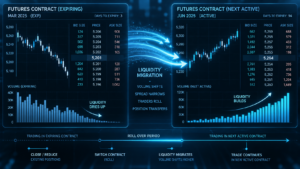
Futures Rollover Dates 2026: ES, MES, NQ & MNQ Calendar
Use this guide to track futures rollover dates for the most actively traded U.S. equity-index contracts in 2026. The page covers the official CME lead-month roll dates for ES, MES, NQ, MNQ, YM, MYM, RTY and M2K, the matching expiration dates, quarterly contract codes, liquidity migration, chart adjustment and the practical difference between rolling a position and simply switching the symbol on your platform.
Understanding futures rollover dates matters because quarterly index contracts eventually expire and liquidity shifts toward the next contract month. Trading the wrong month can mean thinner order books, wider spreads or a chart that no longer matches the contract most market participants are using. CME Group publishes an official lead-month schedule, while actual trading volume can begin migrating before or around that date.
Quick Answer
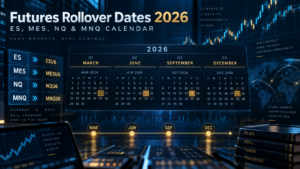
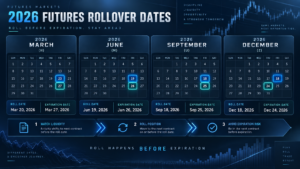
For major U.S. equity-index futures, CME’s official 2026 roll dates are March 16, June 15, September 14 and December 14. The corresponding expiration dates are March 20, June 18, September 18 and December 18. These futures rollover dates apply to CME’s U.S. equity-index lead-month convention, including popular contracts such as ES and MES. Traders can roll earlier or later, so volume and open interest should still be checked before switching contracts.
Affiliate Disclosure: TradeboticsAI may receive compensation when readers complete qualifying actions through certain links. NinjaTrader buttons on this page are affiliate links. Editorial conclusions and rollover dates are not determined by compensation.
2026 Futures Rollover Dates Calendar
This interactive calendar makes the official quarterly futures rollover dates easier to use. Keeping futures rollover dates in one calendar also reduces symbol-selection mistakes around quarterly transitions. Select a quarter to see the CME lead-month roll date, the expiration date and the standard month-code transition. The tool includes 2026 and 2027 so traders can plan the December-to-March transition without opening another calendar.
Equity Index Futures Roll Calendar
The dates in this tool follow CME Group’s published U.S. equity-index lead-month calendar. They are not a universal rule for every futures product. A trader may choose to roll at another time, and physical-delivery contracts use different expiration and notice procedures.
Official CME Futures Rollover Dates for 2026
CME Group states that the lead month for its U.S. equity-index futures changes on the Monday prior to the third Friday of the expiration month. These official futures rollover dates are the cleanest reference point for the 2026 quarterly cycle. The exchange’s published 2026 table gives the following official futures rollover dates and expirations.
| Quarter | Contract Code | Official CME Roll Date | Expiration Date | Next Contract |
|---|---|---|---|---|
| March 2026 | H26 | March 16, 2026 | March 20, 2026 | M26 |
| June 2026 | M26 | June 15, 2026 | June 18, 2026 | U26 |
| September 2026 | U26 | September 14, 2026 | September 18, 2026 | Z26 |
| December 2026 | Z26 | December 14, 2026 | December 18, 2026 | H27 |
The June expiration is notable because CME lists June 18 rather than June 19 in 2026. June 19 is the Juneteenth holiday, so the published quarterly expiration falls on the preceding Thursday. The official roll date remains Monday, June 15.
For the current exchange table, see
CME Group Equity Index Roll Dates.
Futures Rollover Date vs Expiration Date
A rollover date and an expiration date are not the same thing. Understanding futures rollover dates means separating the lead-month transition from the contract’s final expiration process. The roll date is a market convention or exchange-defined lead-month transition point used to identify the contract that should be treated as the primary month. Expiration is when the expiring contract reaches its final trading or settlement process according to its rules.
That distinction explains why futures rollover dates occur before expiration. Traders generally do not wait until the final moment to move exposure. As expiration approaches, liquidity tends to concentrate in the next contract, and platforms may begin treating that next month as the front or lead contract.
Rolling a position means closing exposure in the expiring month and opening economically similar exposure in a later month. Institutional traders often execute the transition with a calendar spread to manage the price difference between the two contracts. Retail traders may close one contract and open the next separately, but doing so creates execution and slippage considerations.
The old contract does not transform into the new one. They are separate instruments with separate prices, order books and expiration dates.
ES, MES, NQ and MNQ Futures Rollover Dates
ES, MES, NQ and MNQ are quarterly equity-index futures, so their key futures rollover dates follow the March, June, September and December cycle. For active index traders, these futures rollover dates are the four recurring checkpoints that matter most each year. ES and MES track the S&P 500 at different contract sizes, while NQ and MNQ track the Nasdaq-100.
For September 2026, for example, the expiring contracts are ESU26, MESU26, NQU26 and MNQU26. CME’s official lead-month roll date is September 14, 2026. The next quarterly contracts are ESZ26, MESZ26, NQZ26 and MNQZ26, with December expiration on December 18.
Micro contracts follow the same quarterly month structure as their E-mini counterparts, so MES does not require a separate quarterly calendar from ES and MNQ does not require a separate quarterly calendar from NQ. The dollar tick value and contract size differ, but the roll cycle is aligned.
Use our
Futures Tick Value Calculator 2026
to compare ES, MES, NQ and MNQ contract economics after selecting the correct month.
Futures Contract Month Codes: H, M, U and Z
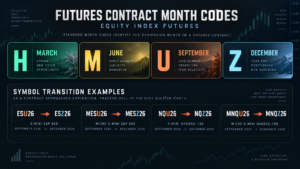
The quarterly futures rollover dates make more sense when you understand contract symbols. Contract codes make futures rollover dates actionable because they show exactly which month is expiring and which month comes next. U.S. equity-index futures use standard month codes. March is H, June is M, September is U and December is Z.
| Month | Code | ES Example | MES Example | NQ Example | MNQ Example |
|---|---|---|---|---|---|
| March | H | ESH26 | MESH26 | NQH26 | MNQH26 |
| June | M | ESM26 | MESM26 | NQM26 | MNQM26 |
| September | U | ESU26 | MESU26 | NQU26 | MNQU26 |
| December | Z | ESZ26 | MESZ26 | NQZ26 | MNQZ26 |
The final two digits usually identify the year in common retail-platform notation. ESZ26 therefore identifies the December 2026 E-mini S&P 500 contract. Platform display formats can vary, so use the full contract description if there is any doubt.
When Does Liquidity Move to the Next Futures Contract?
Official futures rollover dates are useful anchors, but liquidity does not obey a single switch that moves every trader at exactly the same second. CME explicitly states that market participants may roll from one quarterly month to the next whenever they choose.
The practical approach is to compare volume and open interest in the expiring and next contracts. As the next month becomes more active, bid/ask depth and execution quality may become more attractive there. Depending on the market and participant, this migration can begin before the official lead-month change.
This also explains why older articles sometimes cite a Thursday one week before expiration as the ES rollover. CME changed its ES and MES lead-month procedure in 2022 from the older Thursday convention to the Monday of expiration week. For current 2026 planning, the CME-published dates should be treated as the authoritative lead-month reference.
Do not confuse the official CME lead-month switch with your chart provider’s continuous-contract rollover rule. A data vendor may roll a continuous series based on volume, open interest or a fixed number of days before expiration.
How to Roll a Futures Position
Knowing futures rollover dates is only the first step if you hold an open position. A useful workflow turns futures rollover dates into a repeatable checklist for positions, working orders and platform symbols. Rolling means replacing exposure in the expiring contract with exposure in a later contract. The economic objective is continuity of market exposure, but the two contracts normally trade at different prices.
A trader can close the expiring position and separately open the new contract, or use an exchange-listed calendar spread where appropriate. The second approach trades the price difference between the two months as one spread transaction, which can reduce legging risk compared with placing two unrelated market orders.
Before rolling, confirm quantity, direction, new symbol, contract multiplier, tick value, order type and whether attached stops or targets need to be recreated on the new position. An order resting in ESU26 does not automatically become an order in ESZ26.
If you use multiple accounts, trade copying or automation, repeat the contract check for every follower account and strategy instance. See our
Best Futures Trade Copiers 2026
guide for multi-account infrastructure.
Futures Rollover Dates, Charts and Backtests
Rollover creates a charting problem because the old and new contracts can trade at different absolute prices. Around futures rollover dates, continuous-chart settings can therefore change how historical price action appears. If historical data is simply stitched together without adjustment, the transition can create an artificial gap that never occurred as a tradable move in either contract.
Continuous futures series solve this in different ways. A platform can use back-adjustment, ratio adjustment or an unadjusted splice. Each method has advantages and disadvantages. Back-adjusted data can create smoother historical price continuity but changes older historical price levels. Unadjusted data preserves actual contract prices but shows roll gaps.
For strategy research, document exactly how your data provider handles futures rollover dates. A backtest using a volume-based continuous contract can produce signals on a different day from a live strategy that follows CME’s official lead-month indicator or a broker-specific symbol mapping.
See our
Best Futures Backtesting Platforms 2026
for tools used to test futures strategies across historical contract data.
Futures Rollover Dates for Automated Trading
Automated systems should treat futures rollover dates as an operational dependency rather than a manual calendar reminder. In systematic trading, futures rollover dates should be encoded into contract-selection and validation logic rather than remembered manually. If the strategy is hard-coded to a contract symbol, it can continue sending orders to an expiring month after most liquidity has moved elsewhere.
A robust automation workflow should define how the active contract is selected, whether the change follows the CME lead month, volume leadership, open interest or a fixed schedule, and what happens to open positions and working orders during the transition.
Backtest data and live routing should use compatible rollover logic. Otherwise, the strategy may be tested on one continuous-contract methodology while live orders are sent according to another.
For always-on infrastructure, use our
Best Futures Trading VPS 2026
and
Best Automated Futures Trading Software 2026
guides.

Rollover Costs, Spread and Slippage
Switching contracts is not free. A roll can generate commissions on the closing and opening transactions, exchange and clearing fees, bid/ask spread costs and slippage. The economic difference between contract months also means the new futures price does not necessarily match the expiring price.
That price difference is the calendar spread. It reflects factors such as financing, dividends, storage or carry depending on the asset class. For equity-index futures, the spread between quarterly contracts should not be mistaken for a sudden directional gain or loss in the underlying index.
Frequent traders should include roll-related transaction costs when reviewing strategy performance. Use our
Futures Commission Calculator 2026
to estimate explicit per-contract trading costs and breakeven ticks from your current fee schedule.
A trading journal can also help separate normal trade P&L from operational rollover transactions. See our
Best Futures Trading Journals 2026
comparison.
Physical-Delivery Futures Use Different Rollover Rules
The quarterly equity-index calendar should not be copied to crude oil, gold, grains or other deliverable products. Those markets can have monthly or product-specific expirations, first notice dates and delivery procedures. A broad search for futures rollover dates can therefore be dangerous if the result is applied to the wrong asset class.
CME provides an official expiration calendar that can be filtered by product, event type and date. For physical-delivery contracts, traders should understand last trade date, first notice date and delivery obligations well before the front month approaches expiration.
See
CME Group’s official Expiration Calendar
for contract-specific dates.
CL and GC traders should not assume that the ES quarterly H-M-U-Z rollover schedule applies to them. The correct process is to check the exact product specification, then monitor liquidity in the next active contract.
Common Futures Rollover Mistakes
Using the Old Thursday Convention for ES
CME changed the lead-month procedure for ES and MES in 2022. Current 2026 futures rollover dates use the Monday-of-expiration-week lead-month convention published by CME.
Waiting Until Expiration to Switch Contracts
Liquidity can migrate before expiration. Monitor the expiring and next contracts instead of assuming the final trading day is the ideal time to move.
Assuming Continuous Charts Equal Tradable Contracts
A continuous symbol is a data construction. Live orders must still route to a specific expiration month.
Forgetting to Move Working Orders
Stops, targets and resting limit orders attached to the old contract may need to be canceled and recreated for the new symbol.
Ignoring the Calendar Spread
The new contract can trade at a different price. Treating the price difference as a chart gap or immediate P&L opportunity can distort analysis.
Applying Equity-Index Dates to CL or GC
Physical-delivery and monthly futures have different expiration and notice rules. Use the official CME product calendar.
Using One Rollover Method in Backtests and Another Live
Inconsistent continuous-contract methodology can change indicators, entries and historical statistics around roll periods.
Futures Rollover Dates FAQ
What are the ES futures rollover dates in 2026?
CME’s official U.S. equity-index lead-month roll dates for 2026 are March 16, June 15, September 14 and December 14. ES follows that quarterly schedule.
What are the MES rollover dates in 2026?
MES follows the same official quarterly futures rollover dates as ES: March 16, June 15, September 14 and December 14, 2026.
Do NQ and MNQ roll on the same quarterly cycle?
Yes. NQ and MNQ use March, June, September and December quarterly contracts and follow CME’s U.S. equity-index lead-month calendar.
When does ESU26 roll to ESZ26?
CME lists September 14, 2026 as the official U.S. equity-index roll date for the September quarter. ESU26 expires September 18, 2026.
When does ESZ26 roll to ESH27?
The official December 2026 CME roll date is December 14, 2026, with December expiration on December 18. The next quarterly contract is March 2027, coded H27.
Why do some websites show a Thursday rollover date?
Older ES conventions used a Thursday one week before expiration, and some traders or data providers still use volume-based or fixed-date rollover conventions. CME changed its ES and MES lead-month procedure in 2022 to Monday of expiration week.
Is rollover the same as expiration?
No. Rollover moves exposure or lead-month focus into the next contract. Expiration is the final settlement or trading process of the old contract.
Do I have to roll exactly on CME’s official date?
No. CME states that participants may roll whenever they choose. The official date is the exchange’s lead-month reference, while individual traders may use liquidity, strategy rules or operational constraints.
What month codes do equity-index futures use?
The quarterly cycle uses H for March, M for June, U for September and Z for December.
Where can I verify current futures expiration dates?
Use CME Group’s official Equity Index Roll Dates page for quarterly equity-index lead months and the CME Expiration Calendar for product-specific expiration, last-trade and delivery events.
Final Verdict: Futures Rollover Dates for 2026
The most important 2026 futures rollover dates for U.S. equity-index traders are March 16, June 15, September 14 and December 14. Those are CME’s official lead-month roll dates. The matching expirations are March 20, June 18, September 18 and December 18.
Do not treat those dates as a mechanical instruction to execute at one specific time. CME allows participants to roll whenever they choose, and actual liquidity can migrate before or around the official transition. Check volume, open interest, bid/ask depth and your platform’s symbol mapping before moving from the expiring month.
The biggest operational mistake is mixing different definitions of rollover. CME lead-month dates, broker symbol changes, continuous-chart rules and volume-based trader conventions can all be different. Document which method your trading, charting and backtesting workflow uses.
For physical-delivery products, abandon the quarterly index template entirely and use the contract-specific CME expiration calendar. Good rollover management is less about memorizing dates and more about ensuring that data, orders, automation and risk controls are all pointed at the contract you actually intend to trade.