NinjaTrader vs MotiveWave 2026: Which Trading Platform Is Better?
NinjaTrader vs MotiveWave is an important comparison for active futures traders, order-flow specialists and systematic traders choosing a professional platform in 2026. Both environments provide advanced charting, strategy development, replay functionality and professional execution tools, but their ecosystems are built around different priorities.
NinjaTrader is primarily a futures-focused trading ecosystem. It combines brokerage access with Desktop, Web and Mobile platforms, advanced charting, SuperDOM, Order Flow+, NinjaScript automation, strategy backtesting, Market Replay and a large third-party marketplace.
MotiveWave takes a broader broker-neutral approach. It connects to more than 30 supported brokers and data providers and provides advanced charting, order-flow analysis, Java-based custom strategies, replay, multi-broker functionality and professional analytical tools across Windows, macOS and Linux.
This detailed NinjaTrader vs MotiveWave 2026 comparison examines futures trading, order flow, programming, backtesting, pricing structure, broker connectivity, operating-system support and usability to determine which trading environment better matches different workflows.
Quick Answer
Choose NinjaTrader if futures are your primary market and you want an integrated futures brokerage ecosystem, C# NinjaScript development, Desktop/Web/Mobile access and a mature third-party marketplace.
Choose MotiveWave if you prioritize broker neutrality, Windows/macOS/Linux desktop support, advanced order-flow tools, Java development and the flexibility to connect multiple brokers or data services.
TradeboticsAI Verdict: NinjaTrader is generally the more streamlined option for dedicated U.S. futures traders. MotiveWave is particularly compelling for advanced users who want cross-platform desktop support and greater freedom over broker and data-feed infrastructure.
Explore NinjaTrader and Free Simulated Trading →
Affiliate disclosure: TradeboticsAI may receive compensation when visitors complete qualifying actions through certain links. Simulated trading is different from live brokerage trading. Futures trading involves substantial risk, and commissions and additional fees may apply.
Table of Contents
- NinjaTrader vs MotiveWave Overview
- Quick Comparison
- Futures Trading
- Charting and Technical Analysis
- Order Flow Analysis
- DOM and Execution
- Automated Trading
- NinjaScript vs MotiveWave Java SDK
- Backtesting and Optimization
- Replay and Simulation
- Broker and Data Connections
- Operating Systems and Mobile Access
- Pricing Comparison
- Ease of Use
- Pros and Cons
- Which Platform Should You Choose?
- Related Comparisons
- FAQ
- Final Verdict
NinjaTrader vs MotiveWave 2026: Overview
The most important difference in NinjaTrader vs MotiveWave is how each company structures the trading environment.
NinjaTrader provides a relatively integrated experience. Traders can use NinjaTrader’s futures brokerage infrastructure while accessing the company’s Desktop, Web and Mobile applications.
This vertical integration can reduce the number of separate decisions required when setting up a futures trading workstation.
MotiveWave is broker and data-feed neutral. Rather than forcing traders into one brokerage relationship, the platform supports more than 30 connections and allows users to select compatible brokers and data providers according to their needs.
That flexibility can be particularly valuable for traders who already maintain brokerage accounts or use specialized institutional-style data feeds.
MotiveWave also supports desktop installation across Windows, macOS and Linux, creating a meaningful advantage for traders who do not want to depend exclusively on Windows for professional desktop analysis.
NinjaTrader vs MotiveWave: Quick Comparison

| Category | NinjaTrader | MotiveWave |
|---|---|---|
| Primary Focus | Integrated futures trading ecosystem | Broker-neutral professional trading platform |
| Futures Brokerage | Integrated NinjaTrader brokerage | Uses supported external brokers |
| Broker / Data Connections | Focused ecosystem | 30+ supported connections |
| Programming | NinjaScript / C# | Java SDK |
| Order Flow | Order Flow+ and add-ons | Dedicated Order Flow edition and tools |
| Advanced DOM | SuperDOM | Advanced DOM / MBO tools |
| Backtesting | Advanced strategy testing | Backtest, optimization and walk-forward tools in supported editions |
| Replay | Market Replay | Replay / Advanced Replay depending on edition |
| Windows | Desktop supported | Supported |
| macOS | Web access; Desktop is Windows-focused | Native desktop support |
| Linux | No equivalent native Desktop platform | Supported desktop installation |
| Mobile | iOS and Android | Mobile app available in compatible editions |
| Best For | Dedicated active futures traders | Advanced multi-broker and cross-platform traders |
NinjaTrader vs MotiveWave for Futures Trading
NinjaTrader has the structural advantage when the trader’s primary objective is simply to build a dedicated futures workflow.
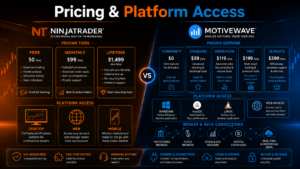
The company combines trading technology with futures brokerage access and currently provides Free, Monthly and Lifetime account plans.
Its ecosystem is specifically designed around instruments such as Micro E-mini and E-mini futures, metals, energy, currencies and other exchange-listed contracts.
MotiveWave can also be an excellent futures platform, but the brokerage relationship is external.
A MotiveWave trader generally chooses a compatible broker or data feed and then connects that relationship to the platform.
This architecture provides flexibility, but it introduces additional decisions involving:
- Broker selection
- Data-feed selection
- Exchange subscriptions
- Commission schedules
- Connection compatibility
- Market-depth availability
Best for integrated futures trading: NinjaTrader.
Best for broker flexibility: MotiveWave.
NinjaTrader vs MotiveWave for Charting
Both platforms provide professional-level charting.
NinjaTrader Charting
NinjaTrader Desktop provides multiple chart types, extensive technical indicators, drawing tools, custom NinjaScript indicators and tight integration between charts, strategies and order execution.
The third-party NinjaTrader ecosystem can also expand charting functionality substantially.
MotiveWave Charting
MotiveWave’s free Community edition currently includes charting tools and more than 280 built-in studies and indicators.
Higher editions add features such as nonlinear bars, second-based bars, advanced replay, order-flow studies, scanners and professional strategy functionality.
MotiveWave is also well known for analytical tools outside conventional technical analysis, including Elliott Wave capabilities in appropriate editions.
For conventional futures charting, both are highly capable.
MotiveWave becomes especially interesting for traders who want one desktop analytical platform across multiple operating systems and broker relationships.
NinjaTrader vs MotiveWave for Order Flow
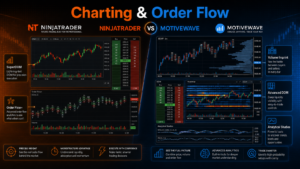
Order flow is one of MotiveWave’s strongest areas and makes the NinjaTrader vs MotiveWave comparison particularly competitive.
MotiveWave’s current Order Flow edition includes dedicated order-flow studies and tools, Advanced DOM functionality and Trade Copier capability.
Its order-flow environment includes tools such as:
- Volume Imprint / Footprint-style charts
- Depth of Market
- Time and Sales
- Delta Volume
- Cumulative Delta
- Bid / Ask Volume
- Speed of Tape
- DOM Power
- Order Heatmap
- Big Trades analysis
Volume Imprint can divide volume at individual price levels into bid and ask activity, providing several different display formats.
NinjaTrader provides Order Flow+ alongside SuperDOM and a substantial third-party marketplace.
The distinction is therefore less about whether order-flow tools exist and more about how each trader wants them integrated.
NinjaTrader: order flow inside a tightly integrated futures ecosystem.
MotiveWave: professional order flow inside a broker-neutral analytical platform.
See the official MotiveWave Order Flow page for current functionality.
NinjaTrader SuperDOM vs MotiveWave Advanced DOM
Both platforms provide sophisticated depth-of-market interfaces.
NinjaTrader’s SuperDOM is designed around active futures execution and integrates directly with the broader NinjaTrader trading environment.
MotiveWave’s DOM can display resting limit orders and additional columns such as recently executed trades, changes in resting orders and volume traded at individual prices.
Its higher-level order-flow functionality also includes Advanced DOM capabilities and support for more detailed market-depth workflows.
The best choice depends partly on brokerage infrastructure.
A NinjaTrader user benefits from direct integration with the company’s futures ecosystem.
A MotiveWave user may prioritize the ability to use professional depth tools while retaining a separate broker relationship.
NinjaTrader vs MotiveWave for Automated Trading
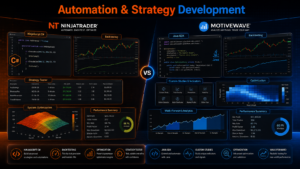
Both platforms can support automated trading strategies.
The major difference is programming language.
NinjaTrader uses NinjaScript, which is based on C#.
MotiveWave’s Software Development Kit uses Java.
Both frameworks can be used to build custom indicators and strategies, but source code is not portable between them.
A developer choosing between the platforms should therefore consider:
- Existing programming experience
- Existing strategy code
- Broker API requirements
- Backtesting workflow
- Third-party ecosystem
- Deployment requirements
For developers already working heavily in .NET and C#, NinjaTrader may be the more natural environment.
For Java developers, MotiveWave can be particularly attractive.
NinjaScript vs MotiveWave Java SDK
NinjaScript
- C#-based development
- Custom indicators
- Automated strategies
- Platform add-ons
- Drawing tools
- Strategy testing
- Large third-party ecosystem
MotiveWave Java SDK
- Java-based development
- Custom studies
- Custom strategies
- Automatic and partially automated strategies
- Access to MotiveWave APIs
- Development through standard Java environments
MotiveWave states that its built-in studies and strategies were themselves created using its SDK, giving developers access to the same basic framework used for native platform functionality.
See the official MotiveWave SDK information.
NinjaTrader vs MotiveWave Backtesting and Optimization
Systematic traders should pay particular attention to this section.
NinjaTrader provides strategy backtesting and optimization inside its Desktop environment.
MotiveWave’s higher editions provide a sophisticated Strategy Optimizer supporting:
- Backtesting
- Parameter optimization
- Walk-forward analysis
- Exhaustive optimization
- Genetic optimization
- Commission assumptions
- Slippage assumptions
- Trade reports
Walk-forward analysis can be especially useful when a trader wants to evaluate whether optimized strategy parameters remain useful outside the original optimization period.
MotiveWave itself cautions that backtesting cannot perfectly reproduce real-world execution.
The same limitation applies to any platform.
Historical models may not fully reproduce:
- Slippage
- Liquidity changes
- Latency
- Partial fills
- Market impact
- Future market regimes
Backtesting should therefore be treated as research rather than proof of future profitability.
Replay and Simulated Trading
Both platforms provide historical replay functionality.
NinjaTrader Market Replay allows users to replay historical market activity tick by tick while practicing execution or evaluating trading ideas.
MotiveWave Community includes Replay Mode, while Standard and higher functionality can include Advanced Replay features.
Replay can be useful for:
- Practicing entries and exits
- Studying order flow
- Testing discretionary systems
- Reviewing volatile sessions
- Debugging strategy logic
- Developing platform familiarity
Neither simulated nor replayed performance guarantees comparable results in live trading.
MotiveWave Broker Connections vs NinjaTrader Integration
Connectivity is one of the clearest MotiveWave advantages.
MotiveWave currently describes itself as a broker and data-feed neutral multi-connection platform supporting more than 30 connections.
The user can select from compatible brokers and data providers and, in higher editions, work with multiple broker connections.
That can appeal to traders who:
- Already use Interactive Brokers or another supported broker
- Want separate execution and market-data sources
- Operate across multiple asset classes
- Need several brokerage relationships
- Want greater control over market-data infrastructure
NinjaTrader’s proposition is more specialized and integrated around futures.
For some traders that narrower structure is an advantage because it eliminates complexity.
For others, MotiveWave’s neutrality is more valuable.
See the official MotiveWave connections page.
NinjaTrader vs MotiveWave Operating Systems and Mobile Access
This section creates another significant distinction in the NinjaTrader vs MotiveWave comparison.
NinjaTrader
- Windows Desktop platform
- Web trading
- iPhone application
- Android application
NinjaTrader’s web platform makes it possible for Mac users to access core trading functionality without running the full Windows Desktop application.
MotiveWave
MotiveWave currently supports desktop installation on:
- Windows
- macOS
- Linux
The company also provides mobile-app functionality in supported editions.
This gives MotiveWave an important advantage for traders who want a full professional desktop platform without using Windows.
A MotiveWave license can be installed on multiple computers, although the company states that one license is intended to be used on one computer at a time.
Desktop operating-system flexibility winner: MotiveWave.
Integrated web/mobile futures ecosystem winner: NinjaTrader.
NinjaTrader vs MotiveWave Pricing
NinjaTrader Pricing
NinjaTrader currently offers three primary futures account plans:
| Plan | Cost | Micro / e-Nano | Standard |
|---|---|---|---|
| Free | $0 monthly plan fee | $0.39 per side | $1.29 per side |
| Monthly | $99/month | $0.29 per side | $0.99 per side |
| Lifetime | $1,499 one-time | $0.09 per side | $0.59 per side |
Exchange, clearing, NFA, market-data and other applicable fees may apply.
Verify current details on the official NinjaTrader pricing page.
MotiveWave Pricing Structure
MotiveWave currently provides several editions rather than one universal subscription.
- Community: Free charting edition
- Standard: Adds live trading, mobile access, cloud workspaces and Advanced Replay
- Order Flow: Adds professional order-flow studies, Advanced DOM and Trade Copier
- Pro: Adds multiple broker connections, strategies, backtesting, scanners and additional professional tools
- Ultimate: Includes Pro functionality plus advanced Elliott Wave and additional premium analytical tools
MotiveWave offers lease and purchased-license structures, and the exact price depends on the edition and selected billing option.
Purchased licenses currently include one year of updates and support. Continuing updates and support after that initial period is optional and separately priced.
The Community edition is permanently free, and MotiveWave currently provides a 14-day trial that normally unlocks the Ultimate feature set without requiring a credit card.
Importantly, market data is not included automatically with MotiveWave software. Traders normally obtain data through their selected compatible broker or data provider.
For current pricing, use the official MotiveWave editions page.
Which Platform Is Easier to Use?
NinjaTrader generally provides the simpler route for a trader whose primary objective is U.S. futures trading.
The brokerage and trading environment are integrated, reducing the need to assemble multiple external services.
MotiveWave may initially require more decisions involving broker connections, data feeds, editions and configuration.
However, traders who already understand professional trading infrastructure may see that flexibility as a benefit rather than added complexity.
Programming requirements also matter.
C# developers may adapt more naturally to NinjaScript.
Java developers may find MotiveWave’s SDK more familiar.
NinjaTrader vs MotiveWave Pros and Cons
NinjaTrader Pros
- Integrated futures brokerage ecosystem
- Free simulated trading
- Desktop, Web and Mobile access
- NinjaScript C# automation
- Strategy backtesting
- Market Replay
- Order Flow+
- SuperDOM
- Large third-party ecosystem
- Futures-focused pricing plans
NinjaTrader Cons
- Desktop platform primarily Windows-based
- Primarily centered on futures
- Less broker-neutral than MotiveWave
- Additional data and trading fees may apply
MotiveWave Pros
- Free Community edition
- 14-day Ultimate trial
- 30+ broker and data connections
- Windows, macOS and Linux desktop support
- Professional Order Flow edition
- Volume Imprint / Footprint tools
- Advanced DOM
- Java SDK
- Automated strategies
- Backtesting and optimization
- Walk-forward analysis
- Replay Mode
- Multiple broker support in higher editions
MotiveWave Cons
- Not an integrated futures broker
- Market data is separate
- Multiple editions can make pricing comparison more complex
- Advanced features require higher editions
- Smaller third-party ecosystem than NinjaTrader in some futures niches
NinjaTrader vs MotiveWave: Which Should You Choose?
Choose NinjaTrader If You:
- Primarily trade futures
- Want integrated futures brokerage
- Trade Micro and E-mini contracts
- Need Web and Mobile access
- Develop in C#
- Use NinjaScript
- Need strategy backtesting
- Use Market Replay
- Want a large third-party marketplace
Choose MotiveWave If You:
- Use multiple brokers or data feeds
- Need Windows, macOS or Linux desktop support
- Trade with professional order-flow tools
- Use Advanced DOM
- Develop in Java
- Need sophisticated backtesting and walk-forward analysis
- Want broker-neutral infrastructure
- Trade several markets through different providers
Want to Test NinjaTrader?
Explore NinjaTrader’s futures charting, strategy backtesting and free simulated-trading environment before deciding which platform fits your workflow.
Free simulation is different from live futures trading. Live accounts involve real financial risk, commissions and applicable fees.
Related NinjaTrader Platform Comparisons
- NinjaTrader vs TradeStation 2026
- NinjaTrader vs TradingView 2026
- NinjaTrader vs Thinkorswim 2026
- NinjaTrader vs Tradovate 2026
- NinjaTrader vs Sierra Chart 2026
- NinjaTrader vs Quantower 2026
- NinjaTrader vs Bookmap 2026
- NinjaTrader vs ATAS 2026
NinjaTrader vs MotiveWave FAQ
Is NinjaTrader better than MotiveWave?
NinjaTrader may be better for dedicated futures traders who want integrated brokerage, C# automation and a complete Desktop/Web/Mobile ecosystem. MotiveWave may be better for traders who want broker neutrality, multiple operating-system support and professional order-flow tools.
Is MotiveWave free?
Yes. MotiveWave currently provides a free Community edition with chart tools, more than 280 built-in studies and indicators, Java SDK access and Replay Mode.
Does MotiveWave have a free trial?
Yes. MotiveWave currently provides a 14-day trial that normally unlocks its Ultimate edition without requiring a credit card.
Does MotiveWave support futures?
Yes. MotiveWave can be used for futures trading through compatible brokers and data providers.
Does MotiveWave support order flow?
Yes. MotiveWave offers a dedicated Order Flow edition with professional order-flow studies, Advanced DOM and additional analytical functionality.
Does MotiveWave have Footprint charts?
Yes. MotiveWave’s Volume Imprint tools provide footprint-style volume analysis, including bid/ask, delta and other price-level displays.
Can MotiveWave automate trades?
Yes. MotiveWave strategies can operate automatically or partially automatically, and custom strategies can be created using the Java SDK.
What programming language does MotiveWave use?
MotiveWave’s SDK uses Java for custom studies and strategies.
What programming language does NinjaTrader use?
NinjaTrader’s NinjaScript framework is based on C#.
Which is better for automated trading?
Both can support sophisticated automation. NinjaTrader may be more attractive to C# developers and futures specialists, while MotiveWave may appeal to Java developers and traders using external brokerage relationships.
Does MotiveWave support Mac?
Yes. MotiveWave currently supports macOS as well as Windows and Linux desktop installations.
Does NinjaTrader support Mac?
NinjaTrader Desktop is Windows-focused, but NinjaTrader Web can be accessed from supported Mac browsers.
Which is better for order flow?
Both provide strong order-flow functionality. MotiveWave offers a dedicated Order Flow edition with Volume Imprint and Advanced DOM, while NinjaTrader combines Order Flow+ with SuperDOM and its broader futures ecosystem.
Does MotiveWave support multiple brokers?
Yes. MotiveWave supports more than 30 broker and data connections, while its Pro and Ultimate editions include multi-broker functionality.
Does MotiveWave include market data?
No. MotiveWave states that market data is not included with its software. Users connect through supported brokers or data-feed providers.
Which platform is easier for futures beginners?
NinjaTrader generally provides the simpler path for traders specifically entering futures because brokerage, simulation and platform access are more tightly integrated.
Final Verdict: NinjaTrader vs MotiveWave 2026
The final NinjaTrader vs MotiveWave 2026 decision depends primarily on whether you value integration or infrastructure flexibility.
NinjaTrader is our preferred choice for dedicated futures traders who want one cohesive environment combining futures brokerage, charting, NinjaScript automation, backtesting, Market Replay and convenient Desktop/Web/Mobile access.
MotiveWave is a powerful alternative for sophisticated traders who want broker neutrality, multiple data connections, Windows/macOS/Linux compatibility, Java development and advanced professional order-flow functionality.
For C# developers, NinjaTrader has an obvious advantage.
For Java developers, MotiveWave provides a compelling native development environment.
For traders who primarily trade Micro and E-mini futures and prefer fewer infrastructure decisions, NinjaTrader will often be the more practical option.
For traders already managing several brokers, data feeds or operating systems, MotiveWave can provide substantially more flexibility.
Neither platform can guarantee profitable trading. Charting, order flow, automation and backtesting are tools, not guarantees of future performance.
Before purchasing either platform or funding a live account, verify current software pricing, brokerage commissions, market-data fees, exchange costs and connection requirements directly with the provider.
Affiliate Disclosure: TradeboticsAI may receive compensation when visitors click certain affiliate links or complete qualifying actions. This does not increase the user’s cost and does not determine our editorial conclusions.
Risk Disclosure: Futures and other leveraged products involve substantial risk and are not suitable for every investor. Losses can be significant and may, depending on the circumstances, exceed the amount initially committed. Simulated, replayed and backtested results are hypothetical and do not guarantee future live-trading performance. This content is provided for informational and educational purposes only and is not financial, investment, tax or legal advice.