NinjaTrader vs AMP Futures 2026: Which Futures Broker Is Better?
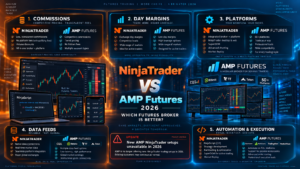

NinjaTrader vs AMP Futures is one of the most relevant broker comparisons for active futures traders in 2026. Both companies focus heavily on futures, provide low intraday margin options, access to professional trading technology and competitive trading costs, but their business models are fundamentally different.
NinjaTrader combines its own futures brokerage infrastructure with NinjaTrader Desktop, Web and Mobile, advanced charting, SuperDOM, Order Flow+, NinjaScript automation, strategy backtesting, Market Replay and free simulated trading.
AMP Futures takes a broker-plus-platform-choice approach. Rather than building the entire experience around one proprietary front end, AMP currently advertises more than 50 trading platforms and multiple data-feed choices, including CQG, Rithmic, Trading Technologies and Teton.
This detailed NinjaTrader vs AMP Futures 2026 comparison examines commissions, Micro futures margins, market data, platforms, data feeds, automation, account costs, execution flexibility and usability to determine which futures broker better matches different trading workflows.
Quick Answer
Choose NinjaTrader if you want one integrated futures ecosystem with clearly published commission plans, NinjaTrader Desktop/Web/Mobile, NinjaScript automation, Market Replay and a large futures-focused add-on marketplace.
Choose AMP Futures if you prioritize platform choice, multiple data feeds, very low published day-trading margins on selected contracts and the ability to build your futures setup around third-party platforms such as Quantower, Sierra Chart and other supported tools.
Important 2026 Update: AMP states that, effective April 10, 2026, it can no longer enable NinjaTrader for new trader setups. Existing grandfathered AMP/NinjaTrader users may continue under applicable legacy conditions. New customers should therefore evaluate NinjaTrader and AMP as separate broker/platform ecosystems rather than assuming they can open a new AMP account and simply select NinjaTrader.
Explore NinjaTrader and Free Simulated Futures Trading →
Affiliate disclosure: TradeboticsAI may receive compensation when visitors complete qualifying actions through certain links. Simulated trading is different from live trading. Futures involve substantial risk, and commissions, exchange, clearing, regulatory, platform and data fees may apply.
Table of Contents
- NinjaTrader vs AMP Futures Overview
- Quick Comparison
- Commissions and Trading Costs
- Day-Trading Margins
- Micro Futures Comparison
- Trading Platforms
- Can AMP Customers Use NinjaTrader?
- Data Feeds
- Market Data Costs
- Execution and DOM Trading
- Automated Trading
- Simulation and Replay
- Account Minimums and Fees
- Markets and Exchanges
- Web and Mobile Trading
- Ease of Use
- Pros and Cons
- Which Broker Should You Choose?
- Related Comparisons
- FAQ
- Final Verdict
NinjaTrader vs AMP Futures 2026: Overview
The central difference in NinjaTrader vs AMP Futures is integration versus choice.
NinjaTrader has developed a vertically integrated futures environment. NinjaTrader, LLC develops the trading technology, while NinjaTrader Clearing, LLC acts as the registered futures commission merchant responsible for customer brokerage accounts and clearing.
That allows a trader to use one primary ecosystem for:
- Futures brokerage
- Desktop trading
- Browser trading
- Mobile trading
- Charting
- Market Replay
- Simulation
- Order flow
- NinjaScript development
- Strategy backtesting
AMP Futures takes a more modular approach.
AMP Global Clearing is a regulated futures commission merchant and CME Group clearing member. It currently advertises access to more than 50 trading platforms and four major data-feed infrastructures: CQG, Rithmic, Trading Technologies and Teton.
This means AMP traders have more freedom to choose their interface and technology stack.
That flexibility can be valuable for experienced traders who already know exactly which platform and feed they want.
It can also create more decisions for beginners.
NinjaTrader vs AMP Futures: Quick Comparison
| Category | NinjaTrader | AMP Futures |
|---|---|---|
| Primary Model | Integrated broker + platform ecosystem | Broker with broad third-party platform choice |
| Futures Focus | Excellent | Excellent |
| Platform Choices | NinjaTrader Desktop, Web and Mobile ecosystem | 50+ supported platforms |
| Data Feeds | Integrated and supported technology options | CQG, Rithmic, TT and Teton |
| MES Day Margin | $50 published | $40 published |
| MNQ Day Margin | $100 published | $100 published |
| MYM Day Margin | $50 published | $50 published |
| M2K Day Margin | $50 published | $50 published |
| Published Commission Model | Free / Monthly / Lifetime | Varies by platform, feed and volume; Exact Cost Calculator |
| Minimum Deposit | No general minimum deposit requirement | $100 published minimum |
| Native Automation | NinjaScript / C# | Depends on selected platform/API |
| New AMP + NinjaTrader Setup | Not applicable | AMP states new NinjaTrader enablement is unavailable |
| Best For | Integrated futures workflow | Platform and data-feed flexibility |
NinjaTrader vs AMP Futures Commissions
Commission pricing is one area where the NinjaTrader vs AMP Futures comparison requires careful interpretation.
NinjaTrader Commission Plans
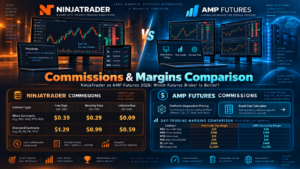
NinjaTrader currently publishes three principal futures pricing plans.
| Plan | Plan Cost | Micro / e-Nano | Standard |
|---|---|---|---|
| Free | $0/month | $0.39 per side | $1.29 per side |
| Monthly | $99/month | $0.29 per side | $0.99 per side |
| Lifetime | $1,499 one-time | $0.09 per side | $0.59 per side |
Exchange, clearing and NFA charges apply in addition to these published commission figures.
Current details can be verified on the official NinjaTrader pricing page.
AMP Futures Commissions
AMP does not present one universal commission table that applies equally to every platform and data-feed configuration.
Instead, AMP directs traders to its Exact Cost Calculator.
The calculator is designed to combine:
- Broker commission
- Exchange fees
- NFA fees
- Clearing fees
- Platform fees
- Order-routing fees
AMP states that commission pricing can vary according to the platform and trading volume.
This makes direct comparison more complicated but can also provide traders with flexibility when configuring a high-volume futures setup.
Use the official AMP Futures commission calculator page to verify the all-in cost for the exact platform, feed and contract you intend to trade.
Which Commission Model Is Better?
NinjaTrader provides the simpler published structure.
AMP provides a more configuration-dependent structure.
A trader should therefore compare actual round-trip cost on the specific contract rather than comparing advertising headlines.
NinjaTrader vs AMP Futures Day-Trading Margins
Low intraday margin is a major selling point for both brokers.
Current published margin figures show that they are very competitive on popular Micro index futures.
| Contract | NinjaTrader Day Margin | AMP Day Margin |
|---|---|---|
| MES | $50 | $40 |
| MNQ | $100 | $100 |
| MYM | $50 | $50 |
| M2K | $50 | $50 |
| ES | $500 | $400 |
| NQ | $1,000 | $1,000 |
Margin figures can change without notice when volatility or exchange conditions change.
They also should never be confused with maximum risk.
A $40 or $50 margin requirement does not mean a trader can only lose $40 or $50.
Futures losses can materially exceed the margin needed to open a position.
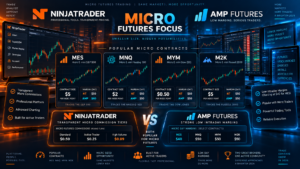
NinjaTrader vs AMP Futures for Micro Futures
Micro futures are where NinjaTrader vs AMP Futures becomes especially relevant for retail traders.
Both brokers actively support contracts such as:
- MES — Micro E-mini S&P 500
- MNQ — Micro E-mini Nasdaq-100
- MYM — Micro E-mini Dow
- M2K — Micro E-mini Russell 2000
- MCL — Micro Crude Oil
- MGC — Micro Gold
NinjaTrader has a very transparent Micro commission ladder.
The Lifetime plan currently publishes its lowest Micro commission at $0.09 per side, while the Monthly plan publishes $0.29 and the Free plan publishes $0.39.
AMP focuses more on all-in pricing generated through its calculator and publishes highly competitive day margins.
For MES specifically, AMP currently publishes a $40 day-trading margin compared with NinjaTrader’s $50.
For MNQ, both currently publish $100.
Because Micro traders often execute many contracts, small differences in commissions, routing fees and market-data costs can compound over time.
NinjaTrader vs AMP Futures Trading Platforms
This is arguably the biggest difference between the two brokers.
NinjaTrader Platforms
NinjaTrader provides its own integrated platform family:
- NinjaTrader Desktop
- NinjaTrader Web
- NinjaTrader Mobile
NinjaTrader Desktop provides the deepest functionality, including NinjaScript development, advanced charting, strategy testing and extensive customization.
Web and Mobile extend the ecosystem to browsers and smartphones.
AMP Futures Platforms
AMP currently advertises more than 50 trading platforms.
The platform lineup can vary by data feed and configuration, but AMP emphasizes choice across:
- Desktop platforms
- Browser-based platforms
- Mobile solutions
- Order-flow software
- Professional charting platforms
- Algorithmic trading environments
AMP also currently provides the full version of Quantower free to AMP customers.
For traders who strongly prefer one specific third-party platform, AMP’s open platform model can be a significant advantage.
Integrated ecosystem winner: NinjaTrader.
Platform-choice winner: AMP Futures.
Can AMP Futures Customers Use NinjaTrader in 2026?
This question deserves special attention because older online comparisons can now be misleading.
AMP states that NinjaTrader restricted AMP’s ability to enable NinjaTrader for new trader setups effective April 10, 2026.
AMP also states that existing qualifying customers who already had NinjaTrader enabled may continue under applicable grandfathered conditions.
Therefore, a new trader should not choose AMP Futures in 2026 on the assumption that they can simply open an AMP account and activate NinjaTrader as their trading platform.
If NinjaTrader itself is your preferred platform, opening the appropriate NinjaTrader brokerage relationship directly is generally the cleaner path.
If AMP is your preferred broker, evaluate its currently supported third-party platforms instead.
See AMP’s official NinjaTrader existing-user policy for current details.
AMP Futures Data Feeds vs NinjaTrader Infrastructure
Data-feed flexibility is another major AMP advantage.
AMP currently offers:
- CQG
- Rithmic
- Trading Technologies
- Teton
Different platforms support different feeds.
This allows an experienced trader to select a combination based on latency requirements, API access, platform compatibility and market-data functionality.
However, changing feeds can create additional costs.
AMP states that switching between platforms using the same feed generally does not trigger an additional platform-switch fee, while switching to another data feed within the same month can cause separate exchange data subscriptions to be billed.
Rithmic currently has additional technology charges at AMP, including a monthly user connection fee and per-contract routing fee.
NinjaTrader provides a more standardized environment where most users do not need to make as many independent infrastructure decisions.
Data-feed flexibility winner: AMP Futures.
Simplicity winner: NinjaTrader.
NinjaTrader vs AMP Futures Market Data Costs
Market-data pricing is another real cost that should be included in the comparison.
AMP CME Market Data
AMP’s published non-professional CME fees effective June 1, 2026 currently include:
- CME bundle Level 1: $15/month
- CME bundle Level 2: $45/month
- Single CME exchange Level 1: $5/month
- Single CME exchange Level 2: $17/month
Equivalent pricing applies across the listed CME Group exchange selections where available through the chosen feed.
NinjaTrader CME Market Data
NinjaTrader currently publishes non-professional CME market-data charges including:
- CME Group bundle Level I: $12/month
- CME Group bundle Level II: $48/month
- Individual exchange Level I: $4/month
- Individual exchange Level II: $16/month
The cheapest option therefore depends on whether you need top-of-book or full-depth data and which exchanges you actually trade.
Pricing can change, so verify market-data charges immediately before subscribing.
NinjaTrader vs AMP Futures for Execution and DOM Trading
NinjaTrader has a very recognizable execution interface through SuperDOM.
SuperDOM is designed specifically around futures ladder trading and can integrate with advanced order management, charting and custom NinjaScript functionality.
AMP execution experience depends substantially on the chosen platform and data feed.
This is simultaneously an advantage and a disadvantage.
An AMP trader can choose a platform optimized for:
- DOM scalping
- Order flow
- Traditional chart trading
- Automated systems
- Browser trading
- Professional multi-monitor workstations
But there is no single universal AMP interface equivalent to saying “all AMP traders use SuperDOM.”
For someone who wants a consistent futures execution environment, NinjaTrader can be easier.
For someone who wants to choose the exact interface, AMP provides more freedom.
NinjaTrader vs AMP Futures for Automated Trading
NinjaTrader has a clear native automation identity.
NinjaScript is based on C# and allows developers to build:
- Automated trading strategies
- Custom indicators
- Platform add-ons
- Custom order-management logic
- Drawing tools
- SuperDOM extensions
Strategies can be backtested and optimized inside NinjaTrader Desktop.
AMP automation depends more heavily on the trading platform and data feed selected.
An AMP customer might choose a platform with its own algorithmic framework or use a supported API infrastructure.
Rithmic, for example, currently provides an optional API service through AMP with additional monthly technology fees.
This makes the architecture more modular.
Best native built-in development environment: NinjaTrader.
Best flexibility across different platform architectures: AMP Futures.
Simulation, Replay and Practice Trading
NinjaTrader provides free simulated trading along with Market Replay.
Market Replay allows historical futures activity to be played back tick by tick, which can be useful for strategy testing and discretionary practice.
AMP’s demo and simulation capabilities depend on the selected trading platform and feed.
Many AMP-supported platforms provide demo or simulated trading functionality, but exact functionality is platform-specific.
This means NinjaTrader offers a more standardized simulation experience, while AMP gives users the ability to choose among different simulation environments.
Account Minimums, Inactivity and Administrative Fees
NinjaTrader
NinjaTrader currently advertises no general minimum deposit requirement to begin.
However, traders still need enough capital to satisfy the margin and risk requirements of the contracts they trade.
NinjaTrader’s current account-fee schedule also states that certain Free-plan accounts that log into the trading platform but do not execute a live trade during a 30-day period may be charged an inactivity fee.
AMP Futures
AMP currently publishes a $100 minimum initial deposit.
AMP also states that it does not charge a monthly inactivity or maintenance fee.
Other service charges can apply, including certain wire, liquidation and administrative fees.
Therefore:
Lower formal starting deposit: NinjaTrader.
No published inactivity/maintenance fee: AMP Futures.
Markets and Exchange Access
Both brokers provide access to major futures markets, but exact products and connections should be verified before opening an account.
NinjaTrader currently provides access to major futures venues including CME Group, Eurex, ICE and Coinbase Derivatives through its brokerage offering.
AMP is a clearing member of CME, CBOT, COMEX and NYMEX and also supports other futures markets through its available clearing and technology relationships.
For most U.S. retail traders focusing on CME index, metal, energy and currency futures, both ecosystems provide substantial coverage.
Traders requiring specific international contracts should verify availability with each broker directly.
NinjaTrader vs AMP Futures Web and Mobile Trading
NinjaTrader’s multi-device experience is standardized.
The same ecosystem includes:
- Desktop
- Web
- iPhone
- Android
AMP’s web and mobile capabilities depend on the selected platform.
AMP advertises platforms capable of operating from browsers and mobile devices, but there is no single universal AMP mobile experience across every customer setup.
If consistency across devices matters most, NinjaTrader has the clearer proposition.
If being able to select your own third-party platform matters more, AMP can provide greater flexibility.
Which Broker Is Easier to Use?
For a new futures trader, NinjaTrader may be easier because there are fewer major infrastructure decisions.
The user can select a NinjaTrader account plan and then use the NinjaTrader platform family.
AMP can require additional decisions involving:
- Trading platform
- Data feed
- Platform fees
- Routing fees
- Market-data subscription
- API requirements
Advanced traders may see those same choices as AMP’s greatest advantage.
The best structure therefore depends on the user.
NinjaTrader vs AMP Futures Pros and Cons
NinjaTrader Pros
- Dedicated futures ecosystem
- Integrated brokerage and platform
- Clearly published commission plans
- Low Micro futures commissions depending on plan
- Competitive intraday margins
- Desktop, Web and Mobile access
- SuperDOM
- Order Flow+
- NinjaScript C# automation
- Backtesting and optimization
- Market Replay
- Large third-party ecosystem
- No general minimum deposit requirement
NinjaTrader Cons
- Less third-party platform choice than AMP
- Less data-feed flexibility
- Desktop development is Windows-focused
- Certain Free-plan accounts can be subject to inactivity fees
- Lowest commission rates require the Lifetime plan
AMP Futures Pros
- Dedicated futures broker
- 50+ trading platforms advertised
- CQG support
- Rithmic support
- Trading Technologies support
- Teton support
- Full Quantower version currently free for AMP customers
- Very competitive published day-trading margins
- $40 MES margin currently published
- No monthly inactivity or maintenance fee
- $100 minimum initial deposit
- Exact Cost Calculator
- Broad platform and technology flexibility
AMP Futures Cons
- More setup decisions for beginners
- Exact costs vary by platform, feed and routing configuration
- Some data feeds have additional technology charges
- Changing feeds can create duplicate market-data charges within the same month
- New NinjaTrader setups are no longer enabled by AMP under its current policy
- Web/mobile experience varies according to selected platform
NinjaTrader vs AMP Futures: Which Should You Choose?
Choose NinjaTrader If You:
- Primarily trade futures
- Want one integrated broker/platform ecosystem
- Use MES, MNQ, MYM or M2K
- Want NinjaTrader Desktop
- Need Web and Mobile access
- Use SuperDOM
- Use Order Flow+
- Develop in C#
- Want NinjaScript automation
- Need backtesting and Market Replay
- Prefer clearly published commission plans
Choose AMP Futures If You:
- Want maximum trading-platform choice
- Prefer CQG, Rithmic, TT or Teton
- Want to choose separate platform and data infrastructure
- Use Quantower or another AMP-supported platform
- Prioritize very low published day margins
- Do not want a monthly inactivity fee
- Are comfortable comparing platform, routing and data costs
- Want a modular futures trading stack
Prefer an Integrated Futures Platform?
Explore NinjaTrader’s charting, SuperDOM, Market Replay, backtesting and free simulated futures environment before choosing your broker.
Free simulation is different from live futures trading. Low margin can increase leverage and risk. Exchange, clearing, regulatory and other fees may apply.
Related NinjaTrader Comparisons
- NinjaTrader vs Interactive Brokers 2026
- NinjaTrader vs TradeStation 2026
- NinjaTrader vs Tradovate 2026
- NinjaTrader vs Sierra Chart 2026
- NinjaTrader vs Quantower 2026
- NinjaTrader vs Bookmap 2026
- NinjaTrader vs ATAS 2026
- NinjaTrader vs MotiveWave 2026
- NinjaTrader vs MultiCharts 2026
- NinjaTrader vs MetaTrader 5 2026
NinjaTrader vs AMP Futures FAQ
Is NinjaTrader better than AMP Futures?
NinjaTrader may be better for traders who want one integrated futures brokerage and trading-platform ecosystem. AMP Futures may be better for experienced users who value broad third-party platform and data-feed choice.
Which has lower margins, NinjaTrader or AMP Futures?
It depends on the contract. AMP currently publishes a $40 day margin for MES while NinjaTrader publishes $50. Both currently publish $100 for MNQ and $50 for MYM and M2K. Margin requirements can change without notice.
Can I use NinjaTrader with AMP Futures in 2026?
New setups generally cannot. AMP states that NinjaTrader restricted AMP’s ability to enable NinjaTrader for new trader setups effective April 10, 2026. Existing qualifying grandfathered users may continue under applicable legacy conditions.
What is AMP Futures’ minimum deposit?
AMP currently publishes a $100 minimum initial deposit.
Does NinjaTrader have a minimum deposit?
NinjaTrader currently advertises no general minimum deposit requirement, although traders still need sufficient capital to satisfy margin and risk requirements.
Which broker has lower commissions?
There is no universal answer because AMP commission pricing varies by platform, feed and volume. NinjaTrader currently publishes $0.39, $0.29 or $0.09 per Micro contract per side depending on the selected account plan. Compare all-in costs for your specific contract and expected volume.
Does AMP Futures have free trading platforms?
Yes. AMP advertises multiple no-monthly-fee platform options and currently provides the full version of Quantower free for AMP customers.
How many platforms does AMP Futures support?
AMP currently advertises more than 50 trading platforms.
Which data feeds does AMP Futures support?
AMP currently lists CQG, Rithmic, Trading Technologies and Teton among its principal data-feed options.
Does NinjaTrader support mobile trading?
Yes. NinjaTrader provides Desktop, Web and dedicated mobile applications.
Does AMP Futures support mobile trading?
Yes, through supported platforms that provide browser or mobile functionality. The exact experience depends on the selected trading platform.
Does AMP Futures charge an inactivity fee?
AMP currently states that it does not charge monthly inactivity or account-maintenance fees.
Does NinjaTrader charge an inactivity fee?
NinjaTrader’s current account-fee schedule states that certain Free-plan accounts that log into the platform but do not place a live trade during a 30-day period may incur an inactivity fee. Account terms should be checked directly before opening an account.
Which is better for automated trading?
NinjaTrader provides a mature native C# strategy environment through NinjaScript. AMP offers more technology flexibility because automation depends on the chosen third-party platform, data feed or API environment.
Which is better for futures scalping?
Both can be suitable. NinjaTrader provides an integrated SuperDOM environment, while AMP allows traders to choose among many professional platforms and currently publishes highly competitive intraday margins on popular futures contracts.
Which is better for beginners?
NinjaTrader may be easier for beginners because platform and brokerage are more tightly integrated. AMP may require more decisions about platforms, data feeds and routing configurations.
Which is better for experienced traders?
Experienced traders who know exactly which data feed and third-party platform they want may value AMP’s flexibility. Traders who want deep C# customization inside one futures ecosystem may prefer NinjaTrader.
Is low futures margin safer?
No. Low margin increases buying power but does not reduce market risk. Greater leverage can magnify losses rapidly and can lead to forced liquidation.
Final Verdict: NinjaTrader vs AMP Futures 2026
The final NinjaTrader vs AMP Futures 2026 decision comes down to integration versus flexibility.
NinjaTrader is our preferred choice for traders who want a complete futures ecosystem combining brokerage access, transparent plan-based commissions, Desktop/Web/Mobile applications, SuperDOM, Order Flow+, NinjaScript automation, backtesting and Market Replay.
AMP Futures is an extremely competitive alternative for traders who want maximum platform and data-feed choice, very low published intraday margins and the ability to build a more modular futures trading environment.
AMP’s current $40 MES day margin is slightly below NinjaTrader’s published $50 figure, while several other popular Micro index margins are currently similar.
However, margin should never be the only factor when choosing a broker.
Platform quality, execution workflow, all-in commission costs, routing fees, market data, reliability and risk-management rules all matter.
The 2026 NinjaTrader restriction at AMP also changes this comparison materially.
New users should no longer think of AMP as an alternative route to obtaining a new NinjaTrader setup.
If you want NinjaTrader itself, the integrated NinjaTrader brokerage ecosystem is now the more straightforward route.
If you want Quantower, Sierra Chart or another compatible third-party trading environment with feed choices such as CQG, Rithmic, TT or Teton, AMP Futures remains highly relevant.
In simple terms:
NinjaTrader = integrated futures platform + broker.
AMP Futures = futures broker + extensive platform/data-feed choice.
Before opening either account, verify the current all-in commission for your contracts, day and maintenance margin, exchange-data subscription, routing charges and platform fees directly with the broker.
Affiliate Disclosure: TradeboticsAI may receive compensation when visitors click certain affiliate links or complete qualifying actions. This does not increase the user’s cost and does not determine our editorial conclusions.
Risk Disclosure: Futures and other leveraged derivatives involve substantial risk and are not suitable for every investor. Low intraday margins can significantly increase leverage. Losses can be substantial and may exceed the amount initially committed. Simulated, replayed and backtested results are hypothetical and do not guarantee future live-trading performance. This content is for informational and educational purposes only and is not financial, investment, tax or legal advice.