Cheapest Futures Brokers 2026: Lowest Commissions & Fees Compared

The Cheapest Futures Brokers in 2026 are not necessarily the firms advertising the smallest headline commission. Futures traders also need to account for exchange fees, NFA fees, clearing charges, routing, market data, platform subscriptions and the number of contracts they actually trade.
After comparing current publicly available pricing, our #1 overall choice among the Cheapest Futures Brokers for active Micro futures traders is NinjaTrader. Its Free plan costs $0 per month with Micro commissions of $0.39 per side, while Monthly reduces the rate to $0.29 and Lifetime reduces it to $0.09 per side.
Other Cheapest Futures Brokers can be more economical for particular trading styles. Optimus Futures advertises Micro commissions starting at $0.25 per side and potentially lower rates for qualifying high-volume traders. Interactive Brokers offers volume-based Micro pricing from $0.25 down to $0.10 on many U.S. Micro contracts. Webull uses a straightforward $0.25 Micro futures commission.
This Cheapest Futures Brokers comparison therefore focuses on the cost that matters: what traders are likely to pay across commissions, recurring software costs, data, routing and account structure rather than one marketing number.
Quick Answer: Cheapest Futures Brokers 2026
- NinjaTrader — Best Overall Low-Cost Futures Broker
- Optimus Futures — Best for Low Base Commissions & Volume Discounts
- Interactive Brokers — Best Low-Cost Global Futures Broker
- Webull — Best Simple $0.25 Micro Pricing
- TradeStation — Best for High-Volume Systematic Traders
- EdgeClear — Best Transparent All-In Micro Pricing
- Ironbeam — Best for Low Fixed Platform & Data Costs
- AMP Futures — Best for Low Margins & Platform Flexibility
- tastytrade — Best Subscription-Free Futures + Options Broker
- E*TRADE — Best Traditional Brokerage Comparison
TradeboticsAI Top Pick: NinjaTrader provides the strongest overall combination of low Micro commissions, a $0/month starting plan, low published intraday margins, free simulated trading and an integrated futures platform ecosystem.
Explore NinjaTrader and Start With Free Simulation →
Affiliate Disclosure: TradeboticsAI may receive compensation when visitors complete qualifying actions through certain links. Affiliate relationships do not determine our rankings. Futures trading involves substantial risk. Pricing and margin requirements can change without notice.
Table of Contents
- Cheapest Futures Brokers Ranking
- How We Compare Futures Costs
- What Makes a Futures Broker Cheap?
- 1. NinjaTrader
- 2. Optimus Futures
- 3. Interactive Brokers
- 4. Webull
- 5. TradeStation
- 6. EdgeClear
- 7. Ironbeam
- 8. AMP Futures
- 9. tastytrade
- 10. E*TRADE
- Commission Comparison
- NinjaTrader Plan Break-Even
- All-In Futures Trading Costs
- Cheapest Broker for Micro Futures
- Cheapest Broker for High Volume
- Cheapest Broker for Day Trading
- Cheapest Broker for Small Accounts
- Platform & Data Costs
- Low-Cost Automated Futures Trading
- How to Choose
- FAQ
- Final Verdict
Cheapest Futures Brokers 2026: Cost Comparison

| Rank | Broker | Representative Micro Pricing | Recurring Platform Cost | Best Low-Cost Use Case |
|---|---|---|---|---|
| 1 | NinjaTrader | $0.39 / $0.29 / $0.09 per side depending on plan | Free $0; Monthly $99; Lifetime $1,499 one time | Active Micro futures traders |
| 2 | Optimus Futures | From $0.25/side; qualifying volume tiers can be lower | Optimus Flow available without separate platform subscription in primary setup | High-volume traders + broker support |
| 3 | Interactive Brokers | Selected U.S. Micros $0.25 → $0.10 by volume + fees | Broker platform ecosystem included | High-volume global trading |
| 4 | Webull | $0.25 per Micro contract | Free trading platforms under current offering | Simple low-cost Micro trading |
| 5 | TradeStation | $0.50 → $0.25 per side according to monthly volume | Account conditions apply | Systematic high-volume traders |
| 6 | EdgeClear | MES/MNQ/MYM/M2K: $0.69 all-in/side under published Rithmic structure | Varies by platform | Transparent all-in Micro pricing |
| 7 | Ironbeam | Commission depends on account/volume | Free native platform + qualifying CME Level 1/2 data | Reducing fixed software/data costs |
| 8 | AMP Futures | Exact all-in cost varies by platform/feed; official calculator available | Many free platform choices | Low margins + configurable low-cost setup |
| 9 | tastytrade | $0.75 open + $0.75 close per Micro | No platform subscription | Futures + options traders |
| 10 | E*TRADE | $1.50 per contract per side + fees | No standard platform fee for Power E*TRADE | Traditional brokerage consolidation |
Rates are not perfectly comparable. Some are base commissions, while EdgeClear’s listed Micro rate explicitly includes specified exchange/NFA, commission and routing components. Always verify the exact contract, platform, data feed and current account conditions.
How We Ranked the Cheapest Futures Brokers
Our Cheapest Futures Brokers methodology does not simply sort brokers by the smallest commission displayed on a marketing page.
We examine six major cost categories:
- Broker commission
- Exchange and NFA fees
- Clearing and routing costs
- Trading-platform subscriptions
- Market-data subscriptions
- Volume requirements or membership costs
The Cheapest Futures Brokers also need to remain economical for the trader’s actual monthly volume.
For example, paying $99 every month for a lower commission may save money for a very active trader while increasing total cost for somebody executing only a few Micro futures trades.
Likewise, a one-time Lifetime plan can become economical over a long enough trading horizon but requires significantly more upfront capital.
That is why this ranking treats Cheapest Futures Brokers as a total-cost problem rather than a single-number comparison.
What Actually Makes a Futures Broker Cheap?
The term Cheapest Futures Brokers can be misleading because futures pricing has several layers.
Broker Commission
This is the amount charged by the broker for executing each contract side.
Exchange Fees
Futures exchanges charge fees associated with trading their contracts.
NFA Fees
Applicable regulatory assessments can also appear on futures transactions.
Clearing and Routing
Depending on the broker, FCM and technology stack, additional clearing or routing charges may apply.
Market Data
Top-of-book and full-depth market data can carry monthly fees depending on provider, exchange and professional status.
Platform Costs
Some software is free. Other professional platforms can cost tens or hundreds of dollars each month.
The genuinely Cheapest Futures Brokers minimize the combination of these costs for the trader’s specific strategy.
1. NinjaTrader — Best Overall Low-Cost Futures Broker

NinjaTrader ranks #1 among our Cheapest Futures Brokers for 2026.
The reason is flexibility. Instead of forcing every trader into one commission structure, NinjaTrader currently offers three plans.
| Plan | Plan Cost | Micro Commission | Standard Commission |
|---|---|---|---|
| Free | $0/month | $0.39/side | $1.29/side |
| Monthly | $99/month | $0.29/side | $0.99/side |
| Lifetime | $1,499 one time | $0.09/side | $0.59/side |
Exchange, clearing and NFA charges apply in addition to those rates.
Why NinjaTrader Can Be One of the Cheapest Futures Brokers
The Free plan avoids a recurring membership charge entirely.
This can make it more economical for low-volume traders even though its per-contract commission is higher than Monthly or Lifetime.
Higher-volume traders can instead trade lower commissions by upgrading.
NinjaTrader also includes access to its Desktop, Web and Mobile platform ecosystem across plans, while simulated trading is available without a separate trading commission.
Current published intraday margins start around $50 on popular Micro contracts.
Best for: active Micro futures traders, MES/MNQ traders, scalpers and traders who want to select a pricing plan according to actual volume.
View official NinjaTrader pricing →
2. Optimus Futures — Best for Low Base Commissions and Volume Discounts
Optimus Futures is one of the strongest alternatives in our Cheapest Futures Brokers ranking.
Its current published self-directed pricing starts around:
- Micro futures: $0.25 per side
- Standard contracts: $0.75 per side
Optimus also advertises substantially lower rates for qualifying higher-volume traders.
Those numbers represent commission rather than every possible futures cost, so clearing, exchange, NFA and connectivity charges still need to be considered.
Optimus Cost Advantages
- Micro commission from $0.25/side
- Volume discount structure
- Free Optimus Flow platform in its primary setup
- Free trading journal
- Free real-time news tools
- Qualifying CME Level 1 data rebate program
- Low day margins
For some high-volume users, Optimus can therefore be among the absolute Cheapest Futures Brokers on base commission.
Best for: active futures traders who want low commissions plus specialist broker support.
View official Optimus Futures pricing →
Read NinjaTrader vs Optimus Futures 2026 →
3. Interactive Brokers — Cheapest Global Futures Broker for High Volume
Interactive Brokers earns a high position among the Cheapest Futures Brokers for traders requiring global market access.
For many U.S. Micro and E-micro futures such as MES, MNQ, MYM and M2K, current tiered execution pricing is approximately:
- Up to 1,000 monthly contracts: $0.25/contract
- 1,001–10,000: $0.20
- 10,001–20,000: $0.15
- Above 20,000: $0.10
Exchange, regulatory and applicable additional costs remain separate.
IBKR also provides futures access alongside stocks, options, currencies, bonds and other instruments across a large global market network.
Why IBKR Is Cost Competitive
- Volume-based futures pricing
- Very low high-volume Micro execution rates
- Global exchange access
- Trader Workstation
- Professional APIs
- Multi-asset infrastructure
For globally diversified professional-style traders, IBKR can be one of the most practical Cheapest Futures Brokers despite not focusing exclusively on ultra-low retail day margins.
View official Interactive Brokers futures commissions →
Read NinjaTrader vs Interactive Brokers 2026 →
4. Webull — Best Simple Low-Cost Micro Futures Pricing
Webull is one of the easiest Cheapest Futures Brokers to understand from a headline pricing perspective.
Current advertised futures commissions include:
- Micro: $0.25 per contract
- Mini: $0.70 per contract
- Regular: $1.25 per contract
Webull also currently promotes free access to its futures trading platforms, data and Paper Trading simulator.
This can reduce the fixed-cost burden for traders who do not need a specialized third-party futures platform.
Webull Cost Advantages
- $0.25 Micro commission
- No separate proprietary platform subscription
- Current free futures data offering
- Paper Trading
- Desktop and mobile access
Webull therefore deserves a high position among the Cheapest Futures Brokers for traders wanting straightforward Micro pricing.
View official Webull futures trading →
Read NinjaTrader vs Webull 2026 →
5. TradeStation — Best Low-Cost Broker for High-Volume Systematic Traders
TradeStation becomes progressively more competitive in the Cheapest Futures Brokers comparison as monthly trading volume increases.
Current Micro futures commissions per side are:
- 0–500 monthly contracts: $0.50
- 501–1,000: $0.40
- 1,001–10,000: $0.30
- Above 10,000: $0.25
Current standard futures commissions fall from approximately $1.75 to $0.50 per side according to volume.
Exchange execution, clearing and NFA charges remain additional.
TradeStation’s main advantage is that the broker pricing sits inside a mature systematic trading environment with EasyLanguage, strategy backtesting and automation.
Best for: systematic traders who can benefit from both higher-volume commission tiers and integrated strategy tools.
View official TradeStation pricing →
Read NinjaTrader vs TradeStation 2026 →
6. EdgeClear — Best Transparent All-In Micro Futures Pricing
EdgeClear deserves special attention in our Cheapest Futures Brokers analysis because it publicly breaks down selected Micro costs into individual components.
Current published Rithmic pricing for MES, MNQ, MYM and M2K shows:
- Exchange & NFA: $0.37 per side
- EdgeClear commission: $0.22 per side
- Rithmic transaction: $0.10 per side
- Total: $0.69 per side
This makes the number more directly representative of the specified all-in transaction structure than many base-commission advertisements.
EdgeClear also supports several professional platforms and data feeds.
Best for: traders who prioritize transparent total pricing and specialized futures infrastructure.
View official EdgeClear Micro rates →
Read NinjaTrader vs EdgeClear 2026 →
7. Ironbeam — Best for Reducing Platform and Data Costs
Ironbeam takes a different route to becoming one of the Cheapest Futures Brokers.
Rather than competing only on a single commission number, it currently promotes:
- Free native trading platform
- Qualifying free CME Level 1 and Level 2 market data for non-professional users
- No general funding minimum
- $50-class day margins on popular Micro contracts
- Web, Desktop and Mobile access
Commission pricing depends on account structure and trading volume.
However, traders who would otherwise pay separate monthly fees for software and market depth should consider those savings when comparing the Cheapest Futures Brokers.
Best for: traders who want to minimize recurring infrastructure costs.
Read NinjaTrader vs Ironbeam 2026 →
8. AMP Futures — Best Low-Margin, Flexible Cost Structure

AMP Futures remains important in any Cheapest Futures Brokers discussion because its business model emphasizes low-cost futures trading and broad platform choice.
AMP’s exact transaction cost depends on the platform, routing technology, exchange and contract.
For that reason, AMP provides an exact-cost calculator rather than one universal commission rate covering every setup.
AMP also provides access to dozens of trading platforms, many with no separate platform subscription.
AMP Cost Advantages
- Exact all-in cost calculator
- Many free trading-platform options
- No inactivity fee under its published pricing program
- Very low published intraday margins
- $100 current live-account activation threshold
- Multiple data feeds and routing choices
Experienced traders who configure the right platform and data-feed combination can make AMP one of the more cost-efficient Cheapest Futures Brokers.
Read NinjaTrader vs AMP Futures 2026 →
9. tastytrade — Best Subscription-Free Futures + Options Pricing
tastytrade does not have the lowest Micro commission in this Cheapest Futures Brokers ranking, but its pricing is extremely easy to understand.
Current futures pricing is:
- Standard futures: $1 open + $1 close
- Micro futures: $0.75 open + $0.75 close
- Options on futures: $1.25 each side
- Options on Micro futures: $0.75 each side
Exchange, clearing and regulatory charges apply in addition to those commissions.
tastytrade does not require a recurring proprietary platform subscription.
That makes it particularly relevant to derivatives traders comparing Cheapest Futures Brokers across futures and options together instead of futures alone.
View official tastytrade pricing →
Read NinjaTrader vs tastytrade 2026 →
10. E*TRADE — Traditional Brokerage Cost Benchmark
E*TRADE provides a useful benchmark when comparing specialist Cheapest Futures Brokers with a major traditional brokerage.
Current standard futures pricing is approximately $1.50 per contract per side plus applicable fees.
That means a standard round trip generates $3.00 in E*TRADE commission before exchange and other applicable fees.
For high-frequency Micro traders, several specialist brokers in this ranking are therefore significantly less expensive on commission.
E*TRADE’s value proposition is instead consolidation: futures can exist alongside stocks, ETFs, options, bonds and other products in the broader Morgan Stanley ecosystem.
Best for: occasional futures traders who prioritize maintaining fewer brokerage relationships over minimizing every contract-side fee.
View official E*TRADE pricing →
Read NinjaTrader vs E*TRADE 2026 →
Cheapest Futures Brokers: Micro Commission Comparison
The table below illustrates why comparing the Cheapest Futures Brokers requires understanding whether a number represents commission only or a broader all-in structure.
| Broker / Plan | Published Micro Rate | Rate Type |
|---|---|---|
| NinjaTrader Lifetime | $0.09/side | Commission; third-party fees additional |
| NinjaTrader Monthly | $0.29/side | Commission; $99 monthly plan |
| NinjaTrader Free | $0.39/side | Commission; $0 monthly plan |
| Optimus Futures | From $0.25/side | Commission; qualifying volume can reduce rate |
| Interactive Brokers | $0.25 → $0.10 | Execution fee on selected U.S. Micros by volume + fees |
| Webull | $0.25 | Published Micro commission |
| TradeStation | $0.50 → $0.25 | Commission by monthly volume + fees |
| EdgeClear selected Micro indexes | $0.69/side | Published all-in Rithmic structure |
| tastytrade | $0.75/side | Commission + applicable third-party fees |
| E*TRADE | $1.50/side | Commission + fees |
NinjaTrader Free vs Monthly vs Lifetime: Break-Even Analysis
Choosing among the Cheapest Futures Brokers requires determining whether paying for lower commissions actually produces net savings.
Free vs Monthly for Micro Futures
NinjaTrader Free costs $0 per month and charges $0.39 per Micro side.
Monthly costs $99 and reduces the rate to $0.29.
That saves approximately:
$0.10 per side = $0.20 per one-contract Micro round trip.
Ignoring third-party fees because they apply separately, approximately 495 one-contract Micro round trips per month would generate $99 of commission savings versus Free.
Free vs Monthly for Standard Futures
The difference is $1.29 versus $0.99 per side.
That equals:
$0.30 per side = $0.60 per round trip.
Approximately 165 one-contract standard round trips per month would equal the $99 Monthly plan fee.
Free vs Lifetime for Micro Futures
Lifetime lowers Micro commission from $0.39 to $0.09 per side.
That saves:
$0.30 per side = $0.60 per Micro round trip.
The $1,499 upfront price therefore equals approximately 2,499 one-contract Micro round trips in commission savings versus Free.
Free vs Lifetime for Standard Futures
Standard commissions decline from $1.29 to $0.59 per side.
The $0.70 per-side difference equals $1.40 per round trip.
The $1,499 plan cost corresponds to roughly 1,071 one-contract standard round trips in commission savings versus Free.
These calculations are mathematical illustrations only. They assume one-contract round trips, current published plan prices and unchanged commission rates. They exclude exchange, clearing, NFA, market-data costs, taxes and the time value of money.
Monthly vs Lifetime NinjaTrader Break-Even for Micro Traders
For active users comparing the Cheapest Futures Brokers, the Monthly-versus-Lifetime calculation is particularly useful.
Lifetime eliminates the $99 monthly plan charge and reduces the Micro commission by another $0.20 per side versus Monthly.
| Micro Round Trips / Month | Approx. Lifetime Break-Even vs Monthly* |
|---|---|
| 100 | ~10.8 months |
| 250 | ~7.5 months |
| 500 | ~5.0 months |
| 1,000 | ~3.0 months |
*Illustrative calculation using current $99 Monthly fee, $1,499 Lifetime cost and the $0.20-per-side Micro commission difference. Actual economics depend on contract count, activity and future pricing.
The result demonstrates why there is no universally cheapest NinjaTrader plan—and why ranking the Cheapest Futures Brokers requires matching pricing to volume.
Cheapest Futures Brokers: Why All-In Cost Matters
The biggest pricing mistake when researching the Cheapest Futures Brokers is comparing a base commission at one broker with an all-in rate at another.
Suppose Broker A advertises a $0.20 commission but separately charges exchange, NFA, clearing and routing fees.
Broker B may advertise $0.69 but explicitly include several of those components.
Broker B has the larger headline number but might not be dramatically more expensive after every charge is included.
For every broker, calculate:
All-In Round Trip = (Commission + Exchange + NFA + Clearing + Routing) × 2 + Allocated Data/Platform Cost.
This formula provides a much better way to compare the Cheapest Futures Brokers.
Cheapest Futures Broker for Micro Futures
For active traders, NinjaTrader is our overall favorite among the Cheapest Futures Brokers for Micro futures.
The Lifetime rate is currently $0.09 per Micro side before applicable exchange, clearing and NFA fees.
However, the $1,499 plan purchase means Lifetime is not automatically cheapest for a low-volume trader.
Alternatives worth comparing include:
- Optimus Futures from $0.25/side
- Interactive Brokers from $0.25 down to $0.10 according to volume on selected U.S. Micros
- Webull at $0.25 per Micro contract
- TradeStation from $0.50 down to $0.25 according to volume
- EdgeClear at $0.69 all-in/side on selected Micro indexes under its published Rithmic structure
Read Best Micro Futures Brokers 2026 →
Cheapest Futures Brokers for High-Volume Traders
Volume can dramatically alter the Cheapest Futures Brokers ranking.
Three particularly interesting structures are:
NinjaTrader
Lifetime charges an upfront amount in exchange for the lowest published plan commission.
Optimus Futures
Qualifying active traders can obtain lower commission tiers than the standard $0.25 Micro starting rate.
Interactive Brokers
The tiered schedule automatically declines as monthly contract volume increases.
TradeStation similarly offers lower rates at larger monthly volume.
A serious high-volume trader should request or calculate exact pricing based on expected monthly contracts rather than selecting one of the Cheapest Futures Brokers from a generic headline rate.
Cheapest Futures Brokers for Day Trading
Day traders need to combine transaction costs with intraday margin and execution tools.
NinjaTrader, AMP Futures, Optimus Futures and Ironbeam are particularly relevant because they specialize heavily in futures and publish low intraday margin structures.
For frequent day traders, software and market-data costs can also become important.
The best Cheapest Futures Brokers for day trading therefore minimize total trading friction rather than simply maximizing leverage.
Read Best Futures Brokers for Day Trading 2026 →
Cheapest Futures Brokers for Small Accounts
Small accounts should focus heavily on fixed costs when comparing the Cheapest Futures Brokers.
A $99 monthly subscription represents 9.9% of a $1,000 account every month before the trader places a single trade.
For this reason, a $0/month plan can make more financial sense for low-volume users even when its per-contract commission is slightly higher.
NinjaTrader Free, free-platform Ironbeam configurations, Webull and selected AMP setups can therefore be especially relevant to smaller accounts.
Read Best Futures Brokers for Small Accounts 2026 →
Cheapest Futures Brokers by Platform and Market-Data Cost
Platform fees can completely change a Cheapest Futures Brokers calculation.
Examples of cost structures include:
- NinjaTrader: Desktop, Web and Mobile included with its brokerage plans; plan pricing determines commission level
- Ironbeam: native platform currently offered free, with qualifying CME data included for non-professional users
- Webull: futures platforms and data currently promoted without separate platform cost
- AMP Futures: dozens of supported platforms, including many free choices
- Optimus Futures: free Optimus Flow in primary configuration plus optional third-party platforms
- tastytrade: no platform subscription
Professional market-data status, specialized routing and third-party software can change these economics.
Cheapest Futures Brokers for Automated Trading
Automation adds another variable when comparing the Cheapest Futures Brokers.
NinjaTrader combines NinjaScript C# strategy development with Strategy Analyzer and brokerage execution.
TradeStation combines EasyLanguage with automated execution.
Interactive Brokers provides professional external APIs.
Ironbeam provides REST and WebSocket API infrastructure.
tastytrade provides an Open API supporting futures and other asset classes.
The lowest commission is not useful if building the required automation infrastructure costs significantly more than an integrated platform.
Read Best Automated Futures Trading Platforms 2026 →
Our #1 Low-Cost Futures Pick for 2026
NinjaTrader gives traders a choice between a $0/month Free plan and progressively lower commission tiers, with Micro commissions reaching $0.09 per side on Lifetime.
Commission is only one trading cost. Exchange, clearing, NFA and other fees may apply. Futures involve substantial risk.
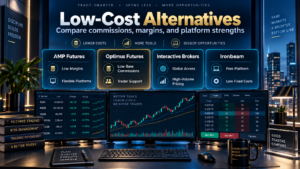
How to Choose Among the Cheapest Futures Brokers
Use this process before selecting one of the Cheapest Futures Brokers.
1. Estimate Monthly Contract Volume
Calculate both contract sides and complete round trips.
2. Identify Your Main Contracts
MES, MNQ, ES, NQ, CL, GC and other futures have different exchange costs.
3. Calculate the True Round Trip
Add every commission and transaction charge for both entry and exit.
4. Add Monthly Fixed Costs
Include software, market data and membership plans.
5. Compare the Correct Pricing Tier
High-volume tiers should not be compared with entry-level rates unless you realistically expect to qualify.
6. Consider Execution Technology
Saving a few cents per contract is not worthwhile if the platform does not support your trading workflow.
7. Recalculate Regularly
Rates change. The Cheapest Futures Brokers today may not have the same relative pricing one year from now.
Related Low-Cost Futures Guides
- Best Futures Brokers 2026
- Best Micro Futures Brokers 2026
- Best Futures Brokers for Small Accounts 2026
- Best Futures Brokers for Day Trading 2026
- Best Futures Brokers for Scalping 2026
- Best Futures Brokers for Beginners 2026
- Best Futures Trading Platforms 2026
- Best Automated Futures Trading Platforms 2026
- NinjaTrader vs Optimus Futures
- NinjaTrader vs Interactive Brokers
- NinjaTrader vs Webull
- NinjaTrader vs TradeStation
- NinjaTrader vs AMP Futures
- NinjaTrader vs Ironbeam
Cheapest Futures Brokers FAQ
What are the Cheapest Futures Brokers in 2026?
Our Cheapest Futures Brokers ranking places NinjaTrader first overall for its flexible $0/month, Monthly and Lifetime pricing structure. Optimus Futures, Interactive Brokers, Webull and TradeStation are also highly competitive depending on volume and trading style.
What is the cheapest futures broker for Micro futures?
NinjaTrader currently publishes Micro commissions as low as $0.09 per side on its Lifetime plan. Because the plan costs $1,499 upfront, traders should calculate whether their volume makes that pricing tier economical.
Is NinjaTrader one of the Cheapest Futures Brokers?
Yes. NinjaTrader is our #1 overall choice among the Cheapest Futures Brokers because users can start with a $0/month plan and move to lower commission tiers as trading activity increases.
How much does NinjaTrader charge for Micro futures?
NinjaTrader currently publishes $0.39 per Micro side on Free, $0.29 on Monthly and $0.09 on Lifetime before applicable exchange, clearing and NFA charges.
How much does NinjaTrader Lifetime cost?
NinjaTrader currently prices Lifetime at $1,499 as a one-time payment.
When does NinjaTrader Monthly beat the Free plan?
Using current Micro commission rates and ignoring third-party fees, approximately 495 one-contract Micro round trips per month generate roughly $99 of commission savings versus Free.
When does NinjaTrader Lifetime beat Free?
Using current Micro commissions, the $0.60 round-trip commission difference means approximately 2,499 one-contract Micro round trips equal the $1,499 Lifetime purchase price versus Free.
Is Optimus Futures cheap?
Yes. Optimus currently advertises Micro commissions starting around $0.25 per side, with lower rates potentially available to qualifying higher-volume traders.
Can Optimus Futures commissions go below $0.25?
Optimus states that high-volume traders can qualify for additional commission reductions. Exchange, clearing, NFA and other applicable costs remain separate.
Is Interactive Brokers cheap for futures?
IBKR can be extremely competitive for higher-volume traders. Selected U.S. Micro and E-micro futures currently use tiered execution pricing ranging from $0.25 down to $0.10 per contract depending on volume.
How much does Webull charge for Micro futures?
Webull currently advertises approximately $0.25 per Micro futures contract.
How much does TradeStation charge for Micro futures?
TradeStation currently publishes approximately $0.50 per side at the lowest volume tier, declining to $0.25 per side above 10,000 monthly contracts.
Is EdgeClear really $0.69 all-in on MES?
EdgeClear currently publishes a $0.69-per-side total for MES, MNQ, MYM and M2K under the specified Rithmic structure, consisting of exchange/NFA, commission and Rithmic transaction components.
Is Ironbeam one of the Cheapest Futures Brokers?
Ironbeam can be cost-efficient because its proprietary platform is currently free and qualifying non-professional users can receive CME market data without a separate standard platform/data charge. Commission depends on account conditions.
Is AMP Futures cheap?
AMP emphasizes low-cost futures trading, provides many free platform choices and publishes an exact-cost calculator because total pricing varies by contract, platform and data-feed configuration.
How much does tastytrade charge for Micro futures?
tastytrade currently charges $0.75 per Micro futures contract to open and $0.75 to close before applicable third-party fees.
How much does E*TRADE charge for futures?
E*TRADE currently charges $1.50 per futures contract per side plus applicable exchange and regulatory fees for standard non-cryptocurrency futures.
What does “per side” mean?
Per side means the commission is charged separately when entering and exiting. A $0.25-per-side commission therefore equals $0.50 in broker commission for one one-contract round trip before additional fees.
What does “all-in” futures pricing mean?
An all-in quote normally combines several transaction components, but the exact definition varies by broker. Always review which exchange, regulatory, clearing and routing costs are included.
Do the Cheapest Futures Brokers still charge exchange fees?
Usually yes. Exchange and regulatory charges commonly remain applicable even when broker commissions are extremely low.
Are free trading platforms really free?
A platform may have no separate software subscription while trading commissions, exchange fees, market data or other account charges still apply.
Are lower commissions always better?
No. Platform quality, execution, data, reliability, automation and support can be more important than saving a few cents per contract.
What is the cheapest broker for futures day trading?
NinjaTrader, AMP Futures, Optimus Futures and Ironbeam are particularly competitive for active futures day traders. The winner depends on contract, platform and monthly volume.
What is the cheapest broker for MES?
NinjaTrader can provide very low MES base commission under Lifetime, while Optimus, Interactive Brokers, Webull, AMP and EdgeClear offer different competitive structures. Compare complete MES round-trip costs rather than base commission alone.
What is the cheapest broker for high-volume futures trading?
NinjaTrader Lifetime, Optimus volume pricing, IBKR’s tiered schedule and TradeStation’s upper-volume tiers are all worth comparing for high-volume traders.
Which Cheapest Futures Brokers have no monthly platform fee?
NinjaTrader’s Free plan, Ironbeam’s native platform, Webull, tastytrade and many AMP platform configurations can operate without a standard recurring proprietary platform subscription, subject to their current conditions.
What should I calculate before choosing a cheap futures broker?
Calculate commission, exchange fees, NFA fees, clearing, routing, market data, platform cost and expected monthly trading volume. This provides a much more accurate comparison of the Cheapest Futures Brokers.
Final Verdict: Cheapest Futures Brokers 2026
The Cheapest Futures Brokers in 2026 cannot be ranked correctly by looking at a single commission number.
NinjaTrader is our #1 overall low-cost choice.
The main reason is pricing flexibility.
A low-volume trader can remain on Free with no monthly plan charge.
A more active trader can use Monthly to reduce per-contract costs.
A very active or long-term trader can consider Lifetime and access the current $0.09 Micro commission tier.
This structure gives NinjaTrader a strong position among the Cheapest Futures Brokers across several different activity levels rather than one narrow customer profile.
Optimus Futures ranks second because its standard Micro commission starts around $0.25 per side and qualifying higher-volume traders can obtain additional discounts.
Interactive Brokers ranks third because its tiered Micro execution fees can decline to $0.10 at high monthly volume while providing extensive global market access.
Webull provides one of the simplest low-cost Micro structures at $0.25 per contract.
TradeStation becomes increasingly competitive as contract volume rises.
EdgeClear deserves particular credit for publishing a transparent $0.69 all-in Rithmic structure for several major Micro equity-index contracts.
Ironbeam can reduce recurring operating expenses through free native software and qualifying market-data benefits.
AMP Futures provides a highly configurable low-cost architecture and exact-cost calculator rather than one universal rate.
tastytrade is attractive when futures are combined with options and a subscription-free platform matters.
E*TRADE has higher futures commissions than the specialist low-cost leaders but remains relevant for investors prioritizing traditional brokerage consolidation.
The central conclusion from our Cheapest Futures Brokers research is therefore:
Optimize total cost—not the headline commission.
A broker charging five cents less can still be more expensive after platform, routing and data costs. Conversely, paying for a lower commission tier only makes sense when trading volume generates enough savings to offset that fixed expense.
For TradeboticsAI’s audience of active futures and Micro futures traders, our final low-cost winner remains:
NinjaTrader — Best Overall Low-Cost Futures Broker for 2026.
Explore NinjaTrader and Start With Free Simulation →
Affiliate Disclosure: TradeboticsAI may receive compensation when visitors click certain affiliate links or complete qualifying actions. This does not increase the user’s cost and does not determine our rankings or editorial conclusions.
Risk Disclosure: Futures and options on futures involve substantial risk and are not appropriate for every investor. Low commissions do not reduce market risk. Reduced intraday margins increase leverage and can magnify losses rapidly. Margin does not represent maximum possible loss. Simulated and backtested results are hypothetical and may differ materially from live trading. Commission schedules, exchange fees, market-data costs, platform charges and margin requirements can change without notice. Verify current pricing directly with every provider before opening or funding an account. This material is educational only and is not financial, investment, tax or legal advice.