Best Micro Futures Brokers 2026: Top 10 for MES, MNQ & More

The Best Micro Futures Brokers in 2026 combine competitive per-contract commissions, efficient intraday margins, reliable futures execution and professional trading tools for contracts such as MES, MNQ, MYM, M2K, MGC and MCL. For active traders focused primarily on Micro futures, our top overall choice is NinjaTrader.
NinjaTrader leads our Best Micro Futures Brokers ranking because its futures-first ecosystem combines Micro commissions starting at $0.09 per side on the Lifetime plan, intraday margins beginning around $50 on selected popular Micro contracts, SuperDOM, Market Replay, Order Flow+, strategy backtesting and NinjaScript automation.
That does not mean NinjaTrader is automatically right for everyone. Optimus Futures can be compelling for traders who value personal futures-broker support. AMP Futures currently advertises a $100 account funding minimum and exceptionally low day margins. Interactive Brokers is attractive for global multi-asset traders, while TradeStation offers mature strategy development and Webull combines low Micro commissions with a modern cross-device platform.
This guide compares the Best Micro Futures Brokers by commissions, MES and MNQ margin requirements, platform technology, automation, market data, account structure and suitability for different trading styles.
Quick Answer: Best Micro Futures Brokers 2026
- NinjaTrader — Best Overall for Micro Futures
- Optimus Futures — Best for Broker Support
- AMP Futures — Best for Low Starting Capital
- Interactive Brokers — Best for Global Multi-Asset Traders
- TradeStation — Best for Systematic Micro Futures Trading
- Webull — Best Modern Low-Cost Multi-Device Broker
- Ironbeam — Best Free Native Futures Platform
- EdgeClear — Best Modular Futures Technology Stack
- tastytrade — Best for Micro Futures + Options
- E*TRADE — Best for Micro Futures Inside a Traditional Brokerage
TradeboticsAI Top Pick: NinjaTrader provides the strongest overall combination of low Micro commissions, specialist futures technology, low published intraday margins, simulation, backtesting and automation.
Explore NinjaTrader and Free Simulated Futures Trading →
Affiliate Disclosure: TradeboticsAI may receive compensation when visitors complete qualifying actions through certain links. Affiliate relationships do not determine our rankings. Micro futures remain leveraged derivatives and can produce substantial losses. Exchange, clearing, NFA, market-data and other fees may apply.
Table of Contents
- Best Micro Futures Brokers Ranking
- How We Ranked the Brokers
- What Are Micro Futures?
- 1. NinjaTrader
- 2. Optimus Futures
- 3. AMP Futures
- 4. Interactive Brokers
- 5. TradeStation
- 6. Webull
- 7. Ironbeam
- 8. EdgeClear
- 9. tastytrade
- 10. E*TRADE
- Micro Futures Commission Comparison
- MES and MNQ Margin Comparison
- Best Broker for MES
- Best Broker for MNQ
- Best Broker for Automated Micro Futures
- Best for Beginners
- How to Choose
- FAQ
- Final Verdict
Best Micro Futures Brokers 2026: Comparison Table

| Rank | Broker | Representative Micro Pricing | Margin Approach | Best For |
|---|---|---|---|---|
| 1 | NinjaTrader | $0.39 / $0.29 / $0.09 per side depending on plan | Selected popular Micros from $50 intraday | Active Micro futures traders |
| 2 | Optimus Futures | From $0.25/side on Micros; volume discounts available | MES/MYM/M2K from $50; MNQ from $100 | Personal support + platform flexibility |
| 3 | AMP Futures | Configuration-dependent | MES currently around $40 | Low starting capital |
| 4 | Interactive Brokers | Fixed about $0.25 or tiered $0.10–$0.25 + fees | Portfolio/risk-based broker framework | Global multi-asset traders |
| 5 | TradeStation | Micro from $0.50/side; high-volume tiers can reach $0.25 | Low intraday margin percentages on selected products | Systematic traders |
| 6 | Webull | $0.25 per Micro contract | Reduced intraday margin on selected contracts | Modern desktop/mobile traders |
| 7 | Ironbeam | Promotional Micro pricing can be available | MES/MYM/M2K $50; MNQ $100 currently | Free native futures platform |
| 8 | EdgeClear | $0.69 all-in/side on selected Micro indexes with current Rithmic structure | Account and FCM dependent | Custom platforms/data feeds |
| 9 | tastytrade | $0.75 open + $0.75 close per Micro contract | Broker/exchange-based | Micro futures + futures options |
| 10 | E*TRADE | $1.50 per contract per side + fees | Generally 50% of Initial Margin intraday for most products | Traditional multi-asset brokerage |
Pricing and margin requirements can change without notice. Some figures represent base commission while others include additional components. Always verify the complete round-trip cost directly with the broker.
How We Ranked the Best Micro Futures Brokers
Our Best Micro Futures Brokers ranking focuses on the practical requirements of traders using smaller futures contracts rather than general brokerage popularity.
Each broker was evaluated on:
- Micro futures commission structure
- MES and MNQ availability
- Intraday margin transparency
- Market-data costs
- Execution and DOM tools
- Desktop, Web and Mobile support
- Simulation and paper trading
- Automation and APIs
- Futures-specific customer support
- Total cost rather than headline commission alone
The Best Micro Futures Brokers should make it easy to understand the difference between broker commission, exchange fees, clearing fees, market-data fees and margin requirements.
We do not automatically reward the lowest margin. A $40 or $50 margin requirement does not reduce the underlying market risk of a futures contract. It simply allows greater leverage relative to the amount of capital posted.
What Are Micro Futures?
Micro futures are smaller versions of many popular futures contracts.
The best-known examples include:
- MES: Micro E-mini S&P 500
- MNQ: Micro E-mini Nasdaq-100
- MYM: Micro E-mini Dow
- M2K: Micro E-mini Russell 2000
- MGC: Micro Gold
- MCL: Micro WTI Crude Oil
- MBT: Micro Bitcoin
- MET: Micro Ether
For equity-index products, Micro E-minis provide approximately one-tenth the exposure of the corresponding E-mini contracts.
That smaller multiplier makes position sizing more granular, but Micro futures remain leveraged derivatives.
This is why choosing among the Best Micro Futures Brokers involves far more than finding the broker advertising the smallest deposit.
1. NinjaTrader — Best Overall Micro Futures Broker
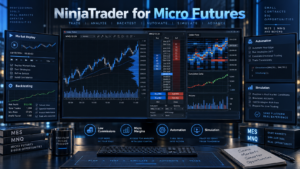
NinjaTrader ranks #1 among our Best Micro Futures Brokers for 2026.
The primary reason is specialization. Futures are the center of the NinjaTrader ecosystem rather than an additional asset class attached to a stock brokerage.
NinjaTrader provides:
- NinjaTrader Desktop
- NinjaTrader Web
- NinjaTrader Mobile
- SuperDOM
- Order Flow+
- Market Replay
- Strategy Analyzer
- NinjaScript C# automation
- Free simulated trading
NinjaTrader Micro Futures Commissions
| Plan | Plan Cost | Micro Commission |
|---|---|---|
| Free | $0/month | $0.39 per side |
| Monthly | $99/month | $0.29 per side |
| Lifetime | $1,499 one-time | $0.09 per side |
Exchange, clearing and NFA charges apply in addition to those commissions.
NinjaTrader Micro Margins
NinjaTrader currently advertises intraday margins beginning around $50 on popular Micro contracts including MES, MYM and M2K.
The margin policy can change in response to volatility and economic events.
Why NinjaTrader Is #1
Most of the Best Micro Futures Brokers can execute MES or MNQ. NinjaTrader differentiates itself by combining execution with a deeper futures development environment.
For active traders, SuperDOM supports ladder-based execution. Market Replay helps practice historical sessions. Strategy Analyzer supports backtesting, while NinjaScript lets C# developers build custom strategies and indicators.
Best for: active Micro traders, scalpers, systematic traders and futures-focused developers.
Main drawback: the lowest $0.09 Micro commission requires the $1,499 Lifetime plan.
View official NinjaTrader pricing →
2. Optimus Futures — Best for Personal Futures Broker Support
Optimus Futures is one of the strongest Best Micro Futures Brokers alternatives for traders who want specialist support alongside competitive pricing.
Current published Micro commissions begin at approximately $0.25 per side, with additional reductions possible for higher-volume traders.
Published day margins currently include approximately:
- MES: $50
- MNQ: $100
- MYM: $50
- M2K: $50
Optimus also provides a free proprietary environment through Optimus Flow and supports additional futures platforms depending on configuration.
Optimus Futures Strengths
- Micro commissions from $0.25/side
- Volume discounts
- Low published Micro margins
- Optimus Flow platform
- Futures-specialist support
- 24-hour trade desk
- Multiple platform choices
- Free Level 1 CME data under qualifying activity conditions
The personal brokerage model is useful for traders who want help selecting platforms, data feeds and account configurations.
Best for: traders who value futures-specific customer support.
View official Optimus Futures pricing →
Read NinjaTrader vs Optimus Futures →
3. AMP Futures — Best for Low Starting Capital
AMP Futures earns a high position among the Best Micro Futures Brokers because it combines a very low account activation threshold with aggressive futures margin requirements.
AMP currently requires a minimum deposit of approximately $100 to activate a live trading account and data connection.
Current published margin examples include:
- MES: approximately $40 per contract
- ES: approximately $400 per contract
AMP supports a broad ecosystem of futures platforms and data-feed configurations.
This allows technically experienced traders to select software based on their workflow rather than being locked into one front end.
AMP Futures Strengths
- $100 minimum account activation deposit
- MES day margin around $40
- Large platform selection
- Multiple routing/data options
- Day margins active through most of the trading session
- Strong appeal for cost-sensitive futures traders
The trade-off is complexity. Traders need to understand their platform, market-data subscription, routing structure and total all-in transaction cost.
Best for: experienced traders seeking low capital requirements and high platform flexibility.
Read NinjaTrader vs AMP Futures →
4. Interactive Brokers — Best for Global Micro Futures Trading
Interactive Brokers is one of the Best Micro Futures Brokers for traders whose futures positions form part of a broader global portfolio.
IBKR currently advertises Micro E-mini commissions around:
- $0.25 per contract under fixed pricing
- $0.10–$0.25 per contract under tiered pricing
Exchange and regulatory fees remain additional.
IBKR’s advantage is scale.
The same brokerage relationship can provide access to futures, stocks, options, currencies, bonds and funds across more than 170 markets in dozens of countries.
Why Choose Interactive Brokers?
- Competitive Micro futures commissions
- Global futures access
- Trader Workstation
- Advanced order types
- Professional APIs
- Portfolio margin and risk tools
- Multi-asset account architecture
Best for: advanced global traders and developers building API-driven multi-asset systems.
Main drawback: the platform is less futures-specialized and can be more complex for new retail traders.
View official IBKR Micro futures information →
Read NinjaTrader vs Interactive Brokers →
5. TradeStation — Best for Systematic Micro Futures Traders
TradeStation remains one of the Best Micro Futures Brokers for traders who prioritize strategy development and systematic execution.
Current Micro futures pricing starts around $0.50 per contract per side at lower monthly trading volumes.
Higher-volume traders can qualify for lower tiers, reaching approximately $0.25 per side at the highest published levels.
TradeStation currently advertises reduced intraday margins of approximately 10% of normal requirements on selected popular contracts, including MES.
TradeStation Strengths
- EasyLanguage
- Strategy backtesting
- Optimization
- Automated strategies
- Advanced charting
- APIs
- Real-time market data
- 600+ futures and futures-options products
EasyLanguage is especially attractive for traders who want automation without immediately learning a general-purpose language such as C# or C++.
Best for: systematic traders and strategy developers.
View official TradeStation futures trading →
Read NinjaTrader vs TradeStation →
6. Webull — Best Modern Low-Cost Micro Futures Broker
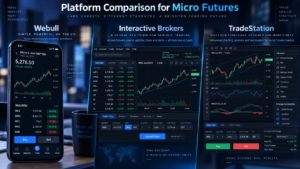
Webull has become a credible entry in the Best Micro Futures Brokers market by combining low commissions with familiar mobile and desktop software.
Webull currently advertises:
- Micro futures: $0.25 per contract
- Mini futures: $0.70 per contract
- Regular futures: $1.25 per contract
Webull also provides reduced intraday margins on selected futures products.
Current published examples include MES near $100, M2K near $50 and MYM around $60, although these values change as exchange and broker margin requirements change.
Webull Strengths
- $0.25 Micro commission
- Desktop, Web and Mobile access
- Free CME market data under current offering
- Unlimited paper trading
- Professional charting tools
- Futures risk monitoring
- Large range of Micro contracts
Webull’s Micro lineup extends beyond equity indices into metals, energy, currencies, crypto futures and Micro yield products.
Best for: traders wanting low-cost Micro futures inside a modern multi-device brokerage ecosystem.
View official Webull futures trading →
7. Ironbeam — Best Free Native Micro Futures Platform
Ironbeam is another futures specialist deserving inclusion among the Best Micro Futures Brokers.
Its current margin schedule includes approximately:
- MES: $50
- MNQ: $100
- MYM: $50
- M2K: $50
- MGC: $100
- MCL: $200
The proprietary Ironbeam platform is currently offered without a monthly software charge and includes desktop, Web and mobile access.
Ironbeam also offers more than 300 indicators and API infrastructure using REST and WebSockets.
Ironbeam Strengths
- No general funding minimum to open an account
- Low Micro day margins
- Free proprietary futures platform
- Windows and Mac access
- Web and Mobile
- 300+ indicators
- TradingView compatibility
- Futures API
Promotional Micro commission structures may be available to qualifying new customers, but eligibility requirements should always be verified directly.
Best for: traders who want a futures-focused cross-platform environment without a recurring proprietary platform fee.
View official Ironbeam Micro futures →
Read NinjaTrader vs Ironbeam →
8. EdgeClear — Best Modular Micro Futures Broker
EdgeClear is one of the more specialized entries in the Best Micro Futures Brokers ranking.
Its current published Rithmic pricing for selected Micro equity-index futures is approximately:
- MES: $0.69 all-in per side
- MNQ: $0.69 all-in per side
- MYM: $0.69 all-in per side
- M2K: $0.69 all-in per side
The stated total currently includes exchange/NFA fees, EdgeClear commission and the reduced Rithmic transaction charge under the published structure.
EdgeClear’s major advantage is technology choice.
Depending on the account setup, traders can use environments involving:
- Rithmic
- CQG
- Sierra Chart Teton
- EdgeProX
- TradingView
- Bookmap
- Quantower
- MultiCharts
- Other professional futures platforms
Best for: experienced traders who know exactly which futures platform and data feed they want.
View official EdgeClear Micro pricing →
Read NinjaTrader vs EdgeClear →
9. tastytrade — Best for Micro Futures and Options
tastytrade differs from many of the Best Micro Futures Brokers because it is particularly strong for traders combining futures with options.
Current published pricing includes:
- Micro futures: $0.75 per contract to open
- Micro futures: $0.75 per contract to close
- Options on Micro futures: $0.75 per contract each side
Exchange, clearing and regulatory charges remain additional.
tastytrade supports futures, options on futures, stocks, equity options and other products inside a single active-trading ecosystem.
tastytrade Strengths
- Micro and Mini futures
- Options on Micro futures
- Desktop, Web and Mobile
- Active Trader interface
- Portfolio risk tools
- Open API
- Sandbox for API development
Best for: traders combining Micro futures with options and portfolio-level derivatives strategies.
Main drawback: pure Micro scalpers can find lower base commissions at specialist futures brokers.
View official tastytrade pricing →
Read NinjaTrader vs tastytrade →
10. E*TRADE — Best for Micro Futures Inside a Traditional Brokerage
E*TRADE completes our Best Micro Futures Brokers ranking for a very different type of trader.
E*TRADE is not primarily a futures specialist. Its advantage is allowing eligible customers to combine futures with:
- Stocks
- ETFs
- Options
- Bonds
- Mutual funds
- Other traditional investments
E*TRADE currently charges approximately $1.50 per futures contract per side plus applicable fees.
Its intraday futures framework generally uses around 50% of exchange Initial Margin for most eligible non-Bitcoin products.
Power E*TRADE provides futures ladders, charting, Web access and mobile trading.
Best for: investors who trade Micro futures occasionally inside a larger brokerage portfolio.
Main drawback: high-frequency Micro traders can generally find lower transaction costs and lower intraday margin requirements at specialist futures brokers.
View official E*TRADE futures information →
Best Micro Futures Brokers by Commission
Commission is one of the most important factors when evaluating the Best Micro Futures Brokers, especially for traders executing many round trips per month.
| Broker | Representative Micro Pricing |
|---|---|
| NinjaTrader | $0.39 / $0.29 / $0.09 per side depending on plan |
| Optimus Futures | From $0.25/side; volume discounts may reduce further |
| Interactive Brokers | Fixed around $0.25 or tiered approximately $0.10–$0.25 + fees |
| TradeStation | From $0.50/side at lower volume; high-volume tiers can reach $0.25 |
| Webull | $0.25 per Micro contract |
| EdgeClear | Selected index Micros approximately $0.69 all-in/side under current Rithmic structure |
| tastytrade | $0.75 open + $0.75 close |
| E*TRADE | $1.50/side + applicable fees |
Do not compare these numbers blindly. Some are base commissions while others are all-in structures. Exchange, clearing, regulatory, routing and platform costs can materially change the final round-trip expense.
Best Micro Futures Brokers by MES and MNQ Margin
Margin differences among the Best Micro Futures Brokers can be substantial.
Representative current published examples include:
- AMP Futures: MES around $40
- NinjaTrader: selected popular Micro index futures around $50
- Optimus Futures: MES $50 and MNQ $100
- Ironbeam: MES $50 and MNQ $100
- Webull: reduced intraday margins that currently vary by contract and market conditions
- E*TRADE: typically a percentage of exchange Initial Margin rather than an ultra-low fixed amount
A low margin requirement is not a recommendation to use maximum leverage.
MES and MNQ retain the same profit-and-loss behavior regardless of how little capital the broker requires to open the contract.
Best Micro Futures Broker for MES
For MES specifically, NinjaTrader is our top choice among the Best Micro Futures Brokers.
Reasons include:
- Micro commissions as low as $0.09 per side on Lifetime
- Published MES-style intraday margin around $50
- SuperDOM
- Market Replay
- Free simulation
- NinjaScript automation
- Strategy Analyzer
AMP Futures can offer even lower published MES margin requirements, while Optimus and Ironbeam provide strong $50-class alternatives.
Interactive Brokers and Webull are compelling when futures sit within a broader multi-asset portfolio.
Best Micro Futures Broker for MNQ
MNQ is often more volatile in dollar terms than MES because the Nasdaq-100 can move quickly during technology-sector volatility and major macroeconomic events.
The Best Micro Futures Brokers for MNQ should therefore combine competitive pricing with strong execution and risk controls.
NinjaTrader remains our preferred futures-first environment, while Optimus and Ironbeam currently publish MNQ day margins around $100.
Webull provides MNQ with reduced intraday margin and a $0.25 Micro commission, while IBKR gives traders access through a broader global brokerage framework.
Best Micro Futures Brokers for Automated Trading
Automation can dramatically change which of the Best Micro Futures Brokers is most attractive.
NinjaTrader is our first choice for native futures automation because NinjaScript uses C# and works directly with Strategy Analyzer, simulation and live execution.
TradeStation is excellent for EasyLanguage users.
Interactive Brokers is strong for external API infrastructure.
Ironbeam provides REST/WebSocket connectivity for developers building independent futures applications.
tastytrade provides an Open API that supports futures and other asset classes.
The correct architecture depends on whether your strategy runs inside the trading platform or on an external server.
Best Micro Futures Brokers for Beginners
For beginners, the Best Micro Futures Brokers are not necessarily those advertising the smallest margin.
A new trader should prioritize:
- Free or inexpensive simulation
- Clear contract specifications
- Transparent fees
- Easy order entry
- Reliable risk controls
- Good educational resources
- Responsive support
NinjaTrader provides unlimited simulated trading and futures-focused education. Optimus Futures is strong when personal broker assistance is important. Webull offers unlimited paper trading and a familiar modern interface.
Before trading live, understand the tick size and tick value of the specific Micro contract.
For example, one MES tick represents a different dollar amount from an MNQ or M2K tick. Smaller contract size does not eliminate futures risk.
How to Choose Among the Best Micro Futures Brokers
1. Calculate Your All-In Round-Trip Cost
A commission advertised at $0.09 or $0.25 is not necessarily the complete cost.
Calculate:
- Opening commission
- Closing commission
- Exchange fees
- NFA fees
- Clearing fees
- Routing fees
- Market-data fees
- Platform subscriptions
2. Compare MES and MNQ Margins Separately
Do not assume every Micro contract uses the same margin.
MNQ, MGC, MCL, MBT and other Micros can have very different risk and margin profiles.
3. Decide Whether You Need a DOM
Active scalpers may value SuperDOM, ladder trading and full market depth far more than long-term or chart-based traders.
4. Decide Whether You Need Automation
If you plan to run algorithmic strategies, select the software architecture before optimizing commissions.
5. Test in Simulation
The best platform on paper may not be the platform that fits your execution workflow.
Practice order entry, stops, flattening, brackets and position management before risking capital.
Our #1 Micro Futures Broker for 2026
NinjaTrader combines competitive Micro commissions, low published intraday margins, SuperDOM, Market Replay, NinjaScript automation, strategy backtesting and free simulated trading.
Start with simulation. Reduced Micro futures margin increases leverage and does not reduce the financial risk of the underlying contract.

Related Micro Futures and Broker Comparisons
- Best Futures Trading Platforms 2026
- Best Automated Futures Trading Platforms 2026
- NinjaTrader vs Optimus Futures 2026
- NinjaTrader vs AMP Futures 2026
- NinjaTrader vs Interactive Brokers 2026
- NinjaTrader vs TradeStation 2026
- NinjaTrader vs Webull 2026
- NinjaTrader vs Ironbeam 2026
- NinjaTrader vs EdgeClear 2026
- NinjaTrader vs tastytrade 2026
- NinjaTrader vs E*TRADE 2026
Best Micro Futures Brokers FAQ
What are the Best Micro Futures Brokers in 2026?
Our Best Micro Futures Brokers ranking places NinjaTrader first overall, followed by Optimus Futures, AMP Futures, Interactive Brokers, TradeStation, Webull, Ironbeam, EdgeClear, tastytrade and E*TRADE. The best choice depends on trading frequency, platform requirements, automation and margin preferences.
Which Best Micro Futures Brokers have the lowest commissions?
NinjaTrader can publish Micro commissions as low as $0.09 per side under its Lifetime plan. Interactive Brokers, Optimus Futures, Webull and high-volume TradeStation tiers can also offer competitive Micro pricing.
Which broker is best for MES?
Our top MES choice is NinjaTrader because it combines low Micro commissions, low published intraday margins and professional futures tools. AMP Futures, Optimus Futures and Ironbeam are also competitive for MES.
Which broker is best for MNQ?
NinjaTrader is our preferred futures-first environment for MNQ. Optimus Futures and Ironbeam currently advertise MNQ margins around $100, while Webull and Interactive Brokers provide strong multi-asset alternatives.
Which Best Micro Futures Brokers have $50 margins?
NinjaTrader, Optimus Futures and Ironbeam currently publish $50-class intraday margins on selected Micro contracts. Requirements vary by contract and can change without notice.
Does AMP Futures really have a $40 MES margin?
AMP’s current published information lists approximately $40 as the MES day-trading margin. Margin rates can change and should always be verified before trading.
How much does NinjaTrader charge for Micro futures?
NinjaTrader currently publishes $0.39 per side on Free, $0.29 on Monthly and $0.09 on Lifetime before applicable exchange, clearing and NFA fees.
How much does Optimus Futures charge for Micros?
Optimus Futures currently advertises Micro commissions from approximately $0.25 per side, with additional volume discounts potentially available.
How much does Interactive Brokers charge for Micro futures?
Interactive Brokers currently advertises fixed Micro E-mini pricing around $0.25 per contract or approximately $0.10–$0.25 under tiered pricing, plus exchange and regulatory fees.
How much does Webull charge for Micro futures?
Webull currently advertises Micro futures commissions of approximately $0.25 per contract.
How much does TradeStation charge for Micro futures?
TradeStation currently lists approximately $0.50 per contract per side at lower trading volumes, with higher-volume tiers capable of reaching approximately $0.25 per contract per side.
How much does tastytrade charge for Micro futures?
tastytrade currently charges $0.75 per Micro futures contract to open and $0.75 to close, before applicable exchange, clearing and regulatory costs.
Is Ironbeam good for Micro futures?
Yes. Ironbeam offers a broad Micro contract lineup, low published day margins, a free native futures platform and API connectivity.
Is EdgeClear good for Micro futures?
Yes. EdgeClear is particularly attractive to experienced traders seeking Rithmic, CQG, Teton or other specialized futures technology. Its current published Rithmic structure shows approximately $0.69 all-in per side on selected Micro equity-index contracts.
Are Micro futures safer than E-mini futures?
Micro futures have smaller contract multipliers, allowing more granular position sizing. They remain leveraged derivatives and can still produce substantial losses.
How much money do I need to trade MES?
The broker’s minimum day margin can be as low as roughly $40–$50 at some specialist brokers, but that is not a recommended account size. Traders need sufficient capital to withstand normal price movement and potential losses.
How much money do I need to trade MNQ?
Requirements differ by broker. Some futures specialists currently publish MNQ day margins around $100. The appropriate account balance should be significantly larger than the minimum margin if normal risk management is applied.
Which Best Micro Futures Brokers offer simulation?
NinjaTrader, Optimus Futures, AMP-compatible platforms, TradeStation, Webull, Ironbeam and several other providers offer simulation or paper-trading environments depending on the platform configuration.
Which broker is best for automated Micro futures trading?
NinjaTrader is our top choice because NinjaScript, Strategy Analyzer, Market Replay and live execution operate inside one futures-first environment.
Which broker is best for Python-based Micro futures automation?
External API brokers such as Interactive Brokers, tastytrade and Ironbeam can be suitable for custom infrastructure where a Python strategy engine communicates with the execution API.
Do I need Level 2 market data for MES or MNQ?
Not necessarily. Chart-based traders may only require top-of-book data. DOM scalpers and order-flow traders are more likely to benefit from full market-depth data.
Are Micro futures good for beginners?
They can provide smaller exposure than full-sized contracts, but beginners should first understand leverage, tick values, margin, expiration and order management and should consider using simulation before live trading.
Can I lose more than my Micro futures margin?
Yes. Margin is collateral required to maintain a position, not a maximum-loss amount. Market losses can exceed the margin initially required to open the trade.
What should I compare between the Best Micro Futures Brokers?
Compare all-in round-trip costs, MES and MNQ margins, market data, platform fees, execution tools, automation, simulation, account funding requirements and customer support.
Final Verdict: Best Micro Futures Brokers 2026
The Best Micro Futures Brokers in 2026 serve several different trader profiles, but our overall winner is NinjaTrader.
NinjaTrader ranks #1 because it is designed around active futures trading from the ground up.
Its commission structure allows traders to choose between Free, Monthly and Lifetime plans, with Micro commissions declining from $0.39 to $0.29 and ultimately $0.09 per side before applicable third-party fees.
Low published intraday margins are another major advantage, but the platform technology is what separates NinjaTrader from many competing Best Micro Futures Brokers.
SuperDOM provides futures-specific ladder execution. Market Replay allows historical sessions to be replayed. Strategy Analyzer provides systematic testing, while NinjaScript enables C# strategy automation.
Optimus Futures ranks second for traders wanting competitive Micro commissions combined with futures-specialist support.
AMP Futures ranks third because of its $100 activation minimum, very low published MES margin and broad platform ecosystem.
Interactive Brokers is particularly strong for global multi-asset traders, while TradeStation is one of the strongest alternatives for systematic strategy developers.
Webull now offers highly competitive $0.25 Micro pricing and a modern multi-device trading experience.
Ironbeam provides a compelling futures-native proposition with low Micro margins and a free proprietary platform.
EdgeClear is best suited to traders who want to construct a customized professional futures stack around platforms and data feeds such as Rithmic, CQG or Teton.
tastytrade stands out when Micro futures are combined with options and futures options.
E*TRADE is most attractive when futures represent only one component of a larger traditional investment portfolio.
For active MES and MNQ traders, however, our final ranking among the Best Micro Futures Brokers remains:
NinjaTrader — Best Overall Micro Futures Broker for 2026.
Explore NinjaTrader and Start with Free Simulation →
Affiliate Disclosure: TradeboticsAI may receive compensation when visitors click certain affiliate links or complete qualifying actions. This does not increase the user’s cost and does not determine our rankings or editorial conclusions.
Risk Disclosure: Futures and options on futures involve substantial risk and are not suitable for every investor. Micro contracts have smaller multipliers than many standard futures contracts but remain leveraged products. Reduced intraday margin increases leverage and should not be interpreted as reduced financial risk. Losses can exceed the capital initially used to establish a position depending on market and account conditions. Simulated, replayed and backtested performance is hypothetical and does not guarantee future results. Verify current commissions, margin requirements, exchange fees, data costs and account conditions directly with each provider. This content is educational only and is not financial, investment, legal or tax advice.