NinjaTrader vs E*TRADE 2026: Which Is Better for Futures Trading?
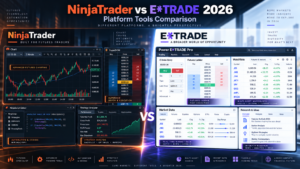
NinjaTrader vs E*TRADE is an important 2026 comparison for traders deciding between a specialized futures ecosystem and a large multi-asset brokerage backed by Morgan Stanley.
NinjaTrader is built primarily around active futures trading. Its ecosystem combines futures brokerage, Desktop, Web and Mobile platforms, SuperDOM, Market Replay, Order Flow+, strategy backtesting and C#-based NinjaScript automation.
E*TRADE takes a broader approach. Through E*TRADE from Morgan Stanley and E*TRADE Futures LLC, customers can access stocks, ETFs, options, bonds, mutual funds, futures and options on futures while using Power E*TRADE platforms across desktop, web and mobile.
This detailed NinjaTrader vs E*TRADE 2026 comparison examines commissions, Micro futures, intraday margins, market data, platforms, futures ladders, automation, backtesting, mobile trading, IRAs and overall trading costs.
Quick Answer
Choose NinjaTrader if futures are your primary market and you want low published intraday margins, plan-based commissions, SuperDOM, NinjaScript automation, Market Replay and integrated strategy testing.
Choose E*TRADE if you want futures inside a broader brokerage account that also handles stocks, ETFs, options, bonds and other investments, with Power E*TRADE providing professional trading tools across desktop, web and mobile.
TradeboticsAI Verdict: For dedicated active futures trading, NinjaTrader has the stronger specialist proposition. E*TRADE is more attractive for multi-asset investors who want futures integrated into a broader Morgan Stanley-backed brokerage relationship.
Explore NinjaTrader and Free Simulated Futures Trading →
Affiliate disclosure: TradeboticsAI may receive compensation when visitors complete qualifying actions through certain links. Futures and options on futures involve substantial risk. Simulated and backtested performance is hypothetical. Exchange, NFA, clearing, data and other fees may apply.
Table of Contents
- NinjaTrader vs E*TRADE Overview
- Quick Comparison
- Broker Structure
- Futures Commissions
- Micro Futures
- Futures Margins
- Account Minimums
- Available Futures Markets
- Trading Platforms
- SuperDOM vs Futures Ladder
- Charting and Analysis
- Market Data Costs
- Automated Trading
- Backtesting and Simulation
- Multi-Asset Trading
- Options on Futures
- Web and Mobile Trading
- Futures in IRAs
- Customer Support
- Total Cost Comparison
- Pros and Cons
- Which Should You Choose?
- Related Comparisons
- FAQ
- Final Verdict
NinjaTrader vs E*TRADE 2026: Overview
The core difference in NinjaTrader vs E*TRADE is specialization versus diversification.
NinjaTrader
NinjaTrader is designed primarily around futures traders.
The ecosystem includes:
- NinjaTrader Desktop
- NinjaTrader Web
- NinjaTrader Mobile
- SuperDOM
- Advanced charting
- Order Flow+
- Market Replay
- Strategy Analyzer
- NinjaScript C# development
- Simulated trading
NinjaTrader Clearing, LLC operates as a registered Futures Commission Merchant.
E*TRADE
E*TRADE from Morgan Stanley is a broad brokerage ecosystem rather than a futures-only operation.
E*TRADE Futures LLC provides commodity futures and options on futures services and is a Member NFA.
Customers can combine futures with:
- Stocks
- ETFs
- Equity options
- Mutual funds
- Bonds
- CDs
- Cryptocurrency exposure
- Other brokerage investments
E*TRADE’s major advantage is therefore account consolidation.
NinjaTrader’s major advantage is specialization.
NinjaTrader vs E*TRADE: Quick Comparison
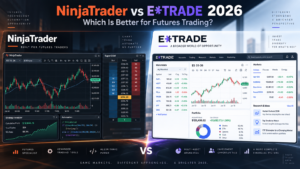
| Category | NinjaTrader | E*TRADE |
|---|---|---|
| Primary Focus | Futures specialist | Multi-asset brokerage |
| Micro Futures Commission | From $0.09 per side | $1.50 per contract per side + fees |
| Standard Futures Commission | From $0.59 per side | $1.50 per contract per side + fees |
| Crypto Futures Commission | Contract-dependent | $2.50 per contract per side + fees |
| Intraday Margin | From $50 on selected Micros | Normally 50% of Initial Margin except Bitcoin |
| General Futures Funding Minimum | No general minimum | No general minimum |
| Desktop | NinjaTrader Desktop | Power E*TRADE Pro |
| Web | Yes | Power E*TRADE Web |
| Mobile | Yes | Power E*TRADE App |
| Futures Ladder | SuperDOM | Power E*TRADE Futures Ladder |
| Native Automation | NinjaScript / C# | No comparable native futures strategy framework |
| Backtesting | Strategy Analyzer + Market Replay | Paper Trading and analysis tools |
| Markets | Broad futures catalog | 60+ futures products |
| Best For | Dedicated futures traders | Multi-asset traders and investors |
NinjaTrader vs E*TRADE Broker Structure
Both companies provide regulated access to U.S. futures markets, but their structures differ.
NinjaTrader
NinjaTrader operates through affiliated companies under NinjaTrader Group.
NinjaTrader, LLC develops the trading software while NinjaTrader Clearing, LLC handles futures brokerage and clearing activities as an FCM.
This produces a tightly integrated futures environment.
E*TRADE
E*TRADE Futures LLC provides futures and futures-options products and services.
E*TRADE states that Morgan Stanley & Co. is its clearing firm for futures.
The futures relationship can also connect with an E*TRADE margin brokerage account, allowing eligible customers to manage futures alongside other investments.
This integration is particularly useful for traders who do not want a separate broker for every asset class.
NinjaTrader vs E*TRADE Futures Commissions
Commission pricing creates one of the biggest differences in the NinjaTrader vs E*TRADE comparison.
NinjaTrader Pricing
| Plan | Plan Cost | Micro / e-Nano | Standard |
|---|---|---|---|
| Free | $0/month | $0.39 per side | $1.29 per side |
| Monthly | $99/month | $0.29 per side | $0.99 per side |
| Lifetime | $1,499 one-time | $0.09 per side | $0.59 per side |
Exchange, clearing and NFA fees remain additional.
Verify current rates on the official NinjaTrader pricing page.
E*TRADE Futures Pricing
E*TRADE currently charges:
- $1.50 per futures contract per side + fees
- $2.50 per cryptocurrency futures contract per side + fees
Applicable exchange, NFA and other charges remain additional.
Verify current rates on the official E*TRADE pricing page.
Which Has Lower Futures Commissions?
For frequent Micro futures trading, NinjaTrader has the stronger published commission structure.
The NinjaTrader Free plan already starts below E*TRADE’s $1.50 futures commission, while the Monthly and Lifetime plans reduce the NinjaTrader base commission further.
E*TRADE’s pricing is simpler because the same $1.50 commission generally applies across standard futures and Micro futures, excluding crypto futures.
That simplicity may appeal to occasional futures traders.
For high-volume traders, however, the difference in per-contract cost can become significant.
NinjaTrader vs E*TRADE for Micro Futures
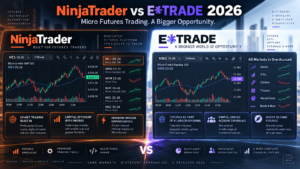
Both brokers support Micro futures.
Popular contracts can include:
- MES — Micro E-mini S&P 500
- MNQ — Micro E-mini Nasdaq-100
- MYM — Micro E-mini Dow
- M2K — Micro E-mini Russell 2000
- MGC — Micro Gold
- MBT — Micro Bitcoin Futures where supported
Micro futures are designed with smaller contract multipliers than their corresponding standard contracts, but they remain leveraged products with substantial risk.
NinjaTrader Micro Advantage
NinjaTrader prices Micro contracts separately from standard futures and currently offers rates as low as $0.09 per side under its Lifetime plan.
E*TRADE Micro Advantage
E*TRADE allows futures to sit alongside the trader’s broader brokerage portfolio.
For somebody who trades futures only occasionally as part of a stock, ETF or options strategy, that convenience may outweigh paying a higher futures commission.
NinjaTrader vs E*TRADE Futures Margins
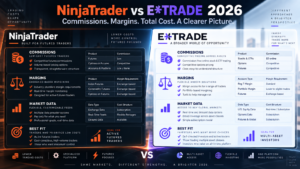
Margin creates an even larger strategic difference than commission.
NinjaTrader Intraday Margin
NinjaTrader publishes reduced day-trading margins for many contracts.
Current examples include:
- Micro E-mini S&P 500: around $50
- Micro E-mini Dow: around $50
- Micro E-mini Russell 2000: around $50
- E-mini S&P 500: around $500
- E-mini Dow: around $500
- E-mini Russell 2000: around $500
Margin requirements can change according to market volatility and risk conditions.
E*TRADE Futures Margin
E*TRADE currently states that futures intraday margining for products other than Bitcoin is normally 50% of the exchange Initial Margin requirement.
Positions held overnight require 100% of exchange minimum margin requirements.
E*TRADE can increase these requirements at any time.
Why This Matters
NinjaTrader’s reduced fixed day margins can require substantially less capital to initiate an intraday position than the percentage-based framework used by E*TRADE.
This does not mean NinjaTrader trades are safer.
Lower required margin creates greater leverage relative to account equity and can accelerate both gains and losses.
Capital-efficient active futures trading: NinjaTrader.
More conservative brokerage-style margin framework: E*TRADE.
NinjaTrader vs E*TRADE Minimum Deposit
Neither provider currently imposes a general funding minimum for a standard futures account.
However, the absence of an account-opening minimum should not be confused with the amount of capital required to trade safely.
Every position must still satisfy:
- Applicable intraday margin
- Initial margin
- Maintenance margin
- Broker risk requirements
- Potential market losses
E*TRADE also has separate requirements for futures-enabled IRAs, discussed later in this comparison.
Available Futures Markets
E*TRADE currently advertises access to more than 60 futures products listed on:
- CME Group
- ICE U.S.
- CFE
The product lineup spans categories such as:
- Equity indexes
- Energy
- Metals
- Interest rates
- Currencies
- Agriculture
- Volatility
- Cryptocurrency futures
E*TRADE advertises futures-market access approximately 24 hours per day, six days per week where applicable.
NinjaTrader also provides access to a broad range of futures across major exchanges and is built specifically around active derivatives trading.
For most retail index, energy, metals and financial-futures traders, both ecosystems cover the primary markets.
NinjaTrader vs E*TRADE Trading Platforms
Both providers now offer multiple device formats.
NinjaTrader
- NinjaTrader Desktop
- NinjaTrader Web
- NinjaTrader Mobile
NinjaTrader Desktop is the centerpiece for advanced traders because it contains NinjaScript, Strategy Analyzer, SuperDOM, Market Replay and extensive customization.
E*TRADE
E*TRADE’s active-trading ecosystem includes:
- Power E*TRADE Pro desktop
- Power E*TRADE Web
- Power E*TRADE App
- E*TRADE Web
- E*TRADE App
Power E*TRADE Pro supports stocks, ETFs, options, futures and options on futures in one desktop environment.
See the official Power E*TRADE Pro page.
Deep futures specialization: NinjaTrader.
Multi-asset integration: E*TRADE.
NinjaTrader SuperDOM vs Power E*TRADE Futures Ladder
Active futures traders often execute directly from a price ladder rather than using a basic order ticket.
NinjaTrader SuperDOM
SuperDOM provides an advanced depth-of-market environment for:
- Bid/ask depth
- Order placement
- Working-order management
- Position management
- ATM strategies
- Custom NinjaScript extensions
Power E*TRADE Futures Ladder
Power E*TRADE Pro also provides a dedicated Futures Ladder.
The ladder displays:
- Futures prices
- Bid size
- Ask size
- Working buy orders
- Working sell orders
- Volume information
Power E*TRADE Pro can use multiple futures ladders and provides functionality for quickly placing, flattening or reversing positions.
Customization and futures-specific depth: NinjaTrader SuperDOM.
Integrated ladder inside a broader multi-asset platform: Power E*TRADE Pro.
NinjaTrader vs E*TRADE Charting and Technical Analysis
NinjaTrader is widely oriented toward futures chart customization and order-flow analysis.
Its environment supports:
- Custom indicators
- Multiple chart types
- Order Flow+
- Market Replay
- Strategy overlays
- NinjaScript development
Power E*TRADE also provides substantial charting capabilities.
E*TRADE currently advertises features including:
- 16 chart types
- 120+ technical studies
- 30+ drawing tools
- Automatic technical pattern recognition
- Customizable desktop workspaces
For discretionary traders, both provide strong charting.
For developers who want to program their own indicators and automated strategy logic directly into the platform, NinjaTrader has the clearer advantage.
NinjaTrader vs E*TRADE Market Data Costs
Market-data pricing deserves attention because it can change total monthly trading cost.
E*TRADE
E*TRADE currently states that it absorbs CME Group and CFE quote fees for non-professional futures clients.
ICE U.S. market-data fees are passed through to customers.
This can be an attractive benefit for occasional or multi-asset futures traders.
NinjaTrader
NinjaTrader offers market-data packages and subscription structures depending on exchange and depth requirements.
Traders requiring full market depth should calculate those subscriptions as part of their total cost.
Therefore, while NinjaTrader can offer substantially lower futures commissions, E*TRADE may offset part of the difference for certain non-professional traders through absorbed CME/CFE quote fees.
NinjaTrader vs E*TRADE Automated Trading
This is one of NinjaTrader’s clearest advantages.
NinjaTrader NinjaScript
NinjaTrader provides NinjaScript, a C#-based development framework.
Developers can build:
- Automated strategies
- Custom indicators
- Trading signals
- Custom order-management logic
- SuperDOM extensions
- Platform add-ons
- Strategy optimizations
The same ecosystem can then be used for historical testing, simulation and live execution.
E*TRADE
Power E*TRADE provides advanced discretionary trading tools, conditional orders and professional execution interfaces.
However, it does not provide a native futures strategy-development framework directly comparable to NinjaScript.
For traders whose primary goal is systematic futures strategy development, the NinjaTrader vs E*TRADE decision therefore strongly favors NinjaTrader.
NinjaTrader vs E*TRADE Backtesting and Simulation
NinjaTrader
NinjaTrader provides an integrated environment including:
- Strategy Analyzer
- Historical backtesting
- Optimization
- Market Replay
- Simulated trading
- NinjaScript strategy development
Market Replay can reproduce historical tick-by-tick market behavior for practice and research.
E*TRADE
Power E*TRADE Pro provides Paper Trading.
The simulated environment currently uses virtual buying power so traders can practice platform usage and test trading ideas without risking real capital.
Paper trading is useful for execution practice, but it should not be confused with NinjaTrader’s deeper native systematic backtesting framework.
Integrated quantitative strategy research: NinjaTrader.
Multi-asset paper trading: E*TRADE.
NinjaTrader vs E*TRADE for Multi-Asset Trading
This is where E*TRADE becomes significantly stronger.
A single E*TRADE brokerage relationship can provide access to:
- Stocks
- ETFs
- Options
- Futures
- Options on futures
- Bonds
- Mutual funds
- CDs
- Other investment products
Power E*TRADE Pro can also combine several active-trading products in one interface.
NinjaTrader’s focus is intentionally narrower.
If your activity is primarily MES, MNQ, ES, NQ, CL, GC and other futures, specialization can be an advantage.
If futures represent only one part of a diversified portfolio, E*TRADE’s broader account structure may be more convenient.
NinjaTrader vs E*TRADE for Options on Futures
E*TRADE officially supports both futures and options on futures.
Power E*TRADE Pro combines derivatives functionality with advanced options analysis tools.
This makes E*TRADE particularly interesting for traders who regularly combine:
- Equity options
- Futures
- Options on futures
- Stocks and ETFs
NinjaTrader remains more directly optimized around active futures execution and systematic futures strategies.
For a trader whose portfolio involves complex cross-asset derivatives, E*TRADE can provide a more consolidated environment.
NinjaTrader vs E*TRADE Web and Mobile Trading
Both providers now extend well beyond desktop software.
NinjaTrader
- Desktop
- Web
- Mobile
E*TRADE
- Power E*TRADE Pro desktop
- Power E*TRADE Web
- Power E*TRADE App
- Standard E*TRADE Web and app
Power E*TRADE is particularly useful for traders who want their stocks, options and futures accessible within the same broader ecosystem.
NinjaTrader’s Web and Mobile applications are more directly aligned with its futures-first workflow.
NinjaTrader vs E*TRADE Futures in IRAs
E*TRADE supports futures trading in certain eligible Traditional, Rollover and Roth IRAs, subject to approval and account requirements.
E*TRADE currently states that futures-enabled IRAs must maintain at least $25,000 in equity.
Futures IRAs are also currently margined at 200% of initial requirements.
Not every futures product is available in every account type.
For retirement investors seeking to integrate approved futures positions into an existing broader brokerage relationship, E*TRADE’s IRA infrastructure is a meaningful feature.
NinjaTrader vs E*TRADE Customer Support
NinjaTrader provides support centered specifically around futures brokerage and its own trading software.
This can be useful for technical questions involving:
- NinjaTrader Desktop
- SuperDOM
- Market data
- Futures orders
- Brokerage accounts
- NinjaScript-related platform workflows
E*TRADE provides broader brokerage support and also advertises access to licensed Futures Specialists.
This allows customers to obtain futures-specific assistance while maintaining their broader Morgan Stanley-backed brokerage relationship.
Specialist futures ecosystem: NinjaTrader.
Broader financial-services ecosystem: E*TRADE.
NinjaTrader vs E*TRADE Total Trading Costs
A serious comparison should consider total cost rather than commission alone.
NinjaTrader Costs Can Include:
- Futures commission
- Exchange fees
- NFA fees
- Clearing fees
- Market-data subscriptions
- $99 Monthly plan if selected
- $1,499 Lifetime plan if selected
- Optional third-party add-ons
E*TRADE Costs Can Include:
- $1.50 futures commission per contract per side
- $2.50 cryptocurrency futures commission per contract per side
- Exchange fees
- NFA fees
- Applicable brokerage charges
- ICE U.S. market-data fees where applicable
For high-frequency Micro futures trading, NinjaTrader’s lower per-contract commissions can be economically significant.
For occasional futures trades inside a larger portfolio, E*TRADE’s account consolidation and absorbed CME/CFE quote fees may offset some of the commission disadvantage.
NinjaTrader vs E*TRADE Pros and Cons
NinjaTrader Pros
- Dedicated futures ecosystem
- Commission plans starting at $0/month
- Micro commissions down to $0.09 per side
- Low published intraday margins
- SuperDOM
- Order Flow+
- Market Replay
- NinjaScript C# automation
- Strategy Analyzer
- Integrated historical backtesting
- Free simulated trading
- Desktop, Web and Mobile
- Large futures-focused third-party ecosystem
NinjaTrader Cons
- Lowest commission tier requires $1,499 Lifetime plan
- Desktop development is Windows-focused
- Market-data subscriptions can add cost
- Less suitable for investors wanting all traditional asset classes in one brokerage account
- Advanced automation requires programming knowledge
E*TRADE Pros
- Backed by Morgan Stanley
- Broad multi-asset brokerage
- Stocks, ETFs, options, futures and futures options
- 60+ futures products
- CME Group, ICE U.S. and CFE futures access
- Power E*TRADE Pro desktop platform
- Power E*TRADE Web
- Power E*TRADE mobile app
- Dedicated Futures Ladder
- 120+ chart studies
- 30+ drawing tools
- Paper Trading
- No general futures funding minimum
- CME Group and CFE quote fees currently absorbed for non-professional customers
- Licensed Futures Specialists
- Eligible IRA futures trading
E*TRADE Cons
- $1.50 futures commission per contract per side
- $2.50 cryptocurrency futures commission per side
- Intraday margin is generally 50% of Initial Margin rather than ultra-low fixed retail margins
- No native futures automation framework comparable to NinjaScript
- No direct equivalent to NinjaTrader Strategy Analyzer
- Less specialized for high-frequency futures trading
- Eligible futures IRAs require $25,000 minimum equity
NinjaTrader vs E*TRADE: Which Should You Choose?
Choose NinjaTrader If You:
- Primarily trade futures
- Trade Micro futures frequently
- Need low intraday margins
- Want lower published futures commissions
- Use DOM-based execution
- Want SuperDOM
- Need Market Replay
- Use order-flow analysis
- Develop automated futures strategies
- Know C# or want to learn NinjaScript
- Need integrated historical backtesting
Choose E*TRADE If You:
- Want stocks and futures in one brokerage ecosystem
- Trade options heavily
- Want options on futures
- Prefer Power E*TRADE
- Want Morgan Stanley research and infrastructure
- Trade futures occasionally rather than at high volume
- Want desktop, web and mobile multi-asset access
- Want eligible futures trading inside an IRA
- Prefer a broader investment account over a futures-only workflow
Want a Futures-First Trading Ecosystem?
Explore NinjaTrader’s SuperDOM, NinjaScript automation, Market Replay, strategy backtesting and free simulated futures environment.
Free simulated trading differs from live trading. Futures involve substantial leverage and financial risk.
Related NinjaTrader Comparisons
- NinjaTrader vs EdgeClear 2026
- NinjaTrader vs Ironbeam 2026
- NinjaTrader vs tastytrade 2026
- NinjaTrader vs Robinhood 2026
- NinjaTrader vs Webull 2026
- NinjaTrader vs Optimus Futures 2026
- NinjaTrader vs AMP Futures 2026
- NinjaTrader vs Interactive Brokers 2026
- NinjaTrader vs TradeStation 2026
- NinjaTrader vs TradingView 2026
- NinjaTrader vs Thinkorswim 2026
- NinjaTrader vs Tradovate 2026
- NinjaTrader vs Sierra Chart 2026
- NinjaTrader vs Quantower 2026
- NinjaTrader vs Bookmap 2026
- NinjaTrader vs MultiCharts 2026
- NinjaTrader vs MetaTrader 5 2026
NinjaTrader vs E*TRADE FAQ
Is NinjaTrader better than E*TRADE for futures?
NinjaTrader is generally stronger for dedicated active futures traders because it offers lower published commission tiers, very low intraday margins, NinjaScript automation, SuperDOM, Market Replay and native strategy backtesting. E*TRADE is stronger for investors who want futures inside a broader multi-asset brokerage account.
How much does E*TRADE charge for futures?
E*TRADE currently charges $1.50 per futures contract per side plus applicable fees. Cryptocurrency futures are currently $2.50 per contract per side plus fees.
How much does NinjaTrader charge for Micro futures?
NinjaTrader currently publishes Micro commissions of $0.39 per side on Free, $0.29 on Monthly and $0.09 on Lifetime, before applicable exchange, clearing and NFA charges.
Does E*TRADE have Micro futures?
Yes. E*TRADE supports Micro and E-mini futures contracts among its available futures products.
Does E*TRADE require a minimum deposit for futures?
E*TRADE currently states that there is no general minimum funding requirement for futures. Traders still need sufficient funds to meet margin and risk requirements.
Does NinjaTrader require a minimum deposit?
NinjaTrader does not currently advertise a general minimum deposit requirement, although sufficient capital is required to satisfy the margin for each position.
What are E*TRADE’s intraday futures margins?
E*TRADE currently states that intraday futures margining for products other than Bitcoin is generally 50% of the exchange Initial Margin requirement. Overnight positions require 100% of the exchange minimum margin requirement.
What are NinjaTrader’s intraday margins?
NinjaTrader publishes reduced intraday requirements beginning around $50 for selected Micro futures and around $500 for several popular standard equity-index futures.
Can I trade futures on Power E*TRADE?
Yes. Power E*TRADE platforms support futures and options on futures for eligible futures-enabled accounts.
Does Power E*TRADE have a futures ladder?
Yes. Power E*TRADE Pro provides a Futures Ladder displaying price, depth and order information and can be used to place, flatten and reverse futures orders.
Does E*TRADE have paper trading?
Yes. Power E*TRADE Pro provides a Paper Trading environment using virtual money for platform practice and strategy experimentation.
Does NinjaTrader have paper trading?
Yes. NinjaTrader offers free simulated trading and also provides Market Replay for historical practice.
Which is better for backtesting?
NinjaTrader is stronger for systematic futures backtesting because Strategy Analyzer and NinjaScript integrate strategy development, optimization and historical testing within the platform.
Does E*TRADE support automated futures trading?
E*TRADE provides advanced orders and professional active-trading tools, but Power E*TRADE does not provide a native C# futures strategy-development framework directly comparable to NinjaScript.
Which is better for algorithmic futures trading?
NinjaTrader is generally the stronger choice because NinjaScript allows C#-based automated strategies, indicators and platform extensions alongside integrated backtesting and live execution.
Which has cheaper futures market data?
E*TRADE currently absorbs CME Group and CFE quote fees for qualifying non-professional futures clients, while ICE U.S. fees are passed through. NinjaTrader market-data costs depend on exchange and depth selection.
How many futures products does E*TRADE offer?
E*TRADE currently advertises access to more than 60 futures products across CME Group, ICE U.S. and CFE.
Can I trade futures 24 hours on E*TRADE?
E*TRADE advertises futures-market access approximately 24 hours per day, six days per week, depending on the specific contract and exchange session.
Does E*TRADE support futures options?
Yes. E*TRADE supports options on futures for eligible accounts.
Can I trade futures in an E*TRADE IRA?
Eligible Traditional, Rollover and Roth IRAs can receive futures approval. E*TRADE currently requires futures-enabled IRAs to maintain at least $25,000 in equity and applies higher margin requirements.
Which is better for stocks and futures together?
E*TRADE is generally better for traders who want stocks, ETFs, options and futures inside the same brokerage ecosystem.
Which is better for Micro futures scalping?
NinjaTrader is generally more competitive for active Micro futures scalping because it provides lower published per-contract commissions and much lower intraday margin requirements on several popular Micro contracts.
Which is easier for beginners?
E*TRADE may feel more familiar to investors already using a traditional brokerage account. NinjaTrader requires more futures-specific knowledge but provides a more specialized environment for traders who intend to focus heavily on futures.
Which platform is better for professional futures tools?
NinjaTrader has the advantage for specialized futures functionality such as NinjaScript, SuperDOM, Market Replay, Order Flow+ and Strategy Analyzer. Power E*TRADE Pro is stronger when the trader wants professional tools across several asset classes.
Final Verdict: NinjaTrader vs E*TRADE 2026
The final NinjaTrader vs E*TRADE 2026 decision depends primarily on how central futures trading is to your overall strategy.
NinjaTrader is our preferred option for dedicated active futures traders.
Its competitive advantage comes from specialization.
Micro commissions can fall to $0.09 per side under the Lifetime plan, while selected Micro contracts can use intraday margins starting around $50.
SuperDOM, NinjaScript, Market Replay, Order Flow+ and Strategy Analyzer create a complete environment for traders who want to analyze, automate, test and execute futures strategies inside one specialist ecosystem.
E*TRADE is the stronger option for multi-asset investors who also trade futures.
The Power E*TRADE ecosystem combines futures and futures options with stocks, ETFs and equity options, while the broader E*TRADE brokerage provides access to additional investment products.
E*TRADE’s $1.50 per-contract, per-side futures commission is considerably higher than NinjaTrader’s lowest published Micro tiers, but the comparison changes for traders who execute only occasional futures transactions.
E*TRADE also currently absorbs CME Group and CFE quote fees for qualifying non-professional futures customers, which can reduce fixed market-data costs.
Margin policy is another major distinction.
NinjaTrader’s low fixed intraday requirements are built for capital-efficient futures day trading.
E*TRADE normally requires 50% of exchange Initial Margin for intraday positions, excluding Bitcoin, and 100% for overnight positions.
This makes E*TRADE a more conventional brokerage-margin environment and NinjaTrader a more aggressive specialist futures environment.
Automation is the clearest technical separator.
NinjaTrader = futures-first trading, NinjaScript C# automation, backtesting and specialized execution.
E*TRADE = broad brokerage, Power E*TRADE, multi-asset investing and futures integrated into a larger portfolio.
Choose NinjaTrader if futures are the core of your trading operation.
Choose E*TRADE if futures are one component of a broader investment portfolio.
Before funding either account, verify current commissions, exchange fees, margin requirements, market-data conditions and account eligibility directly with the provider because futures costs and risk requirements can change.
Affiliate Disclosure: TradeboticsAI may receive compensation when visitors click certain affiliate links or complete qualifying actions. This does not increase the user’s cost and does not determine our editorial conclusions.
Risk Disclosure: Futures and options on futures involve substantial risk and are not suitable for every investor. Reduced intraday margins increase leverage and can magnify losses rapidly. Losses may exceed the amount initially committed depending on market and account conditions. Simulated, replayed and backtested results are hypothetical and do not guarantee future live-trading performance. This material is provided solely for informational and educational purposes and is not financial, investment, tax or legal advice.