NinjaTrader vs EdgeClear 2026: Which Futures Broker Is Better?


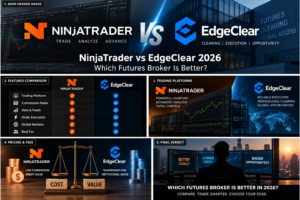
NinjaTrader vs EdgeClear is a high-intent comparison for active futures traders choosing between an integrated broker-platform ecosystem and a more modular futures brokerage setup in 2026.
NinjaTrader combines futures brokerage through NinjaTrader Clearing with NinjaTrader Desktop, Web and Mobile, SuperDOM, Market Replay, Order Flow+, strategy backtesting and C#-based NinjaScript automation.
EdgeClear takes a different approach. EdgeClear is a regulated futures Introducing Broker that provides access to multiple trading platforms, data feeds and clearing configurations. Its current technology ecosystem includes EdgeProX plus third-party solutions powered by Rithmic, CQG, CTS, Trading Technologies and Sierra Chart Teton.
This detailed NinjaTrader vs EdgeClear 2026 comparison examines futures commissions, Micro futures costs, day-trading margins, EdgeProX, TradingView, Sierra Chart, Rithmic, CQG, market-data fees, simulation, automation and platform flexibility to determine which setup better fits different traders.
Quick Answer
Choose NinjaTrader if you want one integrated futures ecosystem, clearly published plan-based commissions, low fixed intraday margins on popular contracts, SuperDOM, NinjaScript automation, Market Replay and native strategy backtesting.
Choose EdgeClear if you want to select among several professional futures platforms and data feeds, use TradingView or Sierra Chart, prefer a more personalized brokerage structure or want infrastructure built around Rithmic, CQG, CTS, TT or Teton.
TradeboticsAI Verdict: NinjaTrader is generally the cleaner choice for futures traders who want an integrated platform and automation environment. EdgeClear is particularly strong for experienced traders who know exactly which platform, routing technology and data feed they want.
Explore NinjaTrader and Free Simulated Futures Trading →
Affiliate disclosure: TradeboticsAI may receive compensation when visitors complete qualifying actions through certain links. Futures trading involves substantial risk. Simulated and backtested performance is hypothetical. Commissions, exchange, regulatory, clearing, routing, platform and market-data fees may apply.
Table of Contents
- NinjaTrader vs EdgeClear Overview
- Quick Comparison
- Broker Structure
- Futures Commissions
- Micro Futures Costs
- Day-Trading Margins
- Account Funding
- Trading Platforms
- EdgeProX vs NinjaTrader Desktop
- TradingView
- Sierra Chart and Teton
- Rithmic, CQG, CTS and Data Feeds
- Market Data Costs
- DOM and Order Flow
- Automated Trading
- Backtesting and Replay
- Web, Mac and Mobile Access
- Broker Support
- Total Trading Costs
- Pros and Cons
- Which Broker Should You Choose?
- Related Comparisons
- FAQ
- Final Verdict
NinjaTrader vs EdgeClear 2026: Overview
The fundamental difference in NinjaTrader vs EdgeClear is integration versus modularity.
NinjaTrader’s ecosystem is vertically integrated.
NinjaTrader, LLC develops its trading technology, while NinjaTrader Clearing, LLC is the Futures Commission Merchant responsible for customer brokerage accounts and clearing.
That gives customers one primary ecosystem covering:
- Futures brokerage
- Desktop trading
- Browser trading
- Mobile trading
- Market data
- SuperDOM
- NinjaScript
- Backtesting
- Market Replay
- Simulation
EdgeClear operates as an Introducing Broker.
Instead of forcing traders into one primary front end, EdgeClear connects customers with different platforms, data feeds and clearing infrastructure according to their requirements.
Its available technology includes platforms using:
- Rithmic
- CQG
- CTS
- Trading Technologies
- Sierra Chart Teton
This means EdgeClear traders can build a more customized futures stack.
That flexibility is valuable for experienced traders but introduces more decisions than NinjaTrader’s integrated structure.
NinjaTrader vs EdgeClear: Quick Comparison
| Category | NinjaTrader | EdgeClear |
|---|---|---|
| Business Model | Integrated platform + FCM | Futures Introducing Broker |
| Primary Market | Futures | Futures |
| Micro Base Commission | From $0.09 per side | $0.22 commission on selected Micro index products under current published structures |
| Published MES/MNQ Rithmic All-In | Depends on NinjaTrader plan | $0.69 per side |
| Published Teton Micro All-In | Not applicable | $0.59 per side for qualifying new Sierra Chart users |
| Day Margin Model | Fixed published values on many contracts | Normally 25%-50% of Initial Margin |
| Proprietary Platform | NinjaTrader | EdgeProX |
| EdgeProX Cost | Not applicable | $34.99/month |
| TradingView | NinjaTrader ecosystem focus | Direct EdgeClear integration |
| Sierra Chart Teton | Not primary ecosystem | Supported |
| Programming | NinjaScript / C# | Depends on selected platform |
| Simulation | Free simulation + Market Replay | EdgeProX simulation plus platform-specific demo tools |
| Best For | Integrated futures automation | Custom platform/data-feed setups |
NinjaTrader vs EdgeClear Broker Structure
The legal and operational structure matters when comparing the companies.
NinjaTrader
NinjaTrader Clearing is a registered Futures Commission Merchant.
An FCM can hold customer funds and clear futures trades.
NinjaTrader therefore controls a large portion of the customer experience within its own corporate ecosystem.
EdgeClear
EdgeClear is a regulated futures Introducing Broker.
An Introducing Broker typically manages the customer relationship and facilitates trading access while customer funds are maintained at the relevant clearing FCM.
EdgeClear’s advantage is that the model can support different infrastructure combinations rather than requiring every customer to use one identical technology stack.
Operational simplicity: NinjaTrader.
Infrastructure customization: EdgeClear.
NinjaTrader vs EdgeClear Futures Commissions
Commission analysis is one of the most important sections of any NinjaTrader vs EdgeClear comparison.
NinjaTrader Commission Plans
| Plan | Plan Cost | Micro / e-Nano | Standard |
|---|---|---|---|
| Free | $0/month | $0.39 per side | $1.29 per side |
| Monthly | $99/month | $0.29 per side | $0.99 per side |
| Lifetime | $1,499 one-time | $0.09 per side | $0.59 per side |
Exchange, clearing and NFA charges apply in addition to NinjaTrader’s published base commission.
Verify current rates on the official NinjaTrader pricing page.
EdgeClear Commission Model
EdgeClear uses a more personalized commission structure.
Its main commission page asks traders for information including:
- Monthly trading volume
- Initial funding
- Day-trading or swing-trading style
- Technology setup
EdgeClear then provides a pricing structure appropriate to the account configuration.
This means there is no single universal EdgeClear commission that applies to every trader and every platform.
However, EdgeClear currently publishes special Micro rates that provide useful comparison benchmarks.
NinjaTrader vs EdgeClear Micro Futures Costs
EdgeClear currently publishes an all-in per-side rate for popular Micro equity-index futures when using its reduced Rithmic transaction rate.
| Contract | Exchange + NFA | EdgeClear Commission | Rithmic Transaction | Published Total / Side |
|---|---|---|---|---|
| MES | $0.37 | $0.22 | $0.10 | $0.69 |
| MNQ | $0.37 | $0.22 | $0.10 | $0.69 |
| MYM | $0.37 | $0.22 | $0.10 | $0.69 |
| M2K | $0.37 | $0.22 | $0.10 | $0.69 |
EdgeClear currently states that the reduced $0.10 Rithmic transaction fee is automatically available to accounts under this published structure.
Its Sierra Chart Teton offer can be even more competitive for qualifying new users.
For MES, MNQ, MYM and M2K, the currently published Teton structure consists of approximately:
- $0.37 Exchange + NFA
- $0.22 commission
- $0.00 Teton order-routing fee
- $0.59 total per side
This is a powerful pricing proposition, but it is linked to the applicable Sierra Chart/Teton setup and eligibility conditions.
NinjaTrader’s advantage is simpler pricing across its own ecosystem.
EdgeClear’s advantage is that certain specialized configurations can produce extremely competitive all-in rates.
NinjaTrader vs EdgeClear Day-Trading Margins
This category works very differently.
NinjaTrader
NinjaTrader publishes specific intraday margin requirements for individual contracts.
Its current proposition includes day margins beginning around $50 on selected Micro futures contracts.
This provides a simple and transparent framework for active retail futures traders.
EdgeClear
EdgeClear does not normally begin every customer at an ultra-low fixed margin amount.
EdgeClear states that its brokers generally start traders at approximately 25%-50% of the contract’s Initial Margin.
The exact rate can depend on factors including:
- Product traded
- Trading volume
- Account capitalization
- Risk profile
- FCM approval
A trader may be able to negotiate lower day margins after discussing trading activity and account characteristics with the EdgeClear broker team.
This produces a very different philosophy.
NinjaTrader: aggressively published low retail intraday margins.
EdgeClear: broker-managed margins tailored more closely to the account and trading behavior.
Lower margin increases leverage and risk. It does not make futures trading safer.
NinjaTrader vs EdgeClear Account Funding
NinjaTrader currently advertises no general minimum deposit requirement.
However, an account must still have sufficient capital to satisfy the relevant margin requirements and withstand normal market movement.
EdgeClear provides recommended starting balances rather than presenting one universal minimum for every trading style.
Its current guidance recommends approximately:
- $1,500 for traders planning to trade only Micro contracts
- $5,000 for standard futures contracts
EdgeClear also recommends, where possible, maintaining enough risk capital to cover at least the full Initial Margin for the intended contract.
This is more conservative than simply funding an account with the minimum amount needed to satisfy an intraday margin requirement.
NinjaTrader vs EdgeClear Trading Platforms
Platform selection is one of EdgeClear’s greatest advantages.
NinjaTrader Platforms
NinjaTrader provides a consistent proprietary family:
- NinjaTrader Desktop
- NinjaTrader Web
- NinjaTrader Mobile
The Desktop application provides the deepest strategy development and customization.
EdgeClear Platforms
EdgeClear supports a large selection of professional futures applications.
Its current platform ecosystem includes solutions such as:
- EdgeProX
- TradingView
- R|Trader Pro
- Sierra Chart
- Bookmap
- CQG
- MotiveWave
- MultiCharts
- Jigsaw daytradr
- Quantower
- Investor/RT
- ATAS
- Trading Technologies
- CTS
- GoCharting
- Volumetrica platforms
The exact availability depends on data feed and account configuration.
Integrated ecosystem winner: NinjaTrader.
Platform-choice winner: EdgeClear.
EdgeProX vs NinjaTrader Desktop
EdgeProX deserves direct comparison with NinjaTrader Desktop because it is EdgeClear’s own primary platform.
EdgeProX
EdgeProX currently costs $34.99 per month and includes a 14-day demo.
Its feature set currently includes:
- Advanced DOM
- Order-flow Heat Map
- Volume Imprint
- Volume Profile
- Market Profile TPO
- MBO support
- Cloud workspaces
- 300+ built-in studies and indicators
- Java SDK
- Replay Mode
- Trade Simulation
- Custom chart tools
- Mac and Windows compatibility
EdgeProX also supports Rithmic, CQG and CTS data-feed configurations.
NinjaTrader Desktop
NinjaTrader Desktop provides deeper native strategy programming through NinjaScript.
Its major strengths include:
- C# development
- Strategy Analyzer
- SuperDOM
- Market Replay
- Order Flow+
- Custom indicators
- Automated strategies
- Large third-party add-on ecosystem
Native automation and backtesting: NinjaTrader Desktop.
Cross-platform order-flow workspace: EdgeProX.
NinjaTrader vs EdgeClear for TradingView
TradingView is a major EdgeClear advantage.
EdgeClear currently offers direct TradingView broker integration.
The setup uses EdgeClear-provided CQG credentials to connect an eligible brokerage account through TradingView’s Trading Panel.
This allows traders to combine EdgeClear execution with:
- TradingView charts
- TradingView Desktop
- Browser trading
- Mobile functionality
- Pine Script
- Community indicators
- Alerts
- Strategy Tester
For users who already perform all analysis inside TradingView, this can be a major reason to choose EdgeClear.
NinjaTrader instead provides its own deeply integrated charting, execution and automation ecosystem.
TradingView-centric workflow: EdgeClear.
Native futures platform workflow: NinjaTrader.
EdgeClear Sierra Chart and Teton
Sierra Chart users receive another compelling EdgeClear option.
EdgeClear currently supports Sierra Chart with Teton order routing.
Teton provides direct futures order-routing architecture without a separate third-party routing intermediary between Sierra Chart and the relevant supported infrastructure.
EdgeClear currently advertises:
- $0 API fee for the applicable Teton setup
- $0 per-contract Teton routing fee
- $0.22 EdgeClear commission on selected Micro index products for qualifying new Sierra Chart users
The Sierra Chart packages currently shown through EdgeClear include:
- Package 10 — $36/month
- Package 11 — $46/month
- Package 12 — $56/month
Higher packages add advanced functionality including Market By Order data.
For traders who strongly prefer Sierra Chart, this configuration can be more attractive than adapting their workflow to a completely different platform.
EdgeClear Rithmic, CQG, CTS and Data Feeds
Data-feed flexibility is one of the clearest differences in NinjaTrader vs EdgeClear.
EdgeClear currently provides access to:
- Rithmic
- CQG
- CTS
- Sierra Chart Teton
Additional front-end platforms can run on one or more of these infrastructures.
Rithmic is particularly popular among futures traders requiring professional market data and execution connectivity.
CQG powers platforms including the direct EdgeClear TradingView connection.
Teton is highly relevant for Sierra Chart users.
Choosing a feed can affect:
- Platform compatibility
- Monthly fees
- Transaction costs
- Market-data subscriptions
- API functionality
- Order routing
NinjaTrader reduces many of these decisions through a more standardized environment.
EdgeClear exposes more of the infrastructure to user choice.
NinjaTrader vs EdgeClear Market Data Costs
Market-data costs can materially change total ownership cost.
NinjaTrader CME Data
NinjaTrader currently publishes non-professional CME Group pricing including:
- Level I bundle: $12/month
- Individual Level I exchange: $4/month
- Level II bundle: $48/month
- Individual Level II exchange: $16/month
EdgeClear Rithmic Data
EdgeClear’s current non-professional Rithmic schedule includes approximately:
- CBOT full depth: $14/month
- CME full depth: $14/month
- NYMEX full depth: $14/month
- COMEX full depth: $14/month
- CME Group full-depth bundle: $42/month
- Single-exchange top of book: $2.55/month
- CME Group top-of-book bundle: $8.65/month
- Rithmic API/login fee: $20/month per login
Pricing differs for professional users and other feeds.
EdgeClear CQG Costs
CQG connectivity costs can also vary by platform.
Current examples include:
- CQG Desktop/Mobile: $25/month plus transaction charges
- CQG QTrader: $75/month plus transaction charges
- TradingView: $10/month plus applicable CQG transaction charges
- Several compatible third-party platforms: approximately $10/month plus applicable transaction charges
This is why EdgeClear’s flexibility requires more careful cost calculation.
A trader should calculate platform + data + routing + commission rather than comparing commission alone.
NinjaTrader SuperDOM vs EdgeClear DOM Trading
NinjaTrader’s SuperDOM is one of the most established ladder interfaces in retail futures trading.
It integrates directly with:
- Orders
- ATM strategies
- Positions
- Market depth
- NinjaScript extensions
EdgeClear does not force every trader into one DOM.
Depending on the selected platform, traders can use:
- EdgeProX Advanced DOM
- Sierra Chart Trade DOM
- Jigsaw daytradr
- R|Trader
- Quantower
- Bookmap
- Other compatible ladder interfaces
Consistent native DOM environment: NinjaTrader.
Choice of specialized DOMs: EdgeClear.
NinjaTrader vs EdgeClear for Automated Trading
Automation architecture differs substantially.
NinjaTrader
NinjaTrader provides a clear native programming framework through NinjaScript.
NinjaScript is based on C# and supports:
- Automated trading strategies
- Custom indicators
- Custom order management
- SuperDOM extensions
- Platform add-ons
- Optimization logic
This gives systematic traders a unified environment from development through backtesting and execution.
EdgeClear
Automation depends on the selected platform.
Examples include:
- Sierra Chart ACSIL
- MultiCharts strategies
- TradingView Pine Script for research, alerts and supported workflows
- EdgeProX Java SDK
- Rithmic-enabled development environments
- Other platform-specific APIs
This can be more flexible but requires the trader to choose an architecture before developing the strategy.
Native automation simplicity: NinjaTrader.
Choice of development frameworks: EdgeClear.
NinjaTrader vs EdgeClear Backtesting and Replay
NinjaTrader has one of the strongest integrated research environments in this comparison.
NinjaTrader Desktop provides:
- Strategy Analyzer
- Historical backtesting
- Optimization
- Market Replay
- NinjaScript testing
- Free simulation
EdgeClear provides research functionality through the selected platform.
EdgeProX includes:
- Replay Mode
- Trade Simulation
- Order-flow tools
- Advanced charting
Sierra Chart and MultiCharts can provide considerably deeper systematic testing for users who choose those platforms.
TradingView also includes its Strategy Tester for Pine Script strategies.
The difference is therefore straightforward:
NinjaTrader provides one integrated research stack.
EdgeClear lets traders choose among several research stacks.
NinjaTrader vs EdgeClear Web, Mac and Mobile Access
NinjaTrader now provides:
- Windows Desktop
- Web
- iPhone
- Android
The deepest NinjaScript development features remain associated with NinjaTrader Desktop.
EdgeClear device support depends on the selected platform.
EdgeProX currently provides Mac and Windows compatibility, while TradingView and other supported solutions provide Web and mobile access.
This can make EdgeClear particularly attractive to Mac users who do not want their primary professional platform tied exclusively to Windows.
NinjaTrader vs EdgeClear Broker Support
Broker support is one of EdgeClear’s core positioning points.
Because EdgeClear uses a broker-assisted model, its team can help customers evaluate:
- Platforms
- Data feeds
- Margin requirements
- Commission structures
- Clearing configurations
- Trading technology
This is useful when the trader is unsure whether Rithmic, CQG, Teton or another configuration best matches the strategy.
NinjaTrader provides support around its own integrated ecosystem, reducing the number of possible combinations that need troubleshooting.
Personalized infrastructure selection: EdgeClear.
Standardized ecosystem support: NinjaTrader.
NinjaTrader vs EdgeClear Total Trading Costs
The cheapest base commission does not automatically produce the lowest monthly cost.
NinjaTrader Costs Can Include:
- Commission
- Exchange fees
- NFA fees
- Clearing fee
- Market data
- $99 Monthly plan if selected
- $1,499 Lifetime plan if selected
- Optional routing fees
- Third-party add-ons
EdgeClear Costs Can Include:
- Commission
- Exchange and NFA fees
- Platform subscription
- Data-feed login fees
- Market-data subscriptions
- Routing transaction fees
- Third-party software
For example, an EdgeClear trader using Sierra Chart/Teton will have a very different cost structure from an EdgeClear trader using TradingView/CQG or EdgeProX/Rithmic.
This is the core economic difference.
NinjaTrader pricing is easier to model.
EdgeClear pricing can be optimized more precisely around a specific technology stack.
NinjaTrader vs EdgeClear Pros and Cons
NinjaTrader Pros
- Dedicated futures ecosystem
- Integrated platform and brokerage structure
- Free plan
- Micro commissions down to $0.09 per side
- Low published day margins
- Desktop, Web and Mobile
- SuperDOM
- Order Flow+
- Market Replay
- NinjaScript C# automation
- Strategy Analyzer
- Integrated backtesting
- Large futures add-on ecosystem
NinjaTrader Cons
- Lowest commissions require $1,499 Lifetime plan
- Native development is Windows-focused
- Less platform choice than EdgeClear
- Less data-feed flexibility
- Full-depth market data can create additional monthly cost
EdgeClear Pros
- Futures-specialist Introducing Broker
- Large platform selection
- Rithmic support
- CQG support
- CTS support
- Sierra Chart Teton support
- Trading Technologies support
- Direct TradingView integration
- Sierra Chart support
- Bookmap support
- Quantower support
- MultiCharts support
- ATAS support
- EdgeProX with 300+ studies
- Replay and simulation through EdgeProX
- Competitive published Micro pricing
- $0.69 published Rithmic all-in rate on popular Micro indexes
- $0.59 published Sierra/Teton rate for qualifying new Micro-index users
- Personalized margin and commission structure
EdgeClear Cons
- More complicated to calculate total cost
- Day margins are less straightforward than NinjaTrader’s fixed published values
- EdgeProX costs $34.99/month
- Different feeds create different fees
- Third-party platform costs may apply
- No single native programming framework across every EdgeClear configuration
- More infrastructure decisions for beginners
NinjaTrader vs EdgeClear: Which Should You Choose?
Choose NinjaTrader If You:
- Primarily trade futures
- Want one integrated ecosystem
- Need low published intraday margins
- Trade MES or MNQ actively
- Want SuperDOM
- Use Order Flow+
- Need Market Replay
- Develop in C#
- Want NinjaScript automation
- Need integrated historical backtesting
- Prefer simple published pricing tiers
Choose EdgeClear If You:
- Want to choose your own trading platform
- Prefer TradingView
- Use Sierra Chart
- Want Teton order routing
- Prefer Rithmic
- Prefer CQG
- Use Bookmap
- Use Quantower
- Need a specific professional platform
- Want personalized commission pricing
- Want broker-assisted technology selection
- Prefer a modular futures infrastructure
Prefer an Integrated Futures Ecosystem?
Explore NinjaTrader’s SuperDOM, NinjaScript automation, Market Replay, backtesting and free simulated futures environment.
Simulation differs from live futures trading. Futures involve substantial leverage, commissions and financial risk.
Related NinjaTrader Comparisons
- NinjaTrader vs Ironbeam 2026
- NinjaTrader vs tastytrade 2026
- NinjaTrader vs Robinhood 2026
- NinjaTrader vs Webull 2026
- NinjaTrader vs Optimus Futures 2026
- NinjaTrader vs AMP Futures 2026
- NinjaTrader vs Interactive Brokers 2026
- NinjaTrader vs TradeStation 2026
- NinjaTrader vs TradingView 2026
- NinjaTrader vs Tradovate 2026
- NinjaTrader vs Sierra Chart 2026
- NinjaTrader vs Quantower 2026
- NinjaTrader vs Bookmap 2026
- NinjaTrader vs ATAS 2026
- NinjaTrader vs MultiCharts 2026
- NinjaTrader vs MetaTrader 5 2026
NinjaTrader vs EdgeClear FAQ
Is NinjaTrader better than EdgeClear?
NinjaTrader is generally better for traders who want one integrated futures platform, low fixed day margins, NinjaScript automation, Market Replay and native backtesting. EdgeClear can be better for traders who value platform, data-feed and clearing flexibility.
Is EdgeClear a futures broker?
Yes. EdgeClear is a regulated futures Introducing Broker serving self-directed futures traders.
What platforms does EdgeClear support?
EdgeClear supports numerous futures platforms including EdgeProX, TradingView, Sierra Chart, Bookmap, MultiCharts, Quantower, ATAS, R|Trader Pro, CQG, MotiveWave, Jigsaw, Trading Technologies and others.
What data feeds does EdgeClear offer?
EdgeClear currently lists Rithmic, CQG, CTS and Sierra Chart Teton among its primary futures data and routing infrastructures.
Can I use TradingView with EdgeClear?
Yes. EdgeClear offers a direct TradingView broker connection. Eligible customers use EdgeClear-provided CQG credentials to connect through TradingView’s Trading Panel.
Does EdgeClear support Sierra Chart?
Yes. EdgeClear supports Sierra Chart including Teton order routing and Denali data configurations.
What is EdgeClear’s Micro futures commission?
EdgeClear currently publishes a $0.22 broker commission for selected popular Micro products under qualifying structures. With exchange/NFA and the current reduced Rithmic transaction fee, MES, MNQ, MYM and M2K are published at approximately $0.69 all-in per side.
What is EdgeClear’s Sierra Chart Teton Micro rate?
EdgeClear currently publishes approximately $0.59 all-in per side for MES, MNQ, MYM and M2K for qualifying new Sierra Chart users using Teton, consisting of exchange/NFA fees plus a $0.22 commission and zero Teton routing fee.
How much does NinjaTrader charge for Micro futures?
NinjaTrader currently charges $0.39 per side on the Free plan, $0.29 on Monthly and $0.09 on Lifetime before applicable exchange, clearing and NFA fees.
How much does EdgeProX cost?
EdgeProX currently costs $34.99 per month and EdgeClear offers a 14-day demo.
Does EdgeProX support Mac?
Yes. EdgeProX currently advertises Mac and Windows compatibility.
Does EdgeProX have Market Replay?
EdgeProX provides Replay Mode and trade simulation functionality.
Does EdgeProX have order-flow tools?
Yes. EdgeProX currently includes tools such as Orderflow Heat Map, Volume Imprint, Volume Profile, Market Profile TPO and an Advanced DOM.
How many indicators does EdgeProX have?
EdgeProX currently advertises more than 300 built-in studies and indicators.
What is EdgeClear’s minimum account size?
EdgeClear currently recommends approximately $1,500 for Micro-only trading and $5,000 for standard futures. The appropriate amount depends on contract, trading style, risk tolerance and margin requirements.
Does EdgeClear offer low day-trading margins?
Yes, but EdgeClear’s approach differs from brokers publishing fixed ultra-low margins. EdgeClear states that brokers normally start traders at approximately 25%-50% of the contract’s Initial Margin and can adjust the requirement based on account and trading characteristics.
Does NinjaTrader offer lower intraday margins?
NinjaTrader publishes very low fixed day-trading requirements on selected contracts, including margins starting around $50 for certain Micro futures.
Does EdgeClear support Rithmic?
Yes. Rithmic is one of EdgeClear’s primary supported data and execution infrastructures.
Does EdgeClear support CQG?
Yes. CQG is supported and powers configurations including EdgeClear’s direct TradingView connection.
Does EdgeClear support automated trading?
Yes, but automation depends on the selected platform. Traders can use platform-specific development environments such as Sierra Chart ACSIL, MultiCharts strategies, EdgeProX’s Java SDK and other compatible technology.
Which is better for C# automated trading?
NinjaTrader is generally better for C# developers because NinjaScript is based on C# and integrates directly with NinjaTrader Desktop, strategy backtesting and live execution.
Which is better for TradingView users?
EdgeClear is particularly attractive for TradingView users because it provides a direct broker integration through CQG.
Which is better for Sierra Chart traders?
EdgeClear is particularly strong for Sierra Chart users because it supports Teton routing, Denali market data and special Micro commission structures.
Which is better for beginners?
NinjaTrader may be easier from an infrastructure perspective because brokerage, platform and automation are part of one ecosystem. EdgeClear requires more choices but offers broker assistance when selecting platforms and data feeds.
Which is better for experienced futures traders?
Experienced traders who already know their preferred platform and data feed may prefer EdgeClear’s modular architecture. Traders wanting deep C# customization inside one platform may prefer NinjaTrader.
Final Verdict: NinjaTrader vs EdgeClear 2026
The final NinjaTrader vs EdgeClear 2026 decision comes down to integration versus infrastructure choice.
NinjaTrader remains our preferred choice for traders who want an integrated futures environment.
The combination of NinjaTrader Clearing, Desktop/Web/Mobile platforms, SuperDOM, Order Flow+, Market Replay, NinjaScript and Strategy Analyzer creates a complete futures trading and development ecosystem.
Its Free, Monthly and Lifetime plans also make commission economics easy to understand.
EdgeClear is one of the strongest choices for traders who want to build their own futures technology stack.
Its platform list is substantially broader and includes TradingView, Sierra Chart, EdgeProX, Bookmap, Quantower, MultiCharts, ATAS, R|Trader and other professional futures tools.
EdgeClear’s special Micro pricing is also highly competitive.
Its current Rithmic structure publishes an all-in $0.69 per side on MES, MNQ, MYM and M2K, while qualifying new Sierra Chart/Teton users can currently access a published $0.59 per-side total on those contracts.
Margin policy creates an important philosophical difference.
NinjaTrader publishes extremely low fixed intraday margins on popular contracts.
EdgeClear normally begins traders around 25%-50% of Initial Margin and then evaluates lower requirements according to account funding, volume, product and other risk factors.
This makes NinjaTrader particularly attractive to active retail day traders focused on capital efficiency.
EdgeClear’s structure may appeal more to traders who prefer individualized brokerage risk management.
Automation creates another clear distinction:
NinjaTrader = one native C# development ecosystem.
EdgeClear = multiple development environments depending on platform and feed.
Choose NinjaTrader when NinjaScript, SuperDOM, Market Replay, integrated backtesting and simple plan-based pricing are priorities.
Choose EdgeClear when TradingView, Sierra Chart, Rithmic, CQG, Teton or the ability to select a specialized futures platform matters more.
Before opening either account, verify the current all-in commission, market-data fees, routing charges, platform costs, day margins and account-specific conditions directly with the provider because futures trading costs can change.
Affiliate Disclosure: TradeboticsAI may receive compensation when visitors click certain affiliate links or complete qualifying actions. This does not increase the user’s cost and does not determine our editorial conclusions.
Risk Disclosure: Futures and options on futures involve substantial risk and are not suitable for every investor. Reduced intraday margins increase leverage and can magnify losses rapidly. Losses may exceed the amount initially committed depending on market and account conditions. Simulated, replayed and backtested performance is hypothetical and does not guarantee future live-trading results. This material is provided for informational and educational purposes only and is not financial, investment, tax or legal advice.