NinjaTrader vs Webull 2026: Which Is Better for Futures Trading?

NinjaTrader vs Webull has become a much more relevant futures trading comparison in 2026. NinjaTrader has long specialized in futures trading, while Webull has expanded its futures offering with competitive commissions, reduced intraday margins, paper trading, cross-platform access and official API support.
NinjaTrader remains a futures-first ecosystem built around NinjaTrader Clearing, NinjaTrader Desktop, Web and Mobile, SuperDOM, Market Replay, Order Flow+, strategy backtesting and C#-based NinjaScript automation.
Webull takes a broader multi-asset approach. Its ecosystem can combine stocks, options, futures and other supported products while providing futures access through Webull Futures LLC across mobile, desktop and web interfaces.
This detailed NinjaTrader vs Webull 2026 comparison analyzes futures commissions, Micro futures margins, platforms, order entry, paper trading, automation, APIs, market data, mobile access and overall usability to determine which platform better fits different traders.
Quick Answer
Choose NinjaTrader if futures are your primary market and you want a specialized futures ecosystem with SuperDOM, Market Replay, NinjaScript C# development, advanced strategy testing and extremely competitive commissions under its upgraded plans.
Choose Webull if you want an easier multi-asset environment, futures alongside stocks and options, competitive Micro futures pricing, strong mobile access, paper trading and official Python/Java API infrastructure.
TradeboticsAI Verdict: NinjaTrader remains our preferred platform for serious futures-first traders. Webull has become a strong alternative for traders who value simplicity, mobile access and a broader multi-asset brokerage ecosystem.
Explore NinjaTrader and Free Simulated Futures Trading →
Affiliate disclosure: TradeboticsAI may receive compensation when visitors complete qualifying actions through certain links. Futures trading involves substantial risk. Simulated results are hypothetical, and commissions, exchange, regulatory, clearing and market-data fees may apply.
Table of Contents
- NinjaTrader vs Webull Overview
- Quick Comparison
- Broker Structure
- Futures Commissions
- Intraday Margins
- Micro Futures
- Markets and Products
- Trading Platforms
- Desktop Trading
- Mobile and Web Trading
- DOM and Order Entry
- Paper Trading and Simulation
- Automated Trading
- NinjaScript vs Webull API
- Backtesting and Research
- Market Data
- Additional Costs
- Ease of Use
- Pros and Cons
- Which Should You Choose?
- Related Comparisons
- FAQ
- Final Verdict
NinjaTrader vs Webull 2026: Overview
The biggest difference in NinjaTrader vs Webull is specialization versus breadth.
NinjaTrader is designed primarily for futures traders.
NinjaTrader, LLC develops its trading technology while NinjaTrader Clearing, LLC operates as a registered Futures Commission Merchant responsible for holding customer funds and clearing futures transactions.
The ecosystem therefore brings together:
- Futures brokerage
- NinjaTrader Desktop
- NinjaTrader Web
- NinjaTrader Mobile
- SuperDOM
- Advanced charting
- NinjaScript
- Strategy backtesting
- Market Replay
- Order Flow+
- Free simulated trading
Webull has a broader business model.
Webull Futures LLC provides futures brokerage while the broader Webull ecosystem also offers securities trading through separate regulated entities.
This makes Webull attractive to traders who do not want futures to exist in an isolated brokerage environment.
A Webull user may already be monitoring stocks and options and then add futures to the same broader platform experience.
For a trader who only trades CME futures, NinjaTrader’s specialization can be more valuable.
NinjaTrader vs Webull: Quick Comparison

| Category | NinjaTrader | Webull |
|---|---|---|
| Primary Strength | Dedicated futures ecosystem | Multi-asset trading ecosystem |
| Futures Broker | NinjaTrader Clearing LLC | Webull Futures LLC |
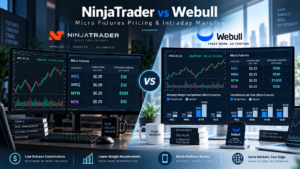
| Micro Commission | From $0.09 per side with Lifetime | Advertised from $0.25 per Micro contract |
| Mini Commission | Contract category dependent | Advertised from $0.70 per contract |
| Regular Futures | From $0.59 per side with Lifetime | Advertised from $1.25 per contract |
| MES Intraday Margin | $50 published | Approximately $100.41 currently published |
| MNQ Intraday Margin | $100 published | Approximately $162.78 currently published |
| MYM Intraday Margin | $50 published | Approximately $59.56 currently published |
| M2K Intraday Margin | $50 published | Approximately $48.97 currently published |
| Desktop | NinjaTrader Desktop | Webull Desktop |
| Web | Yes | Yes |
| Mobile | iPhone and Android | iOS and Android |
| Paper Trading | Free simulation + Market Replay | Unlimited futures Paper Trading |
| Programming | NinjaScript / C# | OpenAPI with Python and Java SDKs |
| Best For | Dedicated futures traders | Multi-asset and mobile-first traders |
NinjaTrader vs Webull Broker Structure
Both futures offerings operate through registered Futures Commission Merchants.
NinjaTrader
NinjaTrader Clearing, LLC is registered with the Commodity Futures Trading Commission as an FCM and is a National Futures Association member.
NinjaTrader’s software development company is legally separate from its clearing entity, but the overall customer experience is closely integrated.
Webull
Futures and cleared swaps trading on Webull is provided by Webull Futures LLC, which Webull identifies as a CFTC-registered Futures Commission Merchant and NFA member.
Webull’s securities accounts are offered separately through Webull Financial LLC.
This distinction is important because futures accounts are not SIPC-protected securities accounts.
Both brokers operate in a regulated U.S. futures environment, but Webull provides access to a broader family of financial products through separate entities.
NinjaTrader vs Webull Futures Commissions
Commission structure is a major factor in the NinjaTrader vs Webull comparison.
NinjaTrader Pricing
| Plan | Plan Cost | Micro / e-Nano | Standard |
|---|---|---|---|
| Free | $0/month | $0.39 per side | $1.29 per side |
| Monthly | $99/month | $0.29 per side | $0.99 per side |
| Lifetime | $1,499 one-time | $0.09 per side | $0.59 per side |
Exchange, clearing and NFA fees apply in addition to NinjaTrader’s published commissions.
Verify current rates on the official NinjaTrader pricing page.
Webull Futures Pricing
Webull currently advertises:
- Micro futures: $0.25 per contract
- Mini futures: $0.70 per contract
- Regular futures: $1.25 per contract
Regulatory, exchange and other applicable charges can still apply.
Webull describes these prices as commissions per contract, while NinjaTrader explicitly quotes its commission schedule per side. Traders comparing round-trip trading costs should therefore use each broker’s current detailed fee schedule rather than assuming the headline figures use identical billing conventions.
See the official Webull futures page for current advertised futures pricing.
Which Has Lower Commissions?
NinjaTrader Lifetime currently has the lowest headline Micro commission at $0.09 per side, but gaining that rate requires a $1,499 Lifetime plan.
NinjaTrader Free currently charges $0.39 per Micro contract per side without a monthly plan fee.
Webull’s $0.25 advertised Micro rate sits between those headline NinjaTrader pricing levels before considering differences in fee conventions and additional charges.
For a high-frequency Micro futures trader, the NinjaTrader Lifetime plan can become economically attractive if accumulated commission savings justify the upfront cost.
For a lower-volume trader, Webull’s simpler pricing may be more convenient.

NinjaTrader vs Webull Intraday Futures Margins
Intraday margin creates another important difference in NinjaTrader vs Webull.
| Contract | NinjaTrader | Webull |
|---|---|---|
| MES | $50 | Approx. $100.41 |
| MNQ | $100 | Approx. $162.78 |
| MYM | $50 | Approx. $59.56 |
| M2K | $50 | Approx. $48.97 |
These values are not permanent.
Webull states that its intraday margin rates are offered at its discretion and can be increased or withdrawn without prior notice. Current Webull intraday rates apply only during designated trading hours and selected products.
NinjaTrader similarly reserves the right to adjust intraday margins based on volatility and market conditions.
For MES and MNQ, NinjaTrader currently provides lower published intraday margin requirements.
M2K is currently slightly lower at Webull based on the rates published at the time of this comparison.
Lower margin should never be interpreted as lower risk.
Lower margin increases available leverage, which can amplify losses rapidly.
Check the current Webull futures margin table and the current NinjaTrader margin table immediately before trading.
NinjaTrader vs Webull for Micro Futures
Micro futures are one of the strongest use cases for both platforms.
Examples include:
- MES — Micro E-mini S&P 500
- MNQ — Micro E-mini Nasdaq-100
- MYM — Micro E-mini Dow
- M2K — Micro E-mini Russell 2000
- MGC — Micro Gold
- MCL — Micro WTI Crude Oil
- Micro FX futures
- Micro crypto futures where supported
NinjaTrader has built much of its retail proposition around Micro futures with low commissions and reduced day margins.
Webull is now competing aggressively in the same category with a $0.25 advertised Micro commission and broad Micro contract coverage.
The winner depends on whether you prioritize specialized futures functionality or an easier multi-asset platform.
Markets and Products
NinjaTrader currently provides futures access across major venues including CME Group, Eurex, ICE and Coinbase Derivatives.
Its brokerage account is fundamentally designed around futures.
Webull’s futures catalog includes major categories such as:
- Equity index futures
- Currency futures
- Energy futures
- Metal futures
- Agricultural futures
- Interest-rate futures
- Crypto futures
- Micro and Nano contracts where supported
The broader Webull ecosystem also supports stocks and options through its securities brokerage.
This makes Webull more appealing for traders who want futures alongside traditional investments.
Futures specialization: NinjaTrader.
Broader retail trading ecosystem: Webull.
NinjaTrader vs Webull Trading Platforms
Both companies now offer genuinely cross-platform trading.
NinjaTrader
- NinjaTrader Desktop
- NinjaTrader Web
- NinjaTrader Mobile for iPhone
- NinjaTrader Mobile for Android
NinjaTrader Desktop remains the most advanced version because it provides the deepest customization, strategy development and professional futures tools.
Webull
Webull offers synchronized access across:
- Desktop
- Web
- Mobile
- PC
- Mac
Webull emphasizes a cleaner and more accessible user interface designed to support several asset classes.
Its futures environment includes charting, price-ladder functionality and TurboTrader-style order-entry tools.
For a trader who values minimal friction and cross-device usability, Webull is compelling.
For someone who wants deeper futures-specific customization, NinjaTrader has the advantage.
NinjaTrader Desktop vs Webull Desktop
NinjaTrader Desktop is designed around advanced futures workflows.
Features include:
- Advanced charting
- SuperDOM
- NinjaScript
- Strategy Analyzer
- Market Replay
- Order Flow+
- Custom indicators
- Third-party add-ons
- Multi-monitor configurations
Webull Desktop prioritizes a more general trading experience across markets.
It provides customizable layouts, advanced charts, order-entry modules, watchlists and futures trading while remaining accessible to users who may also trade stocks and options.
Advanced futures workstation: NinjaTrader.
General multi-asset workstation: Webull.
NinjaTrader vs Webull Mobile and Web Trading
Webull has historically been particularly strong as a mobile-first trading platform.
Its mobile application combines market monitoring, analysis, account management and order entry in a polished environment.
Webull now supports futures across synchronized mobile, desktop and web applications.
NinjaTrader also provides dedicated mobile and web futures interfaces.
This has significantly reduced one of NinjaTrader’s historical weaknesses because traders are no longer limited to its powerful Windows desktop environment.
Webull can still be easier for users who want all their investments inside a familiar consumer trading app.
NinjaTrader is better aligned with users who want their mobile experience centered almost entirely around futures.
NinjaTrader SuperDOM vs Webull Futures Order Entry
NinjaTrader SuperDOM remains one of the major differentiators in NinjaTrader vs Webull.
SuperDOM is a price-ladder interface built specifically for futures execution.
It can integrate:
- Market orders
- Limit orders
- Stop orders
- ATM strategies
- Position management
- Custom NinjaScript functionality
Webull also provides price-ladder functionality and fast order entry through its futures platform.
That can be sufficient for many discretionary traders.
However, NinjaTrader’s SuperDOM ecosystem is substantially more established for traders whose workflow revolves around ladder-based futures execution.
DOM winner: NinjaTrader.
NinjaTrader Simulation vs Webull Paper Trading
Both platforms offer strong environments for practicing without immediately risking capital.
NinjaTrader
NinjaTrader provides free simulated trading with no required live funding for basic simulation and strategy testing.
Its Market Replay functionality can replay historical market activity tick by tick.
This is particularly useful for traders who want to practice a specific historical futures session.
Webull
Webull advertises unlimited futures Paper Trading.
Its Paper Trading environment supports futures practice and intraday functionality through its trading ecosystem.
For a beginner, Webull Paper Trading may be easier to approach.
For detailed historical-session replay and futures-system development, NinjaTrader remains stronger.
Neither simulated environment reproduces every aspect of live execution, liquidity, slippage or psychological pressure.
NinjaTrader vs Webull for Automated Trading
The automation comparison has become significantly more interesting because Webull now provides official futures support through its OpenAPI.
NinjaTrader Automation
NinjaTrader uses NinjaScript, a C#-based framework integrated directly into NinjaTrader Desktop.
Developers can create:
- Automated strategies
- Custom indicators
- Custom trade-management logic
- SuperDOM extensions
- Platform add-ons
- Custom analytical tools
Webull Automation
Webull’s official OpenAPI now supports futures trading for eligible clients.
The current API architecture supports programmatic:
- Order placement
- Order modification
- Order cancellation
- Account access
- Futures contract information
- Historical market data
- Market-data streaming
- Order-status notifications
Webull currently provides official SDK support for Python and Java.
This is important because it means Webull should no longer be considered purely a discretionary retail application.
It now has credible infrastructure for developers building external quantitative systems.
NinjaScript vs Webull OpenAPI
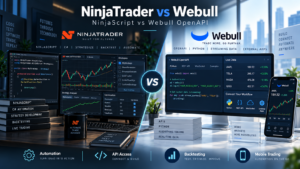
The architecture is very different.
NinjaScript
NinjaScript code runs deeply integrated within NinjaTrader Desktop.
This is excellent when you want your:
- Charts
- Indicators
- Orders
- Strategy logic
- Backtesting
- Optimization
inside one application.
Webull OpenAPI
Webull OpenAPI is designed for external programmatic access.
Its current architecture uses HTTP for trading and account functionality, streaming protocols for real-time information and official SDKs to simplify development.
The API currently supports futures orders including market, limit and stop-related orders.
It can therefore be attractive for:
- Python quant developers
- Custom trading dashboards
- External strategy engines
- Automated data pipelines
- AI-assisted trading research infrastructure
Review current capabilities in the official Webull Futures API documentation.
Native platform automation: NinjaTrader.
Python-first external development: Webull has become increasingly competitive.
NinjaTrader vs Webull Backtesting
NinjaTrader has the advantage for integrated strategy backtesting.
Strategy Analyzer allows NinjaScript strategies to be evaluated against historical data within the same environment used for live trading.
Users can combine this with optimization and Market Replay.
Webull provides historical market-data access and API infrastructure that developers can use with external Python or Java research environments.
That architecture can be very flexible, but the trader must build or connect additional backtesting logic rather than relying on one integrated futures strategy-development suite.
Therefore:
Ready-made futures backtesting workflow: NinjaTrader.
External quantitative research flexibility: Webull.
NinjaTrader vs Webull Futures Market Data
Market-data pricing requires careful attention because promotional access and standard subscription rates can differ.
NinjaTrader
NinjaTrader provides top-of-book market data benefits with funded qualifying plans and publishes additional exchange-data pricing for more advanced access.
Webull
Webull’s futures marketing currently promotes free CME market data for qualifying futures traders.
Its separate market-data documentation currently lists standard CME Group pricing of approximately:
- Level 1: $11.99/month
- Level 2: $38.99/month
Webull notes that current promotions may provide these quotes without the normal subscription cost.
The distinction matters because “free CME market data” can depend on eligibility or promotional conditions.
Traders should verify the current account-specific data entitlement before assuming it will remain free indefinitely.
Additional Trading Costs
Do not compare brokers using commission alone.
NinjaTrader Costs Can Include:
- Base commission
- Exchange fees
- NFA fees
- Clearing fees
- Market-data subscriptions
- Optional Monthly or Lifetime plan cost
- Optional third-party indicators or add-ons
Webull Costs Can Include:
- Futures commission
- Exchange fees
- Regulatory charges
- Potential data subscriptions
- Other contract-specific charges
The correct way to evaluate NinjaTrader vs Webull is to calculate all-in round-trip cost for the exact contract and trading frequency you expect.
Which Platform Is Easier to Use?
Webull will generally feel easier to a new retail trader.
Its interface is designed for fast onboarding across mobile, desktop and web.
NinjaTrader becomes more complex because it provides much deeper futures functionality.
Webull May Be Easier If:
- You already have a Webull account
- You trade stocks and options
- You primarily use a smartphone
- You want a simpler futures interface
- You prefer Paper Trading
- You do not need deep custom scripting
NinjaTrader May Be Better If:
- You primarily trade futures
- You use a DOM extensively
- You develop systematic strategies
- You need Market Replay
- You want C# customization
- You trade high volume
- You use advanced order-flow tools
NinjaTrader vs Webull Pros and Cons
NinjaTrader Pros
- Dedicated futures ecosystem
- Integrated futures brokerage
- Free plan
- Micro commissions from $0.09 per side on Lifetime
- Competitive intraday margins
- Desktop, Web and Mobile
- SuperDOM
- Order Flow+
- Market Replay
- Free simulated trading
- NinjaScript C# automation
- Integrated strategy backtesting
- Large third-party futures ecosystem
NinjaTrader Cons
- Lowest commissions require Lifetime plan
- Primarily futures-focused
- Advanced Desktop functionality has a learning curve
- Native scripting is centered on C# rather than Python
Webull Pros
- Competitive futures pricing
- $0.25 advertised Micro commission
- Futures Paper Trading
- Mobile, Desktop and Web access
- Mac support
- Broader stocks and options ecosystem
- Official futures API support
- Python SDK
- Java SDK
- Price-ladder trading
- Strong mobile user experience
- Broad Micro futures selection
- Promotional CME market-data benefits
Webull Cons
- Less specialized around professional futures trading
- No native equivalent to NinjaScript’s complete integrated strategy environment
- Less mature futures-focused third-party ecosystem
- Current MES and MNQ day margins are higher than NinjaTrader’s
- Market-data promotions and standard subscription pricing should be checked carefully
NinjaTrader vs Webull: Which Should You Choose?
Choose NinjaTrader If You:
- Primarily trade futures
- Trade MES or MNQ actively
- Need low intraday margins
- Want SuperDOM
- Use Order Flow+
- Need Market Replay
- Develop in C#
- Want NinjaScript automation
- Need integrated backtesting
- Trade enough volume to benefit from upgraded commission plans
Choose Webull If You:
- Trade futures plus stocks or options
- Prefer mobile-first trading
- Want a simpler interface
- Want unlimited futures Paper Trading
- Value PC and Mac support
- Prefer Python development
- Want an official external API
- Do not need NinjaTrader’s full futures-specialist toolset
Serious About Futures Trading?
Explore NinjaTrader’s futures-specific ecosystem, low published intraday margins, Market Replay, SuperDOM, strategy development and free simulated trading.
Simulated trading differs from live futures trading. Futures involve substantial risk, leverage, commissions and applicable exchange or regulatory fees.
Related NinjaTrader Comparisons
- NinjaTrader vs Optimus Futures 2026
- NinjaTrader vs AMP Futures 2026
- NinjaTrader vs Interactive Brokers 2026
- NinjaTrader vs TradeStation 2026
- NinjaTrader vs TradingView 2026
- NinjaTrader vs Thinkorswim 2026
- NinjaTrader vs Tradovate 2026
- NinjaTrader vs Sierra Chart 2026
- NinjaTrader vs Quantower 2026
- NinjaTrader vs Bookmap 2026
- NinjaTrader vs ATAS 2026
- NinjaTrader vs MotiveWave 2026
- NinjaTrader vs MultiCharts 2026
- NinjaTrader vs MetaTrader 5 2026
NinjaTrader vs Webull FAQ
Is NinjaTrader better than Webull?
NinjaTrader is generally better for dedicated futures traders who want specialized tools, low futures margins, SuperDOM, Market Replay and NinjaScript automation. Webull may be better for traders who want futures alongside stocks and options in a simpler multi-device ecosystem.
Can you trade futures on Webull?
Yes. Webull Futures LLC offers futures trading across major contract categories including equity indexes, energy, metals, currencies, interest rates, agriculture and crypto futures.
How much does Webull charge for Micro futures?
Webull currently advertises commissions starting at $0.25 per Micro futures contract. Exchange and other applicable fees may also apply.
How much does NinjaTrader charge for Micro futures?
NinjaTrader currently charges $0.39 per side on the Free plan, $0.29 per side on Monthly and $0.09 per side on Lifetime, before applicable exchange, clearing and NFA fees.
How much is NinjaTrader Lifetime?
The NinjaTrader Lifetime plan currently costs $1,499 as a one-time payment.
What is the Webull MES margin?
Webull’s current published intraday margin for MES is approximately $100.41. Margin rates change with market conditions and should be verified directly before trading.
What is NinjaTrader’s MES margin?
NinjaTrader currently publishes a $50 day margin for MES.
What is the Webull MNQ margin?
Webull currently publishes an intraday MNQ margin of approximately $162.78.
What is NinjaTrader’s MNQ margin?
NinjaTrader currently publishes a $100 intraday margin for MNQ.
Does Webull offer futures Paper Trading?
Yes. Webull advertises unlimited futures Paper Trading with intraday functionality and access to multiple futures products.
Does NinjaTrader offer Paper Trading?
Yes. NinjaTrader provides free simulated trading along with Market Replay and strategy-testing capabilities.
Does Webull have a futures API?
Yes. Webull OpenAPI officially supports futures trading for eligible users and provides programmatic order, account and market-data functionality.
Does Webull support Python?
Yes. Webull provides an official Python SDK for its OpenAPI infrastructure.
Does NinjaTrader support Python?
NinjaTrader’s primary native programming framework is NinjaScript, which is based on C#. Python is not its primary native strategy-development language.
Which is better for automated futures trading?
NinjaTrader is generally stronger for traders who want automation integrated directly into the trading platform. Webull can be attractive to developers who prefer external Python or Java applications connected through an API.
Which is better for futures scalping?
NinjaTrader is generally the stronger specialist option because of SuperDOM, futures-focused tooling and lower published margins on contracts such as MES and MNQ.
Does Webull have a DOM?
Webull provides price-ladder functionality for futures execution. NinjaTrader’s SuperDOM offers a deeper futures-specialized ladder ecosystem with advanced customization.
Can I trade futures on Webull from a Mac?
Yes. Webull advertises futures access through its platforms on mobile devices, PC and Mac, together with browser-based access.
Can I use NinjaTrader on mobile?
Yes. NinjaTrader provides dedicated iPhone and Android applications together with NinjaTrader Web and Desktop.
Is Webull market data free for futures?
Webull currently promotes free CME futures market data under applicable account or promotional conditions. Its standard published CME Group subscription prices should still be reviewed because eligibility can change.
Which is better for beginners?
Webull can be easier for beginners because its interface and broader retail ecosystem are simpler. NinjaTrader requires more learning but provides significantly deeper futures-specific capabilities.
Which is better for advanced futures traders?
NinjaTrader is generally stronger for advanced futures traders who use DOM execution, custom automation, Market Replay, order-flow tools and systematic backtesting.
Final Verdict: NinjaTrader vs Webull 2026
The final NinjaTrader vs Webull 2026 decision depends on whether futures trading is your main activity or only one part of a broader portfolio.
NinjaTrader remains our preferred platform for dedicated futures traders.
Its combination of futures brokerage, low published intraday margins, SuperDOM, Market Replay, Order Flow+, NinjaScript automation, strategy backtesting and three commission plans creates a highly specialized trading environment.
Webull is becoming a much stronger futures competitor.
Its $0.25 advertised Micro futures commission, Paper Trading, mobile-first design, cross-platform access and new OpenAPI futures functionality make it significantly more capable than a basic retail futures add-on.
Webull is especially attractive for traders who already use the platform for stocks and options and want to add futures without learning a completely different ecosystem.
It also becomes more interesting for developers because official Python and Java SDKs now provide a path toward external automated trading applications.
NinjaTrader still has the stronger specialist advantage.
Its current MES margin is roughly half Webull’s published requirement, while its MNQ margin is also materially lower.
NinjaTrader Lifetime also provides a very low published Micro commission, although the $1,499 upfront cost must be justified by trading volume.
The strategic distinction is therefore:
NinjaTrader = specialist futures trading infrastructure.
Webull = accessible multi-asset platform with increasingly capable futures tools.
Choose NinjaTrader when futures trading, DOM execution, backtesting and C# automation are central to your workflow.
Choose Webull when simple multi-device access, stocks/options integration, Paper Trading and Python API development matter more.
Before funding either account, verify the latest commission schedule, intraday margins, data costs and regulatory fees directly with the provider because futures pricing and margin requirements can change without notice.
Affiliate Disclosure: TradeboticsAI may receive compensation when visitors click certain affiliate links or complete qualifying actions. This does not increase the user’s cost and does not determine our editorial conclusions.
Risk Disclosure: Futures and other leveraged derivatives involve substantial risk and are not suitable for every investor. Low intraday margins increase leverage and can result in rapid and significant losses. Losses may exceed the amount initially committed depending on market conditions and account circumstances. Simulated, paper-trading, replayed and backtested results are hypothetical and do not guarantee future live-trading performance. This material is provided for informational and educational purposes only and is not financial, investment, tax or legal advice.