Best Crypto Grid Bot Settings 2026: Range, Grid Count, Fees & Risk
Best crypto grid bot settings are not a universal percentage recipe copied from a dashboard. They are a connected set of decisions about the trading range, grid count, order size, fees, capital exposure and exit rules. A setting can look attractive in a backtest and still fail when price leaves the range, fees consume each cycle or the bot accumulates an unwanted position.
This guide turns the settings screen into a testable process. It shows how to select a candidate range, calculate fee-adjusted spacing, budget the full order ladder and define what happens when the market invalidates the setup. The examples are hypothetical; they are not forecasts, platform performance claims or financial advice. The phrase crypto grid bot settings is used here as a checklist for those linked decisions, not as a promise of an ideal preset.
Quick Answer: Best Crypto Grid Bot Settings
There is no single best crypto grid bot settings template for every coin or market. A defensible starting process is:
- Use a defined market scope: begin with an unleveraged spot grid if you are testing the mechanics; treat futures as a separate system.
- Build the range from evidence: use repeated price reactions and recent volatility, then write down what would invalidate the range.
- Choose grid count after fees: each completed cycle must clear both execution fees and a realistic cost cushion.
- Size the entire ladder: include initial inventory, pending orders, minimum notionals, fee reserves and the loss if price breaks the range.
- Define exits before launch: a lower grid boundary is not automatically a stop-loss, and a take-profit or trailing rule changes the strategy.
The right answer is the configuration that remains understandable, affordable to test and falsifiable when the market does not behave as expected. These crypto grid bot settings should be rejected when the evidence is too weak.
Affiliate disclosure: TradeboticsAI may receive compensation if you complete a qualifying action through a labeled affiliate link. Affiliate compensation does not determine the calculations, risk discussion or editorial conclusion on this page.
Review the interface only after defining the rules. Bitsgap offers a GRID workflow and a demo environment; verify current exchange support, limits and available controls before connecting an account.
Affiliate link · A product trial does not establish suitability or expected returns.

Best Crypto Grid Bot Settings: What the Phrase Really Means
Searchers often ask for the best crypto grid bot settings as if a bot has one ideal combination of numbers. In practice, crypto grid bot settings describe a model. Change the range and you change the market conditions the bot is supposed to trade. Change the grid count and you change the gross margin available per cycle. Change the allocation and you change the loss that a range break can create.
A fixed-range spot grid generally places buy and sell orders between a lower and upper boundary. A filled order can create an opposing order at a neighboring level. The exact behavior depends on the provider, the grid type, starting inventory, rounding rules and whether the bot trails the range. Read the actual order logic instead of relying on the product label.
Futures grids add leverage, margin, funding and liquidation mechanics. The calculations in this guide use unleveraged spot examples unless stated otherwise. A settings screen that looks similar does not make a futures grid equivalent to a spot grid.
| Setting | It controls | Failure if chosen poorly |
|---|---|---|
| Lower and upper price | Where new grid orders can operate. | The market leaves the range, trades stop or inventory becomes exposed outside the original thesis. |
| Number of grids | Distance between neighboring levels and approximate trade frequency. | Spacing becomes too small after fees, spread and slippage. |
| Investment | How much quote currency and base inventory the bot can deploy. | More capital is exposed when the range breaks or the asset declines. |
| Trigger | When the bot is allowed to start. | The bot opens during a move that already invalidates the intended range. |
| Take-profit or stop-loss | How the bot exits when the plan succeeds or fails. | The bot continues operating or holds inventory after the thesis is no longer valid. |
| Trailing behavior | Whether the active range moves with price. | The strategy silently changes from a fixed range into a moving exposure model. |
The central test is not whether every field is filled. It is whether another person can reproduce the order levels, fees, capital requirement and exit decision from your written rules. That reproducibility is the quality gate for crypto grid bot settings.
Best Crypto Grid Bot Settings: Choose the Price Range First
The range is usually the most consequential input because every other setting is built inside it. The current price alone is not enough. A candidate range should have an evidence-based reason to exist, a time horizon for review and a defined failure condition. In other words, the first stage of crypto grid bot settings is a market-condition decision, not a number copied from a preset.
Use repeated reactions, not a fixed internet recipe
Review a consistent historical window and mark areas where price has repeatedly reversed. Compare the width of those movements with the ordinary volatility of the pair. A range that is only slightly wider than a normal daily move may be crossed quickly; a range that is too wide may leave capital idle or require more money than you intend to risk.
The official Pionex grid-parameter guide makes the same important distinction: support, resistance and volatility can help identify a candidate range, but there is no universal percentage buffer. Treat those observations as evidence to test, not as guaranteed boundaries.
Write the range-break rule before starting
A fixed spot grid can pause new activity when price moves outside its boundaries while the account still holds the asset. Below the lower boundary, completed buys can increase base-asset exposure as price falls. Above the upper boundary, completed sells can leave the account with less exposure to a continued rally. The lower boundary is therefore not automatically a stop-loss.
Write a sentence such as: “If the price or market condition invalidates the range, I will cancel pending orders, review the remaining inventory and follow the pre-defined exit rule.” The exact level must come from the tested thesis and loss limit; copying a universal 5%, 10% or 20% stop would create false precision. Without that sentence, the crypto grid bot settings are incomplete.
| Question | Evidence to record | Hard stop for the analysis |
|---|---|---|
| Why these boundaries? | Prior reactions, volatility context and intended holding period. | If the range cannot be explained without a recent spike, do not force it. |
| What happens below the range? | Base inventory, cash reserve and liquidation or review plan. | If the loss exceeds the account limit, the allocation is too large. |
| What happens above the range? | Remaining inventory and whether missed upside is acceptable. | If the bot must be moved repeatedly to stay active, retest the strategy. |
| How often will settings be reviewed? | Scheduled review point and objective conditions for a change. | Do not widen a losing range simply to keep the bot running. |
Range selection is deliberately separate from spacing mode. The companion guide on arithmetic vs geometric grid explains equal-price versus equal-percentage levels in detail. This page uses the distinction only when checking fee and order-size consequences.

Best Crypto Grid Bot Settings: Choose Grid Count After Fees
More grids do not automatically improve a strategy. Holding the range constant while increasing the count brings levels closer together. That may allow smaller price movements to trigger orders, but it also reduces the gross margin available for each completed cycle. Grid count is therefore a fee decision inside the wider crypto grid bot settings framework.
The fee-only break-even formula
Let fb be the buy fee and fs the sell fee, both as decimal rates. If the same quantity is bought and sold, the minimum price increase required to break even on those two fees is:
Minimum gross step = (1 + fb) ÷ (1 − fs) − 1
With a hypothetical 0.10% fee on each side, the fee-only threshold is approximately 0.2002%. Spread, slippage, rounding, missed fills, subscription cost and taxes are not included in that threshold.
If you want a hypothetical net margin m after the two stated execution fees, use:
Required gross step = (1 + fb) × (1 + m) ÷ (1 − fs) − 1
At 0.10% per side and a 0.20% illustrative net-margin target, the required gross step is approximately 0.4006%. That is a mathematical filter, not a return target. A cycle that clears this formula can still lose money because the order may not fill, the market may gap or the remaining inventory may decline. The calculation is one of the most useful checks in a crypto grid bot settings review.
Apply the formula to the grid count
For a hypothetical arithmetic range of $90 to $110, the price step is ($110 − $90) ÷ N. The table below inspects the upper cycle, where a $110 sell follows a buy one level below it. It assumes 0.10% on each execution and does not include spread or slippage.
| Grid intervals | Price step | Gross step at upper cycle | Fee-adjusted result |
|---|---|---|---|
| 10 | $2.00 | 1.8519% | +1.6484% |
| 20 | $1.00 | 0.9174% | +0.7158% |
| 40 | $0.50 | 0.4566% | +0.2559% |
| 60 | $0.3333 | 0.3040% | +0.1035% |
| 80 | $0.25 | 0.2278% | +0.0275% |
| 100 | $0.20 | 0.1821% | −0.0180% |
These calculations show why the upper section of an arithmetic grid can be weaker than the lower section: the same dollar gap is a smaller percentage at a higher price. The table is an accounting example, not an optimal-count recommendation. In a real account, use the actual fee tier, fee currency, order quantity, rounding and fill type. A valid set of crypto grid bot settings must also leave room for costs the formula does not know.
A geometric grid changes the spacing pattern, but it does not remove the need for a fee check. Use the full arithmetic vs geometric grid comparison when spacing itself is the decision under review.
Best Crypto Grid Bot Settings: Size Capital and Order Slots
Investment is not a harmless field at the bottom of a setup form. It determines the dollars available for pending orders, the base asset held after fills and the account value exposed to a range break. The amount used for a bot should be smaller than the amount you might theoretically be able to deposit. Capital sizing is the part of crypto grid bot settings that converts a model into real financial exposure.
Separate four different capital buckets
- Initial inventory: base asset purchased at launch, if the platform seeds the grid.
- Pending-order liquidity: quote currency reserved for lower buy levels or other orders.
- Fee and rounding reserve: extra capacity for execution costs, minimum order rules and precision changes.
- Uncommitted emergency liquidity: capital that is not already promised to this bot and can remain outside the strategy.
A simple accounting illustration is a $1,000 trading account with a $600 bot budget, $30 held as a fee and rounding reserve inside that budget, and $400 kept uncommitted. Those numbers show the difference between account size and strategy allocation; they are not a universal risk rule.
If a platform divides a $600 budget across 20 order slots, a simplified quote allocation might be $30 per slot. That does not prove that the platform will use equal quote amounts: it may reserve base inventory, apply different quantities, enforce a minimum notional or calculate order size from a percentage. Rebuild the provider’s actual order preview before funding. The preview is part of the evidence for crypto grid bot settings, not a cosmetic confirmation screen.
Use maximum loss, not minimum deposit, as the sizing constraint
The minimum investment shown in a dashboard answers whether the bot can be created. It does not answer whether the position is affordable if price moves against it. Estimate the maximum base exposure after the lower buy levels fill, then test the account value at several adverse exit prices. Include the possibility that a stop order slips or an API connection fails.
Do not increase order size because a short test produced a positive grid-profit line. Completed grid profit can coexist with an unrealized loss on unsold inventory. The relevant scorecard is total account equity after costs, not one favorable metric.
| Check | Calculate | Why it matters |
|---|---|---|
| Order feasibility | Minimum notional, quantity precision and fee currency. | Orders can be rejected or resized when the theoretical amount is too small. |
| Full ladder | Initial inventory plus every potential buy order. | The first order is not the maximum capital requirement. |
| Adverse liquidation | Account value after the lower levels fill and price falls further. | A range break can convert a trading model into an unwanted holding. |
| Idle capital | Funds outside the bot that are not needed for pending orders. | Concentration risk is different from software minimums. |
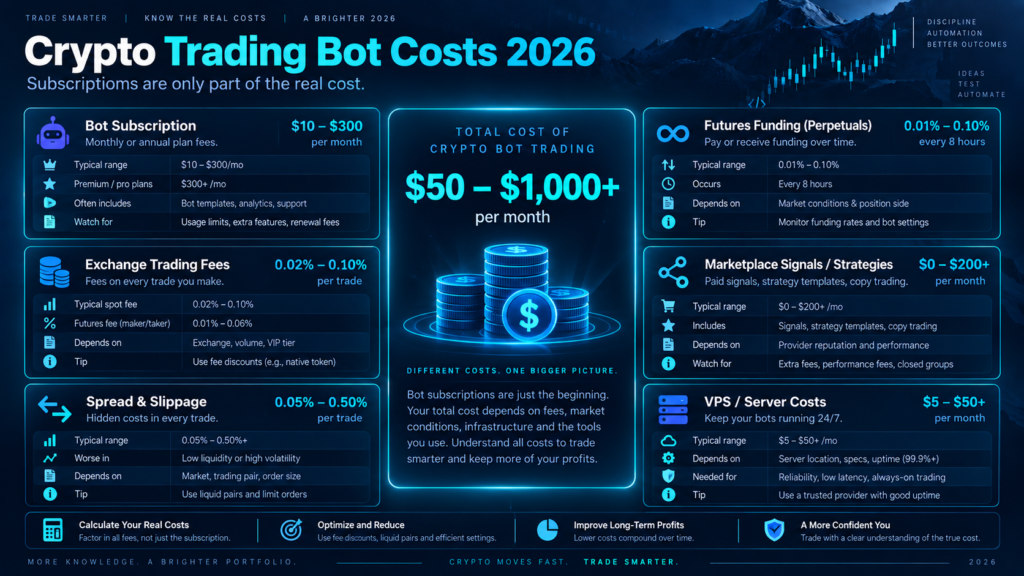
| Subscription burden | Monthly or annual software cost divided by the bot allocation. | A small bot can be burdened by a fixed subscription before trading costs. |
Best Crypto Grid Bot Settings: Add Trigger, Take-Profit, Stop-Loss and Trailing Rules
The exit plan is where many settings guides become incomplete. A grid can make money on completed cycles while the overall account loses value. Decide what “stop” means in the provider: stop new orders, cancel all orders, sell spot inventory, close a leveraged position or execute several actions together. Exit behavior is a required field in any serious crypto grid bot settings audit.
| Setting | Useful question | Common mistake |
|---|---|---|
| Trigger or entry price | What condition must occur before the bot opens exposure? | Starting immediately even though the range has already broken. |
| Take-profit | At what condition should the complete strategy be closed? | Confusing grid-profit withdrawals with liquidation of the remaining position. |
| Stop-loss | What observation invalidates the range and limits the loss? | Assuming the lower grid boundary automatically exits inventory. |
| Trailing up or down | When may the range move, and how are old orders handled? | Calling a moving range the same strategy as a fixed-range test. |
Official product documentation can differ. For example, the Bybit futures-grid guide lists price range, grid count, investment, leverage, trailing and TP/SL as separate inputs and explains that its futures P&L includes realized and unrealized components. That is a product-specific reference, not a universal rule for every spot or futures bot.
For a first controlled experiment, keep trailing disabled unless the research question is specifically about a moving range. Otherwise, a profitable result may be caused by a different exposure path rather than by the original grid settings. Changing trailing rules means you are testing a new set of crypto grid bot settings.
Best Crypto Grid Bot Settings: A Worked Validation Example
The following example demonstrates a reproducible review rather than a configuration to copy. Assume a hypothetical spot pair trades near $100, recent observations suggest a candidate range of $90–$110, the intended bot budget is $600 and the exchange fee is 0.10% per side. There is no leverage, funding cost or guaranteed fill. These crypto grid bot settings are deliberately hypothetical so the accounting remains visible.
- Range: record why $90 and $110 are candidate boundaries and the condition that would invalidate them. Do not widen the range after a loss without rerunning the test. This is the thesis layer of the crypto grid bot settings.
- Grid count: choose 20 arithmetic intervals for the accounting illustration. The nominal step is $1.00. The upper-cycle gross step is about 0.9174%, comfortably above the hypothetical fee-only break-even, but the margin is not a promised return.
- Order budget: divide the $600 budget in the model into 20 simplified $30 slots only to inspect capital feasibility. Confirm whether the actual platform uses equal quote amounts, base inventory or another sizing method.
- Cost test: add the stated buy and sell fees, then stress the result with spread, slippage, rounding and at least one rejected or missed fill. A theoretical cycle is not a live execution.
- Exit: define the price or market condition that invalidates the range and what happens to inventory. The example does not invent a universal stop percentage.
- Stress test: test sideways oscillation, a sustained decline below $90, a rally above $110, a gap through multiple levels and a connection interruption.
This process may conclude that the bot should not be launched. That is a valid result. The best crypto grid bot settings are not the most active or the most profitable-looking; they are the settings whose assumptions survive an honest failure test.
Show the minimum accounting assumptions
The fee-adjusted cycle calculation treats the same quantity as bought at one grid level and sold at the next. It uses proportional fees in quote currency and ideal prices. It does not model candle sequencing, queue priority, partial fills, spread, slippage, subscription fees, tax, market impact or inventory losses. Replace every assumption with actual account data before relying on a result.
Best Crypto Grid Bot Settings: Use Cases, Pros, Cons and Poor Fits
Settings should match the job. A grid is not a universal replacement for scheduled accumulation, a trend-following system or a risk-managed futures strategy. The earlier grid bot vs DCA bot comparison explains why the order logic and failure modes differ. The best crypto grid bot settings cannot make the wrong strategy fit the market.
| Potential fit | Why it may fit | When it is not a fit |
|---|---|---|
| Two-way, liquid market | Repeated movement can test the order-recycling logic. | Liquidity is too thin for consistent fills or spreads consume the margin. |
| Rule-based monitoring | Range, fee and exit assumptions can be documented and reviewed. | You cannot monitor exposure or respond to a broken connection. |
| Small controlled experiment | Capital can be limited while mechanics are validated. | The money is needed soon or a loss would affect essential expenses. |
| Spot automation research | No liquidation mechanism is added to the baseline model. | You are actually seeking leveraged directional exposure. |
Pros
- Turns repeated order rules into an auditable process.
- Can reduce manual order placement in a defined range.
- Makes fee, capital and exit assumptions explicit before launch.
- Can be tested with historical, simulated and small live stages.
Cons and limitations
- A range-bound design can struggle during a sustained directional move.
- Completed grid profit may hide losses on inventory still held.
- More orders mean more opportunities for fees, slippage and execution failure.
- Automation does not remove exchange, API, custody or software risk.
- A good backtest can be overfit and may not reproduce live fills.
Best Crypto Grid Bot Settings: Hidden Costs and Implementation Checks
Fee-adjusted spacing is necessary but not sufficient. Before calling a configuration viable, list every cost that can reduce account equity or change the order behavior. Hidden costs are where apparently attractive crypto grid bot settings often fail.
| Cost or constraint | What to verify |
|---|---|
| Trading fees | Maker/taker tier, fee currency, discounts and whether the actual order is immediately marketable. |
| Spread and slippage | Difference between theoretical level and filled price, especially during fast moves. |
| Minimum order rules | Notional minimum, quantity increment, price precision and rounding behavior. |
| Software subscription | Monthly versus annual billing, bot limits, backtest limits and trial conditions. |
| Rebalancing or range changes | Whether moving the range cancels orders, realizes losses or adds new exposure. |
| Futures-only charges | Funding, margin, liquidation and leverage; these do not belong in an ordinary spot model. |
| Operational interruption | Exchange downtime, API limits, revoked keys, software outages and manual recovery. |
The CFTC advisory on AI trading bots warns that automation and artificial intelligence do not turn trading systems into guaranteed money machines. Any page or dashboard promising certain returns should be treated as a risk signal, not as proof that its settings are superior.
Record each cost beside the relevant crypto grid bot settings so later changes remain auditable.
Best Crypto Grid Bot Settings: How to Test Before Live Deployment
Use the same scientific discipline for a grid as for any trading strategy. Define the parameters before looking at the final result, and reserve data that the setup did not use for out-of-sample evaluation. The purpose of testing crypto grid bot settings is to discover failure conditions, not to manufacture a favorable screenshot.
- Freeze the rules: pair, timeframe, range method, grid mode, count, order sizing, fees, slippage, exits and restart behavior.
- Use clean historical data: record exchange, timestamp convention, candle resolution and missing-data treatment.
- Model execution: distinguish a price touching a level from a limit order actually filling. Include partial fills and order sequencing where possible.
- Run in-sample and out-of-sample: do not tune the range and then call the same period independent evidence.
- Use walk-forward checks: retest the fixed process across multiple market regimes rather than selecting only sideways periods.
- Stress assumptions: increase fees and slippage, remove selected fills, widen spreads and simulate a price gap outside the range.
- Measure the right outputs: total equity after costs, maximum drawdown, time in exposure, inventory, completed cycles, idle time and operational failures.
- Stage deployment: demo or paper testing teaches workflow; a small live stage tests real execution; neither guarantees future performance.
Our backtesting software guide can help with the research-tool stage. A backtest is evidence about a defined historical simulation, not a promise about the next market regime.
Save the configuration, data window and assumptions as a versioned record of the crypto grid bot settings you actually tested.

Platform and API Checklist Before Using the Settings
Software can make the configuration easier to enter, but it cannot decide whether the range fits your risk limit. Before paying or connecting an exchange, verify each item in the actual account and provider documentation. Treat the interface as an implementation of your crypto grid bot settings, not as independent evidence that the strategy is sound.
- Does the product support the exact pair, market type and region you intend to use?
- Does the displayed grid count mean intervals, price lines or active orders?
- Does the order preview show initial inventory, pending liquidity and estimated fees?
- Can the platform explain how it handles rounding, partial fills, failed orders and range exits?
- Are historical tests clearly labeled as backtests, and do they include fees and unsold inventory?
- Can you cancel orders and close exposure directly at the exchange if the bot stops?
- Can the API key trade without withdrawals, and are supported IP restrictions available?
- What happens when the subscription expires, the exchange disconnects or the bot reaches a plan limit?
For a broader shortlist, use our best crypto grid trading bots comparison. That comparison answers which platform types may fit different workflows; this page answers how to validate the settings after you have selected a candidate tool.
Compare the controls against your written test. Use the provider’s demo or order preview to verify range levels, grid count, allocation and exit behavior before any live connection.
Affiliate link · Confirm current pricing, exchange support and account eligibility directly with Bitsgap.

Best Crypto Grid Bot Settings FAQ
What are the best crypto grid bot settings for beginners?
There is no universal beginner template. Start with a clearly defined spot-market experiment, a range you can explain, a fee-adjusted grid count, limited capital and a written exit rule. Test the order behavior before increasing the allocation. Those are the minimum building blocks of defensible crypto grid bot settings.
What is the most important grid bot setting?
The range is often the most consequential because it defines where the bot is designed to operate. A poor range can weaken every grid count and order-size choice. It is still necessary to test fees, capital and exits separately.
How many grids should a crypto bot use?
Choose the count only after calculating the gross step and the fee-adjusted result for the weakest cycle. More grids create smaller intervals and may increase trade frequency, but they can leave too little margin after fees, spread and slippage.
Can a crypto grid bot settings calculator guarantee profit?
No. A calculator can reproduce formulas and hypothetical scenarios. It cannot guarantee fills, future price behavior, liquidity, exchange uptime or the value of inventory held when price leaves the range. It can validate arithmetic inside crypto grid bot settings, but not the future.
Should I use spot or futures grid settings?
They should be treated as separate systems. Futures add leverage, margin, funding and liquidation risk. A spot-grid backtest or fee calculation does not validate a futures configuration.
Does a stop-loss fix a bad grid range?
No. A stop-loss can define an exit condition, but it cannot make the original range valid or remove slippage and gap risk. Decide the invalidation rule and maximum acceptable loss before funding the bot.
Are more grid levels always better?
No. More levels reduce the distance between orders. That can make smaller moves tradable, but it also reduces gross margin per cycle and may create minimum-order or fee problems.
Best Crypto Grid Bot Settings: Final Verdict
The best crypto grid bot settings are the ones you can explain, calculate and reject when the evidence is weak. Start with the market thesis and range, calculate the fee-adjusted spacing, budget the full ladder and define the exit before the bot is live. That is the complete crypto grid bot settings workflow.
Do not evaluate a grid from completed-cycle profit alone. Track total account equity, unsold inventory, drawdown, fees, idle time and operational failures. If the configuration only works after optimistic fills, a narrow cost model or an unexplained range adjustment, it has not passed validation.
Run the checklist before committing funds. Review the platform, confirm the actual order preview and keep the allocation small enough that a failed range does not threaten essential finances.
Review Bitsgap Before You Start
Affiliate link · Automation does not guarantee profits or prevent losses.
Editorial sources and method
Parameter definitions and product-specific examples were checked against current provider documentation and regulatory education. The formulas and tables on this page are independently stated hypothetical calculations; they are not live trades, platform results or investment recommendations.