Table of Contents
ToggleBest Backtesting Software for Traders in 2026
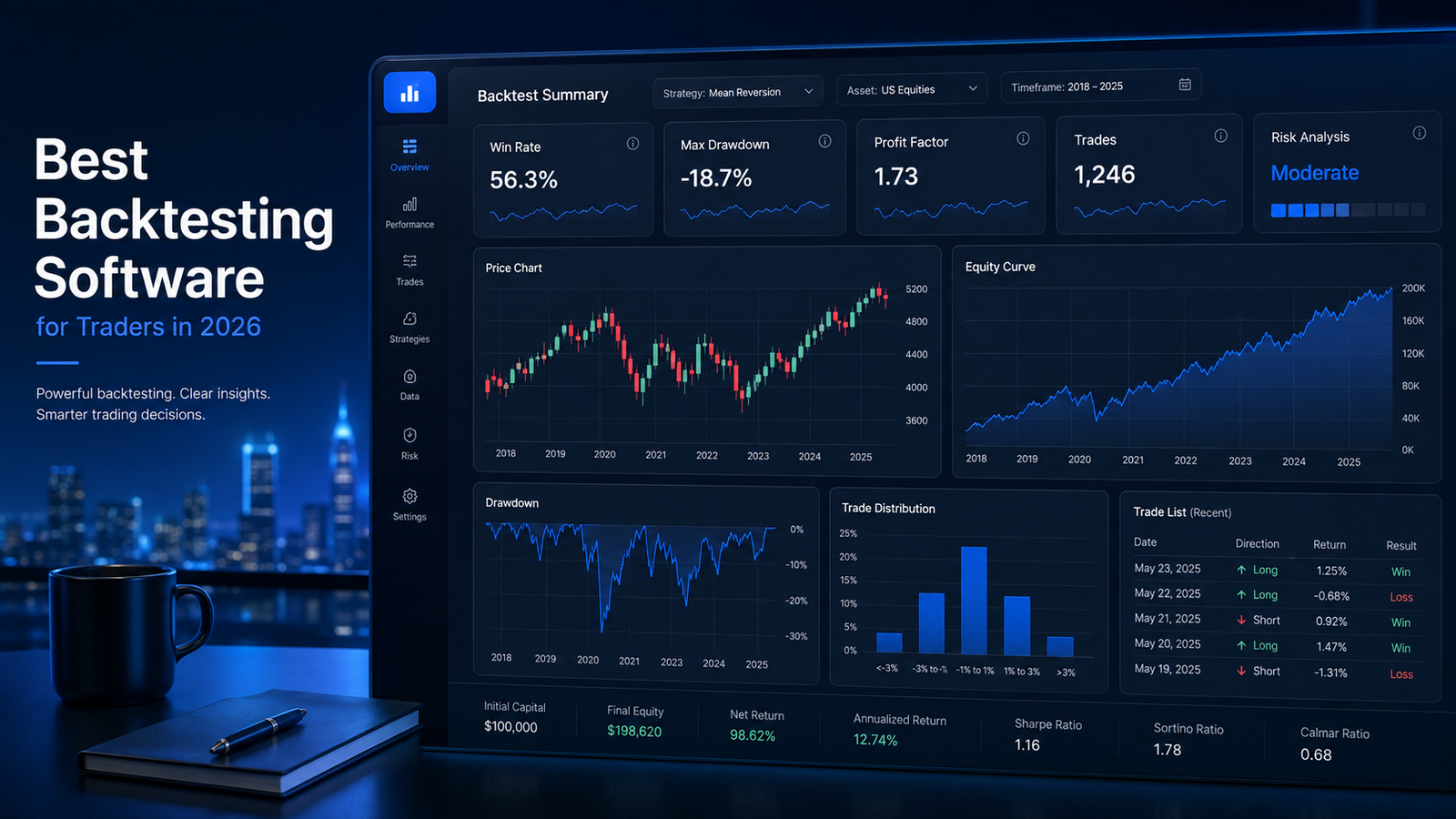
The best backtesting software helps traders test strategies against historical market data before risking real capital.
In this 2026 comparison, TradeboticsAI evaluates leading backtesting platforms for stocks, crypto, forex, and algorithmic trading based on usability, strategy testing capabilities, automation potential, pricing transparency, and risk-analysis features.
Whether you are testing your first rule-based strategy or building a more advanced quantitative workflow, the goal is the same: identify which tools provide the most useful environment for validating trading ideas before live deployment.
The best backtesting software should combine reliable historical data, realistic testing conditions, and tools that match the trader’s strategy and experience level
How We Evaluated the Best Backtesting Software
Our evaluation focuses on the factors that matter most when testing a trading strategy: historical data quality, supported asset classes, ease of strategy creation, realism of execution assumptions, risk metrics, automation capabilities, broker or exchange connectivity, and pricing transparency.
We also consider whether each platform is better suited to beginners, active traders, developers, or quantitative users. Rankings are based on publicly available product information and documented capabilities, not guaranteed trading performance.
Best Backtesting Software: Evidence-Based Buying Framework
Before choosing the best backtesting software, separate the historical dataset, strategy engine, fill assumptions and deployment workflow. A program that plots past entries is not necessarily capable of recreating execution timing or order-book events. Match each platform to a specific test you need to reproduce, not to a marketing superlative.
| Research need | Documented example | Verify before subscribing |
|---|---|---|
| Longer historical chart strategy test | TradingView Deep Backtesting: available historical dataset, up to 2 million bars per calculation | Eligible subscription, symbol history and timeframe limits; report is not identical to the ordinary chart calculation |
| Custom fill, brokerage and slippage models | QuantConnect LEAN: configurable order fill, fee, slippage and brokerage models | Data licensing, coding effort, model assumptions and local versus cloud needs |
| Historical tick-based Expert Advisor tests | MetaTrader 5 Strategy Tester: real-tick mode or generated-tick and OHLC modes | Broker history quality, selected tick mode, spreads and instrument-specific settings |
| Out-of-sample parameter validation | NinjaTrader Strategy Analyzer: walk-forward optimization with separate training and test windows | NinjaScript strategy, historical coverage and whether the fitted settings survive unseen samples |
Best backtesting software selection rule: choose the cheapest supported workflow that can meet your evidence requirements after data, licensing and execution-model costs. This is a capability matrix, not a comparative speed benchmark or evidence that the four vendors produce equivalent fills.
Official documentation: TradingView Deep Backtesting; QuantConnect LEAN reality modeling; MetaTrader 5 test modes; and NinjaTrader walk-forward optimization.
Best Backtesting Software in 2026: Quick Comparison
Research note: This comparison is based on publicly available product documentation and capabilities. It does not represent guaranteed trading performance or hands-on performance claims.
| Platform | Best For | Backtesting Approach | User Profile | Details |
|---|---|---|---|---|
| TrendSpider | No-code strategy testing | Visual and natural-language strategy development with backtesting tools | Beginner–Advanced | View Analysis |
| TradingView | Chart-based strategy testing | Pine Script strategies tested against historical chart data | Intermediate | View Analysis |
| QuantConnect | Quantitative developers | LEAN engine with local and cloud algorithm backtesting | Advanced | View Analysis |
| MetaTrader 5 | Expert Advisor optimization | Historical strategy testing and multi-currency optimization | Intermediate–Advanced | View Analysis |
| Forex Tester | Manual Forex backtesting | Historical simulation, manual backtesting and forward testing | Beginner–Intermediate | View Analysis |
| NinjaTrader | Advanced strategy testing | Backtesting, optimization, walk-forward and Monte Carlo analysis | Advanced | View Analysis |
| AmiBroker | Portfolio backtesting | AFL-based portfolio testing, optimization and walk-forward analysis | Advanced | View Analysis |
| TradeStation | Integrated testing and brokerage | EasyLanguage strategy testing with historical and simulated trading | Intermediate–Advanced | View Analysis |
| MultiCharts | Portfolio-level testing | Strategy backtesting, optimization and multi-instrument portfolio analysis | Advanced | View Analysis |
| ProRealTime | Visual strategy optimization | ProBacktest historical simulation with strategy optimization tools | Intermediate–Advanced | View Analysis |
Detailed Reviews of the Best Backtesting Software
TrendSpider: Best for No-Code Strategy Backtesting
TrendSpider is one of the strongest choices for traders who want to build and test rules-based strategies without writing code. Its Strategy Tester supports visual and natural-language strategy creation, historical backtesting, trade-cost assumptions, and analysis across multiple asset classes.
TrendSpider also provides AI-assisted strategy refinement and can test strategies across groups of symbols, making it useful for traders who want to evaluate whether an idea behaves consistently beyond a single chart.
The main limitation is that backtest results remain historical simulations and should not be treated as evidence of future profitability.
TradingView: Best for Chart-Based Strategy Testing
TradingView is a strong option for traders who want to design and backtest strategies directly on interactive charts.
Strategies are built with Pine Script and can simulate orders on historical and real-time data, while the Strategy Report displays metrics such as total P&L, drawdown, trade count, win rate, and profit factor.
TradingView also offers Bar Replay for manual historical simulation and Deep Backtesting on eligible plans for testing strategies across a larger historical dataset.
Its main limitation is that custom systematic strategies generally require familiarity with Pine Script, making it better suited to traders comfortable with rules-based scripting than users seeking a fully no-code workflow.
QuantConnect: Best for Quantitative Developers
QuantConnect is designed for traders and developers who want a more advanced quantitative research environment.
Its open-source LEAN engine supports algorithm development and backtesting across multiple asset classes, with workflows that can run locally or in the cloud. The platform is especially useful for users who want more control over data, code, execution logic, and research reproducibility.
Compared with no-code tools, the learning curve is higher because effective use generally requires programming skills and a stronger understanding of quantitative workflows.
For technically experienced users, however, that additional complexity can provide greater flexibility when building and validating systematic strategies.
MetaTrader 5: Best for Expert Advisor Backtesting
MetaTrader 5 is a strong choice for traders who want to test and optimize automated strategies built as Expert Advisors.
Its Strategy Tester can evaluate trading algorithms against historical market data, compare different parameter combinations, and support multi-currency testing for more complex systems.
The platform is particularly relevant for forex and CFD traders already working within the MetaTrader ecosystem. Its main limitation is usability: creating sophisticated automated strategies usually requires MQL5 programming knowledge or access to prebuilt Expert Advisors, so it is less beginner-friendly than modern no-code platforms.
Forex Tester: Best for Manual Forex Backtesting
Forex Tester is built primarily for traders who want to practice and validate forex strategies using historical market simulations.
It supports manual backtesting, forward-testing workflows, configurable trading conditions such as spreads, swaps, commissions, and leverage, and testing across multiple currency pairs and timeframes.
The platform is especially useful for traders who want to replay market conditions, review decisions, and refine discretionary or rules-based forex strategies before using real capital. Its main limitation is specialization: traders focused primarily on stocks, options, or broader multi-asset quantitative research may prefer a more general-purpose platform.
How to Choose the Right Backtesting Software
Looking for automated trading platforms too? Compare our 10 Best Trading Bots in 2026.
The right backtesting platform depends on how you trade and how much control you need.
Beginners may benefit from visual or no-code tools, while quantitative traders and developers typically need programmable environments, broader datasets, and more detailed execution controls.
Before choosing a platform, compare the asset classes supported, historical data quality, strategy-building workflow, transaction-cost modeling, risk metrics, automation options, broker connectivity, and total cost.
Most importantly, choose software that lets you test assumptions realistically rather than simply producing attractive historical results.
Testing futures specifically? This list covers stocks, forex, crypto and other trading workflows. For a futures-only comparison, see our best futures backtesting platforms guide. When testing ES, MES, NQ or MNQ, verify contract rollover handling, exchange data entitlements, commissions, slippage and whether the historical test uses bar or tick data. Our futures data feeds comparison and futures rollover calendar cover two inputs that can materially change backtesting assumptions.
Best Backtesting Software: Test Transaction-Cost Sensitivity
One way to compare the best backtesting software is to ask whether it can model realistic costs rather than simply display gross historical returns. For a systematic strategy, the relevant metric is what remains after the specific broker’s commission, spread, slippage, financing and any exchange or data costs that belong in the experiment. QuantConnect documents configurable transaction fee models and slippage models; other tools may expose different configuration options.
Worked example: 200 historical round trips with different fill assumptions
Illustrative arithmetic only; not a real strategy result or vendor quote. Suppose a test generates 200 one-contract completed round trips and $12 in gross profit per round trip, or $2,400 gross. Assume $2.20 of combined commissions and other per-trade charges per round trip, then stress-test two different slippage estimates. Results change as follows:
| Assumption | Lower slippage | Higher slippage |
|---|---|---|
| Completed round trips | 200 | 200 |
| Gross profit | $2,400 | $2,400 |
| Commission and fees per round trip | $2.20 | $2.20 |
| Modeled slippage per round trip | $1.00 | $3.00 |
| Combined modeled trade costs | $640 | $1,040 |
| Illustrative net result | $1,760 | $1,360 |
Formula: illustrative net P&L = gross P&L − [completed round trips × (round-trip commissions and fees + round-trip slippage)]. This simple sensitivity check changes the net result by $400 while leaving signals and gross outcomes unchanged. It does not model market impact, partial fills, adverse selection or changing spreads; those require their own assumptions.
When reviewing the best backtesting software, reject a cost comparison that mixes commissions quoted per side with completed-trade totals, or assumes zero slippage without justification. Check if the platform and data allow you to rerun the same strategy under several cost settings. The aim is robustness, not manufacturing an attractive equity curve.
Best Backtesting Software: A Reproducible Out-of-Sample Checklist
The best backtesting software should help distinguish fitting a model to historical data from validating it on unseen data. A walk-forward test trains or optimizes parameters on one interval and evaluates them on a later interval; repeating this process can reveal whether a setting works only in a narrow historical regime. NinjaTrader documents this separation of optimization and testing windows.
- Freeze the research question: document symbols, timeframe, trading sessions, sample start and end, entry and exit rules, before running a search over parameters.
- Audit data quality: check missing bars, timezone, exchange holidays, corporate actions and futures contract rollover assumptions as applicable.
- Define transaction costs first: commission per side, spread and slippage, whether fees are charged per execution, and treatment of partial fills.
- Reserve unseen periods: use separate training and later test windows; an illustrative 70%/30% split is not an optimal split for every market or sample.
- Prevent information leakage: indicators and selection logic must not use prices, constituents or revisions that were unknown at decision time.
- Repeat across regimes: compare trending, sideways and volatile periods, and document parameter sensitivity.
- Stress-test fills and costs: rerun with different plausible execution assumptions; a gross-only result is insufficient.
- Record reproducibility: save code version, parameter set, raw data source, adjustments and model assumptions.
- Check paper operation: confirm signal timing, order states, reconnects and error handling before any live use.
These checks are editorial research guidance, not provider certifications or proof that a given platform passed an independent benchmark. Select the best backtesting software for the particular test it lets you reproduce, and record limitations that a simulation cannot eliminate.
5 More Backtesting Platforms Worth Considering
NinjaTrader: Best for Advanced Strategy Backtesting
NinjaTrader is a strong choice for traders who want to backtest and optimize automated strategies using historical market data.
Its Strategy Analyzer supports standard backtesting, parameter optimization, walk-forward analysis, basket testing across multiple instruments, and Monte Carlo simulation.
The platform is particularly relevant for futures traders and users building strategies with NinjaScript. Its main limitation is complexity: advanced strategy development generally requires familiarity with NinjaScript and a more technical workflow than no-code platforms. Historical results should also be treated as simulations rather than evidence of future performance.
AmiBroker: Best for Portfolio Backtesting and Optimization
AmiBroker is a powerful option for traders who want portfolio-level backtesting, optimization, walk-forward analysis, and Monte Carlo simulation within a highly customizable research environment.
Strategies are typically defined using AmiBroker Formula Language (AFL), giving experienced users substantial control over entry and exit rules, portfolio logic, and optimization parameters.
It is particularly well suited to systematic traders who want to test ideas across multiple symbols rather than evaluating one chart at a time. The trade-off is a steeper learning curve: users who prefer a visual or no-code workflow may find AmiBroker less accessible than newer platforms.
TradeStation: Best for Integrated Backtesting and Brokerage
TradeStation combines historical strategy testing, simulation, and brokerage tools in a single ecosystem.
Traders can build custom rule-based strategies with EasyLanguage, backtest them against historical market data, and then evaluate the same ideas in a simulated trading environment before considering live execution.
The platform supports stocks, options, and futures, making it particularly useful for users who want research and brokerage capabilities under one roof.
Its main limitation is that advanced customization still requires learning TradeStation’s platform and EasyLanguage workflow, so it may be less immediate than fully visual no-code alternatives. Historical and simulated results should not be treated as guarantees of future performance.
MultiCharts: Best for Portfolio-Level Backtesting
MultiCharts is designed for systematic traders who need detailed historical testing across individual strategies and multi-instrument portfolios.
It supports strategy backtesting, optimization, performance reporting, and portfolio-level analysis, making it useful for traders who want to evaluate how multiple systems or markets behave together rather than in isolation.
The platform is better suited to experienced users because advanced strategy development and configuration require a more technical workflow than modern no-code tools. Its strength is depth and flexibility, while its main drawback is the steeper learning curve for beginners.
ProRealTime: Best for Visual Backtesting and Strategy Optimization
ProRealTime combines advanced charting with ProBacktest, its historical strategy-testing environment.
Traders can simulate rule-based systems using past market data, analyze detailed performance results, and optimize strategy parameters before considering live deployment.
Premium functionality also supports multi-instrument backtesting and optimization, while PaperTrading provides a complementary environment for testing systems under current market conditions.
ProRealTime is particularly useful for traders who want charting, strategy development, backtesting, and optimization within the same ecosystem.
Its main limitation is that more advanced automated systems require learning the platform’s programming and strategy-building workflow, and simulated results should never be interpreted as guarantees of future performance.
Backtesting Software FAQ
What Is the Best Backtesting Software for Beginners?
For most beginners, the best backtesting software is a platform that makes strategy rules easy to define and historical results easy to interpret.
Visual or no-code tools can reduce the technical barrier, while features such as clear performance metrics, transaction-cost assumptions, and risk analysis help users understand whether a strategy behaves realistically. As experience grows, traders can move toward more programmable platforms for greater control and customization.
Can Backtesting Predict Future Trading Performance?
No. Backtesting can show how a strategy would have behaved under historical market conditions, but it cannot predict future results.
Outcomes can be distorted by overfitting, look-ahead bias, survivorship bias, transaction costs, slippage, changing liquidity, and shifts in market regimes.
A strong backtest is useful for validating assumptions and identifying weaknesses, but it should be combined with out-of-sample testing, realistic execution assumptions, and careful risk controls before any live deployment.
What Is the Difference Between Backtesting and Paper Trading?
Backtesting evaluates a strategy against historical market data, while paper trading tests the strategy under current market conditions using simulated capital.
Backtesting is useful for studying how rules would have behaved across past periods, whereas paper trading helps evaluate live execution logic, signals, and workflow without risking real money.
The two methods are complementary: backtesting is best for historical validation, while paper trading is better for testing how a strategy behaves in a live environment before real deployment.
Is Free Backtesting Software Good Enough?
Free backtesting software can be enough for learning basic strategy validation and testing simple ideas, but advanced users may eventually need better historical data, more realistic execution modeling, portfolio-level analysis, optimization tools, automation, or broker connectivity.
The right choice depends on the complexity of the strategy and the quality of the data required. A free tool can be a good starting point, but cost should not be the only factor when reliability and research depth matter.
Final Verdict: Which Backtesting Software Should You Choose?
New to automated trading? Read our complete guide: How Do AI Trading Bots Work?
When comparing the best backtesting software, prioritize realistic testing assumptions, reliable historical data, and risk analysis over impressive-looking simulated returns. The best backtesting software should help you challenge a strategy, not simply confirm what you want to see.
Risk Disclosure: Backtesting results are hypothetical and based on historical data. They do not guarantee future performance. Trading involves substantial risk, including the possible loss of capital. TradeboticsAI provides educational software research and technology analysis and does not provide personalized investment advice.
The best backtesting software depends on your trading style, technical experience, and the level of control you need.
TrendSpider is a strong fit for traders who prefer a visual or no-code workflow, TradingView works well for chart-driven strategy testing, and QuantConnect is better suited to developers and quantitative users who need deeper programmability.
MetaTrader 5 remains a practical choice for Expert Advisor testing, while NinjaTrader, AmiBroker, TradeStation, MultiCharts, ProRealTime, and Forex Tester each serve more specialized workflows.
The most important factor is not choosing the platform with the most features, but choosing one that lets you test assumptions realistically, model trading costs, analyze risk, and validate strategies before any live deployment.
The best backtesting software should combine reliable historical data, realistic testing conditions, and tools that match the trader’s strategy and experience level.
The best backtesting software should help traders validate strategies, measure risk, and identify weaknesses before committing real capital