
Crypto Trading Bot Hosting: Cloud vs VPS vs Local (2026)
Crypto trading bot hosting determines where automation runs, who maintains it, where credentials are processed, and what happens when a computer, network, process, or provider fails. This guide compares managed cloud platforms, self-hosted virtual private servers, and local computers using total cost, uptime, security, latency, control, and recovery responsibility—not marketing claims.
Last fact-checked: September 23, 2026 · Written for U.S. readers · Educational content, not financial, security, or investment advice
Coinrule states that its platform is cloud-based and runs rules on its servers 24/7. Start with its demo workflow and verify every rule, permission, limit, and stop condition before connecting live funds.
Explore Coinrule Cloud Automation
Crypto Trading Bot Hosting: The Fast Decision
The best crypto trading bot hosting model is the one whose failure responsibilities you can actually fulfill. “Cloud,” “VPS,” and “local” describe where software runs; they do not prove reliability, safety, execution quality, or profitability. Start with the strategy’s operational needs, then choose the environment.
A managed platform can still depend on exchange APIs, data feeds, third-party infrastructure, account permissions, and correct user configuration. A self-hosted system can still fail because of weak server hardening, stale software, full storage, clock drift, lost state, or unsafe restart logic. Local crypto trading bot hosting can appear free while consuming electricity, hardware life, maintenance time, and attention.
Separate research from live execution. Heavy backtests, optimization, machine-learning training, and data downloads may need bursts of CPU, RAM, or storage that a small live worker does not. Combining both jobs on one host can starve execution at the worst time. A sound crypto trading bot hosting design assigns resources and failure boundaries deliberately.
Managed Cloud vs VPS vs Local Crypto Trading Bot Hosting
This crypto trading bot hosting comparison describes typical responsibility boundaries. Individual providers and open-source systems differ, so verify the current documentation, supported exchanges, permissions, pricing, export options, and incident procedures before choosing.
| Decision factor | Managed cloud platform | Self-hosted VPS | Local computer |
|---|---|---|---|
| Infrastructure operations | Mostly handled by the vendor | Handled by you or your operator | Handled by you on physical hardware |
| Custom code | Limited to supported rules, signals, bots, or integrations | Broad control over code, services, libraries, and schedules | Broad control, but tied to local availability |
| Root / OS access | Usually unavailable | Available on the server | Available on your machine |
| API-secret boundary | Processed within the provider’s architecture | Stored and processed in your chosen environment | Stored and processed on your device |
| Uptime responsibility | Vendor operates the platform; you still monitor bot and exchange state | You own process, host, network, storage, updates, alerts, and recovery | You own those layers plus local power, router, ISP, and hardware |
| Latency control | Limited to vendor architecture and integrations | You can select a region and measure the path | Depends on home or office network and geography |
| Maintenance burden | Lower infrastructure burden | Moderate to high | Moderate to high, with physical maintenance |
| Cost model | Subscription or plan limits | Server, storage, backups, monitoring, and labor | Hardware, electricity, ISP, backups, and labor |
| Portability | Depends on export and platform capabilities | High if deployment, data, and configuration are documented | High at the code level, lower operationally unless reproduced elsewhere |
| Best fit | No-code or supported automation with convenience | Custom, open-source, or infrastructure-controlled bots | Development, learning, research, and supervised testing |
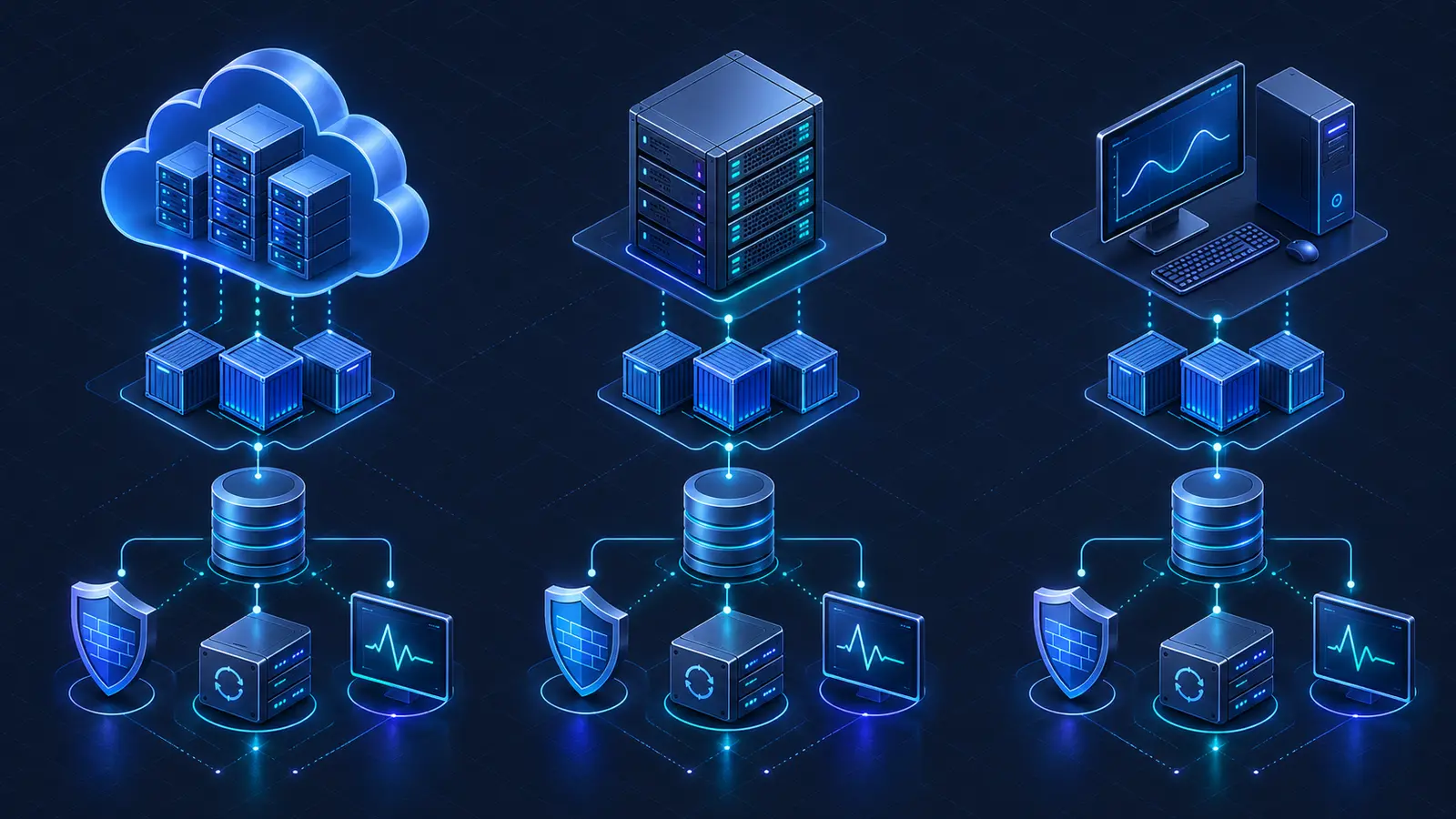
Control is not identical to safety. Self-hosting can reduce dependence on a bot vendor’s application boundary and can keep files and secrets inside infrastructure you select. It also creates a larger personal operations burden. Managed crypto trading bot hosting can reduce routine systems work, but you must evaluate the provider’s security model, supported controls, data portability, outage behavior, and account connection process.
Crypto Trading Bot Hosting Cost and Fit Calculator
Crypto trading bot hosting sticker price misses operator time and local infrastructure costs. This calculator estimates monthly ownership cost for the three models and gives a fit signal based on control, convenience, custom-code needs, home-internet reliability, and always-on requirements. Enter your own current values; the defaults are illustrative, not market quotes.
Fit is based on the inputs above, not trading performance. Validate supported exchanges, features, limits, security, exportability, and incident behavior separately.

The cheapest crypto trading bot hosting option on paper can be the most expensive operationally. A small VPS may have a low monthly invoice, yet an operator who spends several hours patching, debugging, and recovering it should count that time. A local computer you already own still has an opportunity cost, electricity use, component wear, storage, and backup requirements.
Do not include expected trading profit as a hosting benefit. Strategy returns are uncertain and should not justify a fragile deployment. Compare environments using costs and capabilities you can verify: resource capacity, data retention, credential handling, restart behavior, monitoring coverage, recovery time, and portability.
The Three Crypto Trading Bot Hosting Models
Model 1Managed Cloud Platform
Managed crypto trading bot hosting runs the automation inside a vendor-operated service. Users typically configure rules, bots, signals, or exchange connections through a web interface while the provider operates the underlying application infrastructure. Coinrule’s official help center states that it is cloud-based and that rules run on its servers 24/7. Cryptohopper documents continuous market monitoring, and WunderTrading describes itself as a cloud-based automation platform.
The main advantage is reduced infrastructure work. You do not normally patch an operating system, maintain Docker, configure a process manager, or keep a home computer online. Managed platforms can also provide guided exchange connections, strategy templates, dashboards, notifications, and support. That convenience is useful when the platform’s supported logic matches the intended strategy.
The main limitation is the vendor boundary. You may not control deployment region, libraries, order-state implementation, data retention, release timing, or every monitoring detail. Plan limits can constrain active rules, bots, positions, backtests, or connected exchanges. Before choosing managed crypto trading bot hosting, verify what happens to open positions and orders if a subscription ends, a bot pauses, an API connection fails, or the platform becomes unavailable.
Managed does not mean custodial by default, and “non-custodial” does not mean risk-free. Funds may remain on the exchange while the connected API key can still place trades. Review exact permissions, disable withdrawals where the integration does not require them, enable strong account security, and confirm exchange-side activity independently. The crypto trading bot API security guide provides a dedicated permission and key-lifecycle checklist.
Model 2Self-Hosted VPS
A VPS is a virtual server rented from an infrastructure provider. Self-hosted crypto trading bot hosting gives the operator control over the operating system, bot software, containers, configuration, storage, logs, network rules, alerts, and update schedule. It is a common fit for open-source systems, custom Python services, webhooks, databases, and supporting processes.
Control is the benefit and the burden. The operator must restrict administrative access, patch the host, protect secrets, configure time synchronization, manage storage, retain backups, monitor processes and exchange connectivity, test updates, and rehearse recovery. Root access can solve a problem quickly, but it can also create one quickly. Use infrastructure-as-code or at least versioned, reproducible deployment instructions so the server is not a one-off mystery.
Freqtrade’s current official documentation recommends Docker and lists a minimum Linux cloud instance of 2 GB RAM, 1 GB disk, and 2 vCPU for its bot. Those figures are product-specific starting points, not a universal capacity promise. Multiple strategies, more pairs, high-frequency data, local databases, long log retention, backtesting, hyperoptimization, or machine learning may require materially more resources.
A VPS should fail closed. Restarting a container restores a process, not necessarily correct account state. After any interruption, the bot must rebuild current orders, fills, positions, balances, data freshness, configuration version, and risk limits before submitting new exposure. Review the dedicated crypto trading bot failure modes guide for unknown orders, partial fills, duplicate processes, and unsafe restarts.
Model 3Local Computer
Local crypto trading bot hosting runs on a desktop, mini PC, laptop, workstation, or home server. It is excellent for development, debugging, historical research, and supervised paper trading because files and tools are directly accessible. It can also be a valid live environment when engineered like production, but “my computer is usually on” is not an uptime design.
A local deployment depends on the device, operating system, disk, router, home power, internet provider, local firewall, physical access, and sometimes sleep or automatic-update behavior. Laptops can sleep, home routers can reboot, consumer IP addresses can change, and desktop restarts can occur at inconvenient times. A battery may bridge a short power interruption but not an ISP outage or a process-state error.
If local crypto trading bot hosting is used live, disable unintended sleep, monitor externally, use a tested startup procedure, protect the device and secrets, keep encrypted backups, separate research workloads, and define how exposure is managed if remote access fails. Do not expose a control panel or API directly to the public internet merely for convenience.
Local is often the correct place to learn and the wrong place to assume reliability. Promote a system to VPS or managed hosting only after crypto bot paper trading proves operational behavior and the target deployment has passed its own restart, network, data, and reconciliation tests.
Bitsgap provides exchange-connected bot workflows without requiring you to operate a VPS. Its documentation says API connections should permit balance viewing and trading while withdrawals remain disabled. Verify current features, pricing, exchange support, and permissions directly.
Review Bitsgap Bot HostingCrypto Trading Bot Hosting Requirements
Crypto trading bot hosting capacity must be measured, not copied from a generic list. Begin with the bot’s official documentation, then load-test the exact configuration. CPU handles strategy calculations, serialization, encryption, and data processing. Memory holds the runtime, data frames, caches, and databases. Storage holds the OS, containers, market data, state, logs, and backups. Network quality affects feed freshness and exchange communication.
| Workload | Primary pressure | What to measure | Capacity warning |
|---|---|---|---|
| One slow-timeframe live bot | Reliability, state, network | CPU peaks, memory headroom, disk growth, API round trip | Low average usage can hide restart and burst problems |
| Many pairs or strategies | CPU, memory, API limits | Cycle duration, queue depth, rate-limit headroom | More pairs multiply data and exchange calls |
| Order-book or high-event-rate logic | Network, CPU, memory, event ordering | Message lag, dropped sequences, p95/p99 processing delay | A general-purpose small VPS may be inadequate |
| Historical backtesting | CPU, memory, disk throughput | Dataset size, parallel workers, peak RAM, run time | Separate research from live execution |
| Optimization or ML training | CPU/GPU, memory, storage | Peak resource use and contention | Do not starve a live worker |
| Long audit retention | Storage and backup | Daily log/data growth, restore duration, retention policy | Disk-full failures can halt or corrupt state |
Minimum Capacity Rules
- Keep headroom above measured peaks; do not size from average CPU and RAM alone.
- Set disk-usage alerts before the filesystem becomes critical, and rotate logs without deleting audit evidence required for reconciliation.
- Use an accurate, regularly synchronized system clock. Freqtrade explicitly warns that the host clock must be current for exchange communication.
- Separate live state from disposable containers or processes. Recreating software must not erase the information needed to identify existing orders.
- Test the same container image, dependencies, strategy, configuration, and exchange adapter that will run in production.
- Measure capacity during reconnects, data catch-up, volatility, and alert storms—not only calm markets.
Hummingbot’s official installation documentation supports Docker and source-based deployment across documented operating systems. Freqtrade provides an official Docker image and Compose workflow. These tools reduce environment drift, but containers do not replace host hardening, secrets management, persistent storage, monitoring, or reconciliation. Production crypto trading bot hosting is a complete operating system, not merely a successful install command.
Security Boundaries for Crypto Trading Bot Hosting
The crypto trading bot hosting security question is not simply “cloud or self-hosted?” It is: which identities, secrets, permissions, network paths, people, devices, and recovery channels can affect the exchange account? Draw that boundary before deploying crypto trading bot hosting.
Use a dedicated exchange API key for the bot, grant only required capabilities, and keep withdrawal permission disabled whenever the workflow does not require it. Where the exchange and platform support IP restrictions, assess and configure them carefully. Separate development, paper, and live credentials. Never paste secrets into source code, screenshots, chat messages, public repositories, or ordinary logs.
Bitsgap’s official security documentation says it requires access to trade history, balance viewing, and trading, rejects keys with withdrawal enabled, and stores API keys in encrypted form. That is a provider statement to verify against the current integration and your exchange settings; it is not an independent security certification. The same evidence standard should apply to any managed crypto trading bot hosting provider.
For self-hosted systems, avoid exposing the bot’s management API publicly. Freqtrade’s official REST API documentation warns against binding its API broadly to the internet and shows a localhost-only port mapping. Use a private network, VPN, authenticated reverse proxy, or similarly controlled access pattern when remote management is genuinely required. Apply operating-system updates through a tested change window rather than unattended changes that can restart live services without state checks.
Reliable Crypto Trading Bot Hosting: Uptime Is Not Enough
A crypto trading bot hosting environment can report 100% process uptime while the strategy is using stale data, authenticated streams are dead, orders are rejected, or local state disagrees with the exchange. Reliability must be measured end to end: market data arrives, decisions complete on time, orders receive definitive status, fills update positions, risk controls remain active, state persists, and alerts reach an operator.
| Layer | Minimum signal | Failure response | Recovery proof |
|---|---|---|---|
| Process | Heartbeat, restart count, loop duration | Pause new work; restart only under policy | Expected version and configuration are active |
| Host | CPU, RAM, disk, clock, network | Degrade or stop before resource exhaustion | Headroom and time synchronization restored |
| Market data | Event age, sequence, subscription state | Block decisions on stale or incomplete input | Fresh snapshot plus continuous updates |
| Exchange API | Error rate, rate limits, authenticated stream | Bound retries and preserve reconciliation calls | Orders and balances verified directly |
| Order state | Unknown status, partial fills, open-order diff | Freeze affected entries | Venue and local ledger agree |
| Risk | Exposure, drawdown, size, order rate | Reject unsafe actions; invoke stop policy | Limits recomputed from confirmed account state |
| Alerting | Delivery and acknowledgement time | Escalate through an independent route | Scheduled synthetic alert received |
| Backup | Age, completeness, restore test | Stop claiming recoverability | Clean restore in an isolated environment |

Restart Policy vs Safe Restart
Docker recommends restart policies for production Compose deployments, and Freqtrade’s Compose workflow is designed to restart after a system reboot. That improves availability. It does not prove that new orders should resume immediately. A safe crypto trading bot hosting restart should identify the expected deployment, establish fresh data, restore persistent intent, query open orders and fills, rebuild positions and balances, verify risk limits, and confirm alert delivery.
If any term is unknown, remain in recovery mode. Preserve protective orders and risk-reduction capability where safe, but block new exposure. The crypto trading bot monitoring framework explains the live signals and alert levels needed around this gate.
Backups That Can Actually Recover
Back up only what you can explain and restore. Typical components include versioned strategy code, configuration without exposed plaintext secrets, database state, order and fill history, infrastructure configuration, alert rules, and operational runbooks. Define retention and encryption, isolate at least one copy from the host, and test a restore on a clean target.
A database backup taken during inconsistent writes may not be usable. A strategy file without the matching dependencies and configuration may not reproduce behavior. A backup containing live secrets becomes another attack target. Reliable crypto trading bot hosting records the backup version, checksum, time, scope, encryption, restore result, and recovery owner.
Crypto Trading Bot Hosting Latency and Server Location
Crypto trading bot hosting latency matters relative to the strategy’s tested timing assumptions. A multi-hour strategy may tolerate hundreds of milliseconds that would invalidate a market-making or order-book strategy. Do not buy “low latency” from a slogan. Measure the complete path your system uses.
- Timestamp each stage. Record market event time, receipt time, decision completion, order send, venue acknowledgement, fill event, and local state update.
- Track distributions. Median latency hides the slow tail. Monitor p50, p95, p99, timeouts, reconnects, and stale-event age by venue and endpoint.
- Test candidate regions. A geographically close server is not automatically closest to the exchange endpoint’s actual network path. Measure from the intended environment.
- Include processing and queues. Network round trip may be small while data parsing, strategy logic, rate limiting, database locks, or overloaded workers add most of the delay.
- Reprice the strategy. Add observed latency, spread, fees, partial fills, and slippage to research. If the edge disappears, faster hosting alone may not rescue it.
Managed crypto trading bot hosting may not expose region selection or detailed telemetry. Ask what latency evidence is available and test the actual integration. A VPS gives more placement control, but the operator must maintain it. Local hosting may route through a consumer ISP with variable paths. In every model, exchange processing, rate limits, maintenance, and outages remain external dependencies.
Crypto Trading Bot Hosting Deployment Checklists
Managed Cloud Checklist
- Confirm the exact exchange, market type, pairs, order types, bot limits, and regional availability.
- Read current pricing and what occurs to running bots, orders, and access when a plan changes or expires.
- Use a dedicated least-privilege API key, disable withdrawals, enable platform and exchange 2FA, and review login sessions.
- Test rule conditions, position limits, stops, notifications, manual pause, emergency procedure, and exchange-side verification in demo or paper mode.
- Document how to export rules, history, configuration, and records needed for tax or incident review.
- Define an independent check at the exchange so a platform outage does not remove all visibility.
Self-Hosted VPS Checklist
- Create a dedicated non-root service identity; use key-based administrative access and restrict inbound network paths.
- Install from official images or verified releases, pin versions, scan configuration, and record the deployment hash.
- Store secrets outside source control, restrict file access, prevent secret logging, and rehearse key rotation.
- Persist order intent, fills, configuration, and state outside disposable containers; verify database durability.
- Configure clock synchronization, restart behavior, log rotation, resource alerts, external heartbeat, and independent incident routing.
- Back up required state and perform a clean restore. A backup job without a restore result is unproven.
- Kill the process at different order stages and prove idempotent recovery before live approval.
Local Computer Checklist
- Disable sleep and unintended shutdown behavior; review automatic-update and reboot policy.
- Use full-disk encryption, a dedicated user, strong authentication, endpoint protection, and controlled physical access.
- Test power loss, router restart, ISP interruption, changed public IP, disk pressure, and remote-access failure.
- Monitor from outside the local network so an ISP or router failure does not report itself as healthy.
- Separate heavy research and gaming or desktop workloads from the live process.
- Maintain a documented migration path to another host and verify the same safe-restart gate used for a VPS.
Every checklist ends with the same rule: paper-test the target environment. Testing strategy logic on a laptop and then deploying a different image, configuration, clock, network path, and exchange connection to a VPS does not validate VPS crypto trading bot hosting. The deployment itself is part of the system under test.
Real and Hidden Crypto Trading Bot Hosting Costs
Crypto trading bot hosting monthly price is only one line in total cost of ownership. Build a cost register before committing to a platform or server. Update it when bot count, data retention, exchange usage, staffing, or availability expectations change.
| Cost category | Managed cloud | Self-hosted VPS | Local computer |
|---|---|---|---|
| Core access | Subscription tier | Compute instance | Hardware purchase or depreciation |
| Data and storage | Plan limits or add-ons | Volumes, snapshots, object storage, transfer | Disk, external backup, cloud backup |
| Monitoring | Included features or external checks | Metrics, logs, alerts, status checks | External checks, remote access, alerts |
| Availability | Provider architecture | Backups, redundancy, recovery host | UPS, router, ISP, replacement hardware |
| Security | Account controls and due diligence | Hardening, patching, secret and access management | Device, network, physical, malware, and remote-access controls |
| Labor | Configuration, review, incident response | Administration, deployment, updates, backups, incidents | All VPS-style work plus hardware and home-network work |
| Exit / migration | Export, rule rebuild, vendor lock-in | Image and state migration | Reproduction on replacement hardware |
Also count exchange fees, spread, slippage, funding, taxes, market data, and strategy subscriptions—but keep them separate from crypto trading bot hosting cost. This distinction makes comparisons clearer. A hosting environment can be inexpensive while trading costs are high, or expensive while operational requirements justify the infrastructure.
Do not pay for redundancy that has never been tested. A second server can become a duplicate-order risk if both instances trade simultaneously. A warm standby requires leader election, unique bot identity, replicated state, credential controls, health logic, and a rehearsed promotion procedure. Availability without single-writer protection can increase risk.
Crypto Trading Bot Hosting Pros, Cons, and Best Use Cases
Use this crypto trading bot hosting matrix to match operational capability to the deployment model.
| Model | Pros | Cons | Best for | Not ideal for |
|---|---|---|---|---|
| Managed cloud | Fast onboarding, lower server burden, integrated UI and support | Platform limits, vendor dependency, less infrastructure visibility and control | Beginners, no-code workflows, supported bots and signals | Arbitrary services, custom libraries, root-level control, specialized low-latency work |
| Self-hosted VPS | Custom code, reproducibility, region choice, logs, network and data control | Administration, security, monitoring, backups, updates, incident ownership | Developers, open-source bots, custom integrations, controlled deployments | Operators who cannot maintain and recover an always-on server |
| Local computer | Direct access, flexible debugging, existing hardware, strong development workflow | Power, ISP, sleep, physical, malware, and remote-access dependencies | Research, development, learning, supervised paper testing | Unattended live operation without production-grade local infrastructure |
Best Managed-Hosting Use Cases
Managed crypto trading bot hosting fits traders who want supported grid, DCA, rule-based, signal, copy, or portfolio workflows without maintaining a server. Compare platforms through the best crypto trading bots guide, then verify each feature on the provider’s current documentation. Our Bitsgap review and Cryptohopper review examine two managed workflows in more detail.
Best VPS Use Cases
VPS crypto trading bot hosting fits Freqtrade, Hummingbot, custom Python services, TradingView webhook receivers, private dashboards, scheduled jobs, databases, and controlled research-to-production pipelines. The operator should be comfortable with Linux, Docker or system services, logs, security patches, network rules, backups, and incident response.
Best Local Use Cases
Local deployment fits IDE-driven development, debugging, offline analysis, data preparation, short supervised experiments, and learning how AI and rule-based trading bots work. It is also useful as a recovery or administration workstation, provided it does not become the only copy of state, credentials, or documentation.
11 Crypto Trading Bot Hosting Mistakes
- Choosing by monthly price alone. Labor, backups, monitoring, electricity, migration, and incident time can dominate the invoice.
- Calling a process “24/7” without end-to-end checks. A running process can consume stale data or lose exchange authentication.
- Exposing a dashboard or API publicly. Convenience does not justify an uncontrolled management surface.
- Storing secrets in code or logs. The fastest deployment becomes a long-lived credential risk.
- Using withdrawal-enabled keys. Grant only capabilities the integration genuinely needs.
- Restarting directly into live trading. Reconcile orders, fills, positions, balances, data, limits, and configuration first.
- Running backtests beside live execution without isolation. Research spikes can starve the worker or fill storage.
- Assuming a local machine costs nothing. Count hardware, power, internet, backups, replacements, and time.
- Buying a nearby VPS without measuring latency. Test the real path and tail latency from the chosen region.
- Creating an active-active duplicate accidentally. Redundancy needs a single-writer control and idempotent order workflow.
- Never testing restore or migration. Unrestored backups and undocumented servers are not recovery plans.
These mistakes show why crypto trading bot hosting is an operational discipline. The environment must preserve the strategy’s assumptions and fail predictably. Use the crypto trading bot risk management framework to connect infrastructure signals to exposure caps and stop conditions.
Crypto Trading Bot Hosting Pre-Live Checklist
A crypto trading bot hosting pre-live review should produce evidence, owners, dates, and pass conditions—not a collection of unchecked assumptions.
- The exact hosting model, owner, bot identity, exchange account, market type, and strategy version are documented.
- The target environment has passed paper or sandbox testing with the same code, configuration, dependencies, and connectivity pattern.
- CPU, RAM, disk, network, clock, and data-retention needs were measured under stress with defined alert thresholds.
- API keys are dedicated, least-privilege, withdrawal-disabled where unnecessary, protected from logs, and covered by a revocation procedure.
- Management interfaces are private or strongly controlled; default credentials and unnecessary inbound ports are removed.
- Market-data freshness, exchange authentication, request errors, order status, fills, positions, balances, exposure, disk, process health, and alerts are monitored.
- Order intent and state survive a process restart; duplicate instances and duplicate submissions are blocked.
- A restart enters recovery mode and cannot create new exposure until the safe-resume gate passes.
- Backups are encrypted where appropriate, isolated, current, and successfully restored on a clean environment.
- Power, router, ISP, host, disk, database, exchange timeout, stale data, and notification failures were tested safely.
- The operator can pause automation, cancel orders, inspect exposure directly at the exchange, revoke keys, and preserve evidence.
- Total cost, provider limits, exportability, offboarding, and migration are understood before live capital is connected.
Crypto Trading Bot Hosting FAQ
What is crypto trading bot hosting?
Crypto trading bot hosting is the environment where automation runs and connects to market data, exchanges, storage, monitoring, and operator controls. Common models are a vendor-managed cloud platform, a self-hosted VPS, or a local computer.
Is a VPS required for a crypto trading bot?
No. A managed cloud platform runs on provider-operated infrastructure, and a bot can also run locally. A VPS is useful when you need an always-on self-hosted environment, custom code, region choice, or infrastructure control and can maintain the server.
Is self-hosted crypto trading bot hosting safer?
Not automatically. Self-hosting increases control over files, secrets, software, and network boundaries, but it also makes you responsible for hardening, patches, backups, monitoring, and recovery. Safety depends on the complete implementation and operating process.
Can I run a crypto trading bot on my laptop?
Yes for development, research, and supervised testing. For unattended live operation, evaluate sleep behavior, power, internet, physical security, disk, updates, external monitoring, remote recovery, and safe restart. A laptop that is merely left on is not production-ready crypto trading bot hosting.
How much RAM does crypto trading bot hosting need?
It depends on the software and workload. Freqtrade currently recommends a minimum Linux cloud instance with 2 GB RAM, 1 GB disk, and 2 vCPU for its bot. Treat product documentation as a starting point and measure your exact pairs, strategies, data, storage, backtesting, and concurrent services.
Does server location improve trading results?
A suitable region can reduce part of the network path, but it cannot guarantee better fills or profit. Measure event-to-order and order-to-acknowledgement latency, especially p95 and p99, then include observed costs and delays in testing. Strategy horizon determines whether the difference is material.
What happens if my hosting goes offline?
The bot may stop receiving data, managing logic, submitting orders, or updating local state, while exchange-side orders and positions can remain active. The incident plan should define exchange-side inspection, exposure control, alerting, reconciliation, and a guarded restart.
Which crypto trading bot hosting model is best for beginners?
A reputable managed platform is often simpler because it removes much of the server administration. Beginners still need to understand API permissions, exchange risk, strategy rules, fees, open positions, stop behavior, and incident procedures. Start in demo or paper mode.
WunderTrading describes its service as a cloud-based crypto automation platform. Review supported exchanges, bot types, plan limits, API permissions, current pricing, and paper-testing options before deployment.
Explore WunderTradingFinal Verdict: Which Crypto Trading Bot Hosting Model Wins?
There is no universal winner. Managed crypto trading bot hosting is the strongest fit when a supported platform covers the intended workflow and the user values convenience over infrastructure control. A self-hosted VPS is the strongest fit for custom code, open-source bots, controlled deployment, detailed telemetry, and reproducibility—provided the operator can secure, monitor, back up, and recover it. A local computer is usually best for development and supervised testing, and only becomes a credible live host after its consumer-grade failure points are engineered and tested.
The decisive question is not “where can the bot run?” It is “where can the complete system fail safely and be restored from verified exchange state?” Score support, permissions, state persistence, monitoring, restart gates, backups, recovery, portability, and total ownership cost before choosing. Then validate the target crypto trading bot hosting environment in paper mode before risking live funds.

Primary Sources and Verification
- Freqtrade official documentation — current hardware and software requirements.
- Freqtrade Docker quickstart — official image, Compose workflow, persistence, and restart behavior.
- Freqtrade REST API security guidance — warnings about public API exposure.
- Hummingbot official installation guide — current Docker/source deployment routes and system requirements.
- Docker Compose production guidance — production changes and restart policy.
- Coinrule official help center — cloud-based operation and demo exchange workflow.
- Bitsgap official security documentation — API permissions and provider-stated credential controls.
- Cryptohopper official documentation — continuously operating automated bot concept.
- WunderTrading official site — provider description of its cloud-based automation service.
Features, limits, security controls, integrations, pricing, and documentation can change. Verify current provider and exchange terms before connecting an account. Product statements above are attributed to their official sources and are not independent certifications.