NinjaTrader vs TradeStation 2026: Which Trading Platform Is Better?
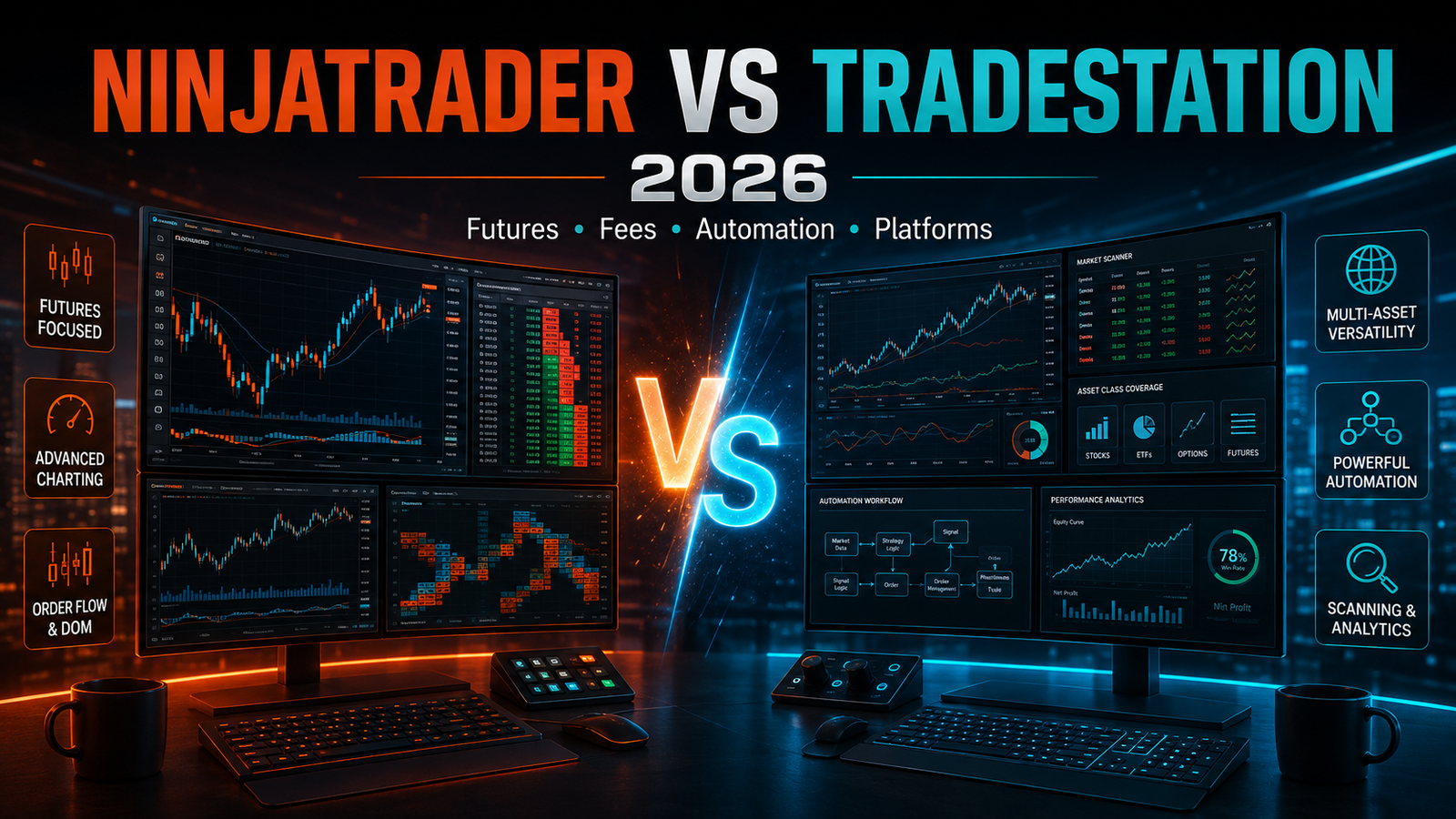
NinjaTrader vs TradeStation is a serious comparison for active traders because both platforms provide advanced trading technology, strategy development, charting and futures access, but they are designed around different priorities.
NinjaTrader is primarily focused on futures trading. Its ecosystem combines futures brokerage services with Desktop, Web and Mobile platforms, simulated trading, advanced charting, strategy backtesting and NinjaScript automation.
TradeStation takes a broader multi-asset approach. Its ecosystem supports futures alongside stocks, ETFs, options and other products, while providing advanced Desktop technology, Web Trading, Mobile Apps, automated strategy development and the EasyLanguage programming environment.
This creates an important distinction.
A trader whose main objective is dedicated futures trading may prefer NinjaTrader’s specialized ecosystem.
A trader who wants futures plus a broader multi-asset brokerage environment may find TradeStation more suitable.
The automation comparison is also important. NinjaTrader uses the C#-based NinjaScript framework, while TradeStation uses EasyLanguage, a proprietary language designed to make strategy development accessible to traders.
In this NinjaTrader vs TradeStation 2026 comparison, TradeboticsAI examines pricing, futures trading, charting, automation, simulation, market access and usability to determine where each platform is strongest.
Free simulated trading is available. Live futures trading is separate and involves substantial financial risk, commissions and other applicable fees. The linked affiliate offer is intended for eligible U.S. users.
This NinjaTrader vs TradeStation comparison is especially useful for traders deciding between a futures-first platform and a broader multi-asset ecosystem.
— NinjaTrader vs TradeStation: Quick Verdict
The NinjaTrader vs TradeStation comparison does not produce the same winner for every trader.
For traders whose primary objective is active futures trading, NinjaTrader offers the more specialized ecosystem.
Its platform, brokerage pricing, simulated trading environment and development tools are strongly centered on futures markets.
TradeStation offers a broader proposition.
It can be particularly attractive to sophisticated traders who want futures trading alongside stocks, ETFs, options and other instruments within a larger multi-asset environment.
For strategy development, both platforms are powerful but use fundamentally different approaches.
NinjaTrader provides NinjaScript, which is based on C#.
TradeStation provides EasyLanguage, a proprietary programming language designed to make strategy development and automation more accessible to traders without requiring traditional software-development experience.
Quick Verdict
Best for dedicated futures trading: NinjaTrader
Best for multi-asset traders: TradeStation
Best for C#-based customization: NinjaTrader
Best for accessible strategy programming: TradeStation
Best for free futures simulation before funding: NinjaTrader
Best overall for a futures-focused trader: NinjaTrader
— NinjaTrader vs TradeStation Comparison
The comparison shows that NinjaTrader and TradeStation overlap in several professional trading capabilities, but the scope of their ecosystems is different.
NinjaTrader is more specialized around futures.
TradeStation provides a broader brokerage environment for traders who want to manage several asset classes.
That difference should carry more weight than simply counting platform features.
— What Is NinjaTrader?
NinjaTrader is a specialized trading technology and brokerage ecosystem focused primarily on futures.
Its current platform lineup includes NinjaTrader Desktop, Web and Mobile.
The ecosystem provides tools for:
- advanced futures charting;
- simulated trading;
- strategy backtesting;
- Market Replay;
- order management;
- futures brokerage execution;
- custom indicators;
- automated strategy development;
- NinjaScript programming.
NinjaTrader’s strongest differentiation is the combination of futures-specific trading infrastructure with advanced Desktop customization and C#-based strategy development.
For a complete analysis of its features, pricing, simulation environment, advantages and limitations, see our NinjaTrader Review 2026.
— What Is TradeStation?
TradeStation is an active-trading brokerage and technology platform with a broader multi-asset focus.
Its platform ecosystem currently includes advanced Desktop software, Web Trading, Mobile Apps and the newer TITAN X environment.
TradeStation supports futures alongside other asset classes, making it particularly relevant to traders who do not want to build their entire workflow around futures alone.
Its Desktop platform provides advanced charts, market scanning, strategy development, automation and market-depth tools.
TradeStation’s EasyLanguage programming environment allows users to create indicators and automated strategies using a syntax designed around familiar trading terminology.
This makes TradeStation especially interesting for traders who want advanced systematic functionality without necessarily working directly in a conventional programming language such as C#.
— Futures Trading
Both NinjaTrader and TradeStation provide serious futures-trading capabilities.
The difference is specialization.
NinjaTrader’s broader product identity is built around futures. Its brokerage structure, platform tools, educational material, commission plans and simulation environment are heavily oriented toward futures traders.
TradeStation provides futures as part of a wider brokerage ecosystem.
This makes TradeStation useful for someone who may trade futures today but also wants access to stocks, ETFs or options without maintaining a completely separate trading environment.
For a trader whose activity is almost entirely concentrated in futures, NinjaTrader’s specialization can simplify the overall workflow.
For a trader managing multiple asset classes, TradeStation may provide greater breadth.
For our broader ranking of platforms in this market, see our Best Futures Trading Platforms 2026 comparison.
— Pricing and Futures Commissions
NinjaTrader currently offers three primary futures brokerage plans.
Free
$0/month
Micro and e-Nano commission: $0.39 per side
Standard commission: $1.29 per side
Monthly
$99/month
Micro and e-Nano commission: $0.29 per side
Standard commission: $0.99 per side
Lifetime
$1,499 one-time
Micro commission: $0.09 per side
Standard commission: $0.59 per side
Exchange, clearing and NFA fees apply in addition to advertised commissions.
— TradeStation Futures Pricing
TradeStation currently uses a volume-based commission schedule.
For traders executing 0–500 futures contracts per month, published commissions currently begin at:
Regular futures: $1.75 per contract, per side
Micro futures: $0.50 per contract, per side
Commission rates decrease at higher monthly trading-volume tiers.
TradeStation also publishes separate clearing, exchange and regulatory charges that can apply in addition to the brokerage commission.
The NinjaTrader vs TradeStation pricing difference becomes more important as trading volume and contract type change.
— Which Is Cheaper?
There is no universal answer.
NinjaTrader’s plan-based pricing may be particularly competitive for dedicated futures traders, especially users willing to pay for a Monthly or Lifetime plan in exchange for lower commissions.
TradeStation’s volume-based structure can become more competitive for traders executing large numbers of contracts each month.
The correct comparison should therefore use:
contract type + monthly trading volume + commission + clearing + exchange fees + regulatory costs + platform costs
rather than a single advertised number.
For a detailed breakdown of NinjaTrader costs, see our NinjaTrader Fees 2026 guide.
Start with simulated futures trading before deciding whether live trading is appropriate for you. Simulated performance is hypothetical and cannot guarantee future live results.
— Charting and Trading Tools
Both platforms provide advanced charting and analytical tools.
— NinjaTrader Charting
NinjaTrader’s charting environment is strongly integrated with its futures workflow.
Traders can build customized workspaces, use technical indicators, analyze market depth and combine charts with futures-specific execution tools.
NinjaTrader Desktop is particularly relevant for traders who use multiple monitors, specialized add-ons and custom indicators.
— TradeStation Charting
TradeStation provides sophisticated charting within its Desktop environment and supports extensive customization.
Its current Desktop ecosystem also includes RadarScreen, which can scan and monitor large numbers of symbols, and Matrix, which combines market-depth information with order-entry functionality.
This broader analytical environment can be particularly valuable to active traders monitoring several markets or asset classes.
— Charting Verdict
For a dedicated futures workflow:
NinjaTrader has the advantage in specialization.
For broad multi-asset analytics:
TradeStation has the advantage in scope.
Both platforms provide sufficient charting capability for sophisticated technical traders.
— Automation: NinjaScript vs EasyLanguage
Automation is one of the most important sections of this comparison.Both NinjaTrader and TradeStation support serious automated-strategy development, but their programming environments target different users.
— NinjaTrader NinjaScript
NinjaTrader Desktop provides NinjaScript, a development framework based on C#.
It can be used to create:
- automated strategies;
- custom indicators;
- drawing tools;
- platform add-ons;
- custom analytical functionality.
The use of C# gives technically advanced users considerable control and makes NinjaTrader attractive to traders with software-development experience.
— TradeStation EasyLanguage
TradeStation provides EasyLanguage, a proprietary programming language specifically designed for traders.
Its syntax is intended to resemble natural trading terminology rather than traditional software-development code.
EasyLanguage supports:
- custom indicators;
- automated strategies;
- entry and exit logic;
- strategy backtesting;
- alerts;
- position-sizing rules;
- stop and target management.
— Which Is Better for Automation?
For traders who already understand C# or want deeper programmatic control:
NinjaTrader may be the better fit.
For traders who want to develop and automate strategies using a more trading-oriented language:
TradeStation’s EasyLanguage may provide a gentler learning curve.
Neither approach eliminates strategy risk.
Automation can improve consistency of execution, but it cannot guarantee profitability.
From an automation perspective, NinjaTrader vs TradeStation is largely a choice between deeper C#-based control and the easier learning curve of EasyLanguage.
— Simulated Trading and Backtesting
Both platforms provide tools for testing strategies without immediately placing live trades.
NinjaTrader currently allows users to access advanced charting, strategy backtesting and simulated paper trading without a time limit or funding requirement.
That makes its simulation environment particularly useful to prospective users evaluating the platform before funding a live account.
TradeStation also provides a sophisticated trading simulator for stocks, options and futures.
Its simulator supports strategy testing, paper positions, historical backtesting and forward testing.
However, TradeStation currently states that its simulator is available to customers who have funded a TradeStation brokerage account.
That creates a meaningful distinction.
NinjaTrader: simulation can be explored before funding.
TradeStation: its full customer simulation environment requires a funded brokerage relationship.
For our dedicated simulation guide, see our NinjaTrader Demo 2026.
— Market and Asset-Class Access
This is one of TradeStation’s strongest advantages.
NinjaTrader is deliberately specialized around futures.
That focus can be beneficial for traders who want a streamlined futures ecosystem, but it is less relevant to someone who needs several asset classes within the same brokerage relationship.
TradeStation provides a broader multi-asset environment that includes futures as well as stocks, ETFs and options.
For a trader who actively moves between asset classes, that breadth may simplify account management and market analysis.
For a futures specialist, however, additional asset classes may provide little practical benefit.
The better choice therefore depends on whether specialization or breadth is more important to your trading model.
— Desktop, Web and Mobile
Both NinjaTrader and TradeStation now provide multi-device trading environments.
— NinjaTrader
NinjaTrader currently provides:
NinjaTrader Desktop
for advanced customization, strategy development and professional futures workflows.
NinjaTrader Web
for browser-based trading.
NinjaTrader Mobile
for monitoring and managing futures activity through supported mobile devices.
— TradeStation
TradeStation currently provides:
TradeStation Desktop
for advanced analysis, EasyLanguage, automation and customization.
TITAN X
as a newer desktop environment available on Windows and Mac.
Web Trading
for browser-based access.
Mobile Apps
for iOS and Android.
— Device Access Verdict
Neither platform should be selected solely because a trader needs web or mobile access.
Both now provide viable multi-device ecosystems.
The larger difference remains the specialized futures orientation of NinjaTrader versus the broader multi-asset environment of TradeStation.
— Who Should Choose NinjaTrader?
NinjaTrader may be the stronger choice if you:
- primarily trade futures;
- want a futures-specific brokerage ecosystem;
- want to start with simulation before funding;
- use Micro or E-mini futures;
- need advanced Desktop customization;
- want NinjaScript and C#;
- plan to develop automated futures strategies;
- value plan-based futures commissions;
- want Desktop, Web and Mobile access within a futures-focused environment.
For technically oriented futures traders, NinjaTrader’s specialization is its greatest advantage.
— Who Should Choose TradeStation?
TradeStation may be the stronger choice if you:
- trade several asset classes;
- want futures alongside stocks and options;
- prefer a broader brokerage ecosystem;
- want advanced market scanning;
- use RadarScreen or Matrix-style tools;
- want EasyLanguage strategy development;
- prefer a trader-oriented automation language;
- generate enough futures volume to benefit from lower commission tiers;
- need sophisticated multi-asset portfolio workflows.
For experienced traders who do not want their brokerage environment centered exclusively on futures, TradeStation deserves serious consideration.
— Frequently Asked Questions
— Is NinjaTrader better than TradeStation?
NinjaTrader is generally the stronger specialized choice for dedicated futures traders, while TradeStation can be more suitable for active traders who want futures alongside stocks, ETFs and options.
The better platform depends on the user’s markets, automation requirements and preferred workflow.
For many active traders, NinjaTrader vs TradeStation ultimately comes down to specialization, automation needs and the markets they trade most often.
— Which is cheaper for futures, NinjaTrader or TradeStation?
The answer depends on trading volume and the NinjaTrader plan selected.
NinjaTrader uses Free, Monthly and Lifetime plans with different per-contract commissions.
TradeStation uses volume-based futures pricing, with commission rates declining at higher monthly contract volumes.
Traders should compare all-in costs rather than brokerage commission alone.
.
— Which is better for automated trading?
Both platforms provide advanced automation.
NinjaTrader uses the C#-based NinjaScript framework, while TradeStation uses EasyLanguage.
NinjaTrader may appeal more to experienced developers, while EasyLanguage may be more accessible to traders who want to automate strategies without working directly in a general-purpose programming language.
— Does TradeStation have paper trading?
Yes. TradeStation provides simulated trading for stocks, options and futures, including strategy testing and paper positions.
TradeStation currently states that access to its trading simulator is available to customers who have funded their brokerage account.
— Does NinjaTrader have free simulated trading?
Yes. NinjaTrader currently provides simulated trading, advanced charting and strategy backtesting without requiring account funding.
Simulated results remain hypothetical and do not guarantee live trading performance.
— Which platform is better for beginners?
For someone specifically learning futures trading, NinjaTrader’s ability to explore simulation before funding is useful.
However, futures trading is leveraged and complex, so beginners should prioritize education, simulation and risk management before considering live trading.
— Is TradeStation only for futures?
No. TradeStation is a multi-asset brokerage and trading ecosystem that supports futures alongside stocks, ETFs, options and other products.
This is one of its main differences from NinjaTrader’s more futures-focused model.
— Can NinjaTrader or TradeStation guarantee profitable automated trading?
No.
Neither platform nor any automated strategy can guarantee profitable results.
Backtested, simulated and automated strategies can perform materially differently under live-market conditions.
— Final Verdict
Our NinjaTrader vs TradeStation 2026 comparison shows two excellent but fundamentally different trading ecosystems.
NinjaTrader — Our Choice for Dedicated Futures Traders
For a trader whose primary objective is active futures trading, NinjaTrader is our preferred starting point.
Its futures specialization, current commission structure, low published intraday margins, free simulated trading and advanced NinjaScript ecosystem create a compelling combination.
The platform is particularly attractive to Micro futures traders, futures day traders and technically sophisticated users who want deep native customization.
TradeStation — Our Choice for Multi-Asset Systematic Traders
TradeStation is the stronger option for users who want futures to exist inside a broader active-trading operation.
Its combination of stocks, options, futures, EasyLanguage, sophisticated Desktop tools, TITAN X and external APIs gives it greater multi-asset flexibility.
High-volume futures traders should also examine TradeStation’s volume tiers carefully because its commission structure becomes significantly more competitive as monthly activity increases.
Overall Winner for Futures-First Users: NinjaTrader
For the typical TradeboticsAI reader specifically searching for a dedicated futures trading platform, NinjaTrader is the platform we would evaluate first through simulation.
For a trader who needs futures plus stocks, options, cross-asset strategy automation and a broader developer API environment, TradeStation may be the better architecture.
The correct platform ultimately depends on markets, trading volume, technology requirements and risk tolerance.
No platform can eliminate the possibility of substantial trading losses.
Overall, the NinjaTrader vs TradeStation decision should be based on futures specialization, multi-asset access, automation requirements and total trading costs.
Start by exploring simulated futures trading before considering a live account. Live futures trading involves substantial financial risk, leverage, commissions and other applicable costs.
— Research & Official Sources
Pricing, commissions, margin requirements, platform functionality and account conditions can change. TradeboticsAI cross-checks platform comparisons against official provider documentation and independent broker research, but users should always verify current information before opening, funding or trading through an account.
For current information, consult NinjaTrader Pricing, NinjaTrader Platform Documentation, TradeStation Pricing and TradeStation Platform Documentation. Independent testing is also available from BrokerChooser and StockBrokers.com.