Best Futures Trading Journals 2026: Top 7 for Active Traders
If you are comparing the best futures trading journals in 2026, the most important question is not which dashboard looks the best. Futures traders need accurate contract handling, commissions, micro and full-size contract support, multi-account separation, reliable imports, session analytics, drawdown tracking, and a review process that turns raw fills into useful decisions.
This TradeboticsAI guide compares seven of the best futures trading journals for NinjaTrader, Tradovate, Rithmic, prop-firm and active futures workflows. We focus on futures-specific usability, data import, analytics depth, risk review, pricing and how each journal fits a different type of trader.
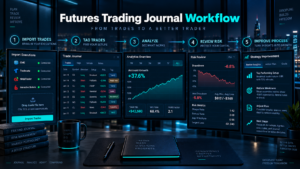
Quick Answer
Our overall pick among the best futures trading journals is Journalytix for futures-first traders who want real-time performance feedback and a journal built around active trading. TradesViz is the strongest value choice for deep analytics and broad futures imports, while TradeZella is compelling for traders who want automated journaling, AI analysis, broker sync and multi-account scaling in one modern interface. TraderSync, Edgewonk, Tradervue and Kinfo each fill a different niche.
Affiliate Disclosure: TradeboticsAI may receive compensation when readers complete qualifying actions through certain links. The NinjaTrader buttons on this page are affiliate links. Journal rankings are editorial and are not based on compensation.
Best Futures Trading Journals Comparison
The best futures trading journals should do more than record wins and losses. Futures traders often move between ES, MES, NQ, MNQ, CL, GC and other contracts with different tick values, session structures and commission profiles. Multi-account and prop-firm traders also need to keep accounts separated while comparing performance across the same strategy.
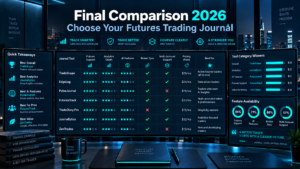
| Journal | Best For | Futures Strength | Import / Sync | Published Starting Price | Main Trade-Off |
|---|---|---|---|---|---|
| Journalytix | Futures-first real-time review | Excellent | Platform integrations / live analytics | $47/mo or $399/yr | Higher price than value journals |
| TradesViz | Analytics and value | Excellent | Tradovate auto-sync + broad imports | Free; Pro from $14.99/mo | Interface can feel dense |
| TradeZella | AI, replay and multi-account workflows | Very strong | NinjaTrader and Tradovate sync | $35/mo | No free plan |
| TraderSync | AI-assisted performance review | Very strong | Futures broker integrations | $29.95/mo | Advanced tiers cost more |
| Edgewonk | Behavior and process analysis | Strong | Imports from many platforms | $197 per current billing period | Less automation-centric |
| Tradervue | Classic reporting and mentoring | Strong | NinjaTrader file import; broker sync on paid plans | $29.95/mo | Less futures-specific than top picks |
| Kinfo | Verified broker-sourced tracking | Good | NinjaTrader/Tradovate broker sync | Free plan | Less advanced journaling depth |
Prices and integrations can change. Verify current plan limits before subscribing, especially if you manage many futures or prop-firm accounts.
How We Ranked the Best Futures Trading Journals
TradeboticsAI ranked the best futures trading journals around the workflow of an active futures trader rather than generic stock-journal features. We weighted futures contract handling, import reliability, multiple-account support, commissions and fees, session analysis, drawdown and risk metrics, tagging, replay or review tools, pricing and the ability to identify repeatable behavior.
We also gave additional credit to journals that support NinjaTrader, Tradovate, Rithmic or common prop-firm workflows. We did not assume that AI coaching automatically makes a journal better. AI can summarize data, but the journal still needs accurate source data and useful filters.
What Makes the Best Futures Trading Journals Different?
A journal built for stocks can fail when applied to futures if it does not understand contract-specific economics. A ten-point move in one contract is not equivalent to ten points in another. Accurate futures analysis needs contract quantity, multiplier, tick value, commission treatment and correct timestamps.
The best futures trading journals also need to cope with overnight sessions, multiple accounts, micros versus full-size contracts, frequent scalping, partial fills and prop-firm evaluation data. A clean equity curve is useful, but it should be possible to drill down by setup, instrument, session, day of week and account.
For traders automating or copying trades, journaling becomes even more important because one decision may create executions across several accounts. See our
Best Futures Trade Copiers 2026
guide for the infrastructure side of multi-account trading.
1. Journalytix — Best Overall Futures Trading Journal
Journalytix earns our top position because it comes from the Jigsaw Trading ecosystem and is built around active-trader performance analysis rather than being a generic spreadsheet replacement. Jigsaw markets Journalytix as a cloud-based trade analytics and journaling system with real-time and post-session review tools.
For traders comparing the best futures trading journals, the main attraction is the futures-first orientation. Journalytix is designed to help traders classify trades, review sessions, track performance and examine what is working while the trading workflow is still fresh.
Current retail pricing is published at $47 per month or $399 per year, with a trial option. You can verify current terms on the
official Jigsaw Trading Journalytix page.
Journalytix Pros
Futures-focused design, real-time analytics, structured journaling, cloud access, detailed performance review and integration with the broader Jigsaw trading ecosystem.
Journalytix Limitations
The subscription is more expensive than TradesViz and some general-purpose journals. Traders who mainly want inexpensive post-session statistics may not need its real-time emphasis.
2. TradesViz — Best Value for Deep Futures Analytics
TradesViz is one of the best futures trading journals for traders who want a large amount of analytics without paying premium-journal prices. Its current free tier supports up to 3,000 executions per month, while Pro expands to unlimited imports, multiple accounts and hundreds of visualizations.
For futures, TradesViz supports Tradovate auto-sync and publishes specific workflows for NinjaTrader Brokerage, Rithmic and Sierra Chart-related environments. Its futures analytics include contract-aware import, commission handling options, custom dashboards and simulation features on higher tiers.
TradesViz Pros
Free plan, strong futures imports, extensive analytics, custom dashboards, multi-account support, AI-assisted review and a futures simulator in the higher plan.
TradesViz Limitations
The feature depth can make the interface feel more complex than a minimalist journal. Some advanced functions require Pro or Platinum.
3. TradeZella — Best for AI, Replay and Multi-Account Traders
TradeZella has grown from a journal into a broader performance platform. Current 2026 pricing starts at $35 per month for Essential, with Pro at $59 and Ultra at $99. Its official integration pages list futures support for NinjaTrader and Tradovate, including auto-sync workflows.
TradeZella is one of the best futures trading journals for traders who want journaling, analytics, replay, backtesting and AI review in one interface. Pro currently supports up to 50 active accounts, which makes it especially relevant for traders managing multiple evaluation or funded accounts.
TradeZella Pros
Modern interface, broker sync, futures support, extensive analytics, trade replay, manual and automated backtesting, AI tools and large multi-account capacity on higher plans.
TradeZella Limitations
There is no free plan, and the most attractive multi-account and replay features require higher-priced tiers.
For traders using NinjaTrader as the execution layer, our
Best Automated Futures Trading Software 2026
guide explains where platform automation fits into the stack.
4. TraderSync — Best for AI-Assisted Futures Review
TraderSync has dedicated futures journal pages and supports futures-oriented broker integrations including NinjaTrader, Tradovate, Rithmic R Trader, TradeStation and Interactive Brokers. Its current Pro plan is listed at $29.95 per month, with Premium and Elite adding more advanced functionality.
Among the best futures trading journals, TraderSync stands out for combining performance analytics with an AI assistant, strategy planning and higher-tier replay and backtesting tools. That makes it useful for traders who want a guided review process rather than only static reports.
TraderSync Pros
Futures-specific journal support, broad integrations, AI analysis, strategy planning, multiple-account tracking and higher-tier replay/backtesting.
TraderSync Limitations
The pricing ladder becomes materially more expensive as you move from core journaling toward advanced replay and coaching features.
5. Edgewonk — Best for Behavioral and Process Analysis
Edgewonk is designed around trade quality, mistake tracking and performance behavior. It supports futures and lists Tradovate, TopstepX, TradeStation and many other import sources, while an Excel import pathway covers platforms not directly listed.
Edgewonk belongs among the best futures trading journals for traders whose main problem is not importing trades but understanding execution habits. Its reports cover drawdowns, MFE/MAE, time performance, risk analysis, losing streaks, trade management and recurring mistakes.
Current pricing is published as $197 for the stated billing period, with the provider occasionally running extended-duration promotions. Always check the live checkout terms.
Edgewonk Pros
Strong behavioral analytics, unlimited journals and trades, futures support, mistake tracking, setup analytics and structured review.
Edgewonk Limitations
It is less focused on real-time futures monitoring and broker-auto-sync workflows than Journalytix, TradesViz or TradeZella.
6. Tradervue — Best Established Journal for Reporting and Mentoring
Tradervue is one of the longest-established trading journals in this comparison. Its paid Silver plan is currently $29.95 per month and Gold is $49.95 per month. Both include unlimited trade imports and multiple trading accounts, while Gold adds more advanced exit and P&L analysis.
Tradervue supports futures and provides a documented NinjaTrader CSV import workflow. It can therefore be one of the best futures trading journals for traders who prefer a mature reporting system and value mentoring or trade-sharing workflows.
Tradervue Pros
Established reporting, unlimited paid-plan imports, multiple accounts, futures support, MFE/MAE statistics, mentoring and detailed chart review.
Tradervue Limitations
Its experience feels more traditional than newer AI-heavy platforms, and NinjaTrader’s documented native workflow is file-based unless you use available sync options or third-party tools.
7. Kinfo — Best Free Verified Broker-Sourced Journal
Kinfo takes a different approach by emphasizing broker-verified performance. Its NinjaTrader and Tradovate page states that futures trades can import automatically through the connected broker workflow, with performance broken down by contract, session and setup.
Kinfo earns a spot among the best futures trading journals because the free plan includes broker auto-sync, basic analytics and a verified profile. Current paid pricing is $24.90 per month for Pro and $44.90 for Pro+.
Kinfo Pros
Free starting tier, broker-sourced data, automatic journaling, futures support, verified performance and simple portfolio tracking.
Kinfo Limitations
Its analytical and process-journaling depth is lighter than the specialist platforms ranked above. It is strongest when data verification and simplicity matter more than advanced review workflows.
Best Futures Trading Journals for Prop-Firm Accounts
Prop-firm traders should pay special attention to account separation, trailing drawdown review, consistency tracking, reset history and whether the journal can import the route used by the firm. One journal account should not merge several prop accounts into a data set that hides which account actually produced each execution.
The best futures trading journals for prop traders are usually the products with strong Tradovate, NinjaTrader, Rithmic or TopstepX support and flexible multi-account analytics. TradeZella, TradesViz, TraderSync and Journalytix are especially relevant, but compatibility can change as firms change their platform vendors.
A journal does not enforce a prop firm’s rules. It records and analyzes activity. If you use multi-account copying as well, read our
Best Futures Trade Copiers 2026
guide and verify each firm’s current rules before connecting accounts.
Risk Metrics the Best Futures Trading Journals Should Track
The best futures trading journals should help you understand risk before you obsess over win rate. Useful metrics include maximum drawdown, average loss, largest loss, profit factor, expectancy, MAE, MFE, average position size, consecutive losses, time-of-day performance and performance after commissions.
For futures specifically, also review results by contract size. A strategy can look stable when MES and ES are combined even though the trader is taking materially different risk on the full-size contract. Separate analysis by account and instrument prevents that distortion.

Pricing and Hidden Costs of Futures Trading Journals
The subscription is only part of the decision. A journal may charge more for additional accounts, advanced AI, replay, broker sync, data storage or professional features. Some products use monthly subscriptions, others offer annual discounts, and Kinfo provides a functional free entry point.
When comparing the best futures trading journals, also consider the cost of your trading platform, data feed, broker commissions, prop-firm fees and any VPS used to keep automation online. A cheaper journal is not cheaper if it creates enough manual work that you stop using it.
For always-on platform infrastructure, see our
Best Futures Trading VPS 2026
comparison.
How to Choose the Best Futures Trading Journal
Choose Journalytix if real-time futures performance feedback is the priority. Choose TradesViz if you want maximum analytics per dollar. Choose TradeZella if you want a polished all-in-one environment with AI, replay and large multi-account capacity. Choose TraderSync if AI-assisted review and strategy planning matter. Choose Edgewonk if behavioral discipline is your main objective. Choose Tradervue if you value mature reporting and mentoring. Choose Kinfo if verified broker-sourced tracking and a free starting point matter most.
The best futures trading journals are the ones you will actually review consistently. A sophisticated dashboard provides no advantage if you never tag mistakes, compare setups or act on the data.
Best Futures Trading Journals FAQ
What are the best futures trading journals in 2026?
Our shortlist of the best futures trading journals includes Journalytix, TradesViz, TradeZella, TraderSync, Edgewonk, Tradervue and Kinfo. Journalytix is our overall futures-first pick, while TradesViz offers exceptional value and TradeZella is strong for AI and multi-account workflows.
What is the best futures trading journal for NinjaTrader?
Journalytix is highly relevant for active futures traders, while TradeZella, TradesViz, TraderSync, Tradervue and Kinfo all provide documented NinjaTrader or NinjaTrader Brokerage import/sync pathways. The best choice depends on whether you prioritize real-time review, analytics, AI or verified performance.
What is the best free futures trading journal?
TradesViz and Kinfo both offer free entry options. TradesViz is stronger for analytics depth, while Kinfo emphasizes automatic broker-sourced tracking and verification.
Do futures journals support Tradovate?
Several of the best futures trading journals support Tradovate. TradesViz, TradeZella, TraderSync, Edgewonk and Kinfo all publish Tradovate-related support or import information.
Can a trading journal improve profitability?
A journal cannot guarantee profitability. It can help identify patterns, costs, mistakes and strategy differences that are difficult to see from memory alone. Improvement still depends on the trader changing behavior or strategy based on evidence.
Should I journal simulated trades?
Yes, but keep simulation and live results clearly separated. Simulated fills, emotional pressure and execution quality can differ materially from live trading.
What futures metrics should I review every week?
Review net P&L after costs, expectancy, drawdown, average win and loss, MAE/MFE, instrument performance, time-of-day results, setup performance, position size and rule violations. The exact set should match your strategy.
Final Verdict: Best Futures Trading Journals for 2026
Journalytix is our overall pick for active futures traders because its core identity is real-time trade analytics and structured performance review. TradesViz is our value winner because it combines a free tier, broad futures imports and deep analytics. TradeZella is the strongest all-in-one choice for traders who want AI, replay, backtesting and multi-account scaling.
TraderSync is a strong AI-assisted alternative, Edgewonk excels at behavioral analysis, Tradervue remains a reliable reporting and mentoring platform, and Kinfo provides a useful broker-verified free entry point.
The best futures trading journals should ultimately make one thing easier: turning a large number of executions into a smaller number of decisions you can actually improve. Choose the tool that matches your broker, accounts, review style and risk process rather than the one with the longest feature list.