CME Market Data Fees 2026: Level 1 vs Level 2 Costs
CME market data fees can look confusing because the exchange fee, the broker’s customer price and the technology provider’s charge are not always the same number. In 2026, traders may pay differently depending on whether they need Top of Book or full Depth of Market, qualify as non-professional or professional, subscribe to one exchange or the full CME Group bundle, and receive data through CQG, Rithmic, Trading Technologies or another licensed distributor.
This guide explains the current CME market data fees for CME, CBOT, NYMEX and COMEX, the difference between Level 1 and Level 2 data, why broker pricing can exceed the exchange’s published fee, and how to estimate the real monthly cost of a futures trading setup.
Affiliate Disclosure: TradeboticsAI may receive compensation when readers complete qualifying actions through certain links. NinjaTrader buttons on this page are affiliate links. Compensation does not determine the fee figures or editorial conclusions.
Explore NinjaTrader for Futures Trading
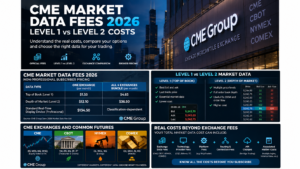
CME Market Data Fees 2026: Official Exchange Pricing
The authoritative starting point for CME market data fees is CME Group’s own Market Data Fee List. The current schedule is effective June 1, 2026 and covers information from CME, CBOT, NYMEX and COMEX.
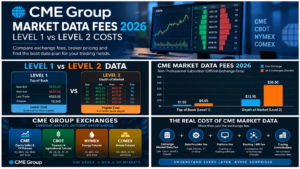
For qualifying non-professional subscribers, the exchange publishes separate prices for Top of Book and Depth of Market. Fees for individual exchanges are assessed per designated contract market, while discounted bundle pricing is available when all four CME Group exchanges are entitled to the same subscriber.
| 2026 Market Data | One CME Group Exchange | All 4 Exchange Bundle |
|---|---|---|
| Non-Professional Top of Book | $1.55/month | $4.65/month |
| Non-Professional Depth of Market | $12.10/month | $36.50/month |
| Standard Real-Time Display Device | $134.50/month per exchange | Classification-dependent |
These are exchange-published CME market data fees, not a guarantee of the final price charged to every retail brokerage customer. Licensed distributors and brokers determine how their customer-facing market-data packages are presented and may assess additional technology or service charges.
See the official CME Group June 2026 Market Data Fee List for the current schedule.
CME Market Data Fees: Level 1 vs Level 2
The biggest pricing decision for many retail traders is whether they actually need Level 1 or Level 2 data. In common retail terminology, Level 1 corresponds roughly to Top of Book, while Level 2 refers to deeper order-book information.
Level 1 / Top of Book
Top of Book provides the best available bid, best available ask and core trade information. For a chart-based trader who primarily watches candlesticks, indicators and price movement, this can provide the essential information required to monitor a market.
Because the official non-professional CME market data fees for Top of Book are much lower than Depth of Market, traders who do not use the DOM should consider whether paying for deeper data creates any practical benefit.
Level 2 / Depth of Market
Depth of Market shows liquidity beyond the best bid and ask. Multiple price levels can be displayed in a DOM or order-book interface, allowing traders to examine resting liquidity at different prices.
Level 2 is more relevant to scalpers, DOM traders, order-flow traders and users of certain footprint or liquidity-analysis tools. If your strategy never reads market depth, the extra CME market data fees may provide no advantage.
For a deeper explanation of the infrastructure behind both types of data, see our Futures Data Feeds 2026 guide.
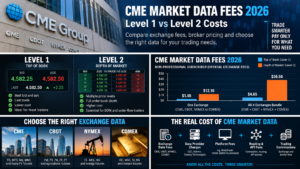
CME vs CBOT vs NYMEX vs COMEX Market Data
A common source of confusion around CME market data fees is the use of “CME” to refer both to CME Group as a company and to one specific exchange within the group.
CME Group’s major U.S. futures exchanges include CME, CBOT, NYMEX and COMEX. Different futures contracts are listed on different exchanges, so the data package you need depends on what you trade.
| Exchange | Common Futures Examples | Typical Trader |
|---|---|---|
| CME | ES, MES, NQ, MNQ and many FX futures | Equity-index and currency traders |
| CBOT | YM, MYM, ZB, ZN, ZF, ZT and grains | Index, Treasury and agricultural traders |
| NYMEX | CL, MCL, NG and energy futures | Crude oil and energy traders |
| COMEX | GC, MGC, SI, HG | Gold, silver and metals traders |
If you only trade ES and NQ, you may not need all four exchanges. If you trade ES, crude oil, gold and Treasuries, the bundle becomes considerably more relevant.
This is why CME market data fees should be selected according to the products you actually trade rather than automatically activating every available exchange.
CME Market Data Bundle Pricing in 2026
The official four-exchange bundle is one of the most important elements of CME market data fees. CME Group’s June 2026 schedule lists a non-professional Top of Book bundle at $4.65 per month and a Depth of Market bundle at $36.50.
The bundle covers the four primary CME Group designated contract markets when the same subscriber is entitled to all four: CME, CBOT, NYMEX and COMEX.
When the Bundle Makes Sense
If you need depth on only one exchange, paying for one exchange can be less expensive. If you require three or four exchanges, bundle economics become more attractive.
For example, four individual official Depth of Market entitlements at $12.10 each would total $48.40. The official bundle price is $36.50, creating a lower exchange-level cost for a user who genuinely needs all four.
The same concept applies to Top of Book. Four individual $1.55 entitlements equal $6.20, while the official bundle is $4.65.
However, the amount appearing on your brokerage statement may differ because retail distributors can package these CME market data fees differently.
Why Broker CME Market Data Fees Can Be Higher
A trader may read the official CME schedule and then find a different number inside a broker portal. That does not automatically mean either price is wrong.
The CME document defines exchange-level licensing fees. Your brokerage experience can involve additional data-feed technology, distributor services, account administration and commercial pricing.
AMP Futures provides a useful real-world 2026 example. Its current market-data table lists non-professional CME, CBOT, NYMEX and COMEX Level 1 at $5 per exchange and Level 2 at $17 per exchange. Its all-CME-markets bundle is listed at $15 for Level 1 and $45 for Level 2 across supported feeds.
| Example | Official CME Schedule | AMP Published Retail Price |
|---|---|---|
| Single Exchange Top of Book | $1.55 | $5 |
| Single Exchange Depth | $12.10 | $17 |
| 4-Exchange Top of Book Bundle | $4.65 | $15 |
| 4-Exchange Depth Bundle | $36.50 | $45 |
The comparison shows why you should never estimate total CME market data fees from the exchange schedule alone. Your final bill is determined by the package actually activated through your provider.
Also remember that market-data fees are different from trading commissions. Use our Futures Commission Calculator 2026 to estimate transaction costs separately.
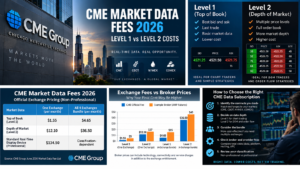
Professional vs Non-Professional CME Market Data Fees
Professional classification is one of the largest potential differences in CME market data fees. The low prices commonly advertised to retail traders generally depend on qualifying for non-professional subscriber status.
CME’s current fee list shows a standard real-time display-device fee of $134.50 per month for CME, CBOT, NYMEX or COMEX information, while qualifying non-professional subscriber pricing is dramatically lower.
Do not declare yourself non-professional simply to obtain a cheaper rate. The correct status depends on CME’s definitions, agreements and your circumstances. Brokers normally present a certification process when enabling market data.
What Can Affect Classification?
Factors can include whether data is used on behalf of a business or financial institution, the nature of the account, employment or registration status, and whether the subscriber meets CME’s current non-professional criteria.
Professional users should therefore evaluate CME market data fees before choosing platforms and brokers. A system that looks inexpensive based on a retail quote can become significantly more expensive after professional data classification.
For official licensing details, use the CME Market Data Policy Education Center.
CQG vs Rithmic vs TT Market Data Costs
Your feed provider can influence the final amount you pay even when the underlying exchange information comes from the same CME Group markets.
Rithmic, CQG and Trading Technologies are infrastructure providers commonly used in futures trading. The provider can affect platform compatibility, routing, historical data, API availability, depth and additional technology charges.
For example, AMP currently displays the same published non-professional CME bundle market-data amount across CQG, Rithmic and TT for Level 2, while separate technology or routing charges can still differ by connection.
Rithmic
Rithmic is popular for detailed order-flow and automated futures workflows. AMP’s current pricing documentation separately lists Rithmic connection and routing charges in addition to exchange market data. API users may face another technology charge.
CQG
CQG is widely integrated across brokers and platforms. Market-data subscription costs should be evaluated alongside whatever platform, brokerage or connectivity charges apply to the account.
Trading Technologies
TT is more common in professional workflows and can combine market-data and execution infrastructure. The correct total depends on the account setup and services enabled.
When comparing CME market data fees, therefore, separate the exchange entitlement from the data-feed or trading-technology fee. Our Futures Data Feeds 2026 comparison covers these providers in more detail.
Explore NinjaTrader Futures Trading Options
Do You Really Need Level 2 CME Data?
Many traders automatically buy Level 2 because it sounds more professional. That is not always rational.
If your system uses five-minute candles, moving averages, RSI or simple price-action rules, Level 1 may contain everything the strategy actually consumes. In that case, paying higher CME market data fees for depth may not improve decisions.
Level 2 becomes more valuable when the order book itself is part of the process. Examples include DOM scalping, liquidity analysis, order-flow strategies, depth imbalance analysis and certain footprint workflows.
Even then, more data is not automatically better. A trader must know how the information will be interpreted. Watching thousands of changing order-book values without a defined process can add noise rather than edge.
For traders using order-flow software, compare our Best Order Flow Trading Platforms 2026 and Best DOM Trading Platforms 2026 guides.
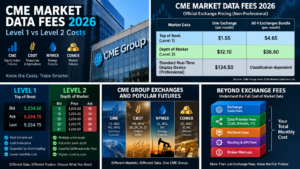
CME Market Data Fees: Monthly Cost Examples
Example 1: ES Trader Using Top of Book
A trader focused exclusively on ES or MES may only need CME exchange data. At the exchange level, the June 2026 non-professional Top of Book fee is $1.55. The final broker price can be higher.
Example 2: ES and NQ DOM Trader
ES, MES, NQ and MNQ are CME-listed products. A trader using full DOM for these contracts requires CME Depth of Market rather than all four exchanges. CME’s published non-professional depth fee is $12.10 for one exchange before distributor pricing.
Example 3: ES, Gold and Crude Oil Trader
This trader needs CME for ES, COMEX for gold and NYMEX for crude oil. Three separate depth entitlements may make the four-exchange bundle economically sensible, depending on the provider’s pricing.
Example 4: Multi-Market Futures Trader
A trader using ES, ZN, CL and GC touches CME, CBOT, NYMEX and COMEX. This is the clearest use case for the four-exchange bundle.
These examples show that optimizing CME market data fees is mainly about matching entitlements to the actual contracts in your trading plan.
How to Reduce CME Market Data Fees Without Losing Needed Data
The simplest way to reduce CME market data fees is to avoid paying for information your system never uses.
First, list the exact contracts you trade. Map each one to its exchange. If every contract is on CME, there is little reason to activate NYMEX or COMEX purely out of habit.
Second, decide whether your strategy actually consumes Level 2. A chart-only trader may be satisfied with Top of Book, while a DOM trader clearly needs depth.
Third, compare the bundle with individual exchange pricing. The bundle can save money for traders who genuinely need several CME Group exchanges.
Fourth, avoid unnecessary mid-month feed switching. A second data provider can generate another monthly entitlement charge even if both connections access the same exchange.
Fifth, check every cost layer before opening an account: exchange data, provider connection, platform license, routing fees, commissions and API charges.
Finally, separate trading costs from data costs. CME market data fees are recurring access costs, whereas commissions and exchange transaction fees are generated by actual executions.
Use our NinjaTrader Fees 2026 guide for a broader look at platform and futures trading expenses.
Pros and Cons of Paying for Full CME Depth
| Pros | Cons |
|---|---|
| Multiple bid and ask price levels | Higher monthly market-data cost |
| Useful for DOM and order-flow analysis | Can add noise for chart-only traders |
| Better visibility into displayed liquidity | Displayed orders can change or cancel rapidly |
| Supports more advanced depth tools | Does not guarantee better trading performance |
Depth should therefore be treated as a tool requirement, not a status upgrade. The appropriate CME market data fees depend on what your strategy actually needs.
CME Data for Automated and API Trading
Automated systems create another important distinction. A trader viewing data on a screen is not necessarily using CME information in the same way as a server-side algorithm, commercial application or non-display process.
CME publishes separate licensing categories for non-display uses, including applications that consume market information without presenting the information directly to a human user.
This matters for algorithm developers and especially for SaaS companies. A normal retail display subscription should not be assumed to cover commercial redistribution, internal automated processing or a product delivered to multiple customers.
CME’s 2026 fee list includes separate non-display categories and application-based pricing. Developers should review their exact use case with CME Group or an authorized distributor before deployment.
If you are building automation, read our Futures Trading APIs 2026 guide. The market-data entitlement and trading API are separate layers of the system.
CME Market Data Fees FAQ
How much are CME market data fees in 2026?
For qualifying non-professional users, CME Group’s June 2026 fee list publishes Top of Book at $1.55 per exchange per month and Depth of Market at $12.10 per exchange. The four-exchange bundles are $4.65 and $36.50 respectively. Your broker or distributor may charge a higher final customer price.
How much is the CME Level 2 bundle?
The official June 2026 non-professional Depth of Market bundle for CME, CBOT, NYMEX and COMEX is $36.50 per month at the exchange-fee level.
How much is CME Level 1 data?
CME Group lists qualifying non-professional Top of Book at $1.55 per exchange or $4.65 for the four-exchange bundle.
Why does my broker charge more than CME’s fee list?
Broker and distributor prices can include technology, connectivity, administrative or commercial charges in addition to the underlying exchange entitlement.
Are CME, CBOT, NYMEX and COMEX separate subscriptions?
They can be entitled separately. CME Group also offers a discounted non-professional bundle covering all four exchanges.
Do I need CME data for ES and NQ?
Yes. ES, MES, NQ and MNQ are CME-listed futures products, so real-time trading data for those contracts requires the appropriate CME entitlement through your provider.
Do I need COMEX data for gold futures?
Gold futures such as GC and MGC are associated with COMEX, so traders requiring real-time COMEX information need the appropriate entitlement.
Do I need NYMEX data for crude oil futures?
WTI crude oil futures such as CL and MCL are NYMEX products, so the relevant real-time NYMEX data entitlement is required.
Is Level 2 necessary for day trading?
No. Many day-trading strategies use charts and Top of Book data only. Level 2 becomes more relevant when the DOM or order-book depth is explicitly part of the strategy.
Are CME market data fees included in commissions?
Generally no. Market-data access is normally a recurring subscription or entitlement, while commissions and exchange transaction fees are incurred when trades are executed.
Can I cancel market data when I am not trading?
Policies vary by provider. Market-data subscriptions are typically billed on a monthly basis, so verify cancellation and activation rules before changing services.
Does a second trading platform require another CME subscription?
Not necessarily. It depends on the provider, login architecture and entitlement rules. A second independent data feed or subscriber login can result in additional charges.
Are professional CME market data fees higher?
Yes. Professional display pricing can be substantially higher than qualifying non-professional pricing. CME’s June 2026 schedule lists the standard real-time display-device fee at $134.50 per exchange per month.
Final Verdict: CME Market Data Fees for 2026
CME market data fees are inexpensive for many qualifying non-professional traders at the exchange level, but the final brokerage price can be higher. CME Group’s June 2026 schedule lists $1.55 per exchange for Top of Book, $12.10 for Depth of Market, $4.65 for the four-exchange Top of Book bundle and $36.50 for the four-exchange depth bundle.
The most important decision is not simply finding the cheapest data. Match the subscription to the products and tools you actually use. ES and NQ traders may only need CME. Gold traders need COMEX. Crude oil traders need NYMEX. Treasury traders typically need CBOT. Multi-market traders may benefit from the full bundle.
Also separate CME market data fees from platform, routing, API and commission expenses. Those costs can exist independently and often explain why a broker’s final price differs from CME’s published exchange fee.
Finally, verify your professional or non-professional classification accurately and use the broker’s current subscription page before activating service. Market-data policies and commercial pricing can change.
Explore NinjaTrader for Futures Trading
Official Sources
Affiliate Disclosure: TradeboticsAI may receive compensation when readers complete qualifying actions through affiliate links. Affiliate relationships do not determine our fee calculations or editorial conclusions.
Risk Disclosure: Futures trading involves substantial risk of loss and is not suitable for every investor. Leverage can magnify losses. Market-data depth, speed or technology does not guarantee profitable trading or better execution.
Pricing Disclaimer: Market-data fees, exchange policies, professional classifications, broker markups and technology charges can change. Prices on this page were reviewed against published information available on September 10, 2026. Confirm current costs with CME Group and your broker before activating a subscription.
Last reviewed: September 10, 2026.