Futures Opening Types 2026: Open Drive, Test Drive, Rejection Reverse & Auction Guide
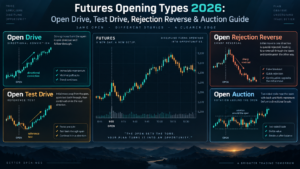
Futures Opening Types classify how a futures session begins and how quickly the market reveals acceptance, rejection or directional urgency around the open. In Market Profile and Auction Market Theory, the four classic opening structures are Open Drive, Open Test Drive, Open Rejection Reverse and Open Auction. These patterns are useful because the first part of the regular session can show whether participants are immediately committed, testing a known reference, reversing from rejection or simply rotating around fair value. The opening type is not a prediction of the entire day; it is a developing framework that must be confirmed by price acceptance, Initial Balance, TPO structure, volume and order flow.
Quick Answer
Futures Opening Types describe four common ways a session begins: Open Drive, Open Test Drive, Open Rejection Reverse and Open Auction. Open Drive shows immediate one-way conviction; Open Test Drive first probes a reference and then drives away; Open Rejection Reverse starts in one direction but is sharply rejected; Open Auction rotates around the opening area without early control. The best use is conditional: classify the open, compare it with prior value and overnight structure, then wait for Initial Balance, TPO, footprint or delta evidence to confirm whether the early hypothesis is holding.
Explore NinjaTrader for futures charting, order-flow tools and simulated opening-session analysis
Affiliate Disclosure: TradeboticsAI may earn compensation when an eligible user completes a qualifying action through an affiliate link, at no additional cost to the user. Affiliate relationships do not determine our editorial conclusions.
What Are Futures Opening Types?
Futures Opening Types are Market Profile classifications used to describe how a session behaves immediately after the main trading window opens. GoCharting’s Market Profile documentation includes Open Drive and Open Test Drive among its core TPO concepts, while modern auction-market education commonly groups four primary opening structures: Open Drive, Open Test Drive, Open Rejection Reverse and Open Auction.
The concept is descriptive rather than deterministic. An opening label should summarize what the auction is doing now, not force a forecast of what the entire day must become. The classification can also evolve as new information appears.
For U.S. equity-index futures, many intraday traders study the regular-session open in relation to the prior session’s Value Area High, Value Area Low, POC, prior high/low and overnight range. The same logic can be adapted to other contracts, but the relevant session must be defined consistently.
Useful references:
GoCharting Market Profile documentation
and
TradingView TPO documentation.
The key benefit of Futures Opening Types is that they force the trader to separate the opening process into observable evidence: where price opens, what it tests, whether it returns through the opening price, how much overlap develops and whether the market begins accepting new prices.
Futures Opening Types and Opening Location vs Prior Value
The same price path can mean something different depending on where the session opens relative to prior value. This is why Futures Opening Types should be read together with yesterday’s VAH, VAL, POC and range.
| Opening Location | Initial Question | What to Watch |
|---|---|---|
| Inside Prior Value | Will the market remain rotational or escape value? | Open Auction, failed extensions, developing POC |
| Outside Value but Inside Prior Range | Will price be accepted outside value or rejected back inside? | VAH/VAL test, drive quality, return to value |
| Outside Prior Range | Is the gap/new area accepted or rejected? | Open Drive, Open Test Drive, gap rejection, new value |
Opening outside value does not automatically mean trend. Opening inside value does not automatically mean balance. The location only defines the starting condition. The opening behavior tells the trader whether the market is accepting that location.
Use Futures Auction Market Theory 2026 and Futures Market Profile 2026 for the broader acceptance-versus-rejection framework.
Futures Opening Types: Open Drive
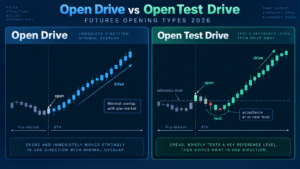
Open Drive is the most immediately directional of the four Futures Opening Types. GoCharting describes an Open Drive as a market opening with a strong directional move and continuing in one direction without breaking back through the opening price.
A bullish Open Drive can show:
- strong upward movement almost immediately after the open;
- limited overlap between early bars or TPO periods;
- little or no sustained trade below the opening area;
- effective aggressive buying on footprint or delta;
- early movement through nearby reference levels;
- developing value migrating higher if the drive persists.
A bearish Open Drive is the mirror image.
The important word is drive. One large candle is not enough. A genuine drive should continue producing directional progress and resist meaningful rotation back through the opening structure.
If the market opens above prior value and drives higher with successful acceptance, the bullish thesis becomes stronger. If the same initial impulse immediately collapses through the open, the Open Drive classification has failed and should be abandoned.
Futures Opening Types are most useful when the trader updates them in real time instead of defending the first label chosen.
Futures Opening Types: Open Test Drive
Open Test Drive begins with a test before the directional move. GoCharting describes Open Test Drive as price moving toward a key support or resistance reference at the open before the broader drive develops.
A typical bullish sequence might be:
- the market opens near or above prior value;
- price briefly tests a known reference such as VAH, prior close or overnight structure;
- the test fails to gain acceptance lower;
- buyers regain the opening price;
- the market drives upward with expanding participation.
The test is what separates this setup from Open Drive. Rather than moving immediately in the final direction, the market first checks whether meaningful business exists the other way.
The best Futures Opening Types analysis does not call every early reversal an Open Test Drive. The initial probe should interact with a pre-defined reference. If there is no identifiable reference and the market simply moves one way before being sharply reversed by opposing activity, Open Rejection Reverse may be the better description.
Order-flow confirmation can include absorption at the test, fading aggressive flow into the reference or a clear opposite-side response after the failed probe.

Futures Opening Types: Open Rejection Reverse
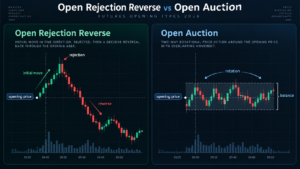
Open Rejection Reverse begins with price auctioning in one direction and then meeting enough opposing response to reverse back through the opening area. Unlike Open Test Drive, the reversal does not need to be built around a clean pre-defined test of one specific reference.
A bearish example can develop as follows:
- ES opens and trades higher;
- buyers initially appear to control the auction;
- price reaches a region where progress slows;
- aggressive buying is absorbed or becomes exhausted;
- price reverses through the opening area;
- selling expands and the session begins building lower.
For Futures Opening Types, the key evidence is not the first move but the rejection of that move. A strong reversal through the opening price or opening range shows that the early auction could not maintain acceptance.
This pattern can overlap with Futures Liquidity Sweep 2026, Futures Trapped Traders 2026 or Futures Absorption Trading 2026 when the opening move breaks an obvious level before failing.
Futures Opening Types: Open Auction
Open Auction is the most rotational of the four opening structures. Price trades on both sides of the opening area without sustained directional progress, indicating that neither side has established early control.
Typical characteristics include:
- repeated crossing of the opening price;
- overlapping bars or TPO periods;
- early development around a central value region;
- failed attempts to leave the opening area;
- less directional efficiency than Open Drive;
- greater importance of the eventual Initial Balance boundaries.
Open Auction can occur inside prior value or outside prior value. The distinction matters. An Open Auction inside value is consistent with continued two-way trade until new information appears. An Open Auction outside value can be more unstable because the market is trying to decide whether the new area should become accepted or whether price should return toward prior value.
The practical response is patience. An Open Auction often offers less information in the first minutes than a clean drive or failed test. Let Initial Balance, value migration or a later range extension add structure before forcing a directional trade.
Four Futures Opening Types Compared
| Opening Type | Early Structure | Primary Evidence | Failure Clue |
|---|---|---|---|
| Open Drive | Immediate one-directional auction | Minimal overlap, effective aggression, no meaningful return through open | Price quickly reclaims the opening area |
| Open Test Drive | Probe of reference followed by drive away | Clear test and rejection at known level | Test area becomes accepted instead of rejected |
| Open Rejection Reverse | Initial move then sharp reversal | Opposite activity forces price through the opening area | Original direction regains acceptance |
| Open Auction | Two-way rotation around open | Overlap, balance, repeated crossing of opening price | Clear directional drive establishes control |
The table shows why Futures Opening Types should be classified by process, not by one candle. Each structure is defined by how price behaves over a sequence of tests, rotations and responses.
Futures Opening Types vs Initial Balance
The opening type and Initial Balance answer different questions. Futures Opening Types describe the character of the opening process. The Initial Balance measures the opening range after the defined IB window is complete.
An Open Drive can later produce a narrow or wide IB depending on volatility. An Open Auction can remain inside the IB for hours or eventually break into a strong directional move. The early classification does not lock the day into one outcome.
Use the new Futures Initial Balance Trading 2026 guide to track IB High, IB Low, relative width and range extensions.
A practical sequence is:
- classify the opening process provisionally;
- measure where price is relative to prior value;
- let Initial Balance complete;
- observe which side, if any, extends;
- check whether value and volume migrate with the extension;
- update the opening thesis if the auction contradicts it.
This prevents an early label from overriding later evidence.
Order Flow Confirmation for Futures Opening Types
Price action identifies the broad opening structure. Order flow can show whether the aggressive side is actually effective.
Footprint Charts
An Open Drive with repeated ask-side aggression and upward price progress is different from a large positive-delta burst that fails immediately. Use Futures Footprint Charts 2026 to analyze transactions at price.
Volume Delta
Futures Volume Delta 2026 measures aggressive buying minus aggressive selling. Strong positive delta supports a bullish opening only when buyers achieve price progress.
Stacked Imbalance
Futures Stacked Imbalance 2026 can show repeated one-sided aggression during a drive. The stack still needs to produce acceptance rather than become trapped flow.
Time & Sales
Futures Time and Sales 2026 can reveal whether transaction speed and size expand during the drive or fade near the test.
DOM and Level 2
Depth can show current resting liquidity, but displayed orders can change before execution. Use Futures Level 2 Data 2026 for the difference between depth and completed transactions.
Order flow should refine Futures Opening Types, not replace the larger auction context.
Explore NinjaTrader Order Flow+ tools for footprint, delta and simulated opening-session analysis
When Futures Opening Types Fail
No opening classification is permanent. A major advantage of Futures Opening Types is that failure itself contains information.
Open Drive Failure
Price initially drives but then quickly returns through the opening area. If value also migrates back, the market has rejected the directional start.
Open Test Drive Failure
The tested reference does not reject price. Instead, the market begins accepting through it, invalidating the idea that the probe found no business there.
Open Rejection Reverse Failure
The reversal cannot maintain control and price reclaims the original opening direction. What looked like strong rejection may have been temporary.
Open Auction Failure
Open Auction is not really a bearish or bullish thesis to fail; it ends when one side finally establishes effective directional control.
The best response is not to rename every small rotation. Wait for material evidence: acceptance outside the opening structure, a failed reclaim, value migration or sustained directional order flow.
TradeboticsAI Futures Opening Types Framework
TradeboticsAI uses six layers to classify Futures Opening Types without turning the concept into a rigid prediction model.
| Layer | Question | Evidence |
|---|---|---|
| 1. Location | Where did the session open? | Inside value, outside value, outside prior range |
| 2. First Auction | Drive, test, rejection or rotation? | Early directional progress and overlap |
| 3. Reference Interaction | Did price test a known level? | VAH, VAL, POC, prior high/low, overnight extreme |
| 4. Aggression | Is one side committing? | Footprint, delta, tape, stacked imbalance |
| 5. Acceptance | Does the market build business in the new direction? | Time, volume, value migration, retest behavior |
| 6. Update | Has later evidence invalidated the label? | IB failure, reclaim, opposite-side acceptance |
The most important rule is the last one: the model must update. Futures Opening Types are a live classification system, not a reason to ignore contrary evidence.
Practical Futures Opening Types Examples: ES
Example 1: Open Drive Above Prior Value
Assume ES prior Value Area High is 6,520.00 and the overnight session trades above it. The regular session opens at 6,524.00. Buyers immediately lift offers, ES trades to 6,529.00, then 6,533.00, and the first meaningful pullback holds above 6,527.00.
Footprint data shows positive delta producing real progress, and the developing profile begins forming above prior value. This is consistent with a bullish Open Drive.
The thesis weakens if ES quickly falls back through 6,524.00 and begins accepting below prior VAH.
Example 2: Open Test Drive at Prior VAH
ES opens at 6,523.00, pulls back toward 6,520.00, trades briefly below VAH and finds little acceptance. Selling delta increases but price stops progressing. ES then reclaims 6,523.00 and drives toward 6,530.00.
This is a cleaner Open Test Drive because the initial move tested a known reference before the opposite drive developed.
Example 3: Open Rejection Reverse
ES opens at 6,518.00 and rallies rapidly to 6,524.00. Buying becomes heavy but price stalls. The market then reverses through 6,518.00 with expanding sell-side transactions and trades toward 6,510.00.
The initial auction was rejected and reversed. If price later regains 6,518.00 and accepts above it, the rejection thesis must be reconsidered.
Example 4: Open Auction Inside Value
ES opens near prior POC and spends the first 30 minutes repeatedly crossing the opening price. Bars overlap, Cumulative Delta oscillates and neither side builds sustained progress. This is consistent with Open Auction behavior.
In this situation, Futures Opening Types analysis says patience is more valuable than prediction. The developing Initial Balance or later range extension may provide the cleaner decision point.
Tools, Data and Hidden Costs for Futures Opening Types
You can study basic Futures Opening Types with standard intraday charts, but a deeper workflow can require additional tools and market data.
| Cost Area | Why It May Matter |
|---|---|
| Exchange Market Data | Real-time futures quotes and depth can require exchange/data subscriptions depending on provider and status. |
| Order-Flow Features | Footprint, volumetric bars, CVD or advanced depth tools may require a platform plan or add-on. |
| Commissions & Fees | Frequent intraday trading increases transaction costs even when the strategy’s gross result is positive. |
| Slippage | Fast opening moves can execute away from the expected price, especially around news or thin liquidity. |
| Replay / Historical Data | Serious testing may require reliable tick, bid/ask or replay data. |
Do not choose a platform solely because it displays an opening-type label. The workflow should remain useful even when the classification is done manually. Verify current NinjaTrader pricing, data access and feature availability directly before purchasing because platform plans and exchange fees can change.
Practical Futures Opening Types Trading Workflow
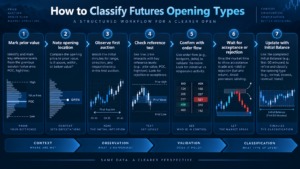
- Define the session. Use one consistent regular-session opening window for the contract being studied.
- Mark prior references. Prior VAH, VAL, POC, high, low, close and overnight extremes should be known before the open.
- Record opening location. Inside value, outside value or outside prior range.
- Observe before labeling. Decide whether the first auction is driving, testing, rejecting or rotating.
- Measure order flow when useful. Footprint, delta and tape should support—not dictate—the classification.
- Wait for acceptance or rejection. One impulse bar is not enough evidence.
- Let Initial Balance complete. Use IB structure to test whether the opening thesis is developing or failing.
- Update the label. If the market contradicts the first hypothesis, change it.
- Define risk from structure. Stops and position size should reflect invalidation, not confidence in a label.
- Review in replay. Build your own sample of openings rather than relying on unsupported win-rate claims.
This process keeps Futures Opening Types observational, conditional and testable.
Common Futures Opening Types Mistakes
1. Labeling the Open Too Early
A single candle can look like a drive and then immediately fail. Wait for enough auction structure to develop.
2. Ignoring Prior Value
Opening behavior becomes more useful when it is interpreted relative to prior acceptance and overnight location.
3. Calling Every Reversal an Open Test Drive
Open Test Drive should involve an identifiable test of a meaningful reference. Otherwise Open Rejection Reverse may be more accurate.
4. Assuming Open Drive Means Trend Day
A strong drive can fail later. The opening structure increases context; it does not guarantee the final day type.
5. Forcing a Direction During Open Auction
Open Auction specifically tells you that early directional evidence is weak. Waiting can be the correct decision.
6. Treating Positive Delta as Bullish by Itself
Positive delta matters only when buyers produce price progress. Failed aggression can be absorption or trapped flow.
7. Assuming Anonymous Flow Reveals Participant Identity
Futures Opening Types describe observable auction behavior. They do not prove whether institutions, retail traders or any specific group caused the move.
8. Ignoring Costs and Slippage
Opening volatility can increase execution uncertainty. A strategy that looks good before costs can behave differently live.
Pros and Limitations of Futures Opening Types
Pros
- Creates a structured framework for the first part of the session.
- Integrates naturally with prior value and Auction Market Theory.
- Helps distinguish conviction, testing, rejection and balance.
- Combines with Initial Balance, footprint and delta.
- Provides early invalidation clues.
- Encourages conditional thinking instead of prediction.
Limitations
- Classification can be subjective at the boundaries.
- The opening type can change or fail later.
- No opening type guarantees the final day type.
- News can rapidly invalidate early structure.
- Different session definitions can alter interpretation.
- Order-flow confirmation still produces false signals.
Best For
Futures Opening Types are most useful for intraday futures traders using Market Profile, TPO, Initial Balance, Volume Profile or order-flow tools who want a repeatable framework for interpreting the session open.
Not Ideal For
They are less useful for traders seeking a mechanical first-minute signal or anyone unwilling to revise an early opinion when later auction evidence changes.
Futures Opening Types FAQ
What are Futures Opening Types?
Futures Opening Types classify how a futures session begins: Open Drive, Open Test Drive, Open Rejection Reverse and Open Auction.
What is an Open Drive?
Open Drive is an immediate directional auction where price moves strongly away from the open with limited overlap and little sustained return through the opening area.
What is an Open Test Drive?
Open Test Drive occurs when the market first tests a meaningful reference, fails to gain acceptance there and then drives in the opposite direction.
What is an Open Rejection Reverse?
Open Rejection Reverse begins with an early move in one direction that meets strong opposing activity and reverses back through the opening area.
What is an Open Auction?
Open Auction is a rotational opening where price repeatedly trades around the open without early directional control.
Is Open Drive the strongest opening type?
It is generally the most immediately directional opening structure, but it can still fail and should not be treated as a guaranteed trend-day signal.
What is the difference between Open Test Drive and Open Rejection Reverse?
Open Test Drive is organized around a test of a known reference before the drive. Open Rejection Reverse is defined more broadly by the initial auction meeting strong opposition and reversing.
How does prior value affect opening types?
Opening inside, above or below prior value changes the auction context. The trader should ask whether the opening location is being accepted or rejected.
Can Initial Balance confirm an opening type?
Initial Balance can provide later confirmation by showing whether the market remains balanced, extends in the opening direction or fails back through the opening range.
Can footprint charts confirm Futures Opening Types?
Footprints can show whether aggressive transactions support the opening move, become absorbed or fail to produce price progress.
Can Volume Delta identify an Open Drive?
Delta can support the classification when aggressive flow produces effective directional progress. Delta alone cannot define the opening type.
Do Futures Opening Types predict the whole trading day?
No. Futures Opening Types describe the developing opening auction. The final session can evolve differently as new information and participation enter the market.
Which references should be marked before the open?
Common references include prior VAH, VAL, POC, high, low, close, overnight high/low and major higher-timeframe levels.
Can opening types be backtested?
Yes, but the classification rules must be explicit. Define the session, time window, prior-value relationship, structural criteria and confirmation rules before evaluating historical results.
Final Verdict: How to Use Futures Opening Types Correctly
Futures Opening Types are valuable because they provide a disciplined vocabulary for the first part of the session. Instead of asking only whether the first candle is bullish or bearish, the trader asks whether the market is driving, testing, rejecting or auctioning around the open.
The four structures answer different questions:
- Open Drive: is one side immediately effective?
- Open Test Drive: did a known reference fail before the real drive began?
- Open Rejection Reverse: did the initial auction meet enough opposition to reverse?
- Open Auction: is the market still searching for direction and value?
The strongest TradeboticsAI process is:
opening location → provisional open type → reference interaction → aggressive flow → acceptance/rejection → Initial Balance confirmation → update → risk.
Use Futures Opening Types alongside Futures Initial Balance Trading, Auction Market Theory, Market Profile, Volume Delta, Footprint Charts and Order Flow Trading.
The objective is not to predict the entire session in the first few minutes. It is to identify what the opening auction is actually doing, know what would invalidate that interpretation and update the plan as the market provides more information.
Explore NinjaTrader for futures charting, order-flow analysis and simulation
Affiliate Disclosure: TradeboticsAI may receive compensation when eligible users complete a qualifying action through certain affiliate links. Affiliate relationships do not determine our editorial conclusions.
Risk Disclosure: Futures trading involves substantial risk of loss and is not suitable for every investor. Opening types, TPO structure, Initial Balance, Volume Delta, footprint charts and historical auction behavior do not predict future returns. An opening classification can fail or change as new information enters the market, execution can differ during volatile conditions, and simulated results do not guarantee future live performance. Nothing on this page is personalized investment, financial, tax or trading advice.