Futures Spoofing 2026: Order Book Manipulation, CME Rule 575 & Detection Guide
Futures Spoofing is a prohibited market practice in which a trader enters an order with the intent, at the time of entry, to cancel it before execution or modify it to avoid execution. The objective can be to create a misleading appearance of buying or selling interest, distort visible market depth, or influence other participants while a genuine order is worked elsewhere. For futures traders, the practical lesson is not to assume that every large DOM order represents durable liquidity. Displayed size must be compared with persistence, actual executions, order-book changes and price response.
Quick Answer
Futures Spoofing involves entering bids or offers with the intent to cancel them before execution, rather than placing them as bona fide orders. CFTC guidance makes intent central to the definition, and CME Rule 575 prohibits entering orders or messages with intent to mislead market participants. A large order that is later canceled is not automatically proof of spoofing because legitimate traders cancel orders constantly as market conditions change. Traders should treat suspected spoofing as an order-book risk signal, not as something they can prove from one DOM snapshot.
Explore NinjaTrader for futures DOM, market depth and simulated order-flow analysis
Affiliate Disclosure: TradeboticsAI may earn compensation when an eligible user completes a qualifying action through an affiliate link, at no additional cost to the user. Affiliate relationships do not determine our editorial conclusions.

What Is Futures Spoofing?
Futures Spoofing is not simply the act of canceling a limit order. Modern futures markets depend on continuous order entry, modification and cancellation. The prohibited conduct centers on the trader’s intent when the order is entered.
The Commodity Futures Trading Commission interprets the statutory spoofing prohibition as requiring intent to cancel a bid or offer before execution. Legitimate good-faith cancellations, including changes made because market conditions changed or because a trader no longer wants the position, are not automatically spoofing.
A common enforcement pattern involves a genuine order on one side of the market and larger orders on the opposite side that are intended to be canceled. The visible orders can create a misleading appearance of supply or demand, potentially influencing prices or other participants. Once the genuine order receives a fill, the misleading orders may be canceled.
That pattern explains why spoofing awareness matters to order-flow traders. A DOM shows resting intentions, not contractual promises that every displayed order will remain until execution.
Futures Spoofing: CFTC Rules and CME Rule 575
The U.S. Commodity Exchange Act prohibits spoofing, commonly described as bidding or offering with the intent to cancel the bid or offer before execution. The CFTC’s interpretive guidance emphasizes that intent is required; accidental, negligent or ordinary good-faith order cancellation is not treated the same way.
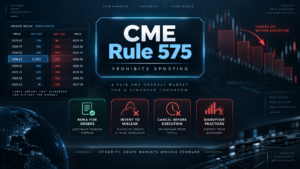
CME Rule 575, “Disruptive Practices Prohibited,” requires orders to be entered for bona fide transactions and prohibits entering an order with intent, at the time of order entry, to cancel it before execution or modify it to avoid execution. The rule also prohibits actionable or non-actionable messages entered with intent to mislead market participants, as well as certain quote-stuffing and disruptive practices.
Official references:
CFTC spoofing interpretive guidance
and
CME Group Rule 575 Advisory Notice.
This is why a retail trader should use spoofing-risk analysis to manage confidence in displayed liquidity—not to publicly accuse another participant of misconduct from a screenshot.
How Futures Spoofing Can Distort the Order Book
The order book displays resting bids and offers. Other traders and algorithms can react to changes in that visible depth. Futures Spoofing can therefore distort the information content of the book when orders are displayed to influence perception rather than to seek genuine execution.
Consider a simplified hypothetical ES order book where the best bid contains 150 contracts and the best ask contains 180. Suddenly, several much larger sell orders appear at nearby ask levels. The displayed book now looks heavily supply-weighted. If those orders were entered with intent to cancel before execution, they can create a misleading impression of selling interest.
The critical point is not the exact quantity or location. It is intent. A trader may legitimately place a large sell order and later cancel it because price moved, risk changed or the trading thesis changed. That is different from entering the order for the purpose of creating a false market signal.
For order-flow traders, the defensive rule is simple: treat visible depth as provisional information until it survives contact with the market.
Futures Spoofing vs Legitimate Order Cancellation
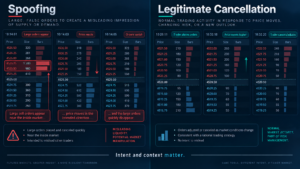
One of the most important distinctions is that high cancellation rates do not automatically equal Futures Spoofing. Electronic markets change rapidly, and legitimate traders routinely modify or cancel resting orders.
| Behavior | Potentially Legitimate Explanation | Why Context Matters |
|---|---|---|
| Order canceled before fill | Price changed or trader no longer wants exposure | Cancellation alone does not reveal original intent |
| Order modified repeatedly | Trader adjusts price or size as risk changes | A pattern must be evaluated in full context |
| Large visible order | Participant genuinely wants to trade size | Size alone does not establish manipulation |
| Partial fill then cancellation | Trader accepts a partial execution and reassesses | CFTC notes that partial fill is neither automatic proof nor automatic exemption |
The CFTC states that it evaluates market context, trading patterns, fill characteristics and other relevant facts when distinguishing legitimate activity from spoofing. A trader analyzing the DOM does not have access to all of that evidence in real time.
Futures Spoofing vs Layering
“Layering” generally describes a spoofing-style pattern in which multiple orders are placed across several nearby price levels to create a larger or more structured appearance of buying or selling interest. The terminology can vary across enforcement documents and trading discussions, but the underlying concern is the same: orders are used to mislead rather than to seek bona fide execution.
A single suspiciously large order can disappear for many legitimate reasons. Several unusually large orders that appear together on one side of the book and then disappear together may deserve more caution, especially if they repeatedly coincide with genuine executions on the opposite side.
However, a trader still cannot infer illegal spoofing from visual symmetry alone. Automated market makers and execution algorithms can update multiple levels simultaneously for legitimate reasons.
Futures Spoofing vs Iceberg Orders
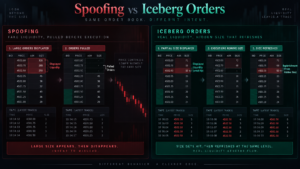
Iceberg orders and spoofing are often confused because both can make the visible order book different from the participant’s full trading interest.
| Feature | Iceberg Order | Spoofing Pattern |
|---|---|---|
| Displayed Size | Only part of genuine order is visible | Visible order may be deliberately misleading |
| Intent to Execute | Yes, hidden quantity is intended for bona fide execution | Spoof order is entered with intent to cancel or avoid execution |
| Exchange Treatment | Permitted order functionality | Prohibited disruptive conduct when legal elements are met |
| Visible Effect | Book can understate genuine liquidity | Book can overstate genuine trading interest |
CME explicitly states that iceberg orders are not, by themselves, a violation of Rule 575. An iceberg can still be involved in a broader manipulative scheme, but legitimate iceberg functionality is not synonymous with Futures Spoofing.
For the full hidden-liquidity framework, see Futures Iceberg Orders 2026.
Futures Spoofing Detection: Useful Clues and Hard Limits
A retail trader cannot prove Futures Spoofing merely by watching the DOM. Still, certain behaviors can reduce confidence in displayed depth and justify waiting for executed-trade confirmation.
Rapid Pulling Near the Market
A large order repeatedly disappears as price approaches. This is a reason to distrust the level as durable liquidity, but it is not legal proof of spoofing.
Repeated Opposite-Side Patterns
Large displayed orders appear on one side while smaller genuine-looking trades repeatedly execute on the other. Enforcement cases have documented variations of this pattern, but an outside observer does not know intent from one occurrence.
Coordinated Multi-Level Changes
Several large levels appear and disappear in close coordination. This may resemble layering, but automated legitimate quoting can also update many levels at once.
Displayed Depth Fails to Trade
A large “wall” appears influential but is repeatedly canceled rather than executed. The practical conclusion is that the wall is unreliable, regardless of whether the conduct is legally spoofing.
The best defensive approach is to compare displayed orders with actual trades. Futures Time and Sales shows what executed; footprint charts show where transactions accumulated; and Cumulative Delta summarizes aggressive order flow.
Using MBO, DOM and Tape Around Suspected Futures Spoofing
Higher-resolution data can improve market-microstructure analysis, but it still does not let a retail trader read intent directly. Market by Order can provide individual order-level information, order IDs and queue detail where supported. That can help distinguish one order being modified from many separate orders appearing at the same price.
A practical Futures Spoofing defense stack is:
- DOM: observe displayed depth and whether it persists.
- MBO where available: examine order-level additions, modifications and cancellations.
- Time & Sales: confirm what actually executed.
- Footprint: measure bid/ask volume at the relevant prices.
- Price response: determine whether the displayed liquidity actually affected the auction.
For MBO and MBP differences, see Futures Level 2 Data 2026. For quantitative displayed-depth asymmetry, see Futures Order Book Imbalance 2026.
Explore NinjaTrader for DOM, Level II and simulated futures order-flow analysis
2026 CFTC Futures Spoofing Enforcement Example
A current enforcement example demonstrates why intent and trading pattern matter. In May 2026, the CFTC announced a settlement with a trader over spoofing in Treasury futures, primarily Ultra U.S. Treasury Bond futures. The agency stated that the trader engaged in spoofing on approximately 50 occasions during 2019 by working genuine orders while entering opposite-side futures orders that he intended to cancel before execution.
The order imposed a $200,000 civil monetary penalty, a one-month trading prohibition and a cease-and-desist requirement. This recent action shows that spoofing in futures remains an active enforcement area rather than merely a historical market-structure topic.
Official source:
CFTC May 6, 2026 enforcement release.
The point for TradeboticsAI readers is not to reverse-engineer prohibited strategies. It is to understand why visible order-book pressure can be misleading and why genuine execution data deserves more weight than a temporary wall of resting orders.
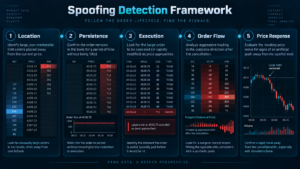
TradeboticsAI Futures Spoofing Risk Framework
TradeboticsAI uses the following framework to grade confidence in displayed liquidity. It is not a legal spoofing detector and should not be used to accuse market participants.
| Evidence Layer | Higher Confidence in Genuine Liquidity | Higher Spoofing-Risk / Low-Trust Signal |
|---|---|---|
| Persistence | Order remains as price approaches | Order repeatedly disappears before contact |
| Execution | Meaningful size actually trades | Displayed size rarely trades before cancellation |
| Repetition | Normal independent updates | Recurring place-pull behavior around similar setups |
| Opposite-Side Activity | No suspicious relationship | Displayed pressure repeatedly accompanies opposite-side fills |
| Price Response | Liquidity survives and meaningfully absorbs flow | Wall vanishes and price immediately trades through |
The framework deliberately avoids declaring an order “illegal.” The trading decision is simpler: if displayed depth proves unreliable, reduce the weight assigned to it and wait for stronger evidence from actual transactions.
How Traders Can Protect Themselves From Misleading Order-Book Signals
The most useful response to possible Futures Spoofing is not to try to outguess manipulators. It is to build a process that does not depend on one resting order.
- Start with location. Prior highs/lows, VWAP, VAH, VAL and other objective levels give the order book context.
- Wait for persistence. A large bid or ask becomes more informative if it remains as price approaches.
- Watch actual trades. Time & Sales shows whether the displayed liquidity receives executions.
- Measure price response. Liquidity that absorbs large volume without moving can be more meaningful than a static number.
- Compare multiple data layers. DOM, MBO, footprint and CVD should support rather than contradict the thesis.
- Avoid chasing disappearing walls. If the reference liquidity vanishes, reassess instead of treating the old snapshot as valid.
- Use predefined risk. No order-book pattern removes the possibility of a fast adverse move.
- Practice in simulation. Replay and simulated trading can help traders learn how often apparently important depth disappears.
This process also improves analysis when no spoofing is present because it forces the trader to distinguish displayed intention from completed execution.
Common Futures Spoofing Analysis Mistakes
1. Calling Every Canceled Order Spoofing
Legitimate orders are canceled constantly. Legal intent cannot be established from one cancellation.
2. Assuming a Large Wall Must Be Fake
A participant may genuinely want to trade substantial size. Let execution behavior determine how much weight to give the order.
3. Assuming an Iceberg Is Spoofing
CME explicitly states that iceberg orders are not inherently a Rule 575 violation. Hidden genuine size and displayed misleading size are different concepts.
4. Trading Against Every Large Order
A wall can be genuine and can absorb aggressive flow. Automatically fading visible depth is as dangerous as automatically following it.
5. Ignoring the Tape
Displayed orders can disappear; completed trades have already happened. Compare the book with Time & Sales before assigning strong confidence.
6. Treating Detection Software as Legal Proof
Software can flag order patterns, cancellations or rapid changes. It cannot independently establish a trader’s state of mind from a retail data feed.
7. Forgetting Market Context
News releases, rollover and volatility can create rapid legitimate order-book changes that superficially resemble suspicious behavior.
8. Using the Topic to Justify Bad Trades
Blaming losses on Futures Spoofing is not a risk-management process. A trade still needs a defined invalidation and maximum acceptable loss.
What Futures Spoofing Monitoring Can and Cannot Do
Useful For
- Reducing confidence in disappearing liquidity.
- Understanding why DOM depth can be misleading.
- Encouraging confirmation from executed trades.
- Separating iceberg behavior from fake displayed pressure.
- Improving order-book and market-depth literacy.
- Building a more robust execution workflow.
Cannot Reliably Do
- Prove illegal intent from one order-book event.
- Identify the person behind anonymous market data.
- Guarantee that a large order is genuine or fake.
- Predict exactly when a displayed wall will disappear.
- Guarantee future price direction.
- Replace position sizing and risk controls.
Futures Spoofing FAQ
What is Futures Spoofing?
Futures Spoofing generally refers to entering a bid or offer with intent, at the time of entry, to cancel it before execution. U.S. law and CME rules prohibit spoofing and other defined disruptive practices.
Is canceling a futures order illegal?
No. Legitimate order cancellation is a normal part of trading. The CFTC’s spoofing guidance focuses on intent to cancel before execution rather than a bona fide attempt to trade.
How can spoofing affect the DOM?
Large orders that were not intended for execution can create a misleading appearance of market depth or buying/selling interest. Other traders may react to that apparent liquidity.
Is layering the same as spoofing?
Layering is commonly used to describe a pattern involving multiple misleading orders across several levels. Whether specific conduct constitutes a violation depends on the facts, intent and applicable rules.
Are iceberg orders illegal?
No. CME states that iceberg orders are not inherently prohibited by Rule 575. An iceberg displays only part of genuine size and can be used legitimately.
Can MBO data prove Futures Spoofing?
No. MBO can provide more granular evidence about order additions, changes, cancellations and order IDs, but legal spoofing analysis still depends on intent and broader facts unavailable from one retail screen.
Can traders detect spoofing in real time?
Traders can detect suspicious or unreliable depth patterns, such as repeated pulling near the market, but they should distinguish a trading-risk observation from a legal conclusion.
Why is Time & Sales useful?
Time & Sales records completed transactions. It helps traders separate displayed liquidity that merely appears in the book from liquidity that actually receives executions.
Does spoofing still happen in futures markets?
Regulatory enforcement continues. In May 2026 the CFTC announced a $200,000 settlement involving spoofing in Treasury futures, demonstrating that the issue remains actively enforced.
Does a large bid mean price will rise?
No. The order may remain and trade, be consumed, be modified or be canceled. Futures Spoofing is one reason traders should not equate displayed quantity with guaranteed support.
What should retail traders do when a large order disappears?
Reassess the market using current depth, actual trades and price response. Do not continue trading from an order-book condition that no longer exists.
Final Verdict: How to Think About Futures Spoofing
Futures Spoofing is a regulatory and market-microstructure issue, but the practical lesson for traders is straightforward: displayed depth is not the same as executed commitment.
CFTC guidance and CME Rule 575 focus on intent. That makes legal classification far more demanding than spotting a large order that later disappears. Retail traders should therefore avoid accusations and instead use suspicious depth as a reason to demand better confirmation.
The strongest defensive framework is location + persistence + execution + price response. If a large order survives as price approaches, receives meaningful execution and influences price, it deserves more weight. If it repeatedly disappears before contact, treat it as low-confidence liquidity regardless of why it vanished.
Combine Futures Spoofing awareness with Level 2 data, DOM analysis, Time & Sales, iceberg analysis and disciplined risk management. The objective is not to identify a manipulator from your screen; it is to avoid making trading decisions from liquidity that may disappear before it matters.
Explore NinjaTrader for futures market depth, Level II and simulation tools
Affiliate Disclosure: TradeboticsAI may receive compensation when eligible users complete a qualifying action through certain affiliate links. Affiliate relationships do not determine our editorial conclusions.
Risk & Regulatory Disclosure: Futures trading involves substantial risk of loss and is not suitable for every investor. This page is educational and does not provide legal advice or determine whether any specific order or trader violated CFTC or exchange rules. Spoofing, layering, DOM behavior, market-depth changes and order-flow patterns do not predict future returns. Displayed orders can be modified or canceled rapidly, and simulated results do not guarantee future live performance.