Futures Iceberg Orders 2026: Hidden Liquidity, MBO & Detection Guide
Futures Iceberg Orders are partially displayed limit orders designed to expose only part of a larger order to the public book. Traders watching a DOM may see a small bid or offer repeatedly refill while far more contracts execute at that price than were initially visible. On CME markets, native iceberg behavior can be studied more precisely with Market by Order (MBO) data because exchange-assigned OrderIDs remain consistent when a CME-held iceberg refreshes its displayed quantity. The important lesson is that hidden liquidity can influence short-term order flow, but an iceberg is not a guaranteed reversal signal and can eventually be fully consumed.
Quick Answer
Futures Iceberg Orders hide part of a limit order while displaying a smaller quantity in the order book. When the visible portion trades, additional hidden quantity can refresh at the same price. CME refers to this functionality as Display Quantity orders, and CME MBO data can expose order-level information that helps identify native iceberg refreshes. Traders typically look for repeated replenishment, executed volume far above displayed size, stable price despite aggressive trading, and MBO evidence such as a consistent OrderID. Synthetic icebergs are harder to confirm because they may be created by an external execution algorithm sending separate orders.
Explore NinjaTrader for futures DOM, order-flow analysis and simulated trading
Affiliate Disclosure: TradeboticsAI may earn compensation when an eligible user completes a qualifying action through an affiliate link, at no additional cost to the user. Affiliate relationships do not determine our editorial conclusions.

What Are Futures Iceberg Orders?
Futures Iceberg Orders are limit orders in which the full order quantity is larger than the amount shown publicly in the order book. The visible portion is often called the displayed quantity, peak, or tip of the iceberg. The remaining quantity is hidden from the standard displayed book.
The purpose is straightforward: a participant may want to trade substantial size without advertising the entire order to the market at once. If a trader displayed an unusually large order in full, other participants could react before the order is completed, potentially increasing market impact or changing execution quality.
CME Globex supports Display Quantity orders. CME technical documentation describes the display quantity as the amount shown in the order book while the total order quantity can be larger. CME has also historically referred to these orders as icebergs.
For a simplified example, imagine an order to buy 500 ES contracts with only 25 contracts displayed. The DOM initially shows 25 at the bid. If those 25 contracts trade and hidden quantity remains, another displayed portion can appear. A trader watching only a static snapshot may think the level contains 25 contracts, even though hundreds can ultimately execute there.
That difference between displayed size and total executed size is the foundation of Futures Iceberg Orders analysis.
Official CME reference:
CME Group Market by Order FAQ.
Futures Iceberg Orders: Display Quantity vs Total Quantity
A native iceberg can be understood as a limit order with two economically important quantities: the total order size and the portion currently displayed. CME’s iLink documentation uses the DisplayQty field for Display Quantity orders.
| Component | Example | Visible to Standard Book? | What Happens After a Fill? |
|---|---|---|---|
| Total Order Quantity | 500 contracts | Not necessarily | Remaining quantity stays available until filled, changed or canceled |
| Displayed Quantity | 25 contracts | Yes | Can refresh from the hidden remainder |
| Hidden Remainder | 475 contracts initially | No in a standard aggregated view | Supplies future displayed portions while quantity remains |
One critical detail is queue behavior. A refreshed displayed slice should not automatically be assumed to preserve exactly the same queue position. Exchange matching rules matter, and traders should treat a refresh as a new liquidity event for queue-analysis purposes rather than assuming their place in line is unchanged.
For the retail trader, the practical point is simpler: a level that appears small can repeatedly refill, and actual traded volume can become much larger than the original visible quantity.
Official technical reference:
CME Group Display Quantity documentation.
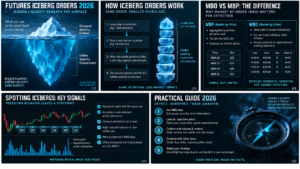
Native vs Synthetic Futures Iceberg Orders
Not all hidden-liquidity behavior is created the same way. A useful distinction is between native exchange-held icebergs and synthetic iceberg execution.
Native Iceberg
A native CME-held iceberg uses the exchange’s Display Quantity functionality. CME states that exchange-assigned OrderIDs are unique for the life of an order and that when a native iceberg refreshes its displayed quantity, the refreshed portion retains the same OrderID. That gives compatible MBO analytics a relatively strong basis for confirming native iceberg activity.
Synthetic Iceberg
A synthetic iceberg can be created by an external algorithm that repeatedly submits separate limit orders rather than storing one larger hidden quantity natively at the exchange. The visible effect can look similar: size trades, disappears and then reappears at the same price.
However, a synthetic sequence may use multiple order IDs and therefore cannot be confirmed in exactly the same way as a native exchange-held iceberg. Detection becomes more inferential and can create false positives.
| Feature | Native Iceberg | Synthetic Iceberg |
|---|---|---|
| Hidden quantity held by | Exchange functionality | External execution logic |
| MBO OrderID behavior | Consistent OrderID through native refresh | Can involve separate new orders |
| Detection confidence | Higher with compatible MBO analytics | More inferential |
| False-positive risk | Lower when native refresh is confirmed | Higher |
This distinction prevents a common error: labeling every replenishing level as confirmed hidden institutional size. Futures Iceberg Orders can be detected with different confidence levels depending on the available data.
Why MBO Data Matters for Futures Iceberg Orders
Market by Price data aggregates order quantity at each price. Market by Order data goes deeper by providing order-level information. CME states that MBO supports all CME Globex futures and options products and can provide full depth, individual order size and queue-position information.
For Futures Iceberg Orders, the key advantage is the OrderID. Because a CME native iceberg keeps the same exchange-assigned OrderID when displayed quantity refreshes, compatible tools can distinguish a confirmed native refresh from a simpler visual pattern that merely resembles one.
MBO does not magically reveal the entire hidden size before execution. The hidden quantity is hidden for a reason. What MBO improves is the ability to identify refresh behavior and attribute it to the life cycle of an exchange order after observable events occur.
This is different from simply staring at an aggregated DOM. On a standard Market by Price ladder, a trader may observe that 20 contracts repeatedly return to the bid. With MBO and the right software, the trader may be able to determine whether the same native order is refreshing or whether several unrelated orders are appearing at the same price.
For the broader distinction between order-level and aggregated depth, see our Futures DOM Trading 2026 guide.
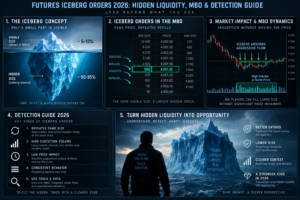
How to Detect Futures Iceberg Orders
Manual detection of Futures Iceberg Orders is based on behavior, not on one large DOM number. The most useful clues tend to appear together.
Repeated Replenishment
A visible bid or ask is repeatedly executed and then reappears at the same price. The level seems to contain more liquidity than the initial displayed quantity suggested.
Executed Volume Exceeds Displayed Size
Suppose only 20 contracts are visible at an offer, yet Time & Sales records 180 contracts trading at that price without the market moving through it. The level is clearly supplying more liquidity than the original visible snapshot showed.
Price Fails to Progress
Large aggressive buying repeatedly hits an offer, but price cannot advance. Or aggressive selling repeatedly hits a bid while price refuses to break lower. That mismatch can support an absorption hypothesis.
OrderID Refresh Evidence
With compatible MBO data, native refresh behavior tied to the same exchange OrderID provides stronger evidence than visual replenishment alone.
Persistent Activity at a Meaningful Location
An iceberg-like pattern at prior VAH, VAL, VWAP, a session high/low, an Initial Balance extreme or another clearly defined location is generally more informative than the same behavior in the middle of random rotation.
The best interpretation is therefore not “I saw an iceberg, so price must reverse.” It is “hidden or replenishing liquidity appears to be absorbing flow at a meaningful location; now I need to observe whether price confirms the hypothesis.”
TradeboticsAI Futures Iceberg Orders Detection Confidence Matrix
To reduce overconfidence, TradeboticsAI separates iceberg evidence into four practical confidence levels. This is an editorial decision framework, not an exchange-certified scoring model.
| Level | Evidence | Interpretation | Confidence |
|---|---|---|---|
| Level 1 | Large static displayed order only | Visible liquidity, not an iceberg signal | Very Low |
| Level 2 | Repeated refill + volume greater than initial display | Possible hidden/replenishing liquidity | Medium |
| Level 3 | Repeated refill + high executed volume + limited price progress + supporting tape/footprint evidence | Strong absorption hypothesis | Medium-High |
| Level 4 | Compatible MBO analytics confirms native refresh / persistent OrderID behavior | Native iceberg evidence | High |
The matrix forces a useful distinction between visible depth, inferred hidden liquidity and native exchange-confirmed refresh behavior. It also prevents Futures Iceberg Orders from becoming a vague label attached to every level that happens to hold.
Futures Iceberg Orders, Absorption and Price Response
Futures Iceberg Orders are often discussed together with absorption because hidden or replenishing passive liquidity can accept repeated aggressive trades without immediately allowing price through the level.
Imagine aggressive buyers repeatedly lifting an ES offer. If the offer is ordinary and finite, enough buying eventually consumes it and price can move higher. If the displayed offer repeatedly refreshes from hidden quantity, significantly more buying may be required before the level breaks.
But an iceberg does not make a price level permanent. Hidden quantity can be exhausted, canceled or overwhelmed. A seller absorbing 1,000 contracts can still lose control when another wave of buying arrives.
- Absorption: aggressive flow hits the level but price shows limited progress.
- Persistence: the hidden or replenishing liquidity continues to refresh.
- Resolution: price either rejects from the level or finally consumes the liquidity and breaks through.
The third stage is crucial. Traders who enter solely because they detect hidden liquidity can be trapped when the iceberg is fully consumed. The price reaction after the detected activity matters more than the label itself.
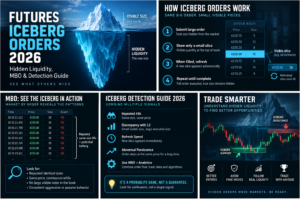
Practical Futures Iceberg Orders Example: ES
Consider a hypothetical ES session trading near prior-day VAH at 6,620.00. The DOM shows 18 contracts offered at 6,620.25. That is not unusual by itself.
Aggressive buyers begin lifting the offer. Time & Sales records 18 contracts, then another 14, 22, 17 and 26 at 6,620.25. Despite more than 90 contracts trading at the level, the offer continues to display around 15–20 contracts and ES cannot sustain a trade at 6,620.50.
At this stage, a standard DOM trader can reasonably say there is replenishing liquidity. A footprint chart may also show strong positive delta at the high with limited price progress. Cumulative Delta may rise while price remains capped.
If compatible MBO analytics then identifies repeated refresh behavior associated with the same native order, the evidence for Futures Iceberg Orders becomes substantially stronger.
Outcome A: Iceberg Holds
The buying slows, ES trades back below 6,620.00, the footprint turns negative and the market begins rejecting the area. In this case, the iceberg/absorption hypothesis is supported by subsequent price behavior.
Outcome B: Iceberg Gets Consumed
Buying accelerates, the visible quantity stops replenishing, ES trades 6,620.50 and 6,620.75, and new bids begin forming above the prior level. In this case, the hidden seller may have been fully executed or canceled. The correct interpretation is not “the signal failed”; it is that the liquidity event reached its resolution and the market moved through it.
This example shows why Futures Iceberg Orders should be treated as dynamic liquidity events rather than permanent support or resistance.
Futures Iceberg Orders vs DOM, Tape, Footprint and CVD
No single tool tells the entire hidden-liquidity story. Each order-flow view contributes a different layer.
| Tool | What It Shows | Iceberg Use | Limitation |
|---|---|---|---|
| DOM | Visible resting liquidity | Spot repeated replenishment | Hidden size is not directly visible |
| Time & Sales | Executed trades | Measure how much actually trades at the level | Does not alone identify native refresh |
| Footprint | Bid/ask volume by price | Show high aggression with limited price movement | Aggregated after trades occur |
| CVD | Running aggressive-volume balance | Show pressure building against a level | Does not isolate one hidden order |
| MBO Analytics | Order-level events and IDs where supported | Confirm native refresh behavior | Requires compatible data and software |
For detailed guides on these layers, see Futures DOM Trading 2026, Futures Time and Sales 2026, Futures Footprint Charts 2026 and Futures Cumulative Delta 2026.
Explore NinjaTrader for futures DOM, charts, simulation and order-flow workflows
A Practical Futures Iceberg Orders Detection Workflow
- Start with location. Mark prior session highs/lows, VWAP, VAH, VAL, POC, Initial Balance or another defensible market reference.
- Watch displayed depth. Record how much bid or ask quantity is initially visible at the level.
- Track executed volume. Use Time & Sales or footprint data to measure how much actually trades there.
- Look for replenishment. Determine whether displayed size repeatedly returns after being executed.
- Compare volume with price progress. Heavy trading plus limited movement supports an absorption hypothesis.
- Check MBO evidence when available. Native OrderID refresh confirmation materially increases confidence.
- Separate native from synthetic inference. Do not assign exchange-level certainty to a pattern that is only visually inferred.
- Wait for price resolution. Observe whether the level rejects price or gets fully consumed.
- Define invalidation. Hidden liquidity does not eliminate the need for a clear risk point.
- Review in replay or simulation. Save examples and compare what was visible in real time with the final outcome.
This workflow is deliberately slower than reacting to one DOM number. The goal is to turn Futures Iceberg Orders into a testable order-flow hypothesis rather than an emotional scalp trigger.
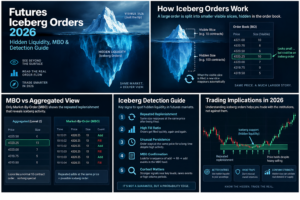
False Positives and Futures Iceberg Orders Detection Limits
Multiple Independent Limit Orders
Several participants can place orders at the same price after earlier orders trade. From an aggregated DOM, the result can look like one continuously replenishing participant.
Market-Making Algorithms
Automated liquidity providers can rapidly add, cancel and replace orders. Frequent refresh behavior is not automatically one hidden parent order.
Synthetic Execution
An external algorithm can submit many separate orders that resemble an iceberg. Without native exchange evidence, classification is probabilistic rather than certain.
Feed and Platform Differences
Market by Price, Market by Order, filtering, aggregation and historical-data reconstruction can all change what the trader sees. A detector cannot recover information that its data feed never received.
Iceberg Consumption
Even a correctly identified native iceberg can be fully executed. Detection does not tell you in advance how much hidden quantity remains unless the relevant system exposes that information, and standard public depth does not reveal the full hidden remainder.
For this reason, serious Futures Iceberg Orders analysis should distinguish confirmed facts from interpretation. Futures Iceberg Orders should be graded by evidence quality, not by how convincing one DOM snapshot looks. “The level refreshed with the same native OrderID” is stronger than “the level looked like it kept refilling.”
Pros and Limitations of Futures Iceberg Orders Analysis
Pros
- Can reveal hidden or replenishing passive liquidity.
- Adds context to absorption and failed-breakout analysis.
- MBO can improve native iceberg confirmation.
- Combines well with DOM, tape, footprint and CVD.
- Useful for studying execution at precise price levels.
- Creates a more nuanced view than static displayed depth alone.
Limitations
- Standard DOM views can produce false positives.
- Native and synthetic icebergs require different detection logic.
- Hidden quantity can still be exhausted or canceled.
- MBO availability depends on data and platform support.
- Detection does not guarantee reversal or continuation.
- Fast order-book data can be difficult to interpret live.
Who Should Study Futures Iceberg Orders?
Futures Iceberg Orders are most relevant to active intraday traders who already understand DOM behavior, Time & Sales, bid/ask execution and basic futures market structure. The topic is especially useful for scalpers and order-flow traders focused on liquid CME products where MBO-compatible data may be available.
It is less useful as a starting point for beginners. A trader who does not yet understand tick value, order types, contract rollover, spread and basic risk can easily mistake hidden-liquidity analysis for certainty.
Before using iceberg observations in live execution, understand your contract specifications with our Futures Contract Specifications 2026 guide and practice the order-flow workflow in simulation.
Futures Iceberg Orders FAQ
What are Futures Iceberg Orders?
Futures Iceberg Orders are partially displayed limit orders in which only a portion of the total quantity is visible in the public order book while additional quantity remains hidden.
What does CME call iceberg orders?
CME uses the term Display Quantity for exchange functionality that allows an order’s displayed size to be smaller than its total quantity. CME documentation has also explicitly referred to these orders as icebergs.
How do traders detect an iceberg order?
Common clues include repeated replenishment at the same price, executed volume much larger than the initially displayed amount, limited price progress despite aggressive trading and, where compatible MBO data is available, native refresh evidence tied to an exchange OrderID.
Can a normal DOM show the full hidden size?
No. The purpose of an iceberg is to avoid displaying the full quantity. An aggregated DOM can reveal replenishment behavior but not necessarily the total hidden remainder.
What is a native iceberg?
A native iceberg uses exchange-supported Display Quantity functionality. CME states that a CME-held native iceberg retains its exchange-assigned OrderID when the displayed quantity refreshes.
What is a synthetic iceberg?
A synthetic iceberg is produced by external execution logic that submits new orders over time rather than relying entirely on one exchange-held hidden quantity. Detection is generally more inferential and can produce false positives.
Does MBO reveal iceberg orders?
MBO provides order-level data that can improve detection. On CME, native iceberg refreshes retain the same exchange-assigned OrderID, allowing compatible analytics to identify native refresh behavior more reliably than an aggregated Market by Price view.
Does an iceberg mean price will reverse?
No. Futures Iceberg Orders can absorb aggressive flow, but the hidden liquidity can be consumed, canceled or overwhelmed. Always wait for price behavior to confirm whether the level actually holds.
What is the difference between absorption and an iceberg?
Absorption describes a market behavior in which aggressive orders produce limited price progress because passive liquidity is meeting them. An iceberg is one possible mechanism that can provide that passive liquidity, but absorption can also occur without a confirmed iceberg.
Are iceberg orders only used by institutions?
No public order-flow observation can reliably identify the owner of an order. Icebergs are commonly associated with larger execution needs, but the presence of an iceberg does not prove which type of participant placed it.
Can iceberg detection work without MBO?
Yes, but confidence is lower. Traders can infer hidden liquidity from repeated refill behavior, Time & Sales and footprint evidence. MBO can provide stronger confirmation for native CME icebergs.
Final Verdict: How to Use Futures Iceberg Orders Correctly
Futures Iceberg Orders matter because the visible order book does not always reveal the full amount of passive liquidity available at a price. A level showing only a small bid or offer can absorb far more contracts when hidden quantity refreshes behind the displayed portion.
The strongest analysis separates what is visible from what is inferred. A large static DOM number is not an iceberg. Repeated replenishment plus high executed volume is stronger evidence. MBO confirmation of native refresh behavior is stronger still.
Most importantly, hidden liquidity is not permanent. An iceberg can hold, cancel or be completely consumed. The final price response determines whether the event becomes a useful trading reference.
Use iceberg analysis together with DOM structure, Time & Sales, footprint charts, Cumulative Delta and disciplined risk management. That combination provides a more defensible framework for studying hidden liquidity without pretending that any detector can predict the next move with certainty.
Explore NinjaTrader for futures DOM, charting, simulation and order-flow analysis
Affiliate Disclosure: TradeboticsAI may receive compensation when eligible users complete a qualifying action through certain affiliate links. Affiliate relationships do not determine our editorial conclusions.
Risk Disclosure: Futures trading involves substantial risk of loss and is not suitable for every investor. Iceberg detection, hidden-liquidity analysis, DOM behavior, MBO data, absorption and historical order-flow patterns do not predict future returns. Displayed and hidden liquidity can change or disappear, and simulated results do not guarantee future live performance. Nothing on this page is personalized investment, financial, tax or trading advice.