Affiliate Disclosure: TradeboticsAI may earn a commission from qualifying referrals at no extra cost to you. Trading involves risk. This page is educational and does not provide personalized investment advice.
Crypto Trading Bot Slippage: Calculate & Reduce It (2026)
Crypto trading bot slippage is the difference between the execution price a system expected and the price it actually received. It is part of live execution and can turn a marginal backtest into a negative live system when fees, spread and market impact are ignored.
Quick Answer
Measure slippage against a documented benchmark such as decision price or arrival midprice, keep it separate from fees and spread, and analyze the distribution by symbol, size, order type and volatility regime. Kraken notes that volatility, low liquidity, large orders and execution delays can all increase slippage.
Explore TradersPost Automation
Primary reference: Kraken slippage guide. Exchange and platform behavior can change; verify current documentation before relying on any setting.
Choose one reproducible benchmark
Do not switch between candle close, last trade, midprice and quoted ask after seeing the result. Capture the benchmark timestamp and price before routing the order. For a buy, adverse slippage occurs when average execution is above the benchmark; for a sell, it occurs when execution is below it.
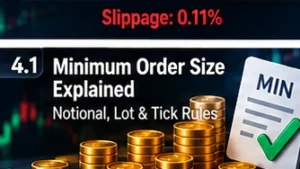
Separate spread, fees and slippage
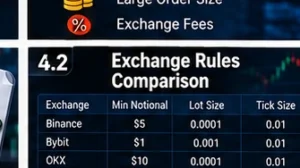
A strategy can lose edge through several frictions at once. Spread is the gap between bid and ask; fee is the venue charge; slippage is movement between the benchmark and realized execution; funding or borrowing can be another cost. Store them separately so optimization targets the actual cause.
| State | What the bot knows | Safe action |
|---|---|---|
| Confirmed | Venue acknowledgement and current state agree | Continue under normal rules |
| Pending | Request exists but terminal outcome is not known | Wait or query; do not duplicate blindly |
| Unknown | Timeout, disconnect or state mismatch | Freeze new exposure and reconcile |
Why size changes the result
A market order consumes available liquidity. As size grows relative to visible depth, the order can walk through multiple price levels. Thin pairs and volatile periods magnify the effect. Splitting large orders, using limit logic or execution schedules can reduce impact, but limit orders trade price control for fill uncertainty.
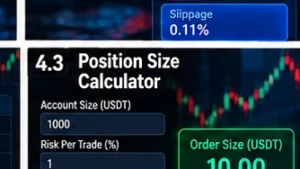
Live slippage monitoring
Track median, 90th/95th percentile and worst observed slippage, not only the average. Segment by pair, side, hour, volatility, order type and notional. Trigger review when the live distribution leaves the stress band used in testing.
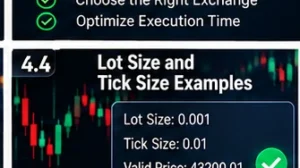
Backtest stress test
Run at least three execution-cost assumptions and include a scenario worse than the recent average. If a small increase in slippage destroys expectancy, the useful conclusion is that the strategy has insufficient execution margin—not that the live venue will cooperate.
Slippage Cost Calculator
crypto trading bot slippage: Pre-Live Checklist
| Check | Pass condition |
|---|---|
| Event identity | Every signal and order can be traced through a stable correlation/client identifier. |
| Exchange truth | Open orders, fills, positions and balances can be queried independently of the bot UI. |
| Restart recovery | A restart with live state rebuilds from venue-confirmed data without duplicating exposure. |
| Failure injection | Timeout, disconnect, rejection and delayed-event tests end in a reconciled state. |
| Paper / micro-live gate | Execution behavior is observed forward before material capital is exposed. |
Use the broader crypto trading bot monitoring and failure modes pages for system-wide controls; this page intentionally stays focused on crypto trading bot slippage to avoid duplicating those pillar topics.
Tools That Fit This Workflow
No platform removes execution risk. The useful comparison is whether the tool exposes enough order history, state and controls for your workflow.
For webhook-based routing, Explore TradersPost
crypto trading bot slippage FAQ
Is slippage the same as a trading fee?
No. A fee is charged by the venue; slippage is the difference between a chosen expected-price benchmark and realized execution.
Do limit orders remove all execution risk?
No. They improve price control but can remain unfilled or partially filled, creating completion and opportunity risk.
Should backtests include slippage?
Yes. Test realistic and stressed execution assumptions rather than assuming every trade fills at the candle price.
Final Verdict
crypto trading bot slippage should be treated as an execution-engineering problem with observable states and explicit recovery rules. Do not infer success from a signal, request or dashboard status. Verify the venue result, preserve the audit trail, test adverse paths and keep new exposure blocked whenever the true state is unknown.
Affiliate & Risk Disclosure
Some links are affiliate links. TradeboticsAI may receive compensation if you sign up through them. Compensation does not change the operational criteria described here. Automated trading can lose money through market movement, fees, slippage, software defects, connectivity failures and exchange-specific behavior. Backtests and simulations do not guarantee live results.