Futures Gap Trading 2026: Gap Up, Gap Down, Fill & Continuation Guide
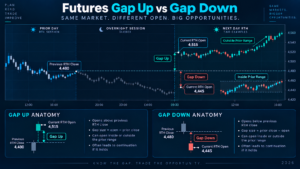
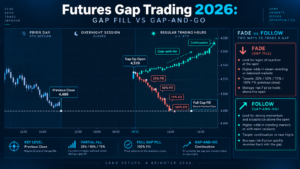
Futures Gap Trading studies the difference between the previous regular-session closing reference and the next regular-session opening price. This requires an important distinction: ES, NQ, MES and MNQ trade electronically for most of the day, so a futures “opening gap” does not normally mean that no trading occurred overnight. Instead, intraday traders commonly compare yesterday’s RTH close with today’s RTH open and then ask whether price will move back toward the prior close, continue away from it or establish a new accepted value region. The gap itself is context. The current auction determines whether fading or following that move makes sense.
Quick Answer
Futures Gap Trading measures the distance between the previous regular-session close and the current RTH open. A gap up occurs when today’s open is above the prior close; a gap down occurs when it is below. A full gap fill occurs when price returns to the previous close. But gaps do not automatically fill. Small gaps opening inside the previous range, large gaps opening outside the entire prior range and news-driven repricing can behave very differently. The strongest framework combines gap size, prior-day range, overnight inventory, PDH/PDL, opening type, Initial Balance and current price acceptance.
Explore NinjaTrader for futures charting, order flow and simulated gap-trading analysis
Affiliate Disclosure: TradeboticsAI may earn compensation when an eligible user completes a qualifying action through an affiliate link, at no additional cost to the user. Affiliate relationships do not determine our editorial conclusions.
What Is Futures Gap Trading?
Futures Gap Trading is a session-based methodology that measures the difference between a prior reference close and the next primary-session opening price.
This matters because index futures such as ES trade for most of the day on CME Globex. CME currently lists E-mini S&P 500 futures as trading Sunday through Friday from 5:00 p.m. to 4:00 p.m. Central Time. Therefore, overnight transactions usually exist between yesterday’s U.S. cash-session close and today’s 9:30 a.m. ET opening.
CME Group E-mini S&P 500 Product Overview
For the TradeboticsAI methodology used here:
- Previous Close: previous U.S. RTH closing reference at 4:00 p.m. ET.
- Current Open: current RTH open at 9:30 a.m. ET.
- Gap: difference between those two prices.
This is a trader-defined RTH gap rather than a claim that the Globex futures market did not trade overnight.
The practical value of Futures Gap Trading is that the prior close represents an important completed-session reference, while the current open reveals where the next primary auction begins after overnight information has been incorporated.
Futures Gap Trading Formula: Gap Up and Gap Down
The basic Futures Gap Trading calculation is simple:
Gap = Current RTH Open − Previous RTH Close
Gap % = Gap ÷ Previous RTH Close × 100
Suppose ES closed the prior RTH session at 6,200.00 and today’s RTH session opens at 6,216.00.
The opening gap is:
6,216.00 − 6,200.00 = +16.00 points.
This is a gap up.
If ES instead opens at 6,184.00:
6,184.00 − 6,200.00 = −16.00 points.
This is a gap down.
A positive gap does not automatically imply bullish continuation, and a negative gap does not automatically imply a rally back toward the previous close.
Futures Gap Trading: RTH Close vs CME Settlement
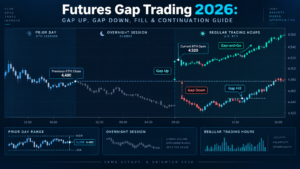
One of the most important technical details in Futures Gap Trading is distinguishing the RTH closing reference from the official CME daily settlement.
They are related concepts but should not automatically be treated as identical prices.
CME explains that equity-index futures have a daily settlement process used for mark-to-market purposes. The exchange calculates daily settlement according to product-specific methodology, while the U.S. equity cash market closes at its own defined time.
CME Group: Understanding Equity Index Daily & Final Settlement
For the gap methodology on this page, TradeboticsAI uses the prior RTH closing reference rather than silently substituting CME settlement.
That means every backtest should record exactly which field created the gap:
- previous RTH last price;
- official settlement;
- cash-index close;
- another explicit reference.
Mixing these definitions can alter the size, direction and even existence of a gap.
Four Useful Futures Gap Trading Types
Futures Gap Trading becomes more useful when gaps are classified by location instead of only by direction.
| Gap Type | Opening Location | Primary Question |
|---|---|---|
| Inside-Range Gap Up | Above prior close but below PDH | Will price rotate toward prior close or break the prior high? |
| Full Gap Up | Above PDH | Will the market accept entirely new higher territory? |
| Inside-Range Gap Down | Below prior close but above PDL | Will the auction return to close or test the prior low? |
| Full Gap Down | Below PDL | Will lower territory be accepted or rejected back into range? |
This distinction adds more information than calling every positive difference a bullish gap.
A 10-point gap up that still opens deep inside the previous range is structurally different from a 10-point gap that opens completely above PDH because yesterday had an unusually narrow range.
How to Measure Futures Gap Trading Size
Absolute points alone are a weak way to compare gaps across different volatility regimes. A 20-point ES gap can be large during one period and routine during another.
TradeboticsAI therefore uses a normalized measure:
Relative Gap Size = |Current RTH Open − Previous RTH Close| ÷ Median Prior-Day Range
Assume:
- Gap size: 18 points
- Median previous-day RTH range over the last 20 comparable sessions: 45 points
The relative gap size is:
18 ÷ 45 = 0.40.
Now assume a 55-point gap against the same 45-point median:
55 ÷ 45 = 1.22.
The second opening represents much more substantial repricing relative to recent daily movement.
This framework improves Futures Gap Trading because it avoids permanent rules such as “all gaps under 20 points should be faded.”
What Is a Futures Gap Fill?
A full gap fill occurs when price returns from the current RTH open to the previous RTH close.
For a gap up:
Full fill = price trades down to the previous RTH close.
For a gap down:
Full fill = price trades up to the previous RTH close.
Traders can also measure partial fills:
- 25% gap fill;
- 50% gap fill;
- 75% gap fill;
- 100% gap fill.
If yesterday closed at 6,200 and today opens at 6,220, the gap is 20 points.
- 25% fill: 6,215
- 50% fill: 6,210
- 75% fill: 6,205
- 100% fill: 6,200
This makes Futures Gap Trading measurable instead of reducing the entire setup to “filled” versus “not filled.”
There is no universal fill percentage that should be assumed across ES, NQ, every year, every volatility regime and every gap definition. Published studies can produce materially different results depending on gap size, session definition and sample period.
Futures Gap Trading: Gap-and-Go Continuation
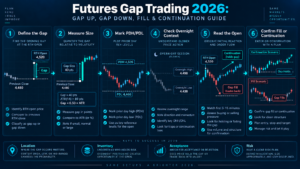
A gap-and-go session occurs when price opens away from the prior close and continues moving in the same direction rather than meaningfully filling the gap.
A bullish continuation setup can show:
- gap up above prior value or PDH;
- early selling fails to reach meaningful partial-fill levels;
- price remains above the RTH open;
- ONH breaks and holds;
- Initial Balance develops above the previous range;
- Volume Profile and POC migrate higher;
- aggressive buying produces real price progress.
A bearish gap-and-go uses the inverse structure.
In Futures Gap Trading, the absence of a gap fill is itself information. If participants repeatedly attempt to fade a gap but cannot move price toward the prior close, the new higher or lower pricing may be accepted.
This is why blindly fading all opening gaps can be dangerous.
Failed Futures Gaps and Opening Rejection
A gap can also fail almost immediately.
Suppose ES gaps 25 points above yesterday’s close and opens just above PDH. Buyers initially attempt to continue the overnight move, but price cannot hold above the prior range.
The sequence might become:
gap up → failed PDH acceptance → return inside prior range → loss of RTH open → partial gap fill → full gap fill.
This is a fundamentally different auction from a gap that opens above PDH and builds value there.
A failed gap down follows the opposite sequence.
The strongest Futures Gap Trading setups often come from recognizing early whether the market is rejecting or accepting the repricing—not from predicting the gap fill before the session begins.
Futures Gap Trading With PDH and PDL
The newly completed Futures Previous Day High and Low 2026 page provides one of the most important context layers.
Consider four opening conditions:
- Gap up inside previous range: today’s open is above prior close but below PDH.
- Gap up above PDH: today’s RTH session starts entirely outside yesterday’s upper boundary.
- Gap down inside previous range: open is below prior close but remains above PDL.
- Gap down below PDL: current RTH begins below the complete previous range.
The second and fourth cases involve a larger structural displacement even when the absolute gap size is similar.
This relationship is central to Futures Gap Trading because PDH and PDL distinguish an ordinary close-to-open difference from an opening that has moved beyond the entire prior auction.
Futures Gap Trading With Overnight Inventory and ONH/ONL
The gap is created by overnight price discovery, so overnight context should not be ignored.
Use Futures Overnight Inventory 2026 to determine whether the Globex session was strongly long, strongly short or relatively balanced.
Use Futures Overnight High and Low 2026 to mark ONH and ONL.
A gap up after strongly long overnight inventory can produce two opposite outcomes:
- Correction: RTH rejects the higher pricing and moves toward the prior close.
- Acceptance: RTH holds above overnight value and continues beyond ONH.
A gap down after strongly short inventory uses the inverse logic.
Futures Gap Trading should never assume overnight traders must be wrong simply because positioning looks one-sided.
Futures Gap Trading With Opening Types
Futures Opening Types 2026 helps determine what the regular session is doing with the gap.
| Opening Type | Gap Interpretation |
|---|---|
| Open Drive With Gap | Strong potential acceptance if direction aligns with gap |
| Open Test Drive Toward Prior Close | Partial correction can fail before continuation |
| Open Rejection Reverse | Initial continuation fails and gap-fill probability may increase |
| Open Auction | Directional information remains weak; wait for more structure |
The gap defines location. The opening type describes the first RTH auction response.
Futures Gap Trading With Initial Balance
The Initial Balance can reveal whether early gap behavior develops into a broader session structure.
Suppose ES gaps above PDH.
If Initial Balance remains entirely above yesterday’s range and later extends higher, the market is providing stronger evidence of successful repricing.
If price gaps above PDH but Initial Balance develops back inside yesterday’s range, the initial displacement has been challenged.
Futures Initial Balance Trading 2026 provides the complete IB High, IB Low, relative-width and range-extension framework.
For Futures Gap Trading, Initial Balance helps distinguish a five-minute opening reaction from a market that is genuinely developing a new value region.
Order Flow Confirmation for Futures Gap Trading
Order flow should be used at decision points rather than as a reason to overcomplicate every gap.
Footprint Charts
A bullish gap that opens above PDH but shows large aggressive buying with almost no upward progress may be meeting significant passive selling.
Volume Delta
Futures Volume Delta 2026 measures aggressive buy/sell imbalance. Positive delta supports continuation only when price is also progressing and holding higher territory.
Absorption
Futures Absorption Trading 2026 becomes relevant when aggressive participants attempt to extend a gap but repeatedly fail.
Cumulative Delta
CVD can show whether broader aggressive flow supports a gap-and-go move or diverges from it.
Time & Sales
Futures Time and Sales 2026 can help identify accelerating transactions during continuation or fading participation near a rejection point.
Explore NinjaTrader Order Flow+ and practice gap-fill versus continuation setups in simulation
TradeboticsAI Futures Gap Trading State Model
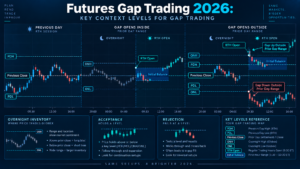
TradeboticsAI uses six layers to keep Futures Gap Trading conditional rather than turning every open into a blind fade.
| Layer | Question | Evidence |
|---|---|---|
| 1. Gap Definition | Which close/open created the gap? | Consistent RTH reference and timezone |
| 2. Relative Size | Is the gap small or large relative to current volatility? | Gap ÷ median prior-day range |
| 3. Range Location | Inside or outside PDH/PDL? | Prior range and prior value |
| 4. Overnight Context | How did Globex reach the opening price? | ONH, ONL, inventory, VWAP, overnight value |
| 5. RTH Response | Fill, rejection or continuation? | Opening type, partial fills and price progress |
| 6. Acceptance | Where is the market building business? | Initial Balance, POC, value and retests |
The model produces four practical states:
- Gap + rapid fill: overnight repricing is being corrected.
- Gap + partial fill + rejection: correction attempts fail before reaching the prior close.
- Gap + no fill + acceptance: new prices are gaining acceptance.
- Gap + failed continuation + reclaim: potential full-gap correction or reversal.
This framework makes Futures Gap Trading testable and prevents one historical statistic from becoming a universal rule.
Practical Futures Gap Trading Examples: ES
Example 1: Inside-Range Gap Up and Fill
Assume:
- Previous RTH close: 6,200
- PDH: 6,225
- PDL: 6,170
- Today’s RTH open: 6,212
ES gaps up 12 points but still opens inside the previous range.
Buyers cannot reach PDH, the opening price fails and ES begins rotating lower. Price trades through the 50% gap level at 6,206 and later reaches the prior close at 6,200.
The gap is fully filled.
Example 2: Full Gap Up and Continuation
Previous close is 6,200 and PDH is 6,225. Overnight news drives ES higher, and RTH opens at 6,240.
This is not simply a 40-point gap. It is an open completely above the prior-day range.
Early sellers attempt to push price toward PDH but cannot regain 6,235. Buyers break ONH, Initial Balance remains above PDH and value begins developing higher.
This is a gap-and-go continuation environment. Blindly shorting toward the prior close would ignore clear acceptance.
Example 3: Full Gap Up That Fails
Use the same 6,240 opening price. This time ES immediately fails above ONH and drops through PDH at 6,225.
The market is now back inside yesterday’s range. Positive delta above PDH failed to produce progress, and an attempted reclaim of 6,225 is rejected.
The probability of deeper gap correction may now be materially different from the opening condition because the auction itself has changed.
Example 4: Gap Down With Partial Fill Only
Previous close is 6,200 and RTH opens at 6,175. ES rallies to the 50% fill near 6,187.50 but fails there.
Sellers regain control, ONL breaks and the market continues lower.
The gap did not remain completely untouched, but it also did not fully fill. Recording only “not filled” would lose useful information.
Practical Futures Gap Trading Workflow
- Use one gap definition. For this framework, compare prior RTH close with current RTH open.
- Mark the previous close. This is the 100% gap-fill level.
- Calculate gap direction and size.
- Normalize the gap. Compare it with recent prior-day ranges.
- Mark PDH, PDL, VAH, VAL and POC.
- Mark ONH, ONL, overnight VWAP and inventory direction.
- Classify whether the open is inside or outside yesterday’s range.
- Mark 25%, 50% and 75% fill levels when useful.
- Observe the RTH opening type.
- Do not pre-commit to fill or continuation.
- Use Initial Balance to test whether acceptance develops.
- Use order flow around decision points, not everywhere.
- Define invalidation before entering.
- Journal gap size, location, fill percentage and final session structure.
A proper journal can eventually show whether your own Futures Gap Trading results vary by gap size, opening location, PDH/PDL relationship, overnight inventory, day of week, volatility regime or opening type.
Common Futures Gap Trading Mistakes
1. Saying Futures Do Not Trade Overnight
ES and other CME equity-index futures trade for most of the day. The RTH gap is a session-reference concept.
2. Assuming Every Gap Must Fill
No universal rule guarantees a same-day or eventual fill. Large repricing events can continue much farther.
3. Assuming Every Large Gap Continues
A market can open far outside the previous range and immediately reject the move.
4. Ignoring PDH and PDL
An opening gap inside yesterday’s range is structurally different from one outside the entire range.
5. Confusing RTH Close With Official Settlement
Define the reference explicitly. They are not automatically interchangeable.
6. Using Fixed Point Thresholds Forever
Volatility changes. Normalize gap size against current market conditions.
7. Ignoring Partial Gap Fills
A 75% correction followed by rejection contains more information than a binary “not filled” label.
8. Ignoring Overnight Inventory
The overnight auction explains how the market reached the new opening price.
9. Fighting Acceptance
If value is clearly building beyond PDH or PDL, continuing to fade the gap can become structurally weak.
10. Using Unverified Fill Statistics as Guarantees
Gap statistics depend on instrument, sample period, session definition, gap-size filter and time horizon.
Pros and Limitations of Futures Gap Trading
Pros
- Gap direction and size are objective.
- All key levels are known at the RTH open.
- Works naturally with PDH, PDL and overnight structure.
- Supports both mean-reversion and continuation frameworks.
- Partial fills can be measured precisely.
- Easy to convert into historical research variables.
Limitations
- No universal gap-fill probability exists.
- Definitions differ across traders and studies.
- Large macro gaps can continue aggressively.
- Opening volatility can create significant slippage.
- Order-flow confirmation remains probabilistic.
- RTH-close and settlement confusion can corrupt testing.
Best For
Futures Gap Trading is best suited to intraday ES, MES, NQ and MNQ traders who define RTH consistently and combine opening-price context with prior-day and overnight structure.
Not Ideal For
It is less useful for traders seeking a mechanical “gap up = short” or “gap down = long” rule without considering size, location, acceptance and risk.
Futures Gap Trading FAQ
What is Futures Gap Trading?
Futures Gap Trading studies the difference between the previous RTH closing reference and the current RTH opening price and then evaluates whether the gap fills, partially fills or continues.
What is a gap up in futures?
A gap up occurs when today’s RTH open is above the previous RTH close.
What is a gap down?
A gap down occurs when today’s RTH open is below the previous RTH close.
Do futures actually gap overnight?
Index futures trade electronically for most of the day, so the common intraday gap is usually an RTH-to-RTH reference rather than an absence of overnight futures transactions.
What is a full gap fill?
A full fill occurs when current RTH price trades back to the previous RTH close.
What is a half-gap level?
It is the midpoint between today’s RTH open and yesterday’s RTH close, representing a 50% correction of the opening gap.
Do futures gaps always fill?
No. Some gaps fill quickly, some partially fill, some remain open for the session and some begin sustained repricing.
Are small gaps more important than large gaps?
Not necessarily. Gap size should be normalized against current volatility and analyzed with opening location.
What is a full gap above PDH?
It means today’s RTH open is not only above the previous close but also above the previous session’s high.
What is gap-and-go?
Gap-and-go describes an opening gap that receives acceptance and continues moving in the same direction rather than reverting toward the previous close.
Can an opening gap reverse?
Yes. A gap can fail immediately if the new price region is rejected and the market returns toward the prior range or previous close.
How does overnight inventory affect Futures Gap Trading?
Overnight inventory provides context for whether the move into the RTH open is one-sided and whether day-session participants accept or correct that positioning.
Can PDH and PDL improve gap analysis?
Yes. They determine whether the RTH open remains inside the previous range or represents a complete range displacement.
Can Initial Balance confirm a gap?
Initial Balance can show whether new prices remain accepted after the opening reaction or whether the gap is being repaired.
Can Volume Delta predict a gap fill?
No. Volume Delta can show aggressive participation, but price response determines whether that aggression succeeds.
Is CME settlement the same as the previous RTH close?
Not necessarily. CME uses specific daily settlement methodology, while an RTH gap strategy can use a separate regular-session closing reference. Define the methodology explicitly.
Does Futures Gap Trading work on NQ and MNQ?
The same framework can be applied, but NQ/MNQ volatility and gap behavior should be tested separately rather than assuming ES statistics transfer directly.
Final Verdict: How to Use Futures Gap Trading Correctly
Futures Gap Trading is useful because it converts the RTH open into an objective measurement relative to the previous session rather than treating every opening move as random.
The gap itself does not tell you whether to fade or follow.
The stronger process is:
previous RTH close → gap size → prior range location → overnight structure → RTH opening type → partial fill or continuation → Initial Balance → acceptance/rejection → risk.
A small gap inside yesterday’s range can behave very differently from a large gap above PDH. A heavily one-sided overnight session can correct or continue. A 50% gap fill can reject before the previous close is reached. A full gap can remain open when the market is genuinely repricing.
Use Futures Gap Trading alongside Previous Day High and Low, Overnight High and Low, Overnight Inventory, Opening Types, Initial Balance Trading, Volume Delta and Order Flow Trading.
The objective is not to assume gaps always fill or always continue. It is to measure the displacement objectively, determine where the open sits relative to the previous auction and let the current market prove whether the overnight repricing is being accepted or corrected.
Explore NinjaTrader for futures charting, gap analysis, order flow and simulated trading
Affiliate Disclosure: TradeboticsAI may receive compensation when eligible users complete a qualifying action through certain affiliate links. Affiliate relationships do not determine our editorial conclusions.
Risk Disclosure: Futures trading involves substantial risk of loss and is not suitable for every investor. Opening gaps, gap-fill levels, previous-day references, overnight inventory, Volume Delta, footprint patterns and historical gap statistics do not predict future returns. Gaps can continue instead of filling, macroeconomic events can cause rapid repricing and slippage, and simulated results do not guarantee future live performance. Nothing on this page is personalized investment, financial, tax or trading advice.