Futures Overnight Inventory 2026: Long, Short, Correction & RTH Open Guide
Futures Overnight Inventory is a Market Profile and Auction Market Theory concept used to describe where the overnight futures session built activity relative to the prior regular-session settlement or close. If overnight trade develops predominantly above that reference, practitioners often describe inventory as long; if it develops predominantly below, inventory is described as short. The concept does not mean the entire futures market is literally net long or net short—every futures contract has both a buyer and a seller. Instead, Futures Overnight Inventory is a positioning heuristic that helps frame whether overnight participants may be vulnerable to an early correction or whether the regular session is accepting the overnight move.
Quick Answer
Futures Overnight Inventory compares the overnight Globex auction with the prior regular-session reference, commonly the settlement or RTH close. Inventory is considered long when overnight activity is concentrated above the reference, short when concentrated below it and balanced when activity is distributed on both sides. A correction back toward the reference is possible, but it is not guaranteed. The stronger question at the RTH open is whether day-session participants reject the overnight positioning or accept it and continue the move.
Explore NinjaTrader for futures charting, order-flow tools and overnight-session replay
Affiliate Disclosure: TradeboticsAI may earn compensation when an eligible user completes a qualifying action through an affiliate link, at no additional cost to the user. Affiliate relationships do not determine our editorial conclusions.

What Is Futures Overnight Inventory?
Futures Overnight Inventory is a practitioner framework used in Market Profile to describe the location of overnight futures activity relative to a prior-session reference. For U.S. equity-index futures such as ES, NQ, MES and MNQ, the overnight session is part of the broader CME Globex trading day, while many intraday traders separately analyze the U.S. regular trading hours session.
The concept is often misunderstood. Futures markets cannot be literally “net long” or “net short” in aggregate because every open contract has a long and a short side. The phrase inventory long means that overnight activity accumulated predominantly above the chosen prior-session reference, leaving participants who bought higher prices more exposed if the RTH auction rejects those prices.
Likewise, inventory short means overnight activity developed predominantly below the reference. If the regular session rejects lower prices and rallies, those overnight sellers can become vulnerable to covering.
This makes Futures Overnight Inventory a contextual positioning estimate rather than an exchange-published statistic.
Futures Overnight Inventory, Globex and the RTH Open
CME equity-index futures trade for most of the day on Globex, with a daily maintenance break. CME currently lists Micro E-mini equity-index futures as trading Sunday through Friday from 6:00 p.m. to 5:00 p.m. Eastern Time, subject to the exchange’s scheduled halt and maintenance periods.
Official reference:
CME Group Micro E-mini Equity Index Futures FAQ.
Market Profile traders commonly split this nearly 24-hour auction into an overnight/Globex segment and a U.S. regular-session segment because the participant mix, liquidity and information flow can differ meaningfully around the cash-market open.
The exact split must be defined before testing Futures Overnight Inventory. For ES and NQ, many U.S. workflows treat the period before the 9:30 a.m. ET cash open as overnight context and then analyze RTH separately. The important requirement is consistency: do not change the overnight start, end or settlement reference from one test to another.
How to Measure Futures Overnight Inventory
There is no CME rule defining one mandatory formula for Futures Overnight Inventory. Different Market Profile practitioners use different proxies, including time above or below settlement, volume above or below settlement, the overnight close relative to settlement or the overnight VWAP relative to prior value.
TradeboticsAI uses a transparent two-layer method:
- Primary location: compare the overnight range, volume and developing value with the prior RTH settlement or close.
- Confirmation: compare overnight VWAP, overnight POC and the overnight close with that same reference.
A simple volume-based research metric is:
Overnight Long Share = Volume traded above prior RTH reference ÷ Total overnight volume
Overnight Short Share = Volume traded below prior RTH reference ÷ Total overnight volume
This is a TradeboticsAI measurement framework, not an exchange standard. It has one advantage: it can be reproduced in a backtest without relying on subjective chart reading.
If 78% of overnight ES volume trades above the prior RTH settlement, the session is strongly long by this metric. If 54% trades above and 46% below, the inventory is much closer to balanced.
Do not mix a volume-based definition on one day with a time-based definition on another. The definition is part of the strategy.
Long, Short and Balanced Futures Overnight Inventory
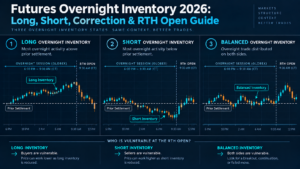
| Inventory State | Overnight Location | Main RTH Question |
|---|---|---|
| Long | Most activity above prior reference | Will RTH accept higher prices or correct lower? |
| Short | Most activity below prior reference | Will RTH accept lower prices or correct higher? |
| Balanced / Mixed | Meaningful activity on both sides | Which side gains control after the open? |
Long Futures Overnight Inventory is not automatically bearish. It becomes bearish only if the regular session rejects the higher prices and begins correcting the overnight positioning.
Short inventory is not automatically bullish. If the RTH auction accepts beneath prior value and continues lower, the overnight sellers were positioned with the developing auction rather than against it.
Balanced overnight structure usually provides less inventory-based directional information and increases the importance of opening type, prior value and Initial Balance.
What Does “100% Long” or “100% Short” Overnight Inventory Mean?
In Market Profile language, “100% long” generally means the entire relevant overnight auction occurred above the chosen prior-session reference. “100% short” means the entire overnight auction occurred below it.
Again, this does not mean every trader is long or short. It is a location statement.
A 100% long overnight session can create a clean pre-market question: if RTH buyers continue accepting above the reference, the overnight move may represent genuine repricing. If RTH immediately sells back toward the prior close or value, the overnight positioning may be correcting.
The same logic applies in reverse to 100% short Futures Overnight Inventory.
TradeboticsAI deliberately avoids universal claims such as “100% inventory corrects 70% of the time.” Such statistics vary by definition, sample period, instrument, session rules and what counts as a correction. Use your own documented dataset before attaching a probability to the setup.
What Is a Futures Overnight Inventory Correction?
An inventory correction is a counter-auction against the direction of the overnight positioning.
If Futures Overnight Inventory is long, correction means price moves lower after the RTH open. If inventory is short, correction means price moves higher.
The correction can be shallow or deep. Possible references include:
- overnight VWAP;
- overnight midpoint;
- overnight POC;
- prior RTH settlement or close;
- prior VAH or VAL;
- prior POC;
- the opposite edge of the overnight range.
The market does not need to reach the prior settlement for a correction to exist. The useful measurement is how much of the overnight directional auction is retraced and whether the counter-auction develops acceptance.
For research, TradeboticsAI recommends defining correction before backtesting. Example: “A long inventory correction occurs when ES trades at least 25% of the overnight range below the RTH open within the first 60 minutes.” This removes hindsight from the analysis.

Futures Overnight Inventory Correction vs Acceptance
Long Inventory + Correction
Overnight activity builds above prior settlement. RTH opens, buyers fail to create further upside progress and price rotates lower through overnight VWAP. The overnight long positioning is being challenged.
Long Inventory + No Correction
Overnight activity builds above prior settlement, RTH opens and selling attempts fail. Price holds above overnight VWAP and begins extending higher. The lack of correction can be evidence that the market is accepting the higher auction.
Short Inventory + Correction
Overnight activity builds below settlement. RTH buyers reclaim overnight VWAP and price auctions higher toward prior value.
Short Inventory + No Correction
RTH attempts to rally but fails below prior value, while sellers continue to make progress. The overnight downside auction remains accepted.
This “correction versus no correction” framework prevents Futures Overnight Inventory from becoming a mechanical fade strategy.
Futures Overnight Inventory, Gaps and Prior Value
Inventory becomes more useful when combined with where the RTH session opens relative to prior value.
| Condition | Interpretation Question |
|---|---|
| Long inventory + open above prior VAH | Will RTH accept the overnight repricing or reject back toward value? |
| Long inventory + open back inside value | Has the overnight upside auction already failed? |
| Short inventory + open below prior VAL | Will lower prices be accepted or corrected? |
| Short inventory + open back inside value | Are overnight shorts vulnerable to a larger correction? |
A gap outside prior value does not automatically continue. Opening back inside prior value does not automatically fill the entire overnight move. The new auction must confirm the hypothesis.
Use Futures Volume Profile 2026 and Futures Auction Market Theory 2026 for the acceptance framework.
Futures Overnight Inventory and Opening Types
Futures Opening Types 2026 provides a natural second layer for Futures Overnight Inventory.
A long overnight inventory followed by a bearish Open Drive creates very different information from long inventory followed by a bullish Open Drive that never trades back through the opening price.
Useful combinations include:
- Long inventory + bearish Open Drive: inventory correction may be beginning.
- Long inventory + bullish Open Drive: higher prices are being accepted; do not force a fade.
- Short inventory + bullish Open Test Drive: downside positioning may be correcting after a failed lower test.
- Short inventory + bearish Open Drive: overnight selling remains aligned with RTH price discovery.
- Balanced inventory + Open Auction: inventory provides little edge; let Initial Balance develop.
The opening type should remain provisional. One large first-minute candle is not enough to override the broader structure.
Futures Overnight Inventory and Initial Balance
The Initial Balance helps determine whether the opening inventory story survives beyond the first few minutes.
Consider long Futures Overnight Inventory. If RTH initially sells off but the completed Initial Balance remains entirely above prior value and later extends upward, the correction was shallow and the larger auction may still be bullish.
If the Initial Balance pushes back through prior VAH, develops value inside the previous range and later extends lower, the overnight long positioning has been more meaningfully rejected.
Use Futures Initial Balance Trading 2026 to evaluate IB High, IB Low, relative width and range extensions.
The sequence becomes:
overnight positioning → RTH open → Initial Balance → acceptance/rejection → range extension.
Order Flow Confirmation for Futures Overnight Inventory
Order flow is most useful when the RTH auction reaches a decision point around overnight VWAP, overnight high/low, prior value or the opening price.
Footprint Charts
A long inventory correction is stronger when aggressive selling produces real downside progress. If negative delta appears but price refuses to fall, sellers may be absorbed.
Volume Delta
Futures Volume Delta 2026 helps separate aggressive effort from outcome. Positive delta during long inventory is continuation evidence only when buyers actually move and hold price higher.
Cumulative Delta
Futures Cumulative Delta 2026 can show whether the broader RTH flow confirms the overnight auction or diverges from it.
Trapped Traders
If RTH opens back through a heavily one-sided overnight auction, Futures Trapped Traders 2026 can help frame vulnerable overnight participants without claiming to know individual positions.
Time & Sales
Tape can show whether the correction is accelerating or whether opposing transactions are failing to move price.
Explore NinjaTrader Order Flow+ and practice overnight-to-RTH scenarios in simulation
TradeboticsAI Futures Overnight Inventory Framework
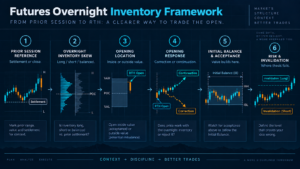
TradeboticsAI uses six layers to evaluate Futures Overnight Inventory without turning the concept into a blind countertrend strategy.
| Layer | Question | Evidence |
|---|---|---|
| 1. Reference | Which prior-session price defines inventory? | Settlement or documented RTH close |
| 2. Inventory Skew | How one-sided was the overnight auction? | Volume/time above vs below reference, ON VWAP and POC |
| 3. Opening Location | Where does RTH open? | Inside value, outside value or outside prior range |
| 4. Opening Response | Correction or continuation? | Open type, VWAP reclaim/failure and price progress |
| 5. Acceptance | Where does value begin to build? | Initial Balance, POC, VAH/VAL and volume distribution |
| 6. Risk | What invalidates the thesis? | Failed correction, failed continuation or opposite acceptance |
The framework creates four practical states:
- Long inventory + correction accepted: downside rebalancing is active.
- Long inventory + correction fails: higher-price acceptance may be stronger than expected.
- Short inventory + correction accepted: upside rebalancing is active.
- Short inventory + correction fails: lower-price acceptance remains intact.
This keeps Futures Overnight Inventory conditional and testable.
Practical Futures Overnight Inventory Examples: ES
Example 1: Long Inventory Corrects
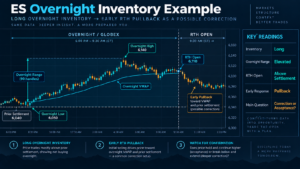
Assume prior ES RTH settlement is 6,500.00. Overnight trading occurs mostly between 6,506.00 and 6,520.00, with 86% of measured overnight volume above the settlement reference. Overnight VWAP is 6,513.25 and the overnight high is 6,521.00.
RTH opens at 6,516.00. Buyers briefly trade 6,518.00 but fail to extend. Price then loses the opening price, breaks overnight VWAP and sells toward 6,507.00.
This is a coherent long Futures Overnight Inventory correction. The trade thesis comes from the failed RTH acceptance, not from the overnight skew by itself.
Example 2: Long Inventory Does Not Correct
Use the same overnight structure, but RTH opens at 6,516.00 and every early sell attempt holds above 6,514.00. ES breaks the overnight high, footprint buying produces progress and Initial Balance develops entirely above prior value.
There is no meaningful correction. Forcing a short because inventory was long would be fighting accepted higher prices.
Example 3: Short Inventory Corrects
Prior settlement is 6,500.00. Overnight volume develops predominantly below the reference with overnight VWAP at 6,489.00. RTH opens at 6,486.00, briefly tests 6,483.00, then reclaims the open and overnight VWAP.
If value begins developing higher, the overnight short positioning is correcting and the auction may rotate toward prior value.
Example 4: Short Inventory Continues
RTH opens below prior VAL, rallies toward overnight VWAP and is rejected. Negative delta expands with real downside price progress. Initial Balance extends lower and value migrates down.
The short inventory was not a fade signal. It was aligned with a continuing downside auction.
Practical Futures Overnight Inventory Trading Workflow
- Define the prior-session reference. Use one documented settlement or RTH close methodology.
- Define the overnight session. Keep start/end times and timezone consistent.
- Measure inventory skew. Use volume, time, VWAP and POC rather than a vague visual guess.
- Mark overnight high, low, midpoint, VWAP and POC.
- Mark prior VAH, VAL, POC, high and low.
- Classify the RTH opening location. Inside value, outside value or outside the prior range.
- Observe the opening response. Do not assume correction before it begins.
- Use order flow only at decision points. Compare aggressive flow with actual price progress.
- Let Initial Balance update the thesis. A correction that fails can become continuation.
- Define invalidation before entry. Inventory context never replaces position sizing or maximum loss rules.
The Futures Position Size Calculator and Futures Risk Reward Calculator can help convert the setup into account-level risk parameters.
Common Futures Overnight Inventory Mistakes
1. Treating Inventory as Literal Net Positioning
Futures are two-sided contracts. Futures Overnight Inventory is a Market Profile positioning heuristic based on where overnight activity developed.
2. Automatically Fading Long Inventory
Long inventory can continue higher if RTH accepts the overnight move. Wait for actual correction evidence.
3. Automatically Buying Short Inventory
Short inventory can continue lower. The market must reject the lower auction before a correction thesis strengthens.
4. Using an Undefined Reference
Settlement, cash close and futures session close are not always identical concepts. Document the price used in your research.
5. Changing the Overnight Session Window
Different windows produce different inventory measurements. Standardization is mandatory for testing.
6. Using Unsupported “70%” or “75%” Correction Claims
Published practitioner claims can use different definitions and samples. Test your own instrument, period and correction rule.
7. Ignoring Prior Value
Long inventory opening back inside prior value is structurally different from long inventory holding above prior range.
8. Ignoring the Lack of Correction
No correction can itself be information. It can show that the regular session is accepting the overnight move.
9. Ignoring News and Macro Events
Overnight repricing can reflect material information. A major catalyst can make a simple inventory-fade thesis inappropriate.
10. Confusing Context With Entry Timing
Inventory describes pre-market structure. Entry timing still requires a separate execution rule and defined risk.
Pros and Limitations of Futures Overnight Inventory
Pros
- Connects overnight Globex activity with the RTH open.
- Provides a structured pre-market context.
- Works naturally with Market Profile and prior value.
- Can identify vulnerable one-sided overnight positioning.
- The absence of correction can strengthen continuation context.
- Can be converted into a transparent backtest variable.
Limitations
- No universal formula defines overnight inventory.
- It is not literal aggregate net positioning.
- Correction is never guaranteed.
- Results depend on session and reference definitions.
- Macro news can overwhelm historical tendencies.
- Order-flow confirmation can still fail.
Best For
Futures Overnight Inventory is most useful for intraday ES, NQ, MES, MNQ and other futures traders who separate overnight and regular-session auctions and already use Market Profile, Volume Profile or Auction Market Theory.
Not Ideal For
It is less useful for traders seeking an automatic countertrend signal, anyone using inconsistent session definitions, or strategies that do not distinguish overnight context from the main trading session.
Futures Overnight Inventory FAQ
What is Futures Overnight Inventory?
Futures Overnight Inventory is a Market Profile heuristic describing whether overnight futures activity accumulated predominantly above or below a prior regular-session reference such as settlement or close.
What does overnight inventory long mean?
It means overnight activity was concentrated above the selected prior-session reference. It does not mean the entire futures market is literally net long.
What does overnight inventory short mean?
It means overnight activity was concentrated below the selected prior-session reference.
What is balanced overnight inventory?
Balanced inventory means meaningful overnight activity developed on both sides of the reference, reducing the usefulness of a one-sided inventory thesis.
What does 100% long overnight inventory mean?
It generally means the entire chosen overnight auction occurred above the prior reference. It is a location description, not proof that every participant holds a long position.
Does long overnight inventory always correct lower?
No. If RTH accepts above prior value and buyers continue to produce progress, the overnight move can continue.
Does short overnight inventory always rally?
No. Short inventory can remain aligned with a bearish auction if RTH continues accepting lower prices.
How do you measure Futures Overnight Inventory?
Methods vary. Traders may use time or volume above/below settlement, overnight VWAP, overnight POC or the overnight close relative to prior value. Use one explicit definition in research.
What is an overnight inventory correction?
It is a counter-auction against the direction of the overnight skew: lower when inventory is long and higher when inventory is short.
Does correction have to reach settlement?
No. A correction can be defined by a partial retracement of the overnight range, a VWAP move or another objective threshold. Define the rule before testing.
How does overnight inventory interact with prior value?
Opening above VAH, below VAL or back inside prior value changes whether the overnight auction appears accepted or rejected.
Can Opening Types confirm Futures Overnight Inventory?
Yes. A bearish Open Drive after long inventory can support correction, while a bullish Open Drive can show continued acceptance of the overnight move.
Can Initial Balance confirm overnight inventory?
Initial Balance can show whether early correction or continuation persists long enough to create broader session structure.
Can Volume Delta confirm an inventory correction?
Volume Delta can show aggressive participation, but the critical question is whether that aggression produces price progress.
Is Futures Overnight Inventory an exchange statistic?
No. It is a Market Profile / Auction Market Theory framework created from market data rather than an official CME “inventory” field.
Can overnight inventory predict the entire day?
No. Futures Overnight Inventory provides opening context. Day-session information, Initial Balance, news and value development can completely change the auction.
Final Verdict: How to Use Futures Overnight Inventory Correctly
Futures Overnight Inventory is valuable because it gives the trader a structured question before the regular session begins: did the overnight auction build one-sided activity, and will the day session accept or correct it?
The concept should never be reduced to “long inventory = short at the open” or “short inventory = buy at the open.” The more robust framework is conditional:
prior reference → overnight skew → opening location → correction or continuation → Initial Balance → acceptance → risk.
Long inventory that cannot attract further buyers may correct. Long inventory that remains above value and survives early selling may continue. Short inventory that is rejected can produce covering and upside correction. Short inventory accepted beneath prior value can remain aligned with a larger downside auction.
Use Futures Overnight Inventory alongside Futures Opening Types, Initial Balance Trading, Market Profile Day Types, Auction Market Theory, Volume Delta and Order Flow Trading.
The objective is not to predict a correction because overnight traders are presumed wrong. It is to measure the overnight auction objectively and let the regular session reveal whether those prices are accepted or rejected.
Explore NinjaTrader for futures charting, order flow and overnight-session simulation
Affiliate Disclosure: TradeboticsAI may receive compensation when eligible users complete a qualifying action through certain affiliate links. Affiliate relationships do not determine our editorial conclusions.
Risk Disclosure: Futures trading involves substantial risk of loss and is not suitable for every investor. Overnight inventory, Market Profile, Volume Profile, Initial Balance, Volume Delta and historical auction behavior do not predict future returns. Overnight inventory correction is not guaranteed, news can rapidly change market structure, and simulated results do not guarantee future live performance. Nothing on this page is personalized investment, financial, tax or trading advice.