Futures Market Liquidity 2026: Spread, Depth, Slippage & Market Impact Guide
Futures Market Liquidity determines how efficiently traders can enter or exit a futures position without causing an excessive price move. A liquid contract generally combines tight bid-ask spreads, sufficient order-book depth, strong trading activity, reliable replenishment and manageable market impact. But liquidity is not one number. Volume can be high while displayed depth temporarily falls, and a one-tick spread can still hide poor execution for a large order. This guide explains how to evaluate liquidity using spread, depth, volume, open interest, slippage, fill quality and actual execution conditions.
Quick Answer
Futures Market Liquidity describes how easily a futures contract can be traded at or near the expected price. The strongest evaluation combines several metrics: bid-ask spread, order-book depth, trading volume, open interest, cost to trade, slippage and market impact. Tight spreads and deep books are generally positive, but CME research shows that depth alone can give an incomplete picture during volatile periods. Traders should evaluate the size of their own order relative to available liquidity and confirm actual fill quality rather than relying on a single DOM snapshot.
Explore NinjaTrader for futures DOM, charting, simulation and execution tools
Affiliate Disclosure: TradeboticsAI may earn compensation when an eligible user completes a qualifying action through an affiliate link, at no additional cost to the user. Affiliate relationships do not determine our editorial conclusions.
What Is Futures Market Liquidity?
Futures Market Liquidity describes the ability to buy or sell futures contracts quickly and efficiently without creating an excessive change in market price. CME Group educational material commonly evaluates futures liquidity using trading volume, open interest, bid-offer spread and order-book depth.
The concept is practical rather than theoretical. If two markets move identically but one lets a trader enter and exit with a one-tick spread and limited slippage while the other requires crossing several price levels, the first market provides better execution conditions for that trade size.
ICE similarly defines liquidity in terms of how easily a futures contract can be bought or sold and the costs associated with the transaction. The common theme is that Futures Market Liquidity combines availability of counterparties with execution cost.
Official CME reference:
CME Group: How Traders Measure Liquidity.
6 Core Metrics for Measuring Futures Market Liquidity
No single metric completely describes Futures Market Liquidity. A robust analysis should combine at least the following six dimensions.
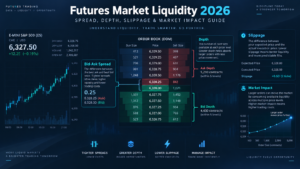
| Metric | What It Measures | Generally Better | Main Limitation |
|---|---|---|---|
| Bid-Ask Spread | Gap between best bid and ask | Tighter | Does not show available size |
| Book Depth | Resting quantity across price levels | Deeper | Orders can be canceled |
| Volume | Contracts actually traded | Higher | Historical activity does not guarantee current depth |
| Open Interest | Outstanding open contracts | Higher participation can help | Not a direct intraday execution measure |
| Slippage | Difference between expected and realized execution | Lower | Depends on order type and volatility |
| Market Impact | How much an order moves available prices | Lower | Strongly dependent on order size |
CME’s Liquidity Tool itself focuses on three central measures: bid-ask spread, book depth and cost to trade. That combination is more useful than declaring one contract liquid solely because it reports high volume.
Official tool:
CME Liquidity Tool.
Futures Market Liquidity and the Bid-Ask Spread
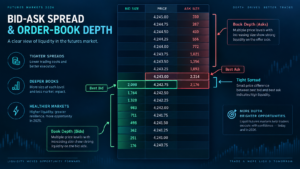
The bid-ask spread is one of the fastest ways to inspect Futures Market Liquidity. It is the difference between the highest currently quoted bid and the lowest currently quoted ask.
If ES shows:
- Best bid: 6,500.00
- Best ask: 6,500.25
the spread is one ES tick, or 0.25 index points.
A trader using a market buy order typically crosses to the ask. If the position were immediately sold at the unchanged bid, the trader would effectively surrender the spread before commissions and other costs.
Tight spreads generally indicate strong competition among liquidity providers. Wider spreads often increase immediate execution cost and can appear during quieter sessions, volatile announcements, contract rollover or thinly traded products.
But spread alone is not enough. A one-tick market containing only two contracts at the best prices can be less usable for a 50-contract trade than a slightly wider market with substantial depth.
That is why Futures Market Liquidity analysis must connect spread with available quantity.
Book Depth and Futures Market Liquidity
Book depth describes the quantity of resting orders available at different prices. A deeper market can often absorb larger trades before the execution reaches additional price levels.
Suppose the ask side of a futures order book contains:
| Ask Price | Displayed Contracts |
|---|---|
| 6,500.25 | 30 |
| 6,500.50 | 45 |
| 6,500.75 | 80 |
A five-contract market order may be filled entirely at the first ask. A 60-contract order, if no liquidity changes during execution, could consume the first level and part of the second.
However, CME research has repeatedly warned that order-book depth by itself can provide an incomplete picture of Futures Market Liquidity. During volatile periods, displayed depth can decline even while actual trading volume and fill rates remain substantial.
A notable CME study analyzing April 2025 found that E-mini S&P 500 futures volume on April 7 was more than 99% above the Q1 2025 average even while order-book depth was materially lower. The lesson is not that depth is irrelevant; it is that liquidity requires multiple measurements.
For detailed ladder mechanics, see our Futures DOM Trading 2026 guide and Futures Order Book Imbalance 2026.
Futures Market Liquidity: Slippage vs Market Impact
Slippage and market impact are related but not identical components of Futures Market Liquidity.
Slippage
Slippage is the difference between the price a trader expected and the price actually received. If a trader expects to buy at 6,500.25 but receives an average fill of 6,500.50, the execution slipped by one ES tick.
Slippage can result from:
- rapidly changing prices;
- insufficient depth;
- large market orders;
- latency;
- news-driven volatility;
- queue position;
- partial fills.
Market Impact
Market impact describes the price effect associated with the trade itself. A sufficiently large aggressive order consumes available liquidity and can force subsequent portions of the order to transact at less favorable prices.
The same 50-contract order can have very different market impact in two contracts. In a deep book, all 50 might be available near the inside market. In a thin contract, the order could sweep several price levels.
This makes order size essential to evaluating Futures Market Liquidity. Liquidity is relative to the amount you intend to trade.
Volume, Open Interest and Futures Market Liquidity
Volume and open interest are useful participation metrics, but they measure different things.
Volume counts contracts traded during a defined period. High volume indicates active transaction flow and is one traditional indicator of Futures Market Liquidity.
Open interest counts outstanding futures contracts that remain open. It reflects market participation and position commitment but does not tell a trader exactly how much liquidity is available at the current bid and ask.
A contract can therefore have substantial open interest but relatively poor liquidity at a specific hour. Conversely, a contract can trade large intraday volume while order-book conditions temporarily deteriorate during a volatility shock.
For a dedicated explanation of volume and open interest, see our Futures Open Interest 2026 guide.
Near expiration, traders must also consider liquidity migration. Volume and depth often shift toward the next active contract. Use our Futures Rollover Dates 2026 guide before comparing liquidity across quarterly expirations.
Why Futures Market Liquidity Changes During the Day
Futures Market Liquidity is not constant. The same contract can display different spreads, depth and trading activity depending on the time of day.
Liquidity often changes around:
- major market opens;
- U.S. cash equity open and close;
- economic releases;
- FOMC announcements;
- overnight sessions;
- holiday schedules;
- rollover periods;
- unexpected geopolitical events.
CME’s Liquidity Tool explicitly allows analysis across Chicago, London and Singapore trading windows because global futures liquidity varies by time zone.
A one-contract trader may still obtain acceptable execution during a quieter period. A participant executing hundreds of contracts may require considerably more depth and may care about replenishment and market impact across several levels.
This reinforces a central rule: there is no useful statement that “this contract is liquid” without also considering when and for what order size.
TradeboticsAI Futures Market Liquidity Scorecard
TradeboticsAI uses the following six-factor framework to evaluate Futures Market Liquidity. This is an editorial decision framework, not an exchange-issued rating.
| Factor | Strong Condition | Warning Condition |
|---|---|---|
| Spread | Consistently tight | Frequent widening |
| Depth | Multiple contracts available across nearby levels | Thin book that disappears easily |
| Volume | Consistent active trading | Sparse transactions |
| Replenishment | Book rebuilds after trades | Depth vanishes after small executions |
| Slippage | Fills close to expected price | Frequent adverse execution |
| Market Impact | Order size absorbed efficiently | Order sweeps multiple levels |
The scorecard prevents a common analytical mistake: calling a futures market liquid because only one attractive statistic is visible. Strong Futures Market Liquidity should survive examination from multiple execution perspectives.
Practical Futures Market Liquidity Example: ES Execution
Consider a hypothetical ES order book:
| Price | Ask Quantity |
|---|---|
| 6,500.25 | 25 |
| 6,500.50 | 35 |
| 6,500.75 | 60 |
Trader A: 1 Contract
A one-contract market order can theoretically execute entirely at 6,500.25 if the displayed quantity remains available. For Trader A, current Futures Market Liquidity looks excellent.
Trader B: 40 Contracts
A 40-contract market order could consume all 25 contracts at 6,500.25 and another 15 at 6,500.50, assuming the book does not change. The average fill becomes worse than the initial best offer.
Trader C: 150 Contracts
A 150-contract aggressive order exceeds the 120 displayed contracts across all three example levels. Execution would depend heavily on new liquidity arriving, hidden liquidity, price movement and additional levels not shown in the simplified table.
The market is the same, but its practical liquidity differs dramatically for the three order sizes.
This is why evaluating Futures Market Liquidity without specifying trade size can be misleading.
Market Orders, Limit Orders and Futures Market Liquidity
Order type determines how a trader interacts with available liquidity.
Market Orders
A marketable order prioritizes execution over price certainty. In strong Futures Market Liquidity, the resulting fill may remain close to the current quote. In a thin or rapidly moving market, the same order can experience meaningful slippage.
Limit Orders
A limit order controls the worst acceptable execution price but does not guarantee a fill. The order may sit behind other contracts at the same price, making queue position important.
Large Orders
Large traders can reduce market impact through staged execution, passive orders or execution algorithms, but no method removes risk. Waiting passively can create opportunity cost, while trading aggressively can create market impact.
For ladder execution, queue behavior and visible liquidity, see our Futures DOM Trading 2026 guide.
Explore NinjaTrader for DOM-based execution and simulated futures trading

A Practical Futures Market Liquidity Trading Workflow
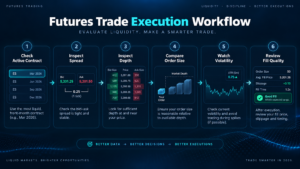
- Confirm the active contract. Avoid evaluating an expiration whose volume has already migrated.
- Check the spread. Record how many ticks separate the best bid and ask.
- Inspect several depth levels. Do not judge the market from the best bid and ask alone.
- Compare order size with available depth. A five-contract trade and a 100-contract trade have different liquidity requirements.
- Check current volume. Determine whether transactions are actually occurring at a healthy pace.
- Review open interest. Use it as a broader participation metric rather than as a direct fill predictor.
- Observe replenishment. Watch whether liquidity rebuilds after trades consume displayed quantity.
- Account for volatility and scheduled events. Spread and depth can change quickly during news.
- Measure realized slippage. Compare expected price with actual fills.
- Track execution quality over time. Real trade data is more useful than assumptions about how liquid a market “should” be.
A trader who follows this workflow evaluates Futures Market Liquidity as an execution problem rather than as a static market statistic.
Common Futures Market Liquidity Mistakes
1. Using Volume Alone
High trading volume is useful but does not guarantee a tight spread or deep book at the exact moment an order is submitted.
2. Using Depth Alone
CME research shows that displayed book depth in isolation can misrepresent overall execution quality, particularly in volatile conditions.
3. Ignoring Order Size
Futures Market Liquidity is relative. A contract can be highly liquid for one lot and less attractive for a much larger trade.
4. Ignoring Time of Day
Liquidity conditions can differ substantially between major session hours and quieter periods.
5. Trading the Wrong Expiration
During rollover, an expiring contract can rapidly lose volume and depth as traders move to the next active month.
6. Assuming Tight Spread Means No Slippage
A tight top-of-book spread says nothing about how much quantity exists behind that quote.
7. Ignoring Hidden Liquidity
Displayed depth can understate available passive liquidity when iceberg or replenishing orders are active. See Futures Iceberg Orders 2026.
8. Ignoring Real Fill Data
If actual executions consistently produce more slippage than expected, the trader’s practical liquidity is worse than the screen suggests.
Pros and Limitations of Futures Market Liquidity Analysis
Pros
- Helps estimate likely execution quality.
- Highlights spread and slippage costs beyond commissions.
- Useful for selecting contracts and active expirations.
- Improves order-size decisions.
- Can reduce avoidable market impact.
- Connects DOM data with actual trading costs.
Limitations
- Liquidity changes continuously.
- Displayed depth can be canceled or hidden.
- Historical volume does not guarantee current fills.
- Market impact depends on order size.
- News can rapidly change spreads and depth.
- No single liquidity metric is sufficient by itself.
Who Should Measure Futures Market Liquidity?
Futures Market Liquidity matters to every trader, but the required depth of analysis depends on strategy. Scalpers and active day traders care heavily about spread, DOM depth and immediate fills. Systematic and institutional traders may focus more on average market impact, cost to trade and capacity. Swing traders may rely more heavily on volume and open interest but still need acceptable execution when entering or exiting.
Beginners should check liquidity before considering margin or leverage. A contract with attractive price movement can still be unsuitable if spreads are wide and execution is poor.
For contract size, tick value and specifications, see our Futures Contract Specifications 2026 guide.
Futures Market Liquidity FAQ
What is Futures Market Liquidity?
Futures Market Liquidity describes how easily a futures contract can be bought or sold with limited transaction cost and market impact.
How do you measure futures liquidity?
Useful measures include bid-ask spread, book depth, trading volume, open interest, cost to trade, slippage, market impact and realized fill quality.
What is a liquid futures market?
A liquid market generally has active participation, relatively tight spreads, sufficient depth, regular transactions and the ability to absorb orders without excessive price movement.
Does high volume mean high liquidity?
High volume is a positive participation signal but does not fully describe Futures Market Liquidity. Current spread, depth, volatility and execution quality also matter.
Does high open interest mean a contract is liquid?
Open interest indicates outstanding positions and broader market participation. It does not directly show how much quantity is available for immediate execution.
What is slippage in futures?
Slippage is the difference between the expected execution price and the actual fill price. Poor liquidity and fast markets can increase slippage.
What is market impact?
Market impact is the effect an order has on available prices. Larger aggressive orders can consume several order-book levels and move the average execution away from the initial quote.
Is book depth the same as liquidity?
No. Book depth is one important component. CME research emphasizes that depth alone can provide an incomplete picture of overall liquidity and fill quality.
Why does liquidity change during the day?
Participation varies by global trading session, scheduled announcements, market opens and closes, volatility, holidays and other conditions.
Why does futures liquidity change during rollover?
Market participants progressively shift trading activity from the expiring contract into the next active expiration, moving volume and order-book depth with them.
Which is more important: spread or depth?
Both matter. Spread measures immediate price separation, while depth shows the quantity available across prices. The importance of each depends on order size.
Can a one-tick spread still have poor liquidity?
Yes. A market can display a narrow spread but very little quantity at the best prices, causing a larger order to sweep multiple levels.
Final Verdict: How to Evaluate Futures Market Liquidity Correctly
Futures Market Liquidity is not synonymous with volume, open interest, spread or depth. It is the combined ability of a market to absorb orders efficiently at acceptable transaction cost.
The strongest evaluation starts with the bid-ask spread, examines depth across multiple levels, considers current volume and open interest, then measures the result that ultimately matters: execution quality.
CME’s research provides an important warning against judging liquidity from one metric. Displayed depth can fall sharply during volatile periods even while enormous trading volumes continue to transact. Conversely, a narrow spread can be misleading if very little size is available behind it.
TradeboticsAI therefore evaluates Futures Market Liquidity through spread + depth + volume + replenishment + slippage + market impact.
Use that framework together with DOM analysis, Order Book Imbalance, Time & Sales and your own realized fill data. The goal is not merely to find a market that looks active—it is to find one that can execute your actual trade efficiently.
Explore NinjaTrader for futures market depth, charting and simulated execution
Affiliate Disclosure: TradeboticsAI may receive compensation when eligible users complete a qualifying action through certain affiliate links. Affiliate relationships do not determine our editorial conclusions.
Risk Disclosure: Futures trading involves substantial risk of loss and is not suitable for every investor. Liquidity, spread, depth, volume, open interest, slippage and market-impact measurements do not predict future returns or guarantee execution quality. Displayed liquidity can change or disappear rapidly. Simulated trading does not guarantee future live results. Nothing on this page is personalized investment, financial, tax or trading advice.