Crypto Grid Bot Fees 2026: Trading Costs, Subscriptions & Break-Even
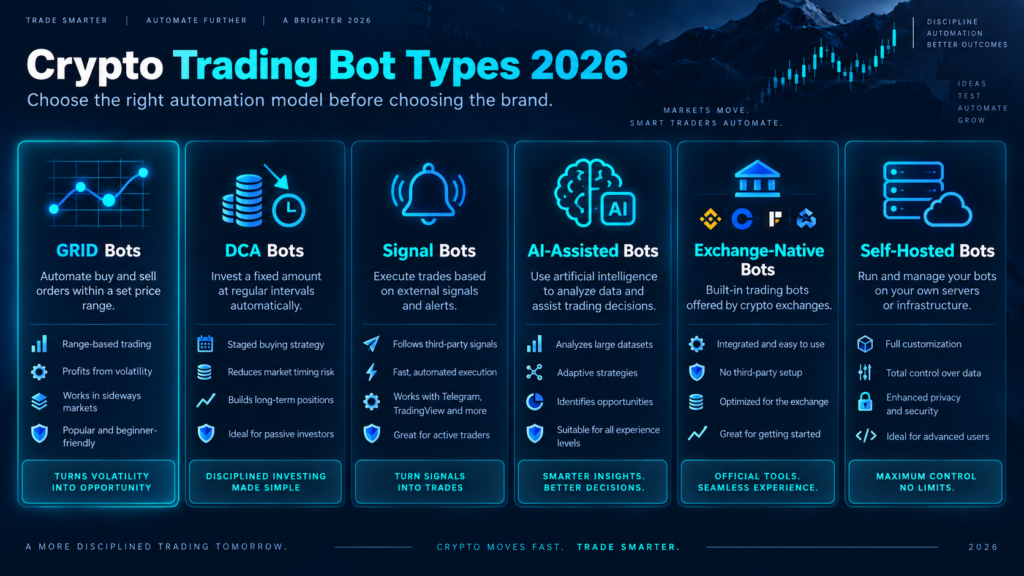
Crypto grid bot fees are not one line on a pricing page. The real bill can include an exchange commission on every filled leg, the bid-ask spread, slippage, a bot subscription, funding or borrowing costs, conversion charges and capital that sits idle while the grid waits for price movement.
This guide builds a provider-neutral cost model for spot and futures grid systems. The central crypto grid bot fees question is whether the edge survives the full operating stack. It shows how to calculate a break-even grid step, compare exchange-native and API-connected bots, audit a fee schedule and decide whether a small expected edge is large enough to justify the operational and market risks. Examples are illustrative, not promises of profit or financial advice.
Quick Answer: Crypto Grid Bot Fees
The practical answer is simple: a grid must earn more per completed buy-sell cycle than its all-in cost. Add these layers before judging a result:
- Trading commission on the buy and the sell, using the actual maker or taker tier.
- Spread and slippage on both executions, especially when the pair is thin or the order is large.
- Software or platform cost, allocated to the volume and time period the grid actually uses.
- Funding, borrow, conversion, withdrawal, network, data and transfer charges where applicable.
- Inventory and idle-capital cost when price trends away from the range instead of oscillating inside it.
A useful break-even test is gross grid step > two-sided trading cost + spread + slippage + allocated software cost. Treat the result as a hurdle rate, not as a target return. A narrow grid can trade often and still lose money if each cycle is too small.
Crypto grid bot fees audit: every percentage should map to a fill, a subscription period, a transfer or an inventory decision.
Affiliate disclosure: TradeboticsAI may receive compensation if you complete a qualifying action through a labeled affiliate link. Affiliate compensation does not determine the cost model, provider comparison or risk conclusions on this page.
Review a bot only after measuring the all-in hurdle. Bitsgap offers GRID automation, demo tools and exchange connections; verify current plan terms, supported venues, exchange fees and account eligibility before using an account.
Affiliate link · A lower platform price does not automatically mean a lower trading cost.
What Crypto Grid Bot Fees Really Include
Crypto grid bot fees checkpoint: write the complete cost stack before choosing a provider or changing the number of grid levels.
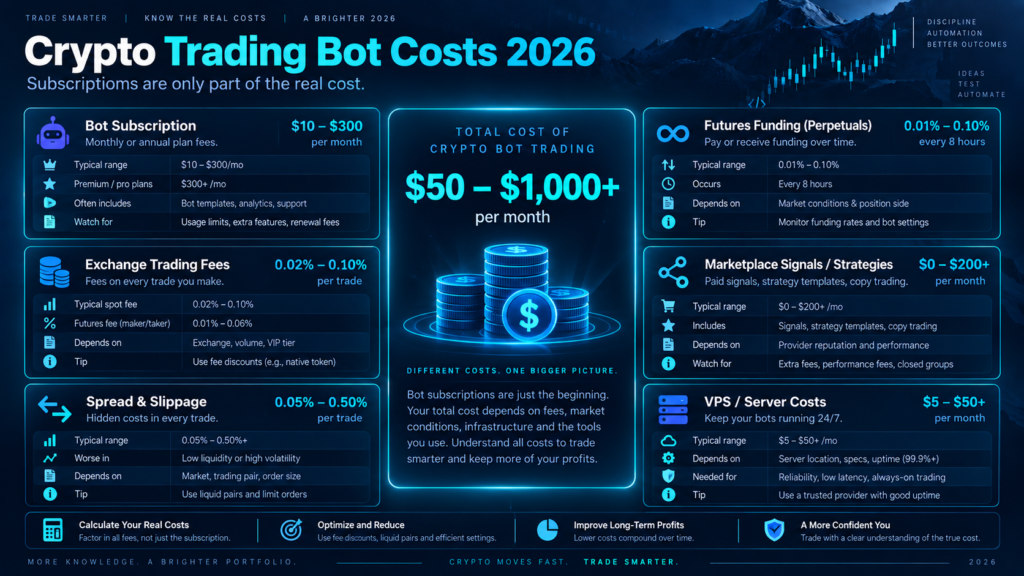
When someone asks, “How much does a grid bot cost?” they may mean the monthly software price. That is only one interpretation of crypto grid bot fees. An exchange-native bot may have no separate subscription while still paying the exchange’s ordinary trading commission. An API platform may charge a monthly plan while routing orders to an exchange that charges its own commission. A futures grid can add funding and liquidation-related costs. A self-hosted script may be free to download but still require a server, monitoring and maintenance.
The right comparison is not “free versus paid.” It is all-in cost per unit of volume and per unit of risk, which is the useful frame for crypto grid bot fees. A paid service can be cheaper in practice if it reduces avoidable errors or gives you usable controls; a free bot can be expensive if its execution model turns a small edge into repeated slippage.
| Layer | How it is charged | What to verify |
|---|---|---|
| Exchange trading fee | Percentage of each filled order, often based on maker/taker status, volume tier or discounts. | Current schedule, market type, account tier, fee currency and whether bot volume qualifies. |
| Bot or platform fee | Subscription, usage fee, volume share, feature tier or a combination. | Plan limits, renewal price, trial conversion, supported bots and cancellation terms. |
| Spread | Difference between executable bid and ask; paid through execution rather than an invoice. | Typical spread for the pair, time of day, venue and order size. |
| Slippage and market impact | Difference between expected and actual fill, often increasing during volatility. | Limit versus market orders, partial fills, depth and retry behavior. |
| Funding or borrow | Periodic cost or credit on leveraged or margin positions. | Funding interval, direction, rate variability, leverage and liquidation rules. |
| Capital and operations | Idle inventory, conversion, transfer, data, server and monitoring costs. | Capital trapped outside the range, uptime, API limits, alerts and recovery process. |
Crypto grid bot fees checkpoint: if a cost cannot be assigned to a fill, a period, a transfer or an inventory state, it is probably missing from the model rather than irrelevant.
For a broader strategy comparison, see the best crypto grid trading bots guide. This page focuses on the cost mechanics that should sit underneath any provider ranking, so crypto grid bot fees are not reduced to a headline subscription.
Do Grid Bots Add a Separate Exchange Fee?
Crypto grid bot fees checkpoint: separate the exchange’s order commission from the software’s access price.
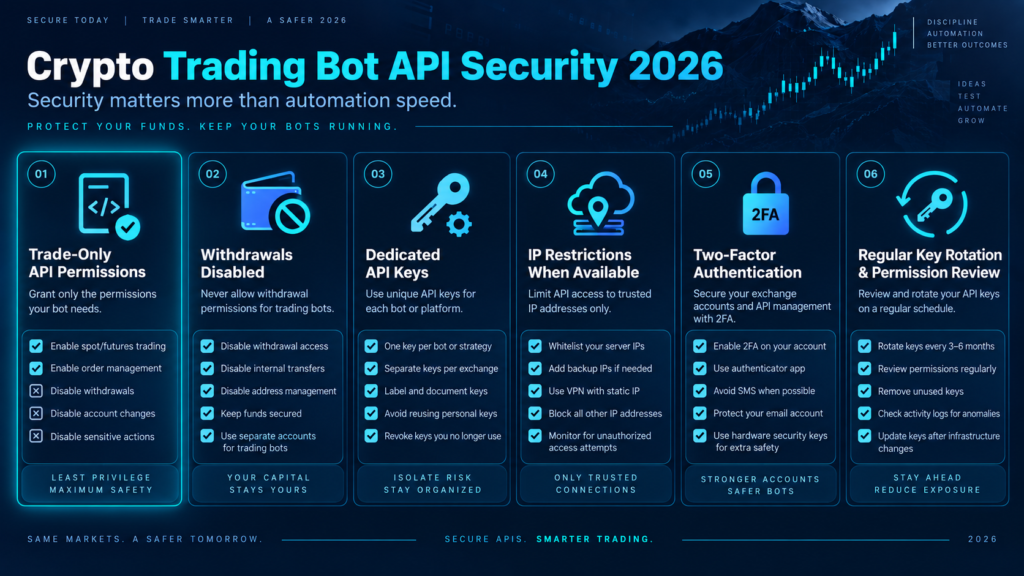
Often, an exchange-native grid tool does not add a second “bot commission.” The orders are still subject to the venue’s normal trading schedule, which is the first distinction in crypto grid bot fees. Crypto.com’s Spot Grid Trading Bots help page, for example, states that its grid bot does not add an additional fee and that the incurred fees are the same as placing a limit or market order. That does not mean the trades are free; it means the cost is handled through the exchange’s regular order-fee rules.
With a third-party API bot, there are usually two separate questions:
- What does the platform charge? Check subscription, volume, feature, trial and renewal terms.
- What does the connected exchange charge? Check the venue’s live schedule and your actual account tier. The platform cannot erase a venue commission unless a specific arrangement says so.
Fee schedules can change, and a global page may not apply to a U.S. account or to every product. Binance’s official spot fee schedule illustrates why the account tier, product and discount column matter when checking crypto grid bot fees. Coinbase Advanced likewise publishes its own fee information. Always open the venue’s current schedule from the account you intend to use instead of copying a rate from a comparison article.
Practical rule: record the actual fee charged in the exchange’s trade history after a paper or very small test. The displayed tier can differ from the effective cost when discounts, fee currency, minimums, rebates or product rules apply.
The Complete Crypto Grid Bot Fees Stack
Crypto grid bot fees checkpoint: calculate each component in the same quote currency and time window.
A clean ledger avoids mixing percentages, dollars and coin units. For crypto grid bot fees, convert subscription cost into the same quote currency as the grid, then decide whether to allocate it by days, by deployed capital or by trading volume. There is no single correct allocation for every research question, but there should be a stated method.
1. Trading commission on both legs
Suppose a grid buys one unit at a lower level and later sells one unit at a higher level. The buy has a commission and the sell has a commission, so both sides belong in the crypto grid bot fees ledger. If the fee is charged in the quote asset, subtract it from quote proceeds; if it is charged in the base asset, subtract it from the quantity received or sold. The accounting detail matters when the price moves sharply between the two fills.
2. Spread and slippage
A limit order can still face an economic spread cost if the fill is compared with a mid-price or with a theoretical grid level. A market order can consume several levels in a thin book. This is where crypto grid bot fees become execution data rather than a static pricing table. A simulator that fills every order at the exact grid line is optimistic unless that is how the live order is actually guaranteed.
3. Platform price
Allocate the platform price to the strategy being evaluated. If a plan costs $30 per month and the bot uses $3,000 of average capital for one month, the simple capital-allocation view is 1% for that period. If the bot turns over $60,000, the same amount is 0.05% of volume. Both figures can be useful, but they answer different questions about crypto grid bot fees.
4. Futures, margin and funding
Spot grids generally do not pay perpetual funding because they do not hold a perpetual futures position. Futures grids can pay or receive funding, and leverage magnifies the effect of small price moves, maintenance margin and forced close rules. These crypto grid bot fees are path-dependent, so do not import a spot cost model into a leveraged strategy.
5. Transfers and conversion
Deposits, withdrawals, network fees, stablecoin conversion, currency conversion and moving collateral between venues can matter when capital is split across exchanges. These may be immaterial for a long-running high-volume bot, but material for a small account or a short test.
| Ledger line | Formula or source | Use in the decision |
|---|---|---|
| Buy commission | Buy notional × buy fee rate. | Deduct from the entry side of each modeled cycle. |
| Sell commission | Sell notional × sell fee rate. | Deduct from the exit side; do not assume one fee covers both legs. |
| Spread | Executable ask minus bid, expressed against the reference price. | Stress the model when the pair or venue is less liquid. |
| Slippage | Expected fill minus theoretical level, for each side. | Use a base and stressed case rather than one perfect-fill assumption. |
| Software allocation | Plan cost ÷ chosen time, capital or volume basis. | Compare platforms on a consistent basis. |
| Funding or borrow | Position notional × applicable periodic rate. | Include only when the market type and direction create the charge. |
How to Calculate Break-Even Grid Spacing
Crypto grid bot fees checkpoint: calculate the hurdle before you optimize level count.
The most useful answer to “are these fees too high?” is not a generic percentage. For crypto grid bot fees, it is whether the chosen grid step leaves enough gross distance after the expected cost of completing a cycle.
minimum gross grid step ≈ buy fee + sell fee + round-trip spread + round-trip slippage + software allocation + safety margin
Express every term as a percentage of the trade notional. If a fee is 0.10% per side, the commission component is about 0.20% for a round trip. If expected slippage is 0.05% per side, add about 0.10%. Add any spread estimate and then a buffer for model error. This crypto grid bot fees calculation is an approximation, not an execution guarantee.
Illustrative example: assume a 0.10% buy fee, a 0.10% sell fee, 0.05% slippage on each side and a 0.03% round-trip spread estimate. The mechanical hurdle is approximately 0.33% before a software allocation or safety buffer. A 0.25% grid step would not clear that hurdle; a 0.60% step might clear the modeled hurdle but can still lose if fills are incomplete, price trends away or the spread widens.
Use the crypto grid bot profit calculator to sanity-check a single cycle, then use crypto grid bot backtesting to apply the same hurdle across a sequence of fills. The calculator answers unit economics; a backtest tests path, inventory and regime sensitivity, which keeps crypto grid bot fees tied to actual conditions.
Why a larger grid step is not automatically better
A wider step can leave more room above fees, but it may trade less often and keep capital idle for longer. A narrow step can create more signals but may fail to cover costs. The optimal crypto grid bot fees question is not “how many trades can the bot make?” It is “how much net contribution does each fill make after realistic costs, and what risk is held while waiting?”
Arithmetic and geometric spacing also change the dollar and percentage distance between levels. Review the arithmetic vs. geometric grid comparison before applying one break-even percentage to every level of a wide range.
Maker, Taker, Spread and Slippage: The Execution Layer
Crypto grid bot fees checkpoint: confirm how the bot actually gets filled instead of assuming every order earns the maker rate.
Maker and taker labels are about whether an order adds liquidity or removes it under the venue’s rules. A grid that posts resting limit orders may often act as maker, but rapid price movement, order replacement, post-only rejection, partial fills or a market-order fallback can change the result. The bot’s documentation and trade history matter more than the strategy name when measuring crypto grid bot fees.
- Post-only behavior: does the order cancel when it would immediately take liquidity?
- Fallback behavior: does the bot convert a rejected or stale limit order into a market order?
- Partial fills: does the bot book fees and inventory for the filled quantity only?
- Order replacement: can frequent cancellations reduce queue priority or create new execution costs?
- Minimum notional: does rounding make the displayed grid step different from the executable order?
- API latency: does the quoted level remain available by the time the order reaches the venue?
When you paper-test, export fills and compare expected versus actual price, fee, fee currency, order type and timestamp. That small crypto grid bot fees audit often reveals why a spreadsheet’s grid edge is not visible in the account.
| Assumption | Optimistic version | More conservative version |
|---|---|---|
| Fee tier | Lowest advertised rate or discount. | Actual account tier without an unverified discount. |
| Order type | Every fill is maker. | Mixed maker/taker results or taker cost during fast moves. |
| Fill price | Exact grid level. | Level plus spread and expected slippage. |
| Liquidity | Unlimited depth at the level. | Depth-sensitive partial fills and wider spreads. |
| Uptime | Every signal reaches the exchange. | Outages, rate limits, stale data and missed fills are possible. |
Platform Pricing Models Compared
Crypto grid bot fees checkpoint: compare what you pay with what the plan unlocks and with the exchange costs that remain outside the plan.
There are four common ways a grid tool can be priced. The names change, but the economic questions behind crypto grid bot fees remain the same: does the platform charge for access, execution, volume, features or some mix; and can you stop the subscription without leaving a bot unmanaged?
| Model | Typical structure | Best question to ask |
|---|---|---|
| Exchange-native | Bot included in the exchange interface; ordinary venue trading fees still apply. | Are the bot’s order rules, range exits and reporting sufficient for the risk I am taking? |
| Subscription SaaS | Monthly or annual plan plus exchange commissions through an API connection. | How much volume or capital must the bot generate before the plan is a tolerable share of cost? |
| Usage or volume share | Fee linked to executed volume, features or a percentage of activity. | Does more trading increase both gross cycles and the platform bill faster than net contribution? |
| Self-hosted | Software may be open or low-cost; the operator pays infrastructure, monitoring and maintenance. | Who patches it, detects a stuck order and responds when the exchange or API changes? |
| Hybrid or free tier | Free access with limits, then paid features, higher bot counts or larger allocations. | What happens at trial expiry, plan limits or a second exchange connection? |
Bitsgap’s current platform page describes a paid plan structure, a free trial and exchange connections; its pricing page is the right place to verify current plan limits rather than relying on an old review. The same principle applies to any provider. A plan price is a moving product detail, not a permanent fact in crypto grid bot fees.
Do not treat “no platform fee” as “no cost.” An exchange-native tool can still have trading fees, spread and inventory risk. Conversely, do not treat a subscription as automatically wasteful: if it provides reliable controls, demo mode, logs and the specific exchange support you need, its cost can be measured against the alternative of manual or self-hosted operation.
Test the workflow before committing to a plan. If you compare Bitsgap, check the current subscription, demo mode, exchange connection, bot limits and cancellation terms against your own cost ledger.
Check Bitsgap Pricing & GRID Tools
Affiliate link · Confirm current pricing and eligibility directly with the provider.
How to Audit Your Crypto Grid Bot Fees
Crypto grid bot fees checkpoint: perform the audit with a small paper or test allocation before assuming the dashboard is complete.
Use this five-pass audit when a bot looks profitable but the account balance does not explain the result. The goal of a crypto grid bot fees audit is reconciliation: every order, charge and inventory change should have one place in the ledger.
- Copy the venue schedule. Save the current link, product name, maker/taker tier, discount rules and fee currency. Record the account’s actual tier.
- Export fills. For each fill, record timestamp, symbol, side, quantity, price, order type, execution fee and fee currency. Avoid relying on a rounded dashboard total.
- Rebuild one cycle. Match one buy to one sell, convert both fees into the quote currency and compare the theoretical grid step with realized net proceeds.
- Allocate the platform price. State whether the allocation is by time, average capital or volume. Run a second view if the account is small or turnover is very uneven.
- Stress the edge. Increase slippage, widen spread, assume more taker fills and include a delayed or missed order. A strategy that fails a modest stress case is fragile.
| Question | Answer to record | Pass condition |
|---|---|---|
| What is the fee per buy and sell? | Rate, tier, product and fee asset. | Both legs are included in the cycle model. |
| What does a completed cycle actually net? | Gross step minus all execution costs. | Net remains positive under the base case. |
| How often does the bot trade? | Completed cycles, partial fills and idle periods. | Turnover is not being assumed from a theoretical signal count. |
| What happens outside the range? | Inventory, stop, trailing, pause and restart behavior. | Total equity and exposure remain visible. |
| What happens when the plan ends? | Trial expiry, renewal, bot continuity and cancellation. | No live bot is left without a reviewed operating plan. |
If the bot is not trading as expected, use the crypto grid bot not trading troubleshooting guide. A lack of fills may mean the strategy is inactive, but it can also mean that the chosen grid step is too narrow after crypto grid bot fees, the range is wrong or the venue rejected the order.
How to Reduce All-In Cost Responsibly
Crypto grid bot fees checkpoint: reduce avoidable friction without weakening the controls that protect the account.
Lowering cost does not mean selecting the smallest advertised commission. The better sequence for crypto grid bot fees is to remove errors first, then compare execution quality and only then optimize the plan price.
- Use a liquid pair and venue. A slightly higher posted fee can be cheaper than a wide spread and shallow book.
- Match grid spacing to the real hurdle. Do not compress levels until each expected cycle has room for fees and slippage.
- Check maker behavior. Confirm that the bot can post and manage resting orders without silently switching to expensive taker execution.
- Control turnover. More fills are not automatically better if each has weak or negative contribution after costs.
- Use the right fee asset carefully. Discounts can add price, custody or conversion risk; verify how the venue applies them.
- Allocate subscriptions honestly. If a plan is oversized for the strategy, test a smaller tier or a different operating model.
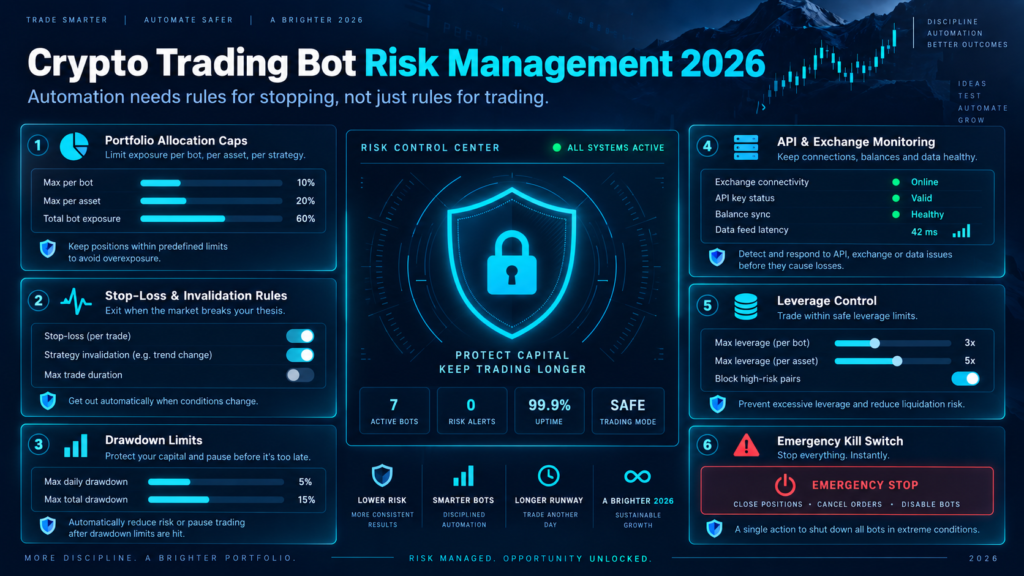
- Keep API permissions narrow. Disable withdrawals, use IP restrictions where supported and store keys securely. Security mistakes can dominate every fee saved.
- Reconcile monthly. Compare theoretical, realized and total-account results, including unsold inventory and platform charges.
Use the crypto grid bot settings guide to review range, spacing and allocation choices. The crypto grid bot fees question is not isolated: changing the number of levels changes order size, turnover, fill probability and capital usage.

USA Account and Venue Checklist
Crypto grid bot fees checkpoint: verify the exact product and account you can use in your jurisdiction before comparing rates.
Fee pages often mix global products, regional products and derivatives. For a U.S.-focused workflow, confirm the venue’s current availability, supported state or account type, market type, identity requirements, API access and product restrictions before relying on crypto grid bot fees. A low global rate is irrelevant if the product is not available to your account.
Before connecting
- Confirm the exchange and product are available to your account.
- Read the venue’s current fee and withdrawal pages.
- Check whether spot, margin or futures rules are different.
- Verify API permissions, IP controls and withdrawal lockout.
- Understand the provider’s data handling and support path.
Before scaling
- Reconcile a small set of actual fills.
- Run the base and stressed cost cases.
- Test a range break and an exchange outage response.
- Export records in a format you can retain.
- Review tax and compliance questions with a professional.
Regional availability, fees and rules can change. This page is educational and does not determine whether a platform or product is suitable, authorized or available for any individual.
Pros, Cons and Best Use Cases
Crypto grid bot fees checkpoint: choose a cost model that fits the strategy’s size, frequency and operational tolerance.
A disciplined crypto grid bot fees model is useful only when it is connected to a strategy and account that can absorb the remaining risks.
Advantages of a disciplined cost model
- It converts a vague “low-fee” claim into a measurable hurdle.
- It makes provider comparisons more consistent.
- It reveals when a narrow grid is too small to overcome costs.
- It separates exchange charges from software charges.
- It encourages reconciliation of fills, inventory and total equity.
Trade-offs and drawbacks
- Fee schedules and discounts can change.
- Execution costs vary with volatility and liquidity.
- Subscription allocation is subjective for small or irregular accounts.
- Lower fees may come with weaker tools, access or controls.
- A clean ledger does not remove market or technology risk.
Best suited for
- Traders who can name the venue, pair, order type and risk limit before starting.
- Strategies with enough expected gross movement to clear a measured round-trip hurdle.
- Users willing to monitor range exits, API health, inventory and fee reports.
- Research workflows that can paper-test and reconcile before scaling.
Not suited for
- Anyone expecting a “free bot” to remove exchange fees or market risk.
- Accounts too small to absorb subscription, withdrawal or conversion costs.
- Thin pairs where spread and market impact are larger than the modeled edge.
- Leveraged strategies whose funding or liquidation rules are not understood.
- Users who cannot monitor an API-connected account or maintain records.
For a strategy-level alternative, compare a grid with grid bot vs. DCA bot. The lowest fee is not the objective if the strategy is a poor fit for the market or for the user’s risk capacity.
Risks and Limitations of Fee Comparisons
Crypto grid bot fees checkpoint: a precise fee calculation can still sit inside an imprecise market model.
Fees are measurable, but the future fills they will be charged on are not known in advance. A backtest may use incomplete order-book information. A paper environment may not replicate the exchange’s production queue. A subscription may change while the bot remains active. A range can break and turn a repeated-cycle system into an inventory position. That is why crypto grid bot fees should be treated as one input to a risk review, not as a guarantee.
- Market risk: crypto prices can move sharply, gap through levels or remain outside the range.
- Inventory risk: a spot grid can accumulate the base asset in a decline or sell too much base in a rally.
- Leverage risk: futures and margin add funding, liquidation and collateral risk.
- Execution risk: orders can be rejected, partially filled, delayed or filled at a worse price.
- Technology risk: APIs, servers, clocks, keys, data feeds and exchange services can fail.
- Provider risk: plan features, supported exchanges, pricing and availability can change.
- Model risk: the assumed spread, slippage, fee tier or fill sequence may be wrong.
Never use a fee estimate as a reason to trade money you cannot afford to lose. Start with research, paper trading and a defined maximum loss; consider professional financial, legal or tax advice where appropriate.
Crypto Grid Bot Fees FAQ
These crypto grid bot fees questions cover the cost assumptions that most often change a grid decision.
Do crypto grid bots have extra fees?
Some exchange-native bots do not add a separate bot charge, but their orders can still incur the exchange’s normal trading fees. Third-party services may add a subscription, usage or volume fee. Check both schedules and then include spread, slippage and any funding or transfer costs.
How much should a grid step exceed fees?
There is no universal percentage. Start with both-side commission plus round-trip spread and slippage, then add software allocation and a safety margin. The grid step should clear that modeled hurdle under a stressed case, but a larger step can trade less often and may increase idle capital.
Are maker fees always used by a grid bot?
No. A bot may post resting orders, but fast markets, post-only rules, retries, partial fills or fallback logic can create taker fills. Confirm order type and realized fee in the exchange trade history.
Should I include a bot subscription in the break-even calculation?
Yes. Allocate the subscription to a stated basis such as the test period, average capital or traded volume. Run more than one view when the account is small or turnover is uneven so the platform cost is not hidden by a convenient denominator.
Are futures grid bot costs different from spot grid bot costs?
Yes. Futures and margin strategies can add funding, borrow, collateral, liquidation and leverage-related costs. A spot commission-only model is not enough for a leveraged grid.
Can low crypto grid bot fees guarantee profit?
No. Lower fees can improve the break-even hurdle, but they do not remove market, inventory, execution, technology or provider risk. A strategy can lose money with low fees when price trends away from its range.
What is the best way to verify my actual fee rate?
Use the venue’s current fee schedule for your exact account and product, then reconcile a small set of completed fills. Record the fee amount, fee currency, order type and timestamp instead of relying only on a headline dashboard percentage.
Final Verdict: Measure the Hurdle, Then Choose the Tool
Crypto grid bot fees checkpoint: the best setup is the one whose cost model you can explain, test and monitor.
Crypto grid bot fees should be evaluated as a complete operating system: exchange commission, maker/taker behavior, spread, slippage, software, funding, transfers, idle capital and range-break risk. A “free” grid can still be expensive, and a paid tool can still be reasonable when its controls and execution workflow justify the price.
Before going live, calculate a unit-level break-even step, apply it to a realistic backtest, stress it with worse execution, paper-test the same settings and reconcile actual fills. If the expected net edge disappears under a modest stress case, the correct response is to change the research question or avoid the trade—not to add leverage or assume more cycles will solve it.
Compare the workflow after your fee ledger is complete. Bitsgap can be one platform to review for GRID automation and demo testing, but confirm current terms, exchange support, security settings and costs for your account before connecting funds.
Explore Bitsgap GRID Automation
Affiliate link · Automation does not eliminate trading or loss risk.