Crypto Grid Bot Backtesting 2026: Test Strategies Before Live Trading
Crypto grid bot backtesting is useful only when the simulation represents the orders a real bot could place, the costs it would pay and the inventory it would carry when price leaves the range. A chart that ends with a positive line is not enough evidence.
This guide gives you a provider-neutral protocol for testing grid range, level count, allocation, fees, slippage, order rules and risk controls. It separates in-sample research from out-of-sample validation, adds a walk-forward step and finishes with paper trading before any live connection. The result is a research process, not a profit promise or financial advice.
Quick Answer: Crypto Grid Bot Backtesting
A useful crypto grid bot backtesting process should answer five questions:
- Did the defined grid receive realistic fills inside the historical range?
- Did net results remain positive after both-side fees, spread, slippage and software cost?
- Did the strategy survive a trend, a sharp move, a low-volatility period and a range break?
- Did the result remain credible on data that was not used to choose the settings?
- Can a paper account reproduce the order sequence and risk behavior before live capital is considered?
If the answer to any of these is no or unknown, the test is not ready to support a live deployment. A backtest can reject a weak idea; it cannot guarantee that an accepted idea will work next.
Affiliate disclosure: TradeboticsAI may receive compensation if you complete a qualifying action through a labeled affiliate link. Affiliate compensation does not determine the test protocol, platform discussion or risk conclusions on this page.
Compare a live bot workflow only after testing the assumptions. Bitsgap provides GRID automation and testing tools; verify the current exchange support, data window, fees, limits and controls before connecting an account.
Affiliate link · A backtest result is not a performance guarantee.
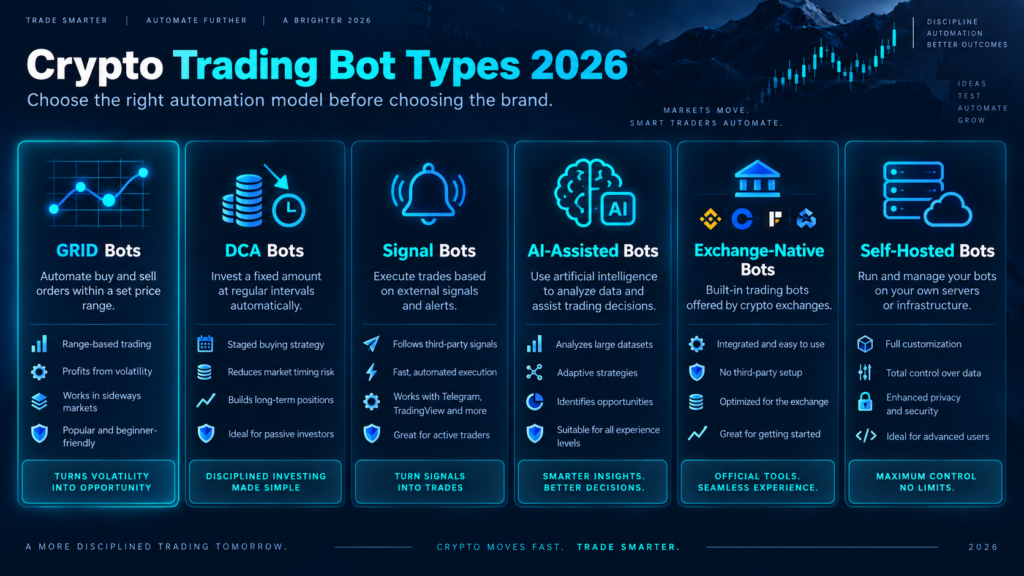
What Crypto Grid Bot Backtesting Can and Cannot Prove
Crypto grid bot backtesting checkpoint: define the claim before running the test. “This range captured historical movement” is a smaller and more honest claim than “this bot will make money.”
Crypto grid bot backtesting replays a set of historical prices under a specified rule set. It can help you inspect how a grid would have placed, filled, cancelled and re-created orders under those assumptions. It can reveal sensitivity to the range, grid count, starting inventory, fee rate, slippage and exit rules.
It cannot recreate the future. Historical candles do not contain every detail of queue position, partial fills, exchange outages, API latency, order-book depth, changed market rules or your real decision to stop after a drawdown. A platform may also report “grid profit” differently from total account equity when unsold inventory remains.
| Backtest output | What it actually tells you | What it does not tell you |
|---|---|---|
| Positive net P&L | The model produced a positive result under the chosen period, rules and cost assumptions. | That the next period will repeat the result or that live fills will match. |
| High number of grid cycles | Price crossed the modeled levels often enough to complete many modeled cycles. | That each cycle was profitable after real fees, spread, slippage and inventory. |
| Small maximum drawdown | The modeled account-to-equity path did not fall far under the selected assumptions. | That a gap, outage, liquidation rule or range exit cannot create a larger loss. |
| Best parameter set | One setting ranked highest in the tested parameter space. | That the setting is robust; a single peak can be overfit. |
| Successful paper test | The order workflow operated in current market conditions without live capital. | That live liquidity, fees and execution will be identical. |
A strong page or platform should show enough assumptions to reproduce the result. If the interface hides the data source, fee model, order logic or inventory treatment, treat the headline result as marketing evidence rather than research evidence.
Define the Grid and Execution Model Before Testing
Crypto grid bot backtesting checkpoint: freeze the rules before looking at the result so the test does not quietly become a search for a flattering chart.
Start with a written specification. A grid bot is not one universal algorithm: equal arithmetic spacing, geometric spacing, quote-sized orders, base-sized orders, trailing ranges and stop rules can produce very different inventory paths. The backtest should reproduce the exact version you intend to paper-test.
Write the state machine
Crypto grid bot backtesting checkpoint: document every state transition before you compare platforms or parameters.
- Market: specify the exchange, symbol, market type, settlement currency and timeframe.
- Range: define lower and upper limits, how the start price is treated and what happens when price exits.
- Grid: define level count, arithmetic or geometric spacing and whether the count means intervals or price lines.
- Allocation: define starting quote, starting base, order size, minimum reserve and whether profits are reinvested.
- Order logic: specify buy, sell, cancel, replace, partial-fill and duplicate-order behavior.
- Risk controls: define stop-loss, take-profit, trailing, auto-close, maximum inventory and maximum drawdown behavior.
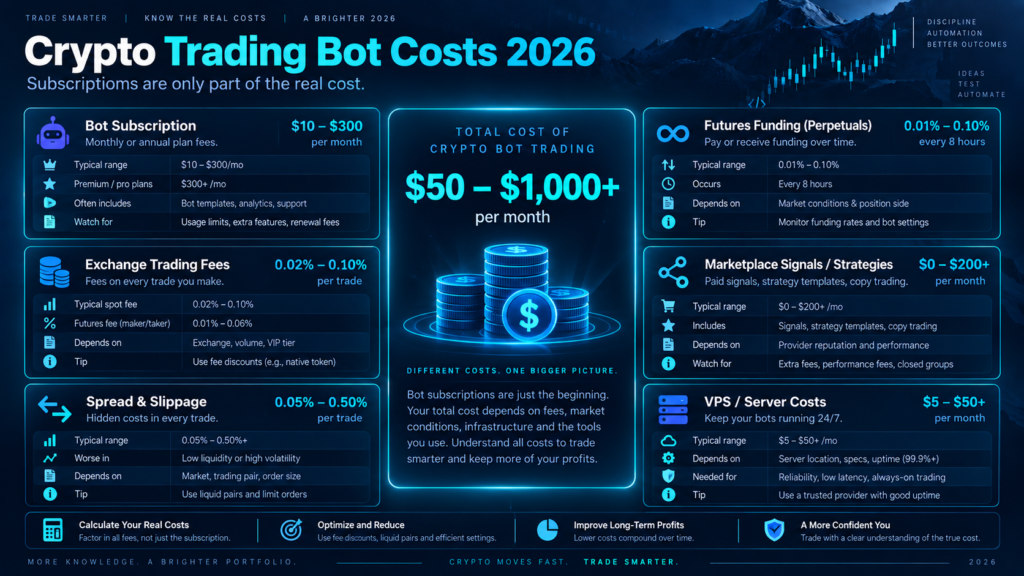
- Costs: define maker or taker fees, spread, slippage, funding where applicable and subscription allocation.
Keep the rules identical when you move from historical testing to paper trading. If the paper version changes the grid count, range, fee assumption or stop logic, it is a new experiment and should be labeled as one.
Use the crypto grid bot settings guide for the configuration vocabulary, and the arithmetic vs. geometric grid comparison for spacing choices. This page adds the validation protocol that comes after the settings are specified.
Do not optimize everything at once. If you change range, grid count, allocation, stop-loss and fee assumptions together, you cannot tell which decision produced the result. Start with a baseline, then change one research dimension at a time.
Data, Fees and Realistic Fills
Crypto grid bot backtesting checkpoint: the model is only as credible as its historical data and fill assumptions.
The data source determines what the simulator can know. Candle data is efficient for broad research, but a candle’s high and low do not reveal the order in which levels were touched. If multiple grid levels fall inside one candle, a close-only model may create fills that could not occur in that sequence.
| Data or model | Useful for | Important limitation |
|---|---|---|
| OHLC candles | Initial range and regime research; broad parameter screening. | Intrabar order sequence and queue position are unknown. |
| Lower-timeframe candles | Reducing ambiguity around level crossings and fast moves. | Still does not show the full order book or your queue position. |
| Tick or trade data | More detailed fill and sequence simulation. | Data cleaning, storage and matching logic become more complex. |
| Order-book or venue replay | Testing limit-order behavior and liquidity-sensitive execution. | Expensive, venue-specific and still unable to guarantee future queue priority. |
| Paper trading | Testing the live connection, order lifecycle, alerts and operator workflow. | It may not reproduce live fees, market impact or emotional pressure. |
Costs must be applied to the same events as the strategy. A completed buy-sell cycle normally pays a fee on each side. Spread and slippage can occur on both sides, while subscription cost is usually a period cost rather than a per-order cost.
net cycle result = gross grid spread − buy fee − sell fee − spread cost − slippage − allocated software cost
Crypto grid bot backtesting checkpoint: apply this cost model to every fill rather than subtracting fees only from the final headline.
The crypto grid bot profit calculator is useful for checking this unit economics layer. Backtesting goes further by applying the cost model across every modeled fill and showing what happens when cycles slow down or inventory remains open.
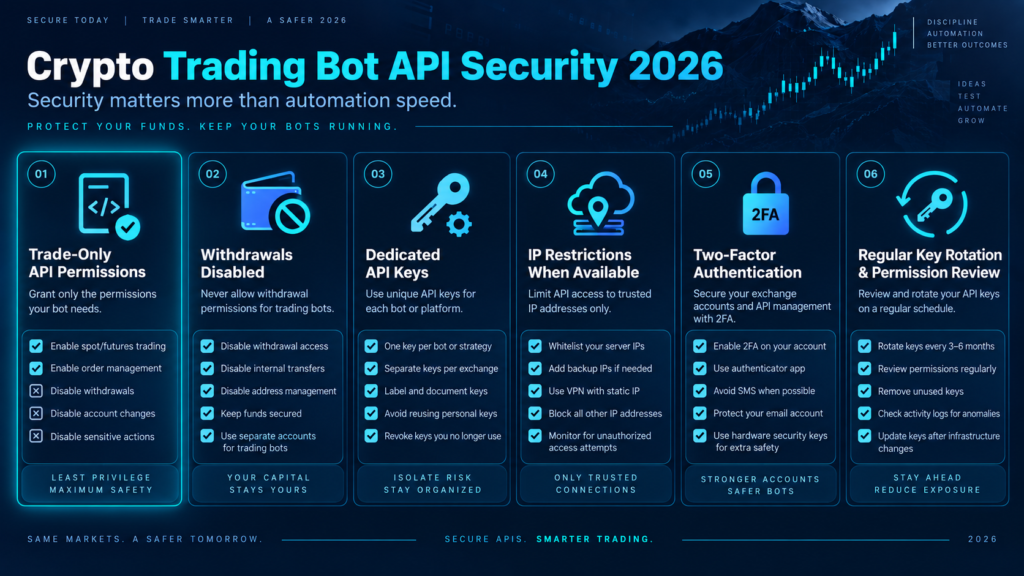
The Nine-Step Crypto Grid Bot Backtesting Protocol
Crypto grid bot backtesting checkpoint: keep a research log with the exact data range, parameters, version, costs and result export for every run.
The following protocol is intentionally conservative. It is designed to reject fragile ideas before they reach a live exchange.
- Define one hypothesis. Example: “This range-based grid captures repeated BTC/USDT movement better than a passive benchmark after costs during specified conditions.” Avoid a vague goal such as “maximize profit.”
- Choose the market and data. Record symbol, venue, timeframe, start and end dates, missing candles, timezone and whether the test uses OHLC, lower-timeframe or trade data.
- Freeze the baseline. Select a reasonable range, grid spacing, allocation, fee tier, slippage assumption and risk rule before viewing the optimization output.
- Model inventory. Track both quote cash and base-asset inventory after every fill. A strategy that ends with a large base position after a range break may have positive grid profit but negative total equity.
- Run a scenario matrix. Test sideways movement, rising trend, falling trend, volatility expansion, volatility contraction, gaps and long periods outside the range.
- Apply realistic costs. Run a base case and at least one stressed case with higher fees, spread and slippage. Include funding or borrowing only when the market type uses them.
- Reserve unseen data. Keep a later period out of the parameter search. Do not use the test set to decide the final range or level count.
- Run a walk-forward check. Train or choose settings on one window, roll the window forward, then evaluate the next unseen segment. Record every change and do not silently retune after seeing the result.
- Paper-test the same version. Confirm order events, fees, alerts, API permissions, range exits, stop behavior and reporting before a small live experiment is even considered.
Crypto grid bot backtesting checkpoint: the protocol is complete only when the same version can be identified in the historical export and paper account.
| Field | Record | Reason |
|---|---|---|
| Strategy version | Rules, code or platform settings, including date and change note. | Prevents results from different versions being compared as one system. |
| Market data | Venue, symbol, timeframe, date window, source and missing-data treatment. | Shows whether the sample represents the intended deployment. |
| Execution model | Order type, fill sequence, partial fills, spread and slippage. | Controls the gap between a candle replay and a live order. |
| Capital path | Quote balance, base inventory, equity, margin and reserved funds. | Prevents grid profit from being confused with total account performance. |
| Validation status | In-sample, out-of-sample, walk-forward or paper-test result. | Shows whether the result was used for discovery or independent confirmation. |
Metrics That Matter More Than Headline Return
Crypto grid bot backtesting checkpoint: review the equity curve and inventory path before looking at the final percentage.
A grid system can make its return look attractive by leaving the account with a large unrealized position, by ignoring idle capital or by counting gross cycle profit before costs. Use a dashboard that lets you inspect the path, not only the end point.
Performance metrics
- Net P&L after trading costs and allocated software cost.
- Return on starting equity and on average capital deployed.
- Annualized return only when the time window makes that comparison meaningful.
- Number of completed cycles, open cycles and average holding time.
- Profit factor and average net result per completed cycle.
- Turnover and the percentage of gross result consumed by fees.
Risk and exposure metrics
- Maximum drawdown, drawdown duration and recovery time.
- Worst mark-to-market inventory loss after a range exit.
- Maximum base-asset and quote-currency exposure.
- Time spent outside the range or with one side unable to trade.
- Largest gap, slippage shock, order rejection or data outage scenario.
- Difference between realized cycle profit and total equity change.
Compare the grid with a benchmark that uses the same starting capital and time window. Useful baselines can include holding the asset, holding the quote currency, a simple recurring purchase schedule or a no-trade cash position. The goal is not to make every grid beat every benchmark; it is to expose what the grid added and what risk it accepted.
Crypto grid bot backtesting checkpoint: report the benchmark and the capital path beside the grid result, not in a separate marketing view.
The five-part score above is TradeboticsAI’s editorial audit framework, not a promise of performance. A strategy with a high return but weak execution realism or no unseen validation should not be treated as high quality.
Crypto grid bot backtesting checkpoint: a high return cannot compensate for missing data, unrealistic fills or an unreported inventory loss.
Out-of-Sample, Walk-Forward and Robustness Testing
Crypto grid bot backtesting checkpoint: a result is more useful when it survives data that did not help choose the parameters.
Divide the historical sample before optimizing. The in-sample period helps you understand the strategy and choose a small set of parameters. The out-of-sample period is a holdout used to test whether those choices generalize. If you repeatedly change the settings after viewing the holdout, it becomes part of the training process and is no longer independent.
Use a walk-forward sequence
Crypto grid bot backtesting checkpoint: keep every rolling window separate so one strong period cannot hide later deterioration.
A walk-forward test rolls the research window through time. You choose or calibrate the grid on one historical segment, test it on the next segment, move the window forward and repeat. The final report should show each segment separately, not only a blended total that hides when the edge disappeared.
For a grid strategy, the windows should include different market behaviors: a stable range, a strong directional move, a volatility shock and a quiet period. Crypto trades continuously, so calendar dates alone are not enough; label the market condition and the asset exposure in each segment.
Look for a parameter plateau
Crypto grid bot backtesting checkpoint: inspect neighboring ranges and grid counts instead of accepting the single highest point.
A robust setting should not depend on one exact lower bound, upper bound or grid count. Test nearby values and inspect whether the result forms a broad, understandable plateau or a narrow spike. A narrow peak can indicate that the model has learned noise, a particular sequence of candles or a hidden data artifact.
An academic example of this caution is the paper Dynamic Grid Trading Strategy: From Zero Expectation to Market Outperformance. It studies a dynamic approach and historical results under explicit assumptions; it does not turn a backtest into a guarantee. Use research papers to understand methodology, then reproduce the assumptions in your own test.
Crypto grid bot backtesting checkpoint: cite the assumptions that produced the result, not only the result itself.
Overfitting Traps and Red Flags
Crypto grid bot backtesting checkpoint: assume a flattering result is fragile until it survives cost stress, unseen data and nearby parameter values.
Overfitting happens when the research process adapts too closely to the historical sample. Grid systems are especially vulnerable because range limits, level counts and cost assumptions offer many combinations that can be searched until one looks excellent.
Crypto grid bot backtesting checkpoint: treat every parameter search as a potential source of selection bias and record the rejected alternatives.
| Red flag | Why it matters | Better response |
|---|---|---|
| Only the best parameter set is shown | You cannot see whether nearby settings also work. | Show a parameter neighborhood and report the distribution. |
| Fees are set to zero or left unexplained | Grid turnover can make friction a major part of the result. | Use the intended fee tier and a stressed cost case. |
| Every candle high and low becomes a perfect fill | The model may invent an order sequence or ignore queue position. | Use lower-timeframe data or conservative fill ordering. |
| Only a sideways market is tested | The strategy may be carrying inventory into an untested trend. | Add rising, falling, breakout and range-failure scenarios. |
| Optimization and evaluation use the same dates | The result is not independent evidence. | Freeze an out-of-sample window before research. |
| Gross grid profit is called total profit | Unsold inventory can dominate the account result. | Mark all base and quote balances to market at every step. |
| One asset and one venue are treated as universal | Liquidity, volatility, fees and exchange rules differ. | Test the exact pair and venue, then label the scope clearly. |
Do not hide failed tests. A research log that records when the grid loses outside a range is more valuable than a promotional screenshot that shows only a selected interval.
Crypto grid bot backtesting checkpoint: failed scenarios are evidence about the strategy’s boundary, not content to delete.

Use a platform only when its test assumptions are visible. Before opening a live connection, compare the displayed range, grid levels, cost model, paper mode, export options and shutdown controls with your written protocol.
Affiliate link · Confirm the current feature set, plan limits, fees and exchange eligibility directly with the provider.
Platform and Tool Checklist
Crypto grid bot backtesting checkpoint: choose the tool that exposes assumptions and exports evidence, not merely the one with the most attractive equity curve.
A platform may offer an automated backtester, manual replay, paper account or a combination. Those are different tools. Automated historical testing is fast for parameter research; paper trading tests live data and operational behavior; manual replay can reveal whether the strategy logic makes sense candle by candle.
Crypto grid bot backtesting checkpoint: choose the tool whose test mode matches the execution mode you plan to use.
| Area | Questions |
|---|---|
| Historical data | Which exchange, symbol, timeframe and date range are used? Are missing candles and market migrations disclosed? |
| Order simulation | Are limit orders filled at touch, close, volume, queue estimate or another rule? Are partial fills and cancellations represented? |
| Costs | Can you set maker/taker fees, spread, slippage, funding and subscription allocation separately? |
| Grid logic | Does the test reproduce arithmetic/geometric spacing, quote/base sizing, trailing and range exits from the live product? |
| Reporting | Can you see realized P&L, unrealized inventory, equity curve, drawdown, fees, exposure and open-cycle state? |
| Validation | Can you hold out a period, run rolling windows, compare nearby parameters and export results? |
| Operations | Does paper mode use the same order lifecycle, alerts, API permissions and stop procedure as live mode? |
| U.S. availability | Does the exact exchange, pair and automation service support your U.S. location, account type and intended market under its current terms? |
Gainium describes automated and manual backtesting plus paper trading as separate research steps on its current platform page. Altrady also advertises grid backtesting and paper trading, with its own data-window and feature limits. These examples show why you should verify what a provider’s “backtest” actually includes rather than treating the label as a universal standard.
For an independent testing workflow, TradingStrategies.work describes cost-aware and out-of-sample research features. It is another example of a methodology-first presentation, not a recommendation or proof that any strategy will profit.
Crypto grid bot backtesting checkpoint: use provider pages to verify features, but keep the acceptance criteria independent from affiliate incentives.

Test assumptions before you fund automation. Use a demo or paper workflow to compare the platform’s fills, fees, range handling, reporting and emergency stop process with your research log.
Affiliate link · Confirm current pricing, exchange support and test limits directly with the provider.
Hidden Costs, Risks and Limitations
Crypto grid bot backtesting checkpoint: a positive historical test is incomplete until the unmodeled failure modes are written down.
Crypto grid bot backtesting can look precise because it produces decimals, charts and trade counts. Precision in the output does not create precision in the assumptions. The following risks can make live behavior worse than the simulation:
Execution and market risk
- Order-book depth may not support the modeled size at the modeled price.
- Fast moves can create slippage, partial fills or gaps across several levels.
- A range exit can leave the bot holding the asset on the wrong side of a trend.
- Exchange maintenance, rate limits or API failures can interrupt the intended sequence.
- Futures or margin grids add funding, liquidation and leverage risk beyond spot logic.
Research and ownership cost
- Subscription, data, API or historical-data charges.
- Time spent cleaning data, reproducing assumptions and monitoring exceptions.
- Tax, reporting and accounting complexity from many small fills.
- Security risk from exchange API permissions and connected software.
- Opportunity cost while capital waits inside a range or inventory position.
Backtesting also has a human limitation: seeing a result can change the researcher’s behavior. If you run enough variations, inspect the winners and quietly discard the losers, the final setting reflects the research process as much as the strategy. Keep the holdout period and decision log intact.
Crypto grid bot backtesting checkpoint: preserve the research trail so a later reader can distinguish evidence from hindsight.
Never connect an API key with withdrawal permission for a bot. Use the narrowest trading scope supported by the exchange, protect the account with strong authentication and retain a manual shutdown path that does not depend on the bot interface.
Pros, Cons and Best Use Cases
Crypto grid bot backtesting checkpoint: use the process to make uncertainty visible, not to manufacture confidence.
A strong crypto grid bot backtesting page should leave you with a testable deployment decision, not a promise of a return.
Pros
- Tests many historical scenarios faster than waiting for live cycles.
- Exposes how range, grid spacing and allocation affect inventory.
- Makes fees, slippage and subscription cost part of the discussion.
- Creates a repeatable research record before capital is connected.
- Supports paper trading and controlled live experiments with clearer expectations.
Cons
- Historical fills can be more optimistic than live execution.
- Parameter searches can overfit even when the result looks professional.
- Different platforms may implement the same “grid” label differently.
- It cannot predict a new regime, outage, fee change or liquidity shock.
- It requires enough research discipline to record failed tests.
Best for
Crypto grid bot backtesting checkpoint: define who can act on the evidence and what information remains unknown.
This workflow is best for traders who can state the market, range, capital, order behavior, cost model and stop conditions in writing. It is useful for comparing a provider’s test feature, auditing a strategy before paper trading and deciding whether spot-grid automation is appropriate for a defined market environment.
Not for
It is not a shortcut to guaranteed income, a substitute for account security or a reason to add leverage. It is not enough evidence for a strategy that cannot explain its fills, inventory, fees or out-of-sample behavior. If the platform will not show its assumptions, downgrade the evidence rather than upgrading the allocation.
Use the crypto grid bot troubleshooting checklist after paper or live testing if the bot stops placing orders. That page handles execution-state diagnosis; this page handles pre-deployment research.
FAQ: Crypto Grid Bot Backtesting
Crypto grid bot backtesting checkpoint: use these answers as research prompts, then verify the exact assumptions in the selected tool.
What is crypto grid bot backtesting?
Crypto grid bot backtesting replays a grid strategy on historical market data to estimate how its orders, inventory, costs and equity path would have behaved under defined assumptions. It is evidence for research, not a guarantee of future returns.
Is crypto grid bot backtesting accurate?
Crypto grid bot backtesting can be useful, but accuracy depends on the data, fill model, order sequence, fees, spread, slippage, partial fills and inventory accounting. Candle-only tests can be optimistic when several grid levels are crossed inside one bar.
How long should I backtest a crypto grid bot?
For crypto grid bot backtesting, there is no universal number of days. Use a window long enough to include the market behaviors relevant to the strategy, then keep a later out-of-sample period and run walk-forward checks. A short, convenient window can miss a range break or volatility shock.
Should I include fees and slippage in a grid backtest?
Yes. Cost-aware crypto grid bot backtesting applies both-side trading fees and a realistic spread or slippage assumption to every modeled fill. Run a stressed cost case as well as a base case, and include subscription or data costs when measuring the economics of the full setup.
What is the difference between backtesting and paper trading?
Crypto grid bot backtesting replays historical data, while paper trading follows a live or near-live market feed without using live capital. Backtesting is faster for research; paper trading is better for checking connections, order lifecycle, alerts and operational discipline.
Why can a grid backtest show profit while the account loses money?
In crypto grid bot backtesting, a report may count completed grid cycles while excluding the mark-to-market loss on unsold base-asset inventory. Review total equity, realized and unrealized P&L, fees, exposure and the result after price exits the selected range.
Should I use the best backtest settings in a live bot?
A crypto grid bot backtesting result should not move directly from a historical leaderboard to live capital. Test nearby parameters, hold out unseen data, run a walk-forward evaluation, paper-test the same version and use a small controlled deployment only if the risks are understood.
Final Verdict
Crypto grid bot backtesting checkpoint: the strongest result is not the highest historical return; it is the result whose assumptions, costs, inventory and failure modes you can explain.
Crypto grid bot backtesting should be treated as a falsifiable research process. Define the state machine, use appropriate data, model costs, track inventory, test different regimes, reserve unseen data and confirm the workflow in paper trading. If the strategy fails those checks, the backtest has done its job by stopping an expensive live experiment.
If it survives, the conclusion is still limited: the strategy behaved acceptably under the tested assumptions and periods. Start any live stage with constrained capital, narrow permissions, written stop rules and continuous reconciliation between the bot and the exchange.
One-line rule: never promote a grid strategy because of its best historical run; promote it only after cost stress, unseen validation, robustness checks and paper execution.
Affiliate & risk disclosure: TradeboticsAI may receive compensation from qualifying affiliate actions. This page is educational information, not investment, legal, tax or financial advice. Crypto trading and automated trading involve substantial risk of loss, including volatility, illiquidity, exchange outages, API errors, software defects, fees, slippage, leverage, liquidation and custody or security failures. Backtests, simulations and paper results do not guarantee live outcomes. Verify current provider terms, data coverage, fees, supported markets and security controls before use. Never risk money you cannot afford to lose.
Related TradeboticsAI Guides
Use the related pages to connect the research result with costs, settings, execution diagnosis and platform selection.
Crypto grid bot backtesting checkpoint: keep research, economics and live-execution diagnosis as separate evidence layers.