Futures Trading Hours 2026: CME Globex Schedule & Holiday Guide
If you are looking for futures trading hours in 2026, the first thing to know is that most major U.S. futures do not follow stock-market hours. CME Globex products commonly trade from Sunday evening through Friday afternoon with a daily maintenance period, while exact opening, closing and holiday schedules can vary by product.
This TradeboticsAI guide explains futures trading hours for popular contracts such as ES, MES, NQ, MNQ, CL, MCL, GC and MGC, how Central Time differs from Eastern Time, what happens during the daily maintenance window, how 2026 CME holidays affect trading, and why prop-firm and broker rules can create additional cutoffs even when the exchange itself is open.
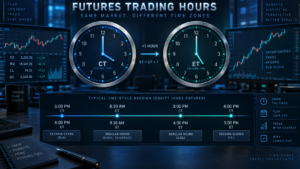
Quick Answer
For many popular CME contracts, futures trading hours extend across nearly the entire weekday, beginning Sunday evening and continuing until Friday afternoon, with a recurring daily maintenance break. U.S. equity-index futures such as ES and NQ are commonly referenced on a 5:00 p.m. CT session open and 4:00 p.m. CT session close, equivalent to 6:00 p.m. and 5:00 p.m. ET. Exact product hours and holiday exceptions should always be verified on CME Group before trading.
Affiliate Disclosure: TradeboticsAI may receive compensation when readers complete qualifying actions through certain links. NinjaTrader buttons on this page are affiliate links. Editorial conclusions are independent of compensation.
Futures Trading Hours at a Glance
The most useful way to understand futures trading hours is to separate the regular electronic session from special holiday schedules. Many popular CME Globex products trade nearly 23 hours on normal weekdays. The broad pattern is a Sunday evening open, continuous weekday trading with a daily maintenance period, and a Friday afternoon close.
| Market | Popular Symbols | Typical Regular CME Globex Pattern | Eastern Time Reference |
|---|---|---|---|
| U.S. Equity Index | ES, MES, NQ, MNQ, YM, MYM, RTY, M2K | Sunday evening through Friday afternoon; daily maintenance break | Commonly referenced as 6:00 p.m.–5:00 p.m. ET on normal sessions |
| Energy | CL, MCL, NG | Nearly around the clock on normal weekdays; product-specific session rules | Verify current CME product schedule |
| Metals | GC, MGC, SI | Nearly around the clock on normal weekdays; product-specific session rules | Verify current CME product schedule |
| Agriculture | ZC, ZW, ZS and others | Often includes distinct day and overnight segments | Product-specific; do not assume equity-index hours |
This table is a planning reference, not a substitute for the exchange schedule. CME Group can revise product hours and publishes separate holiday schedules. Before a time-sensitive trade, confirm the exact contract and date on the official exchange page.
See the
official CME Group Holiday and Trading Hours page
for the current exchange schedule.
Futures Trading Hours: Central Time vs Eastern Time
CME Group frequently publishes futures trading hours in U.S. Central Time because Chicago is the exchange’s primary time reference. Many retail traders, broker interfaces and financial-news calendars instead use Eastern Time. During normal U.S. daylight-saving alignment, Eastern Time is one hour ahead of Central Time.
That means 5:00 p.m. CT corresponds to 6:00 p.m. ET, 8:30 a.m. CT corresponds to 9:30 a.m. ET, and 4:00 p.m. CT corresponds to 5:00 p.m. ET. Confusing CT and ET can create order-timing mistakes, especially near the daily break, economic releases and broker margin cutoffs.
When you save a trading plan, write the timezone beside every important time. “Exit before 3:45” is ambiguous. “Exit before 3:45 p.m. CT” is operationally much clearer.
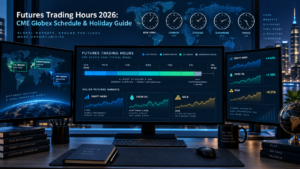
ES and MES Futures Trading Hours
ES and MES are among the most searched contracts for futures trading hours. On regular sessions, E-mini and Micro E-mini S&P 500 futures trade electronically for most of the day and night, allowing participation during Asia, Europe and U.S. market hours.
A widely used 2026 reference for these equity-index contracts is a session open around 5:00 p.m. CT on the prior calendar day and a close around 4:00 p.m. CT, with the daily maintenance period separating sessions. In Eastern Time, that corresponds to approximately 6:00 p.m. to 5:00 p.m. on normal trading days.
The cash U.S. equity market opens at 9:30 a.m. ET, or 8:30 a.m. CT. That does not mean ES suddenly “opens” at that moment; futures have already been trading. Instead, the cash open is a separate liquidity and price-discovery event inside the longer electronic session.
For contract economics, use our
Futures Tick Value Calculator 2026
before combining session timing with stop distance or position size.
NQ and MNQ Futures Trading Hours
NQ and MNQ generally follow the same broad equity-index session structure as ES and MES. This makes futures trading hours easier to remember for traders who switch between S&P 500 and Nasdaq-100 products, but it does not mean liquidity and volatility are identical across the contracts.
Nasdaq futures can react sharply to U.S. economic reports, large technology-company news and the cash-equity open. A market being technically open does not guarantee tight spreads, deep liquidity or stable execution conditions at every hour.
Traders using bracket orders, automation or copy trading should therefore separate “exchange open” from “preferred strategy window.” Your algorithm may be able to trade overnight, but the strategy should only operate during hours that were actually tested.
CL, MCL, GC and MGC Trading Hours
Energy and metals also trade electronically across most of the weekday, but do not assume every contract has identical futures trading hours. WTI Crude Oil futures and Gold futures have their own product specifications, settlement procedures and exchange schedules.
For CL and MCL, energy-market events, weekly inventory data and global geopolitical developments can create sharp changes in liquidity and volatility. For GC and MGC, U.S. economic data, interest-rate expectations and global risk events can affect activity across different sessions.
The safest rule is to use the current product page for the exact contract instead of copying an old schedule from a screenshot or forum post. CME can modify hours or issue special holiday schedules, and newer products may follow different rules from legacy contracts.
The Daily CME Maintenance Break
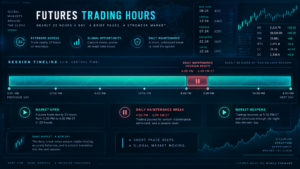
One of the most important details in futures trading hours is the daily maintenance period. “Nearly 24 hours” does not mean uninterrupted trading every minute of the weekday. A recurring break separates trade dates and gives the exchange and market infrastructure time for operational processes.
For many major equity-index futures, traders commonly plan around the 4:00 p.m.–5:00 p.m. CT maintenance window, equivalent to 5:00 p.m.–6:00 p.m. ET. Exact product treatment can vary, so confirm the live CME schedule.
Orders, automated strategies and broker connections should be designed with the break in mind. A system that assumes the market is always open can generate rejected orders, stale signals or synchronization problems when the exchange transitions between sessions.
RTH vs ETH in Futures Trading
Many platforms divide futures trading hours into Regular Trading Hours (RTH) and Extended Trading Hours (ETH). These labels are useful for chart templates and strategy analysis, but the exact session template can depend on the platform, instrument and analytical convention.
For U.S. equity-index futures, traders often use the U.S. cash-equity session as the RTH reference and the broader Globex session as ETH. That distinction affects indicators, volume profiles, VWAP calculations, opening ranges and backtests because resetting a study at a different session boundary can change its output.
When comparing a live chart with a backtest, make sure both use the same session template. A strategy tested on RTH-only data can behave differently when allowed to trade the overnight session.
2026 CME Holiday Trading Schedule
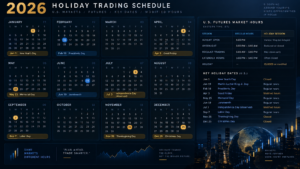
Holiday exceptions are a major reason traders should recheck futures trading hours instead of memorizing one weekly schedule. CME Group publishes special Globex schedules for U.S. holidays and states that exact holiday hours are generally finalized close to the holiday date.
| 2026 Holiday | CME Schedule Window | Planning Note |
|---|---|---|
| New Year’s | Dec. 31, 2025–Jan. 2, 2026 | Special schedule |
| Martin Luther King Jr. Day | Jan. 18–20 | Modified Globex hours |
| Presidents Day | Feb. 15–17 | Modified Globex hours |
| Good Friday | Apr. 2–4 | Product-specific holiday treatment |
| Memorial Day | May 24–26 | Modified hours |
| Juneteenth | Jun. 18–19 | Modified hours |
| Independence Day | Jul. 3–5 | Modified hours |
| Labor Day | Sep. 6–8 | Modified hours |
| Thanksgiving | Nov. 26–28 | Early closes / modified sessions by product |
| Christmas | Dec. 24–26 | Special schedule |
| New Year’s 2027 | Dec. 31, 2026–Jan. 1, 2027 | Special schedule |
CME Group notes that holiday schedules are subject to change and that exact hours are generally finalized approximately two weeks before the holiday. That makes an official exchange check essential before Thanksgiving, Christmas, New Year’s and other modified sessions.
Futures Trading Hours and Prop-Firm Session Rules
Prop-firm traders must distinguish exchange futures trading hours from account-program rules. A futures market can still be open while a prop firm requires positions to be flattened, resets its daily loss calculation, changes the trading day, or restricts certain news periods.
The practical result is that the earliest applicable cutoff controls your account. If CME remains open but your program requires flat positions by a particular time, the prop-firm rule matters for account compliance.
Use our
Prop Firm Drawdown Calculator 2026
and
Prop Firm Consistency Rule Calculator 2026
for separate account-rule calculations.
Trading Hours and Futures Margin
Futures trading hours also interact with broker margin policy. A broker can offer a reduced intraday margin during the active session and require a much larger initial or overnight amount before the session close or during specified risk windows.
This means a position can be valid under intraday margin at 2:00 p.m. CT but no longer fit the account when the broker switches to the higher requirement near the end of the session. The exchange being open does not guarantee your brokerage account has enough equity to carry the position.
Use our
Futures Margin Calculator 2026
to compare intraday and overnight requirements using the current rates provided by your broker.
Automation, VPS and Futures Session Cutoffs
Automated systems need explicit awareness of futures trading hours. A robust strategy should know when new entries are permitted, when orders should be canceled, when positions must be flattened, when the daily maintenance period begins and how the strategy behaves after the session reopens.
A VPS can keep a trading platform online, but it does not solve poor session logic. If the automation is allowed to submit orders during a closed market or broker cutoff, continuous uptime can actually reproduce the same operational error more consistently.
For infrastructure, see our
Best Futures Trading VPS 2026
and
Best Automated Futures Trading Software 2026
guides.
Common Futures Trading Hours Mistakes
Assuming Futures Follow Stock-Market Hours
ES and NQ trade well outside the U.S. cash-equity session. The 9:30 a.m. ET stock-market open is an important liquidity event, not the start of the full futures session.
Ignoring the Timezone
Always note whether a schedule is in CT or ET. One hour can make the difference between a normal entry and an order sent into a maintenance or broker cutoff window.
Assuming “23 Hours” Means Every Contract Has Identical Hours
Product groups can have different schedules. Check the exact CME contract rather than using one generic timetable.
Ignoring Holiday Schedules
Normal futures trading hours can be shortened or modified on U.S. holidays. CME publishes the official 2026 holiday schedule and warns that times can change.
Confusing Exchange Hours With Broker Rules
A broker can impose margin cutoffs or risk restrictions before the exchange closes. Your account must satisfy both exchange availability and broker requirements.
Backtesting the Wrong Session
RTH-only and extended-hours data can produce different indicators, entry signals and statistics. Match the test session to the intended live strategy.
Futures Trading Hours FAQ
What are futures trading hours in 2026?
Many major CME futures trade nearly 23 hours per normal weekday from Sunday evening through Friday afternoon, with a daily maintenance period. Exact hours depend on the product and date.
What time do ES futures open?
On a normal weekly schedule, ES is commonly referenced as opening around 5:00 p.m. CT on Sunday and after the daily session break, equivalent to 6:00 p.m. ET. Verify the current CME schedule before trading.
What time do NQ futures close?
On normal sessions, NQ is commonly referenced with a 4:00 p.m. CT session close, equivalent to 5:00 p.m. ET, before the daily maintenance period. Holiday schedules can differ.
Do futures trade overnight?
Yes. Many major CME contracts trade through overnight Asia and European hours as part of the broader Globex session.
Do futures trade on weekends?
Most traditional CME futures are closed for the standard weekend after Friday’s close and reopen Sunday evening. Some newer CME products now use expanded 24/7 schedules, so check the exact contract rather than assuming one weekend rule applies to everything.
What is the daily futures maintenance break?
Many major CME products have a recurring daily trading halt or maintenance period. For equity-index futures, traders commonly plan around the 4:00 p.m.–5:00 p.m. CT interval, but verify current product hours.
Are futures trading hours different on holidays?
Yes. CME publishes special holiday schedules that can include early closes, delayed opens or product-specific changes.
What is RTH in futures?
RTH generally means Regular Trading Hours, often used by platforms to isolate the primary daytime session. ETH refers to the broader electronic session. Exact templates can vary by platform and instrument.
Are prop-firm trading hours the same as CME hours?
Not necessarily. A prop firm can impose its own flatten times, daily resets or news restrictions even while CME remains open.
Where should I verify current CME hours?
Use CME Group’s official Holiday and Trading Hours page and the product page for the exact contract. Treat third-party schedules as references rather than final authority.
Final Verdict: Futures Trading Hours for 2026
Understanding futures trading hours means more than memorizing a Sunday open and Friday close. Traders need to know the exchange session, daily maintenance period, CT-versus-ET conversion, holiday exceptions, broker margin cutoff and any prop-firm rule that shortens the usable trading window.
For ES, MES, NQ and MNQ, the broad 2026 pattern remains nearly around-the-clock weekday access on CME Globex, while CL, MCL, GC, MGC and other product groups should always be checked against their current contract-specific schedules. Holiday sessions deserve a fresh check because CME states that exact holiday hours can be updated close to the date.
The best operational habit is simple: verify the exchange first, then the broker, then the prop-firm or strategy rules. Use futures trading hours as an input to your trading system rather than assuming that “market open” automatically means “strategy should trade.”