NinjaTrader vs Interactive Brokers 2026: Best Broker?
NinjaTrader vs Interactive Brokers 2026: Which Broker Is Better?
NinjaTrader vs Interactive Brokers is one of the most useful broker comparisons for sophisticated traders in 2026 because the two platforms solve very different problems.
NinjaTrader is primarily designed around active futures trading. Its ecosystem combines futures brokerage, advanced charting, low intraday margins, simulated trading, strategy backtesting and C#-based NinjaScript automation.
Interactive Brokers, commonly known as IBKR, is a much broader global brokerage platform. It provides access to futures alongside stocks, options, currencies, bonds, funds and other products across more than 170 markets worldwide.
This means the NinjaTrader vs Interactive Brokers decision is not simply about which company charges the lowest futures commission.
A futures day trader who primarily trades Micro E-mini contracts may value NinjaTrader’s specialized workflow, simulation environment and capital-efficient intraday margin structure.
A sophisticated global trader or developer may instead prefer Interactive Brokers for its multi-asset infrastructure, international market access, advanced order types and extensive API ecosystem.
There is also an important third possibility: eligible users can connect an Interactive Brokers account to NinjaTrader Desktop using NinjaTrader’s Multi-Broker functionality.
This detailed NinjaTrader vs Interactive Brokers 2026 comparison examines futures pricing, margins, platforms, automation, APIs, paper trading, market access and regulation to determine which broker is better for different trading workflows.
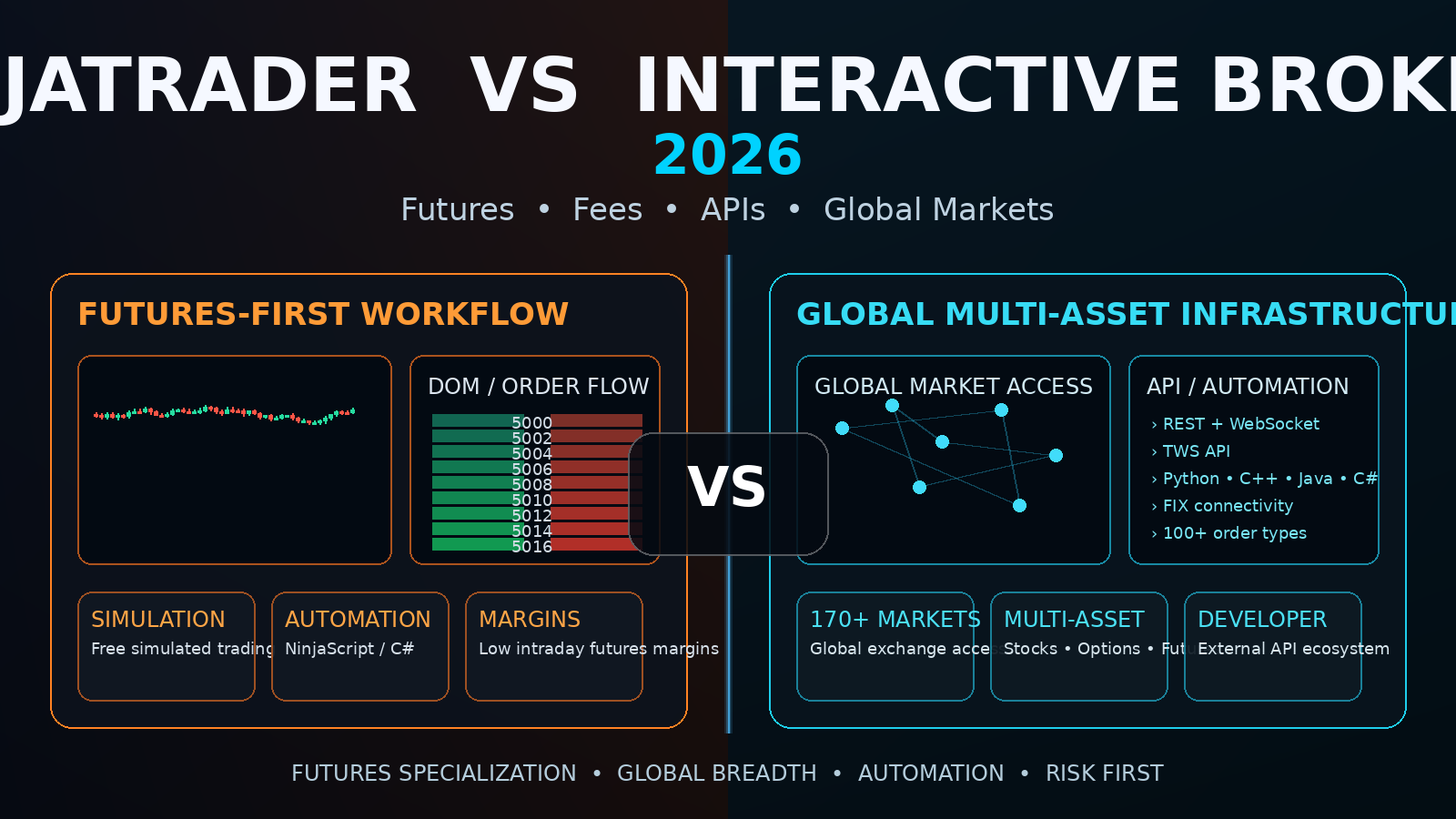
Free simulated trading is available through NinjaTrader. Live futures trading involves substantial financial risk, leverage, commissions and other applicable fees. The linked affiliate offer is intended for eligible U.S. users..
Table of Contents
- NinjaTrader vs Interactive Brokers: Quick Verdict
- NinjaTrader vs Interactive Brokers Comparison
- What Is NinjaTrader?
- What Is Interactive Brokers?
- Futures Fees and Commissions
- Futures Margin Requirements
- Trading Platforms and Usability
- Automation and API Trading
- Simulation and Paper Trading
- Markets and Asset Classes
- Can You Use Interactive Brokers With NinjaTrader?
- Regulation and Broker Structure
- Who Should Choose NinjaTrader?
- Who Should Choose Interactive Brokers?
- Frequently Asked Questions
- Final Verdict
— NinjaTrader vs Interactive Brokers: Quick Verdict
The NinjaTrader vs Interactive Brokers comparison produces two very different winners depending on what the trader actually needs.
Best for dedicated futures trading: NinjaTrader
NinjaTrader offers a tightly focused futures ecosystem with competitive commissions, low advertised intraday margins, free simulated trading and advanced futures-specific tools.
Best for global multi-asset trading: Interactive Brokers
Interactive Brokers provides access to more than 170 markets and supports equities, options, futures, currencies, bonds and additional financial products from one brokerage environment.
Best for futures-focused desktop automation: NinjaTrader
NinjaScript gives technically advanced users access to a C#-based framework designed around NinjaTrader Desktop.
Best for external APIs and global automated systems: Interactive Brokers
IBKR provides REST/WebSocket APIs, the TWS API, FIX connectivity and support for multiple programming languages.
Best for unfunded futures simulation: NinjaTrader
NinjaTrader allows users to explore advanced charting, strategy backtesting and simulated trading without a funding requirement or time limit.
Best for broad institutional-style infrastructure: Interactive Brokers
IBKR’s Trader Workstation provides advanced execution, risk monitoring and more than 100 order types across global markets.
For a trader focused almost entirely on U.S. futures, NinjaTrader wins our quick verdict.
For a global multi-asset trader or developer, Interactive Brokers wins on breadth.
— NinjaTrader vs Interactive Brokers Comparison
| Feature | NinjaTrader | Interactive Brokers |
|---|---|---|
| Primary Focus | Dedicated futures trading | Global multi-asset brokerage |
| Futures | Excellent | Excellent |
| Stocks & ETFs | Not core brokerage focus | Yes |
| Options | Futures-focused ecosystem | Yes |
| Global Markets | Selected futures exchanges | 170+ markets |
| Advanced Charting | Excellent | Yes |
| Simulation | Free simulated trading | Demo / Paper Trading available |
| Automation | NinjaScript / C# | Multiple APIs |
| External API Ecosystem | More platform-centered | Extensive |
| Desktop | Yes | Yes |
| Web | Yes | Yes |
| Mobile | Yes | Yes |
| Best For | Active futures specialists | Global multi-asset traders |
The table illustrates why NinjaTrader vs Interactive Brokers should not be reduced to a simple broker ranking.
NinjaTrader concentrates on building a highly specialized futures workflow.
Interactive Brokers attempts to provide professional infrastructure across a much larger universe of products and exchanges.
The better choice depends on whether specialization or global breadth creates more value for the trader.
.
— What Is NinjaTrader?
NinjaTrader is a trading technology and brokerage ecosystem primarily focused on futures.
Its current platform environment includes NinjaTrader Desktop, Web and Mobile.
Futures traders can access:
- advanced charts;
- simulated trading;
- strategy backtesting;
- Market Replay;
- order-flow tools;
- futures order execution;
- custom indicators;
- automated strategies;
- NinjaScript development.
NinjaTrader currently advertises access to more than 100 futures contracts across major venues including CME Group, Eurex, ICE and Coinbase Derivatives.
Its specialization is important when considering NinjaTrader vs Interactive Brokers.
Rather than attempting to provide every possible asset class, NinjaTrader concentrates much of its technology and pricing architecture specifically around active futures traders.
For our full platform analysis, see our NinjaTrader Review 2026.
— What Is Interactive Brokers?
Interactive Brokers is a global multi-asset brokerage designed for active traders, investors, professionals and institutional users.
Its flagship Trader Workstation platform provides access to more than 170 markets worldwide.
IBKR supports a much broader product universe than NinjaTrader’s core brokerage, including:
- stocks;
- ETFs;
- options;
- futures;
- futures options;
- currencies;
- bonds;
- funds;
- additional global financial products.
Trader Workstation also provides sophisticated execution functionality, including advanced order management, algorithmic orders, market scanners and portfolio-risk tools.
This makes Interactive Brokers particularly attractive to traders who do not want their brokerage infrastructure centered exclusively around futures.
The NinjaTrader vs Interactive Brokers decision therefore becomes much clearer when market breadth is important.
Verifica dati, non copiare: IBKR descrive TWS come piattaforma multi-asset con accesso a 170+ mercati e più di 100 tipi di ordine.
— Futures Fees and Commissions
Futures pricing is one of the most important parts of the NinjaTrader vs Interactive Brokers comparison.
NinjaTrader currently offers three primary plans.
Free
$0/month
Micro and e-Nano commission: $0.39 per side
Standard futures commission: $1.29 per side
Monthly
$99/month
Micro and e-Nano: $0.29 per side
Standard: $0.99 per side
Lifetime
$1,499 one-time
Micro: $0.09 per side
Standard: $0.59 per side
Exchange, clearing and NFA fees apply in addition to the advertised brokerage commissions.

Interactive Brokers uses volume-based futures pricing.
For U.S.-denominated standard futures and futures options, current execution commissions begin at approximately:
Up to 1,000 contracts/month: $0.85 per contract
1,001–10,000: $0.65
10,001–20,000: $0.45
More than 20,000: $0.25
For specified Micro and E-micro futures including contracts such as MES and MNQ, the schedule currently begins at:
Up to 1,000: $0.25
1,001–10,000: $0.20
10,001–20,000: $0.15
More than 20,000: $0.10
Exchange and regulatory charges can apply in addition to these execution commissions.
— Which Is Cheaper?
There is no universal winner.
NinjaTrader can be highly competitive for futures specialists, particularly traders using its Lifetime pricing.
Interactive Brokers becomes increasingly competitive as volume increases and does not charge a separate trading-platform fee.
For example, IBKR’s current published execution commission for certain Micro futures begins at $0.25 for lower-volume clients and can fall to $0.10 at more than 20,000 contracts per month.
NinjaTrader Lifetime currently advertises $0.09 per Micro contract per side before additional applicable charges.
Actual all-in cost depends on:
commission + exchange fee + clearing fee + regulatory fee + platform plan + market data + trading volume
For our detailed NinjaTrader analysis, see our NinjaTrader Fees 2026 guide.
— Futures Margin Requirements
Margin policy creates another major distinction in NinjaTrader vs Interactive Brokers.
NinjaTrader aggressively targets active futures traders with reduced intraday margin requirements.
It currently advertises intraday margins beginning around:
$50 for selected Micro contracts
$500 for several popular E-mini contracts
and higher amounts for certain commodity contracts.
Interactive Brokers also publishes intraday futures-margin schedules, but its requirements are contract-specific and positions revert to full overnight margin outside the applicable intraday window.
For traders whose main objective is maximizing intraday futures capital efficiency, NinjaTrader can therefore be particularly attractive.
However, low margin is not automatically an advantage from a risk perspective.
Lower margin means greater leverage can be applied to a smaller account.
The broker’s minimum margin answers whether a position can technically be supported.
It does not answer whether the trader has enough capital to manage normal losses responsibly.
For a deeper explanation, see ourNinjaTrader Minimum Deposit 2026 guide.
.
Practice with simulated futures trading before deciding whether live trading is appropriate for you. Simulated performance does not guarantee future live results.
— Trading Platforms and Usability
Platform design is another area where NinjaTrader vs Interactive Brokers reflects two very different philosophies.
— NinjaTrader
NinjaTrader provides:
- NinjaTrader Desktop;
- NinjaTrader Web;
- NinjaTrader Mobile.
Desktop provides the deepest customization, including advanced futures charts, NinjaScript and third-party trading tools.
The ecosystem is designed around creating a specialized futures workstation.
— Interactive Brokers
Interactive Brokers provides multiple interfaces including:
- Trader Workstation;
- IBKR Desktop;
- Client Portal;
- IBKR Mobile;
- API-based access.
Trader Workstation is particularly powerful for complex multi-asset execution and portfolio management.
It supports sophisticated conditional orders, algorithmic orders, spreads and risk-monitoring functionality.
— Platform Verdict
For a dedicated futures workstation:
NinjaTrader wins on specialization.
For global portfolio and multi-asset execution:
Interactive Brokers wins on breadth.
For a new user, both platforms have meaningful learning curves because they provide professional functionality rather than simplified investing interfaces.
— Automation and API Trading
Automation is one of the strongest reasons to compare NinjaTrader vs Interactive Brokers.
— NinjaTrader NinjaScript
NinjaTrader Desktop provides NinjaScript, a development environment based on C#.
It can be used to create:
- automated futures strategies;
- custom indicators;
- trading tools;
- custom analytics;
- chart components;
- platform add-ons.
This provides deep control inside the NinjaTrader Desktop ecosystem.
— Interactive Brokers APIs
Interactive Brokers has one of the broader brokerage API environments in the retail and professional trading market.
IBKR currently supports:
- Web API;
- WebSocket functionality;
- TWS API;
- FIX;
- Excel integration;
- multiple programming languages including Python, Java, C++ and C#.
These APIs can be used to automate strategies, create proprietary interfaces and integrate external systems directly with Interactive Brokers brokerage infrastructure.
— Automation Winner
For deep native futures automation inside a specialized desktop platform:
NinjaTrader
For external, multi-asset and global algorithmic infrastructure:
Interactive Brokers
This distinction is strategically important.
A trader building a futures-specific system may prefer NinjaScript.
A fintech developer building a scalable multi-market application may prefer the breadth of IBKR’s APIs.
Verifica dati, non copiare: IBKR documenta Web API, WebSocket, TWS API, FIX, Excel e supporto multi-language; NinjaTrader documenta il proprio ambiente C# NinjaScript.
— Simulation and Paper Trading
Simulation is another meaningful NinjaTrader vs Interactive Brokers difference.
NinjaTrader currently allows users to use advanced charting, strategy backtesting and simulated trading without a time limit or brokerage funding requirement.
This makes it straightforward for a prospective futures trader to evaluate the platform before depositing capital.
Interactive Brokers also provides demo and paper-trading functionality.
Trader Workstation currently advertises a simulated environment with virtual funds for users learning its professional tools.
However, IBKR’s technical documentation distinguishes its demo environment from a full Paper Trading Account attached to a regular brokerage account. Its API documentation states that a regular account generally needs to be approved and funded before the associated Paper Trading Account can be created.
For users whose priority is simply exploring a futures platform before opening and funding a brokerage relationship:
NinjaTrader has the simpler proposition.
For our complete simulation guide, see our NinjaTrader Demo 2026.
— Markets and Asset Classes
Market breadth is where Interactive Brokers clearly separates itself.
NinjaTrader focuses primarily on futures brokerage.
That specialization includes more than 100 futures contracts across several major futures venues.
Interactive Brokers operates on a much broader scale.
Its platforms provide global access to equities, options, futures, currencies, bonds and other products across more than 170 markets.
This makes the NinjaTrader vs Interactive Brokers decision relatively straightforward for traders who need multiple asset classes.
Choose specialization: NinjaTrader.
Choose global breadth: Interactive Brokers.
For traders focused purely on identifying the strongest futures-specific choices, see our Best Futures Trading Platforms 2026 comparison.
— Can You Use Interactive Brokers With NinjaTrader?
Yes, and this is one of the most interesting facts in the NinjaTrader vs Interactive Brokers comparison.
NinjaTrader Desktop currently supports Interactive Brokers as an additional third-party brokerage connection.
This means a trader can potentially maintain funds and brokerage services at Interactive Brokers while using NinjaTrader Desktop as the trading platform.
However, NinjaTrader currently requires its Multi-Broker add-on for third-party brokerage integrations.
The published price is currently:
$99 per month
This setup can be attractive to traders who want:
Interactive Brokers for brokerage and multi-asset market access
combined with:
NinjaTrader Desktop for charting, futures workflow or NinjaScript-based tools
There is an important limitation.
NinjaTrader Web and NinjaTrader Mobile are primarily available to NinjaTrader Brokerage account holders. Third-party brokerage integrations such as Interactive Brokers are centered around NinjaTrader Desktop.
Therefore, using both ecosystems together is possible, but it does not automatically combine every feature of both platforms.
Verifica dati, non copiare: NinjaTrader ufficialmente elenca Interactive Brokers tra i broker supportati via Desktop e indica il Multi-Broker add-on a $99/mese.
— Regulation and Broker Structure
Both brokers operate within the regulated U.S. futures framework.
NinjaTrader Clearing, LLC is registered with the Commodity Futures Trading Commission as a Futures Commission Merchant and is a member of the National Futures Association.
Interactive Brokers LLC is also a registered Futures Commission Merchant and operates under CFTC and NFA oversight for its commodities brokerage activity.
Interactive Brokers additionally operates as a U.S. broker-dealer for securities activities, reflecting its broader multi-asset business.
Regulation should never be interpreted as a guarantee against losses or operational problems.
Traders should independently verify the current legal entity, regulatory registration, customer-fund arrangements and account terms before depositing money.
Verifica dati, non copiare: entrambe le strutture hanno registrazione FCM/CFTC per futures; IBKR è anche broker-dealer regolamentato per securities.
— Who Should Choose NinjaTrader?
NinjaTrader may be the stronger choice if you:
- primarily trade futures;
- trade Micro and E-mini contracts;
- want low published intraday margins;
- want to explore simulation without funding first;
- need futures-specific order-management tools;
- prefer a specialized futures environment;
- use multi-monitor desktop setups;
- want C#-based NinjaScript automation;
- want extensive third-party futures tools;
- do not need one brokerage account for many asset classes.
For these users, the NinjaTrader vs Interactive Brokers decision generally favors NinjaTrader because specialization matters more than global product breadth.
Independent 2026 testing also continues to rate NinjaTrader particularly highly for dedicated futures trading.
— Who Should Choose Interactive Brokers?
Interactive Brokers may be the stronger choice if you:
- trade futures and additional asset classes;
- require global market access;
- trade on international exchanges;
- manage a multi-asset portfolio;
- need sophisticated risk tools;
- use complex order types;
- build external trading software;
- need Python, Java, C++, C# or REST/WebSocket integrations;
- operate algorithmic strategies across different markets;
- want institutional-style brokerage infrastructure.
For these traders, NinjaTrader vs Interactive Brokers generally favors IBKR because market breadth and infrastructure outweigh the advantages of a futures-only workflow.
— Frequently Asked Questions
— Is NinjaTrader better than Interactive Brokers for futures?
For traders focused almost exclusively on active futures, NinjaTrader may provide the more specialized experience through its futures-specific tools, low advertised intraday margins and simulation environment.
Interactive Brokers may be better for futures traders who also need global markets or additional asset classes.
— NinjaTrader vs Interactive Brokers: which is cheaper?
The answer depends on contract type, monthly volume and NinjaTrader plan.
NinjaTrader uses Free, Monthly and Lifetime pricing.
Interactive Brokers uses volume-based futures commissions.
Total cost should include brokerage commission, exchange charges, regulatory fees, market data and any applicable platform-plan cost.
For lower monthly trading volumes, Interactive Brokers currently lists approximately $0.25 execution commission for specified Micro futures, while NinjaTrader’s Free plan currently lists $0.39.
NinjaTrader Monthly lowers its Micro commission to $0.29, while Lifetime currently lists $0.09.
At very high volume, Interactive Brokers’ Micro schedule can currently fall to approximately $0.10.
Additional charges apply to both brokers.
— Which has lower futures margin requirements?
NinjaTrader strongly emphasizes low intraday futures margins and currently advertises requirements beginning at approximately $50 for selected Micro contracts.
Interactive Brokers uses contract-specific intraday and overnight margin schedules.
Margin requirements can change and should always be verified immediately before trading.
— Which is better for automated trading?
It depends on architecture.
NinjaTrader provides deep C#-based NinjaScript integration within NinjaTrader Desktop.
Interactive Brokers provides a broader external API ecosystem suitable for building multi-asset and global trading applications.
— Can Interactive Brokers connect to NinjaTrader?
Yes.
Interactive Brokers is currently listed by NinjaTrader as a supported third-party brokerage connection for NinjaTrader Desktop.
A paid Multi-Broker add-on is required for this integration.
— Does Interactive Brokers have paper trading?
Yes.
IBKR provides demo and paper-trading environments, although requirements can differ between a simple demo and a full Paper Trading Account associated with an approved brokerage account.
.
— Does NinjaTrader offer free simulation?
Yes.
NinjaTrader currently allows advanced charting, backtesting and simulated trading without a funding requirement or time limit.
— Is Interactive Brokers better for global trading?
Interactive Brokers has a clear advantage for traders who need broad international and multi-asset market access.
Its Trader Workstation currently supports access to more than 170 markets.
— NinjaTrader vs Interactive Brokers: which is better overall?
For dedicated futures specialists, TradeboticsAI prefers NinjaTrader.
For sophisticated global multi-asset traders and developers, Interactive Brokers provides greater breadth.
The better broker therefore depends on what the trader actually intends to trade and automate.
— Final Verdict
Our NinjaTrader vs Interactive Brokers 2026 comparison reveals two high-quality platforms designed for fundamentally different trading operations.
NinjaTrader — Our Choice for Dedicated Futures Traders
NinjaTrader provides a highly focused futures ecosystem combining competitive pricing, low advertised intraday margins, advanced charts, simulation, strategy testing and NinjaScript automation.
For traders primarily focused on Micro futures, E-mini futures and active futures workflows, this specialization is a major advantage.
Interactive Brokers — Our Choice for Global Multi-Asset Traders
Interactive Brokers provides substantially greater market breadth.
Its global market access, multi-asset brokerage structure, Trader Workstation and extensive API ecosystem make it particularly powerful for sophisticated traders, developers and users managing strategies across several asset classes.
The Hybrid Option
The NinjaTrader vs Interactive Brokers comparison also has a unique third answer.
Eligible traders can connect Interactive Brokers to NinjaTrader Desktop through NinjaTrader’s Multi-Broker functionality.
This can potentially combine IBKR brokerage infrastructure with NinjaTrader’s futures-oriented Desktop experience.
Overall Winner for Futures-First Users: NinjaTrader
For the typical TradeboticsAI visitor specifically searching for a dedicated U.S. futures trading platform, NinjaTrader is the platform we would evaluate first through simulation.
For a trader requiring a global brokerage, multiple asset classes and extensive APIs, Interactive Brokers may be the superior infrastructure.
The best platform depends on markets, trading volume, software architecture and risk-management requirements.
Neither platform, lower commissions nor automated trading technology can guarantee profitable results.
Explore NinjaTrader through simulated futures trading before considering a live account. Futures trading involves substantial financial risk, leverage and applicable trading costs.
— Research & Official Sources
Pricing, margin requirements, platform functionality, integrations and account conditions can change. TradeboticsAI cross-checks comparisons against official provider documentation and independent broker research, but traders should always verify current information before opening, funding or trading through an account.
For current information, consult NinjaTrader Pricing, NinjaTrader Brokerage & Platform Options, Interactive Brokers Futures Pricing, IBKR Trader Workstation and IBKR API Documentation. Independent broker testing can also provide additional context.
— Affiliate Disclosure
TradeboticsAI may receive compensation when eligible users register or purchase products through affiliate links on this page. This does not increase the price paid by the user. Our comparisons and conclusions consider platform functionality, pricing, market access, target users and publicly available information and are not determined solely by affiliate compensation.
— Risk Disclosure
Futures and derivatives trading involves substantial risk and is not appropriate for every investor. Leverage can magnify losses, and traders may lose all or more than their initial investment. Margin requirements, commissions and platform conditions can change. Simulated, hypothetical and backtested results do not represent actual trading results and should not be interpreted as a guarantee of future performance. Automated trading introduces additional technology, connectivity, execution and strategy risks. TradeboticsAI provides educational and informational content only and does not provide personalized investment, financial, legal or tax advice..