Futures vs Stocks 2026: Key Differences, Leverage & Risk
Futures vs Stocks is a fundamental comparison for traders deciding whether they want direct ownership of companies or leveraged exposure through standardized derivatives. Stocks represent an ownership interest in a corporation, while futures are standardized contracts whose value is tied to an underlying market such as an equity index, commodity, interest rate or currency. The two markets differ in margin, leverage, trading hours, short exposure, expiration, dividends, taxes and risk. This 2026 guide explains those differences so you can decide which structure better fits your trading horizon and risk tolerance.
Quick Answer: Futures vs Stocks in 2026
For long-term investors who want ownership, voting rights and potential dividends, stocks are usually the more natural instrument. For active traders who want standardized leverage, nearly around-the-clock access in many contracts, straightforward long or short exposure and efficient index trading, futures can be attractive. The right Futures vs Stocks choice depends on whether your priority is investment ownership or tactical market exposure.
Practice Futures Trading with NinjaTrader
Affiliate Disclosure: TradeboticsAI may earn compensation when a qualifying action is completed through an affiliate link, at no extra cost to you. This does not affect our editorial analysis.
Futures vs Stocks 2026: Core Difference

The central Futures vs Stocks distinction is ownership. When you buy common stock, you purchase an equity interest in a corporation. Depending on the share class, that can include voting rights and eligibility for dividends. Your position does not automatically expire simply because time passes.
A futures contract is different. It is a standardized exchange-traded agreement tied to an underlying asset or benchmark and has defined contract specifications and an expiration cycle. Equity-index futures such as contracts on the S&P 500 or Nasdaq-100 provide market exposure without purchasing the individual shares that make up the index.
This structural difference affects nearly every other part of the comparison. Futures are built primarily for exposure, hedging and trading. Stocks are built around ownership in operating companies, even though they are also widely traded speculatively.
For the official stock definition, see Investor.gov’s stock overview. For futures education, see the CME Group Introduction to Futures.
Ownership vs Contract Exposure
A useful Futures vs Stocks framework begins by asking whether you actually want to own the underlying company. Stockholders participate directly in the company’s equity. A long-term investor may hold the same shares for years, reinvest dividends and benefit if the business grows in value.
A futures trader generally wants price exposure rather than corporate ownership. An equity-index futures position may rise or fall with the index, but it does not provide shareholder voting rights in the companies inside that index. The position also has an expiration date, which means long-term exposure must be rolled from one contract to another.
Neither structure is inherently better. Ownership is useful when your thesis is about long-term business value. Futures are useful when your thesis is about market direction, hedging, tactical exposure or capital efficiency.
Futures vs Stocks: Key Differences Compared
| Factor | Futures | Stocks |
|---|---|---|
| Ownership | No ownership of underlying companies | Equity ownership in a company |
| Expiration | Contracts expire | Shares normally have no expiration date |
| Leverage | Margin-based, often highly leveraged | Cash ownership or securities margin |
| Short exposure | Long or short through the same contract structure | Short sales depend on securities borrowing and broker rules |
| Income | No direct stock dividend ownership | Eligible shares may pay dividends |
| Trading hours | Many major contracts trade nearly 24 hours on business days | Core exchange session plus available premarket/after-hours access |
| Typical use | Trading, hedging and tactical exposure | Investment ownership and trading |
The strongest Futures vs Stocks decision is therefore based on use case rather than on a single feature such as leverage or commission.
Futures vs Stocks Margin and Leverage
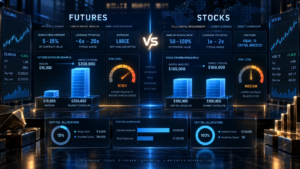
Margin is one of the biggest Futures vs Stocks differences. In futures, margin is a performance bond or collateral supporting the contract. It is not a down payment on the underlying asset. Because the required margin is only a portion of the contract’s notional value, futures can create substantial leverage.
Stock margin works differently. In a margin securities account, the investor borrows part of the purchase price from the broker and owns the securities subject to the broker’s lien and margin requirements. A cash stock purchase, by contrast, does not require borrowed money at all.
CME Group explains that futures margin can represent a relatively small percentage of contract notional value, while securities margin follows a different borrowing framework. This capital efficiency is useful for hedgers and active traders, but it also means a small price movement can create a large percentage gain or loss relative to the collateral deposited.
Do not size a futures position from the maximum contracts your broker permits. Size from maximum acceptable loss, tick value and stop distance. Low required margin does not make the market movement smaller.
Going Short: Futures vs Stocks
Short exposure is operationally simpler on the futures side of Futures vs Stocks. A trader can generally sell a futures contract to open a short position using the same standardized contract mechanism used for a long position.
Shorting individual stocks involves securities-lending mechanics. The broker normally must be able to borrow or locate shares, and hard-to-borrow securities can involve additional fees or restrictions. Short sellers can also face buy-in or recall-related issues depending on the security and broker.
That makes futures attractive for traders who frequently move between long and short index exposure. However, easier short access does not mean lower risk. A short futures position can lose rapidly when the market rises, and leverage can magnify that move.
Trading Hours and Liquidity

Trading hours influence the Futures vs Stocks choice for traders who react to overnight news. Many major CME futures contracts trade through extended sessions from Sunday evening through Friday, with a daily maintenance break. This can allow traders to adjust index exposure around overseas markets, economic releases and events outside U.S. stock-market hours.
Stocks have a defined regular exchange session, while many brokers also provide premarket and after-hours access. Liquidity and spreads can differ significantly outside the core session, especially in less-active individual stocks.
Extended futures hours are not automatically an advantage for every strategy. Overnight liquidity may be thinner than during U.S. cash hours, and slippage can increase. Trade the session your strategy was designed and tested for rather than assuming every hour behaves the same.
Dividends and Corporate Ownership
Dividends are another structural Futures vs Stocks difference. A shareholder who owns an eligible dividend-paying stock on the required dates can receive distributions declared by the company. Futures traders do not receive those company dividends as shareholders because they do not own the constituent shares.
For equity-index futures, expected dividends are one factor incorporated into the relationship between futures prices and the underlying cash index. That economic adjustment is different from receiving dividend cash directly into a brokerage account as a shareholder.
For a long-term investor seeking business ownership, dividend income or shareholder voting rights, stocks generally fit the objective more directly. For a trader who only wants temporary index exposure, those ownership benefits may be irrelevant.
Futures vs Stocks Trading Costs
Trading cost should be compared on an all-in basis when evaluating Futures vs Stocks. Futures costs can include broker commissions, exchange fees, clearing fees, regulatory charges, bid-ask spread, market-data subscriptions and possible routing or technology charges.
Many U.S. stock brokers advertise zero commissions for online stock trades, but zero commission does not mean zero cost. Bid-ask spreads, securities margin interest, short-borrow fees and other broker charges can still affect results. Individual stock liquidity also varies dramatically.
Futures do not have ETF-style annual management fees when the trader uses the futures contract directly, but long-term futures exposure involves contract rollover and an implied financing relationship embedded in futures pricing. Stocks held in cash do not require contract rollover.
For high-frequency traders, small per-trade costs can compound quickly. For long-term investors, recurring trading costs may matter less than ownership, taxes, dividends and portfolio construction.
Futures vs Stocks Tax Considerations in the U.S.
Tax treatment can differ materially in a U.S. Futures vs Stocks comparison, but it should never be generalized without checking the exact instrument and taxpayer situation. Many regulated futures contracts can fall under Internal Revenue Code Section 1256, which generally uses year-end mark-to-market treatment and a 60% long-term / 40% short-term capital-gain split for qualifying positions.
Stocks normally follow the securities capital-gain framework, where holding period can determine whether a gain or loss is short-term or long-term. Dividends can also have separate tax treatment depending on whether they qualify and on the investor’s circumstances.
Not every derivative or futures-like product receives identical treatment, and tax law can change. Use the current IRS guidance and a qualified tax professional rather than choosing a trading product solely because of a simplified tax claim.
Futures vs Stocks for Day Trading
For active intraday traders, Futures vs Stocks often comes down to centralized index exposure versus security selection. A futures trader can use one liquid contract such as MES, ES, MNQ or NQ to express a view on a broad equity index. A stock trader can instead choose among thousands of individual companies with different catalysts and volatility profiles.
Futures have standardized tick values and typically make switching from long to short straightforward. Stocks provide greater instrument variety and company-specific opportunities. Earnings releases, mergers, analyst changes and sector news can create moves that do not exist in broad index futures.
Futures leverage can also accelerate losses. A trader should not choose futures simply because the broker requires less intraday collateral than the cash value of a stock position.
For a structured learning path, see our Futures Trading for Beginners 2026 guide and our Futures Trading Strategies 2026 guide.
Which Is Better for Long-Term Investing?
For traditional long-term investing, the Futures vs Stocks comparison generally favors stocks because shares can be held indefinitely and represent actual equity ownership. Investors can build diversified portfolios, receive eligible dividends and participate directly in company growth.
Futures can still be used for long-term portfolio hedging or tactical exposure, but an expiring futures position must eventually be rolled if the trader wants to maintain exposure. The pricing difference between contract months can create gains or costs during that process.
A long-term investor should therefore distinguish between investing in productive companies and trading a derivative linked to a market benchmark. Futures can complement a portfolio, but they are not simply stock ownership with more leverage.
Micro Futures and Smaller Trading Accounts

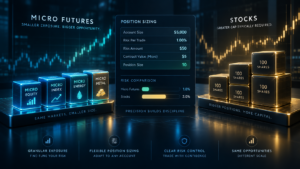
Micro contracts have changed the retail Futures vs Stocks decision because traders no longer need to use only larger E-mini contracts for major equity-index exposure. CME’s Micro E-mini contracts are one-tenth the size of their corresponding E-mini products.
MES tracks the S&P 500 with a $5 multiplier, while MNQ tracks the Nasdaq-100 with a $2 multiplier. Their smaller tick values can make it easier to align position size with a defined dollar-risk limit.
A smaller contract does not eliminate leverage. Multiple Micro contracts can quickly recreate the exposure of a larger contract, and per-contract fees can accumulate. The purpose of Micros should be precision, not an excuse to maximize buying power.
Our Micro Futures Trading 2026 guide covers MES, MNQ, tick values and position sizing in detail.
Futures vs Stocks Pros and Cons
Futures Pros
- Efficient standardized exposure to indexes, commodities, rates and other markets.
- Long and short positions use the same basic contract framework.
- Many major contracts trade through extended sessions.
- Micro contracts provide smaller increments of exposure.
- Potential capital efficiency through futures margin.
Futures Cons
- Leverage can magnify losses quickly.
- Contracts expire and may need to be rolled.
- Margin requirements can change.
- Market-data, clearing and exchange fees can add cost.
- Futures ownership does not provide company voting rights or direct dividends.
Stocks Pros
- Direct ownership of corporations.
- Potential dividends and voting rights.
- No futures-style contract expiration.
- Broad choice of individual companies and sectors.
- Suitable for long-term investment portfolios.
Stocks Cons
- Individual companies can face company-specific business risk.
- Short selling can require share borrowing.
- Cash stock positions can require more capital for equivalent notional exposure.
- After-hours liquidity may be thinner.
- Concentrated stock positions can create significant idiosyncratic risk.
Futures vs Stocks Risks and Common Mistakes
The biggest Futures vs Stocks mistake is comparing only required capital. A futures broker may allow a position with relatively little margin, but the contract can still represent substantial notional exposure. A stock position may require more cash while producing less leverage.
Another mistake is assuming diversified index futures have no risk because they are not tied to one company. Index futures can still move sharply during economic releases, geopolitical events or broad market selloffs. Diversification across companies does not remove market-wide risk.
Stock traders face a different concentration risk when a portfolio is dominated by one company or sector. Earnings gaps and company-specific events can create large overnight losses, particularly in leveraged or concentrated accounts.
In both markets, size positions from the loss you can tolerate rather than from the buying power available. Use simulation before trading unfamiliar futures contracts, and understand the exact order type, margin rules and exit plan before entering a leveraged trade.
Futures vs Stocks FAQ
Are futures riskier than stocks?
The answer depends on position size and strategy. Futures can produce large gains or losses relative to deposited margin because they are leveraged. A fully paid stock position has no futures-style margin leverage, but an individual stock can still fall dramatically or even become worthless.
Do futures give you ownership?
No. In the Futures vs Stocks comparison, stock represents equity ownership in a corporation, while a futures position is exposure through a standardized derivative contract.
Do futures pay dividends?
Futures traders do not receive corporate dividends as shareholders. Expected dividends can influence equity-index futures pricing relative to the cash index, but that is different from owning dividend-paying shares.
Can you short futures more easily than stocks?
Operationally, futures typically make long and short exposure more symmetric because a trader can buy or sell the same contract. Stock short sales depend on securities-lending and broker requirements.
Do futures expire?
Yes. Futures contracts have defined expiration months. Traders who want to maintain exposure typically close or roll positions before expiration according to the contract and strategy.
Are futures good for day trading?
They can be useful because major contracts offer liquidity, standardized tick values and extended trading hours. The leverage also increases risk, so simulation and disciplined position sizing are important.
Are stocks better for long-term investing?
Stocks are generally more natural for long-term ownership because they do not require futures-style rollover and can provide dividends and shareholder rights. Futures can still be useful for hedging or tactical portfolio exposure.
What are Micro futures?
Micro futures are smaller versions of certain standard or E-mini contracts. CME’s Micro E-mini equity-index contracts are one-tenth the size of their corresponding E-mini contracts, which can provide finer position sizing.
Which is cheaper, Futures vs Stocks?
There is no universal answer. Futures can use less margin for equivalent market exposure but include commissions, exchange and clearing costs. Many stock brokers charge no online stock commission, but spreads, margin interest and short-borrow costs can still apply.
Which should a beginner start with?
Beginners should start with the product they understand well enough to calculate risk before entry. Long-term investors often find stocks more intuitive, while aspiring futures traders should first learn contract specifications, margin, tick value and expiration in simulation.
Final Verdict: Futures vs Stocks 2026
The Futures vs Stocks decision is really a choice between derivative exposure and corporate ownership. Futures are compelling for active traders who want standardized leverage, efficient index exposure, straightforward long/short positioning and extended trading hours. Stocks are compelling for investors who want direct ownership, potential dividends, company-specific opportunities and positions that do not require contract rollover.
For day trading and tactical hedging, futures can offer a highly efficient structure. For building a conventional long-term portfolio, stocks are usually the more natural foundation. Some sophisticated investors use both: stocks for strategic ownership and futures for temporary exposure or risk management.
The correct instrument is the one whose mechanics and downside you understand before the trade. Do not choose futures solely because margin is low, and do not assume stocks are safe simply because they represent ownership. Risk comes from the combination of instrument, position size, leverage, concentration and execution.