Micro Futures Trading 2026: MES, MNQ, Tick Values & Risk
Micro Futures Trading 2026 gives active traders smaller contract sizes for gaining futures exposure without immediately using the larger E-mini contracts. The most widely followed CME Micro E-mini equity-index contracts include MES for the S&P 500, MNQ for the Nasdaq-100, MYM for the Dow Jones Industrial Average and M2K for the Russell 2000. They are one-tenth the size of their corresponding E-mini contracts, but they remain leveraged futures products with real market risk. This guide explains contract multipliers, tick values, margin basics, trading hours, position sizing, strategies, common mistakes and how to practice before moving to live execution.
Quick Answer: What Is Micro Futures Trading 2026?
Micro Futures Trading 2026 means trading smaller-sized futures contracts such as MES, MNQ, MYM and M2K. CME Group lists MES at $5 times the S&P 500 Index with a 0.25-point minimum tick worth $1.25, MNQ at $2 times the Nasdaq-100 with a 0.25-point tick worth $0.50, MYM at $0.50 times the Dow with a 1-point tick worth $0.50, and M2K at $5 times the Russell 2000 with a 0.10-point tick worth $0.50. Smaller dollar movement can make position sizing more precise, but leverage and losses still require strict risk controls.
Practice Micro Futures with NinjaTrader
Affiliate Disclosure: TradeboticsAI may earn compensation when a qualifying action is completed through an affiliate link, at no extra cost to you. This does not affect our editorial analysis.
What Are Micro Futures?
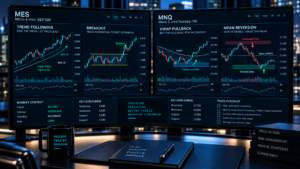
Micro Futures Trading 2026 is built around contracts with smaller multipliers than larger benchmark futures. CME Group introduced the Micro E-mini equity-index suite to provide more precise exposure to major U.S. stock indexes. The smaller multiplier means each point or tick produces a smaller dollar profit or loss than the corresponding E-mini contract.
That matters for risk management. A trader who wants to risk $50 on a setup may have difficulty sizing a larger contract if the required stop distance already produces more than $50 of risk. A Micro contract can make it possible to use the same market thesis with a smaller dollar value per tick. This can also make scaling in or out more granular.
Smaller does not mean safe. Micro futures are still leveraged derivatives. The contract can move quickly, broker margin requirements can change and losses can exceed the cash initially committed to a trade. The correct use case is finer exposure control, not maximum leverage.
For official product details, see the CME Group Micro E-mini futures FAQ.
Micro Futures Trading 2026: MES, MNQ, MYM and M2K Specs
The core Micro Futures Trading 2026 contracts differ in multiplier and tick size. Before trading any one of them, memorize its dollar value per point and per minimum tick. Those numbers determine the position’s P&L sensitivity.
| Contract | Symbol | Multiplier | Minimum Tick | Tick Value |
|---|---|---|---|---|
| Micro E-mini S&P 500 | MES | $5 × index | 0.25 points | $1.25 |
| Micro E-mini Nasdaq-100 | MNQ | $2 × index | 0.25 points | $0.50 |
| Micro E-mini Dow | MYM | $0.50 × index | 1.00 point | $0.50 |
| Micro E-mini Russell 2000 | M2K | $5 × index | 0.10 points | $0.50 |
The tick values above come from CME Group’s current contract specifications. They are contract mechanics, not broker margin requirements. Margin is separate and can vary by exchange requirement, broker policy, account status and time of day.
Micro Futures vs E-mini Futures
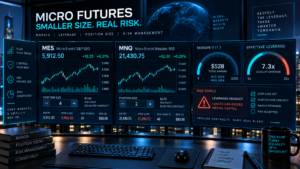
One of the biggest advantages of Micro Futures Trading 2026 is contract granularity. CME states that the Micro E-mini equity-index contracts are one-tenth the size of their corresponding E-mini products. MES therefore has a $5 index multiplier versus $50 for E-mini S&P 500 futures, while MNQ uses $2 per Nasdaq-100 point versus $20 for the E-mini Nasdaq-100.
This does not mean ten Micro contracts are always economically identical to one E-mini after costs. The notional exposure can be similar, but commission and fee structures are charged per contract and can make ten Micros more expensive to trade than one E-mini. That trade-off is important when scaling up.
For small position sizes, Micros can offer much finer risk increments. As account size and strategy capacity grow, traders should compare whether the lower per-contract granularity still justifies the total transaction cost relative to a larger contract.
Tick Value and Dollar Risk
The most practical skill in Micro Futures Trading 2026 is converting chart distance into dollars. Do not decide position size from the number of contracts you feel comfortable seeing on the screen. Calculate it from tick value and stop distance.
For MES, one 0.25-point tick is $1.25. One full index point is therefore $5 per contract. If a setup requires a 10-point stop, one MES contract represents $50 of price risk before commissions and slippage. Two MES contracts would represent $100.
For MNQ, one tick is $0.50 and one full Nasdaq-100 index point is $2 per contract. A 25-point stop therefore represents $50 of price risk for one MNQ contract. If volatility increases and the technically valid stop becomes 50 points, the same one contract now represents $100 of price risk.
This is why fixed contract quantity is not a complete risk plan. The same quantity can represent very different dollar risk from one session to the next when stop distance changes.
Margin and Leverage in Micro Futures Trading 2026

Margin is often misunderstood in Micro Futures Trading 2026. A broker may require only a fraction of a contract’s notional value as collateral, especially for intraday positions. That does not cap the loss at the margin amount. Futures P&L continues to change with the contract’s price movement.
Exchange initial and maintenance margin and broker intraday margin are different concepts. Brokers can impose requirements that are higher than exchange minimums and can change intraday policies around volatility, major events or market conditions. Positions held toward the close may also require substantially more capital than positions opened and closed within the broker’s intraday window.
Use margin as an operational constraint, not as a position-sizing target. If your broker allows 20 Micro contracts but your risk plan allows only two, the correct quantity is two. Maximum available leverage is not the same thing as sensible leverage.
For beginners, our Futures Trading for Beginners 2026 guide explains margin, leverage and contract mechanics in more detail.
Micro Futures Trading Hours and Contract Months
Micro Futures Trading 2026 also requires understanding the futures calendar. Micro E-mini equity-index futures follow the customary quarterly cycle with March, June, September and December expirations, and CME lists multiple concurrent contracts. Liquidity usually concentrates in the front active contract until traders roll to the next quarterly contract.
For active traders, Micro Futures Trading 2026 is especially sensitive to session liquidity and rollover timing. These contracts trade on CME Globex for extended hours through most of the business week, subject to the exchange’s daily maintenance break and holiday schedules. Do not assume that “nearly 24 hours” means identical liquidity at every time of day. U.S. cash-market hours often have much more activity than quiet overnight periods.
Before trading, confirm the active contract month and current session. Using an old symbol after rollover can produce thinner liquidity and misleading chart behavior.
Which Micro Futures Contract Should You Trade?
There is no universally best contract for Micro Futures Trading 2026. MES, MNQ, MYM and M2K all represent different equity-index exposure and can display different volatility, liquidity and intraday behavior.
MES tracks the S&P 500 and is often used by traders who want broad large-cap U.S. equity exposure. MNQ tracks the Nasdaq-100 and can react strongly when large technology and growth stocks move. MYM follows the Dow Jones Industrial Average, while M2K tracks the Russell 2000 small-cap universe.
Choose based on tick value, typical stop distance, liquidity during your trading hours and how well you understand the underlying index. Do not choose MNQ simply because it appears to move faster or MES simply because it looks calmer on one session. Compare actual dollar risk at your planned stop.
For broker selection, see our published Best Micro Futures Brokers 2026 guide.
Micro Futures Trading 2026 Strategy Ideas

The smaller contract size does not require completely different strategy logic. Micro Futures Trading 2026 can use many of the same rule-based frameworks applied to larger contracts, including trend following, opening-range breakouts, VWAP pullbacks, momentum setups and mean reversion.
The difference is sizing flexibility. Suppose a tested strategy produces an entry where one E-mini contract would risk more than your account limit. A Micro version can preserve the same market thesis with smaller dollar exposure. That makes Micros especially useful for testing live execution with limited size after a strategy has already been validated in simulation.
Do not lower strategy standards just because the contract is smaller. A poor setup on MES is still a poor setup. A random entry on MNQ is still a leveraged trade. Use the same checklist for market regime, entry, invalidation and exit regardless of contract size.
Our Futures Trading Strategies 2026 guide compares seven practical strategy families and their risk rules.
Position Sizing Example for Micro Futures
A disciplined Micro Futures Trading 2026 position starts with maximum acceptable loss. Assume a trader allows $75 of price risk on one MES setup. If the technical stop is 5 points away, one MES contract risks $25 because MES is $5 per point. Three contracts would therefore represent $75 before commissions and slippage.
If the same setup requires a 10-point stop, one contract risks $50. The $75 limit now supports only one contract if the trader refuses to exceed the cap. The correct quantity decreased because volatility or structural distance increased.
The formula is simple:
Position Size = Maximum Dollar Risk ÷ Dollar Risk Per Contract
Always round down to a whole contract and include a buffer for transaction costs and possible slippage. If even one contract exceeds the maximum risk, skip the trade rather than moving the stop closer simply to force the position to fit.
Practice Micro Futures Trading 2026 in Simulation
Simulation is an efficient way to learn Micro Futures Trading 2026 without putting real money at risk. For many new traders, Micro Futures Trading 2026 should begin with repeated simulated execution before any live position is considered. Use it to confirm symbol selection, contract month, order type, quantity, bracket orders and how your platform behaves during fast price movement.
Simulation is also useful for collecting a meaningful trade sample before live deployment. Record entry, stop distance, target, actual rules followed and maximum adverse excursion. The purpose is not to create a large virtual account balance. It is to prove that the process can be followed repeatedly.
Simulated results still have limitations. Live trading introduces real liquidity, queue position, slippage, technical latency and psychological pressure. A simulator should therefore be a development stage rather than evidence of guaranteed live profitability.
Our NinjaTrader Demo Account 2026 guide explains how simulated futures trading can be used for platform practice.
Micro Futures vs E-nano Futures in 2026
A newer consideration for Micro Futures Trading 2026 is CME’s E-nano equity-index lineup. E-nano contracts are smaller again than Micro E-mini contracts. For example, CME describes E-nano Nasdaq-100 futures as one-tenth the size of MNQ, using a $0.20 multiplier versus MNQ’s $2 multiplier.
The smaller exposure can make E-nano contracts useful for very fine position sizing, but traders should compare liquidity, spread, broker availability and transaction cost before assuming the smallest possible contract is automatically the best choice. A tiny multiplier is only helpful if the overall market and execution characteristics fit the strategy.
Micro E-minis remain the established small-sized benchmark contracts for many active equity-index futures traders, while E-nanos expand the sizing spectrum further.
Micro Futures Trading 2026 Costs and Hidden Considerations
Transaction cost matters because Micro Futures Trading 2026 can involve multiple contracts. A complete Micro Futures Trading 2026 cost review should compare all-in round-trip expenses rather than headline commissions alone. Your all-in cost may include broker commission, exchange fees, clearing fees, regulatory fees, routing or technology charges and real-time market-data subscriptions.
Ten Micro contracts can approximate the notional exposure of one corresponding E-mini contract, but ten contracts can create more per-contract transaction charges. This is why scaling should eventually include a cost comparison between Micro and larger contracts.
Slippage should also be included when evaluating a strategy. A one-tick difference may look small, but repeated over many entries and exits it can materially change high-frequency or scalping results. Use realistic trading costs when backtesting and reviewing simulator performance.
If you use NinjaTrader, our NinjaTrader Review 2026 covers platform pricing, commissions and additional fee categories.
Micro Futures Trading 2026 Pros and Cons
| Potential Advantages | Important Limitations |
|---|---|
|
|
Common Micro Futures Trading Mistakes
The most common Micro Futures Trading 2026 mistake is treating a smaller contract like a harmless practice product. Traders often compensate for the lower tick value by increasing quantity until total exposure becomes as large as, or larger than, the E-mini position they were trying to avoid.
Another mistake is sizing from broker margin instead of stop risk. A low intraday margin requirement tells you how much collateral the broker requires, not how much the market can move against the position. Position size should come from maximum dollar loss and stop distance.
Contract rollover is another operational risk. Trading an old contract after liquidity has migrated can create wider spreads and weaker execution. Check the current active contract before every session.
Finally, avoid moving immediately from profitable simulation to oversized live trading. Real fills and emotional pressure are different. A sensible transition keeps live size small enough that execution mistakes remain manageable.
Micro Futures Trading 2026 FAQ
What are the main Micro E-mini futures contracts?
The main equity-index Micro E-minis include MES for the S&P 500, MNQ for the Nasdaq-100, MYM for the Dow and M2K for the Russell 2000. CME also lists additional Micro E-mini equity-index products such as S&P MidCap 400 and S&P SmallCap 600 futures.
How much is one MES tick worth?
MES has a minimum tick of 0.25 index points, worth $1.25 per contract. One full S&P 500 index point is therefore worth $5 per MES contract.
How much is one MNQ tick worth?
MNQ has a 0.25-point minimum tick worth $0.50 per contract. One full Nasdaq-100 point is worth $2 per MNQ contract.
Are Micro futures good for beginners?
They can provide more precise sizing than larger contracts, which can be useful while learning. They are still leveraged futures and are not inherently safe. Beginners should first understand tick value, margin, contract months and order types and should practice in simulation.
Can I lose more than the margin requirement?
Yes. Margin is collateral, not a maximum-loss figure. Adverse futures price movement can create losses larger than the intraday or initial margin associated with the position.
Is Micro Futures Trading 2026 cheaper than E-mini trading?
Micro Futures Trading 2026 requires less notional exposure per contract, but “cheaper” depends on quantity and fees. Trading many Micro contracts can produce higher total per-contract costs than using one larger E-mini contract with comparable notional exposure.
How many Micro futures equal one E-mini?
For the corresponding Micro E-mini equity-index products, ten Micro contracts represent the same contract multiplier as one E-mini. Transaction costs and execution still differ because ten contracts are being traded instead of one.
Do Micro futures expire?
Yes. Micro E-mini equity-index futures use expiration cycles, with quarterly March, June, September and December contracts among the listed maturities. Traders should monitor rollover and avoid assuming one symbol represents a perpetual contract.
What is the best Micro futures contract to trade?
There is no universal best choice. Compare tick value, liquidity, typical volatility, underlying index behavior and the dollar risk created by your strategy’s stop distance.
Should I trade Micro futures live immediately?
No. Learn the platform and contract mechanics first, then test the strategy in simulation. If you later move live, use a size small enough to keep software, execution and decision-making mistakes within a predefined loss limit.
Final Verdict: Micro Futures Trading 2026
Micro Futures Trading 2026 gives futures traders a practical way to control exposure in smaller increments. MES, MNQ, MYM and M2K provide one-tenth-sized versions of key E-mini equity-index contracts, with tick values small enough to support more granular position sizing.
The real benefit is not simply lower margin or a smaller dollar tick. It is the ability to make the contract quantity fit a predefined risk budget more precisely. That makes Micros useful for beginners learning futures mechanics, experienced traders testing new systems and systematic traders moving gradually from simulation to live execution.
The risk remains real. Know the multiplier, tick value, active contract month and stop distance before every trade. Size from the amount you can afford to lose rather than from the maximum contracts your broker allows. Used that way, Micro Futures Trading 2026 can be a flexible bridge between education, simulation and disciplined live futures trading.