Trading platform comparison · Updated September 9, 2026 · U.S. audience
NinjaTrader vs TradeStation 2026: Which Trading Platform Is Better?
NinjaTrader vs TradeStation 2026 is a high-intent comparison between two mature trading ecosystems that now serve noticeably different priorities. NinjaTrader is centered on futures brokerage, futures execution, simulation, order-flow workflows, and NinjaScript automation. TradeStation is broader, combining stocks, options, futures, advanced charting, EasyLanguage strategy development, and multi-asset research tools. The best choice depends less on which platform has the longest feature list and more on what you trade, how you build strategies, and how much you value futures-specific execution versus broader market coverage.
Quick answer: NinjaTrader vs TradeStation 2026
For dedicated futures traders, NinjaTrader usually has the cleaner value proposition because its current plans are built around futures commissions, low intraday margin requirements, simulation, Desktop/Web/Mobile access, SuperDOM, Strategy Analyzer, and NinjaScript. TradeStation is the stronger fit when you want one ecosystem for stocks, options, and futures, or when EasyLanguage, RadarScreen, and TradeStation’s broader research stack are central to your workflow. If your primary market is futures and execution cost is a major decision factor, compare the actual commission tier, exchange fees, clearing fees, data subscriptions, and account charges rather than headline pricing alone.
Explore NinjaTrader
Affiliate link. Futures involve substantial risk. Simulation uses virtual funds and does not predict live results.
Table of contents
- At-a-glance verdict
- What each platform is built for
- Markets and asset coverage
- Futures trading and execution
- Automation: NinjaScript vs EasyLanguage
- Backtesting and simulation
- Pricing and fees
- Charting and research tools
- Desktop, web, and mobile access
- Who should choose which platform?
- Pros and cons
- FAQ
- Final verdict
NinjaTrader vs TradeStation 2026 at a glance
The core difference in NinjaTrader vs TradeStation 2026 is specialization. NinjaTrader is designed around futures as the primary market. TradeStation is a broader active-trading platform and brokerage ecosystem. That distinction affects everything from commissions and margin structure to scripting language, research tools, and the type of trader each platform serves best.
| Category | NinjaTrader | TradeStation | Best fit |
|---|---|---|---|
| Primary focus | Futures-first brokerage and platform | Multi-asset active trading | Depends on market |
| Futures trading | Core specialization | Supported alongside other assets | NinjaTrader for futures-first users |
| Stocks and options | Not the core brokerage focus | Major part of the platform | TradeStation |
| Automation language | NinjaScript / C# | EasyLanguage | Depends on coding preference |
| Backtesting | Strategy Analyzer and NinjaScript tools | Strategy testing, EasyLanguage, Portfolio Maestro options | Both are strong |
| DOM workflow | SuperDOM and futures-focused tools | Matrix and order-entry tools | NinjaTrader for native futures depth |
| Web/mobile | Desktop, Web, Mobile | Desktop, Web, Mobile | Both |
| Best overall use case | Dedicated futures trader | Multi-asset active trader | Workflow dependent |
What NinjaTrader and TradeStation are built for
A useful NinjaTrader vs TradeStation 2026 comparison starts by separating platform identity from individual features. NinjaTrader combines a futures brokerage relationship with a trading stack that includes NinjaTrader Desktop, Web, and Mobile. Its ecosystem is especially deep around futures charting, SuperDOM, order flow, Market Replay, simulation, strategy development, and third-party add-ons. For a broader overview, see our NinjaTrader review.
TradeStation has a wider mandate. Its platform is built for active traders who may move between stocks, ETFs, options, and futures. The desktop environment includes chart analysis, RadarScreen, strategy development, order-entry tools, and EasyLanguage. Its web and mobile products extend access beyond the main desktop workstation.
This difference matters because feature comparisons can otherwise become misleading. A futures trader may never use TradeStation’s equity and options tooling. A trader managing stocks, options, and futures from one brokerage relationship may find NinjaTrader’s specialization too narrow. NinjaTrader vs TradeStation 2026 is therefore primarily a question of market focus before it becomes a question of interface preference.
NinjaTrader vs TradeStation 2026 for markets and asset coverage
TradeStation has the clear advantage in breadth. It supports active trading workflows across stocks, ETFs, options, and futures. This can simplify account management and research for a trader who does not want a separate futures-only environment.
NinjaTrader concentrates on futures. Its brokerage materials emphasize access to major futures venues and a large range of futures contracts rather than trying to be a universal brokerage for every retail asset class. That narrower focus can be a strength for traders whose entire process revolves around CME, CBOT, NYMEX, COMEX, Eurex, ICE, or other supported futures markets.
For NinjaTrader vs TradeStation 2026, choose breadth only if you will use it. A platform covering more asset classes is not automatically better for a trader who only trades index, energy, metal, rate, or currency futures.
NinjaTrader vs TradeStation 2026 for futures trading
Futures execution is where NinjaTrader vs TradeStation 2026 becomes most commercially relevant. NinjaTrader’s current pricing and platform design are directly organized around futures contracts, per-side commissions, intraday margins, market data, and futures-specific execution tools. SuperDOM is one of the most recognizable parts of that workflow. Our NinjaTrader SuperDOM review covers that interface separately.
TradeStation also supports futures and offers its own order-entry and chart-based trading tools. Its current pricing is volume-tiered, meaning the commission rate can change according to monthly contract volume. That makes a simple one-number comparison inaccurate. A low-volume trader and a very high-volume trader can face different commission tiers, and exchange, regulatory, clearing, data, and other charges may still apply.
If the only objective is trading futures, NinjaTrader’s specialization is easier to evaluate. If futures are one part of a broader portfolio containing stocks or options, TradeStation’s consolidated ecosystem becomes more valuable.
Automation: NinjaScript vs EasyLanguage
Automation is one of the strongest reasons to compare NinjaTrader vs TradeStation 2026. Both platforms have long-established strategy-development environments, but their programming models are different.
NinjaTrader uses NinjaScript, which is based on C#. It supports custom indicators, strategies, and platform extensions. Traders who want a visual starting point can use Strategy Builder for supported rule logic before moving into code. Our NinjaTrader Strategy Builder 2026 guide explains that workflow.
TradeStation uses EasyLanguage, a proprietary language intentionally designed around trading concepts and relatively readable syntax. TradeStation documents EasyLanguage for custom analysis, strategy creation, backtesting, and automated execution. For users who find full C# development excessive, EasyLanguage can be easier to approach. For developers who want a general-purpose language, deeper object-oriented programming, or broader .NET-style skills, NinjaScript may be more attractive.
| Automation area | NinjaTrader | TradeStation |
|---|---|---|
| Language | NinjaScript / C# | EasyLanguage |
| Visual entry point | Strategy Builder for supported logic | Built-in strategies and configurable platform studies |
| Historical testing | Strategy Analyzer | Strategy testing and performance reports |
| Portfolio-level research | Possible through custom workflows and add-ons | Portfolio Maestro available as a specialized tool |
| Live automation | Supported with correct strategy and account configuration | Strategy-generated orders and automated execution supported |
| Learning profile | More programming depth | Trading-oriented syntax |
NinjaTrader vs TradeStation 2026 for backtesting and simulation
Both platforms are serious research environments. In NinjaTrader vs TradeStation 2026, the better backtester depends on the strategy architecture rather than a generic winner label.
NinjaTrader’s Strategy Analyzer supports historical backtesting and optimization. Market Replay and simulated accounts provide additional ways to observe strategy behavior and manual execution without placing live trades. The key is to record assumptions: data source, session template, commissions, slippage, fill settings, parameter values, and the strategy version used for each test.
TradeStation supports historical strategy testing, performance reporting, real-time strategy evaluation, simulated trading, and EasyLanguage automation. Its documentation also describes Portfolio Maestro for portfolio-level backtesting and testing strategies across multiple symbols.
No backtest from either platform should be treated as evidence of future profitability. Overfitting, survivorship issues, data quality, commission assumptions, slippage, latency, and live order behavior can materially change results. A strong NinjaTrader vs TradeStation 2026 comparison therefore evaluates the research process, not the prettiest equity curve.
NinjaTrader vs TradeStation 2026 pricing and fees
Pricing is one of the biggest differences in NinjaTrader vs TradeStation 2026. The platforms use different structures, so compare the cost of your actual trading pattern rather than a single advertised commission.
NinjaTrader pricing
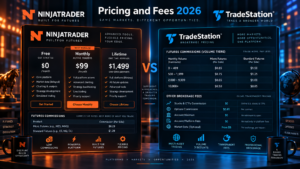
NinjaTrader currently lists three U.S. futures plans. The Free plan has a $0 monthly plan fee with commissions of $0.39 per Micro or e-Nano contract per side and $1.29 per Standard contract per side. The Monthly plan costs $99 per month and lists $0.29 per Micro or e-Nano and $0.99 per Standard contract per side. The Lifetime plan is a $1,499 one-time payment and lists $0.09 per Micro or e-Nano and $0.59 per Standard contract per side. Exchange, clearing, and NFA fees apply in addition.
NinjaTrader also publishes separate market-data and account fees. Those charges can include exchange data subscriptions, clearing charges, routing charges for certain connections, and an inactivity fee under specified conditions for qualifying Free-plan accounts. Always verify the current official schedule before funding.
TradeStation pricing
TradeStation’s current pricing is volume-tiered. For futures traders in the 0–500 monthly contract tier, the published regular-futures commission is $1.75 per contract per side and the Micro rate is $0.50 per contract per side. Lower rates apply at higher monthly volume tiers. The page also lists a clearing fee for applicable futures tiers, while exchange execution and regulatory fees are separate.
TradeStation also publishes account, transfer, platform, market-data, and specialized-service fees. Some platform technology subscriptions apply in particular non-brokerage configurations. Because the schedule is tiered and account-dependent, confirm the current pricing page instead of relying on an old flat-rate comparison.
| Cost item | NinjaTrader | TradeStation |
|---|---|---|
| Basic futures plan structure | Free, Monthly, Lifetime | Volume-tiered commission schedule |
| Low-volume Micro commission | $0.39 per side on Free plan | $0.50 per side at current 0–500 tier |
| Low-volume standard futures commission | $1.29 per side on Free plan | $1.75 per side at current 0–500 tier |
| Paid plan option | $99 monthly or $1,499 Lifetime | Pricing varies by activity and product; additional subscriptions may apply |
| Exchange/regulatory fees | Additional | Additional |
| Market data | Separate entitlements may apply | Separate entitlements may apply |
These figures are not an all-in cost comparison. The exact total depends on contract, exchange, monthly volume, account type, data selections, routing, and other applicable charges. That is why NinjaTrader vs TradeStation 2026 should be evaluated with a realistic monthly trade count.
Check NinjaTrader Current Plans
Affiliate link. Verify current commissions, market data, account fees, and margin requirements before trading.

Charting, scanning, and research tools
For charting, NinjaTrader vs TradeStation 2026 is much closer than a simple beginner-versus-professional comparison. Both platforms offer advanced charting, indicators, customization, historical data, and strategy-linked analysis.
NinjaTrader’s advantage is the way charts connect to a futures-centered workstation. Charts can sit beside SuperDOM, order-flow tools, Market Replay, NinjaScript indicators, and strategy windows. The ecosystem of third-party futures indicators and add-ons is also extensive.
TradeStation’s advantage is broader integrated research. RadarScreen can monitor and rank large symbol lists using technical and fundamental criteria, while OptionStation Pro supports options analysis. EasyLanguage can be used to build custom indicators and research logic. For a trader screening many stocks or options in addition to futures, this broader analysis layer may be more useful than NinjaTrader’s futures specialization.
Desktop, web, and mobile access
Older comparisons sometimes describe NinjaTrader as desktop-only, but that is no longer accurate. NinjaTrader currently includes access to Desktop, Web, and Mobile platforms across its plans. The full NinjaTrader Desktop environment remains the deepest choice for NinjaScript, advanced add-ons, and specialized futures tooling.
TradeStation also provides desktop, web, and mobile access. Its desktop product is the most feature-rich environment for EasyLanguage, RadarScreen, advanced charting, and strategy work, while web and mobile access are useful for monitoring and trading away from the primary workstation.
For NinjaTrader vs TradeStation 2026, cross-device access is therefore not a decisive difference by itself. The more useful question is which advanced features require the desktop environment you plan to use most often.
Who should choose NinjaTrader and who should choose TradeStation?
Choose NinjaTrader if you:
- Primarily trade futures.
- Want futures-specific pricing plans and low intraday margin options.
- Use SuperDOM, Market Replay, Strategy Analyzer, or order-flow tools.
- Want NinjaScript/C# strategy and indicator development.
- Prefer a large futures-focused third-party ecosystem.
- Want to begin with simulation before considering live execution.
For these users, NinjaTrader vs TradeStation 2026 generally favors NinjaTrader because fewer platform features are unrelated to the core futures workflow. In that futures-first scenario, NinjaTrader vs TradeStation 2026 becomes primarily a comparison of execution depth, commissions, and automation architecture.
Choose TradeStation if you:
- Trade stocks, options, and futures from one broader ecosystem.
- Use RadarScreen for real-time scanning.
- Prefer EasyLanguage for custom strategies and indicators.
- Need options-analysis tools alongside futures trading.
- Want portfolio-level strategy research tools.
- Value a multi-asset research environment more than futures-only specialization.
For these users, NinjaTrader vs TradeStation 2026 can favor TradeStation even when NinjaTrader has lower headline futures commissions on some plans. When multi-asset access is essential, NinjaTrader vs TradeStation 2026 shifts toward breadth rather than futures specialization.
NinjaTrader vs TradeStation 2026 pros and cons
NinjaTrader pros
- Strong futures specialization.
- Current Free plan has no monthly plan fee.
- SuperDOM, Strategy Analyzer, Market Replay, and NinjaScript ecosystem.
- Desktop, Web, and Mobile access.
- Large third-party futures add-on community.
NinjaTrader cons
- Less suitable as an all-in-one stocks/options brokerage workflow.
- Advanced NinjaScript development requires technical skill.
- Exchange, data, clearing, and account fees can add to headline commissions.
- Low intraday margins can encourage excessive leverage if risk is not controlled.
TradeStation pros
- Broader stocks, options, and futures ecosystem.
- EasyLanguage lowers the barrier to custom strategy development.
- RadarScreen and options-analysis tools expand research capability.
- Strong backtesting and automation heritage.
- Desktop, Web, and Mobile access.
TradeStation cons
- Low-volume futures commissions can be higher than NinjaTrader’s published Free-plan rates.
- Pricing is more complex because commission tiers and additional fees vary.
- Some advanced tools or non-brokerage subscriptions may add cost.
- Multi-asset depth can be unnecessary complexity for futures-only users.
Frequently asked questions
Is NinjaTrader better than TradeStation for futures?
For a futures-only workflow, NinjaTrader is usually easier to justify because futures are its primary focus and its current pricing, SuperDOM, Strategy Analyzer, Market Replay, and NinjaScript ecosystem are built around that market. TradeStation remains a capable futures platform, especially for users who also trade stocks or options. For that reason, NinjaTrader vs TradeStation 2026 usually leans toward NinjaTrader when futures are the sole priority.
Which is cheaper for futures, NinjaTrader or TradeStation?
At the currently published low-volume rates, NinjaTrader’s Free plan lists lower base commissions than TradeStation’s 0–500 monthly futures tier for both Micro and standard futures. However, TradeStation commissions decline at higher volume tiers, and both brokers can add exchange, regulatory, clearing, data, and account-related costs. Calculate the all-in cost for your own contracts and volume.
Which platform is better for automated trading?
NinjaTrader vs TradeStation 2026 has no universal automation winner. NinjaTrader is attractive if you want NinjaScript and C# flexibility. TradeStation is attractive if you prefer EasyLanguage’s trading-oriented syntax and its long-established strategy automation environment. Both require careful testing and live supervision.
Does TradeStation support backtesting?
Yes. TradeStation supports historical strategy testing, Strategy Performance Reports, simulated trading, EasyLanguage strategies, and additional portfolio-level research through Portfolio Maestro. Historical performance remains hypothetical and should not be interpreted as expected live returns.
Does NinjaTrader have web and mobile trading?
Yes. NinjaTrader’s current plans include access to NinjaTrader Desktop, Web, and Mobile. The desktop platform remains the most complete environment for advanced NinjaScript and third-party add-ons.
Is TradeStation better for stocks and options?
TradeStation is the more natural choice if stocks and options are important because those markets are integrated into its broader platform and research ecosystem. NinjaTrader is primarily a futures platform and broker.
Which platform is easier to learn?
It depends on the task. A futures trader may find NinjaTrader’s specialized workflow more direct, while a developer new to programming may find EasyLanguage easier to read than C#. Both platforms become substantially more complex when you move from basic charting into automation, custom research, and advanced order management.
Final verdict: NinjaTrader vs TradeStation 2026
NinjaTrader vs TradeStation 2026 is best resolved by choosing the market and workflow first. NinjaTrader is the stronger fit for dedicated futures traders who want futures-specific execution, competitive published commissions, low intraday margins, SuperDOM, Market Replay, Strategy Analyzer, and NinjaScript. TradeStation is the stronger fit for active traders who want stocks, options, and futures in a broader ecosystem with RadarScreen, EasyLanguage, sophisticated charting, and multi-asset research.
If futures are your only serious market, NinjaTrader’s specialization is difficult to ignore. If futures are one component of a larger active-trading portfolio, TradeStation’s breadth can outweigh the advantages of a futures-only platform. In either case, the platform is only an execution and research tool. It cannot create a trading edge or remove market risk.
The practical way to approach NinjaTrader vs TradeStation 2026 is to test the workflow you actually intend to use, record the real fee structure, and evaluate simulation and strategy behavior before risking capital. A disciplined NinjaTrader vs TradeStation 2026 decision should be based on the job the platform must perform, not brand familiarity.
Explore NinjaTrader for Futures
Affiliate link for eligible users. Review current pricing, eligibility, market data, margin, and risk disclosures before funding an account.
Official sources checked
NinjaTrader pricing
NinjaTrader futures brokerage overview
TradeStation pricing
TradeStation EasyLanguage overview
TradeStation simulated trading
Editorial scope: This comparison uses publicly available provider documentation checked September 9, 2026. We did not independently benchmark execution latency, slippage, fills, or strategy profitability. Pricing, features, margin requirements, and account terms can change.
Affiliate disclosure: TradeboticsAI may receive compensation from qualifying NinjaTrader referrals through marked affiliate links. Readers are not paid or incentivized to register or trade.
Risk disclosure: Futures are leveraged products and involve substantial risk, including losses that can exceed the initial investment. Simulated and historical results are hypothetical and do not predict live performance. This content is educational and is not personalized financial advice or a recommendation to trade.