NinjaTrader vs Thinkorswim 2026: Which Trading Platform Is Better?
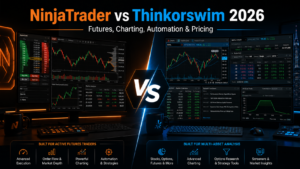
NinjaTrader vs Thinkorswim is a high-value comparison for U.S. traders choosing between two sophisticated trading ecosystems in 2026. Both provide advanced charts, futures access, simulated trading and professional-grade analytical tools, but they are designed around different priorities.
NinjaTrader is heavily focused on futures trading, execution, strategy development and automation. Thinkorswim, now offered through Charles Schwab, covers a broader range of products including stocks, ETFs, options, futures and forex while providing powerful charting, analysis and research tools.
This NinjaTrader vs Thinkorswim 2026 comparison examines futures trading, commissions, charting, automation, backtesting, paper trading, usability and platform access so you can understand which environment better matches your trading workflow.
Quick Answer
NinjaTrader is generally the stronger fit for futures-focused traders who prioritize specialized execution tools, lower published futures commission options and deeper automated strategy development.
Thinkorswim is generally better suited to traders who want advanced analysis across stocks, ETFs, options, futures and forex inside the broader Charles Schwab ecosystem.
Explore NinjaTrader and Free Simulated Trading →
Affiliate disclosure: TradeboticsAI may earn compensation if you complete a qualifying action through certain links. Futures trading involves substantial risk. Free simulated trading is different from a funded live brokerage account, where commissions and other fees may apply.
Table of Contents
- NinjaTrader vs Thinkorswim Overview
- Quick Comparison
- Markets and Products
- Futures Trading
- Pricing and Commissions
- Charting and Analysis
- Automation and Strategy Development
- Backtesting and Simulation
- Desktop, Web and Mobile
- Ease of Use
- Who Should Choose Each Platform?
- Related Comparisons
- FAQ
- Final Verdict
NinjaTrader vs Thinkorswim Overview
The most important difference in NinjaTrader vs Thinkorswim is specialization.
NinjaTrader is built around active futures trading. Its platform combines charting, order execution, market replay, simulated trading, backtesting, strategy development and futures brokerage access. Advanced users can also build custom indicators, add-ons and automated strategies through NinjaScript.
Thinkorswim takes a broader multi-asset approach. Charles Schwab clients can use the thinkorswim platform suite to analyze and trade stocks, ETFs, options, futures and forex where eligible. This makes it particularly attractive to active traders who operate across several asset classes rather than concentrating primarily on futures.
Neither platform is universally better. The correct choice depends primarily on the instruments you trade and how much emphasis you place on automation, futures-specific execution, multi-asset research and account integration.
NinjaTrader vs Thinkorswim: Quick Comparison
| Category | NinjaTrader | Thinkorswim |
|---|---|---|
| Primary Strength | Futures trading and automation | Multi-asset active trading and analysis |
| Stocks & ETFs | Not the primary brokerage focus | Yes |
| Options | Futures options availability varies | Strong options toolset |
| Futures | Core specialization | Supported |
| Forex | Not its primary brokerage focus | Supported for eligible accounts |
| Paper Trading | Free simulated trading | paperMoney |
| Automation | Advanced NinjaScript automation | thinkScript studies, strategies, alerts and conditional orders |
| Desktop | Yes | Yes |
| Web | Yes | Yes |
| Mobile | Yes | Yes |
| Best Fit | Dedicated futures and algorithmic traders | Multi-asset active traders |
NinjaTrader vs Thinkorswim: Markets and Products
Product coverage is one of the clearest differences between these platforms.
NinjaTrader Market Focus
NinjaTrader is primarily a futures trading ecosystem. Traders can access a broad selection of futures contracts spanning equity indexes, metals, energy, agriculture, currencies, interest rates and other markets through supported exchanges.
This focused approach has an advantage: many of NinjaTrader’s platform features, execution tools and pricing structures are specifically designed around futures traders.
Thinkorswim Market Coverage
Thinkorswim operates inside Charles Schwab’s broader brokerage ecosystem and supports multiple trading products. Depending on account eligibility, users can work with stocks, ETFs, options, futures and forex from the thinkorswim suite.
For someone who trades SPY options in the morning, individual equities during the session and futures at another time, thinkorswim provides the convenience of a broader multi-asset environment.
Winner for futures specialization: NinjaTrader.
Winner for breadth of asset classes: Thinkorswim.
NinjaTrader vs Thinkorswim for Futures Trading
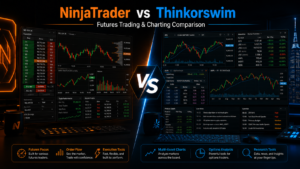
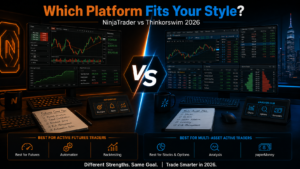
For traders researching NinjaTrader vs Thinkorswim specifically for futures, NinjaTrader has the more specialized proposition.
NinjaTrader is designed around futures execution and offers dedicated tools for charting, order management, simulation, strategy development and market replay. Its futures brokerage pricing also provides several commission plans so traders can choose a structure based on activity level.
Thinkorswim also supports futures trading through Charles Schwab Futures and Forex. Its major advantage is that futures sit alongside stocks, ETFs, options and forex within the same broader brokerage ecosystem.
Charles Schwab currently publishes a futures commission of $2.25 per contract, per side, with exchange and regulatory fees potentially applying.
NinjaTrader’s published base commissions vary according to plan and contract category. Its current published pricing starts at substantially lower commission amounts for Micro futures, but traders should compare the complete all-in cost for the specific contract they intend to trade rather than evaluating commission alone.
NinjaTrader vs Thinkorswim Pricing and Commissions
Comparing pricing requires care because these companies use different business models.
NinjaTrader Pricing
NinjaTrader currently publishes three principal futures trading plans:
- Free: $0 monthly plan fee, with published commissions of $0.39 per Micro/e-Nano and $1.29 per Standard contract, per side.
- Monthly: $99 per month, with published commissions of $0.29 per Micro/e-Nano and $0.99 per Standard contract, per side.
- Lifetime: $1,499 one-time payment, with published commissions of $0.09 per Micro/e-Nano and $0.59 per Standard contract, per side.
Exchange, clearing and NFA fees can apply in addition to the advertised commission. Market-data and other account-related charges can also depend on usage and account configuration.
Importantly, NinjaTrader’s free simulated trading environment is not the same as live brokerage trading. Traders can explore charting, backtesting and simulation without committing capital, while live futures trading involves commissions, exchange-related charges and real financial risk.
Thinkorswim Pricing
Schwab clients receive access to the thinkorswim platform suite without a separate platform subscription charge. Standard Schwab transaction pricing still applies when trades are placed.
- Listed U.S. stocks and ETFs: $0 online commission under Schwab’s published pricing.
- Options: $0 online base commission plus $0.65 per contract.
- Futures and futures options: $2.25 per contract, per side, plus applicable fees.
- Forex: $0 online commission, with trading costs reflected in the bid/ask spread.
Pricing can change, so confirm the latest costs directly with each provider before opening or funding an account.
NinjaTrader vs Thinkorswim for Charting and Analysis
Both platforms are capable charting environments, but their strengths differ.
NinjaTrader provides sophisticated charting designed around active futures workflows. Traders can combine charts with order-entry functionality, custom indicators, Market Analyzer tools and strategy components.
Thinkorswim is also well known for deep charting and analysis. Its desktop platform provides extensive indicators, studies, drawing tools, scanning capabilities, options analytics and customizable workspaces.
NinjaTrader Charting Strengths
- Futures-oriented workflows
- Custom indicators
- Market Analyzer
- Order-flow functionality
- Strategy integration
- Extensive add-on ecosystem
Thinkorswim Charting Strengths
- Hundreds of technical indicators and studies
- Strong options analysis
- Custom thinkScript studies
- Flexible scans and watchlists
- Integrated research and market information
- Multi-asset analysis
For pure futures execution workflows, NinjaTrader has an advantage. For broad technical and derivatives analysis across multiple asset classes, thinkorswim is exceptionally capable.
NinjaTrader vs Thinkorswim for Automated Trading
Automation is one of the most important distinctions in the NinjaTrader vs Thinkorswim comparison.
NinjaTrader Automation
NinjaTrader Desktop uses NinjaScript, a C#-based development framework that can create custom indicators, add-ons and automated trading strategies capable of submitting and managing orders.
Traders who do not want to program every strategy manually can also use strategy-building tools, while developers can create more sophisticated systems directly in C#.
The ability to develop, backtest, optimize and deploy automated strategies makes NinjaTrader particularly relevant to algorithmic futures traders.
Thinkorswim Automation
Thinkorswim provides thinkScript for creating custom studies, strategies, scans, alerts and watchlist calculations. ThinkScript strategies can generate simulated trade signals for historical backtesting.
Thinkorswim can also create conditional orders based on specified study conditions. However, its scripting environment should not simply be treated as equivalent to NinjaTrader’s full NinjaScript automated strategy framework.
Automation winner: NinjaTrader for traders specifically seeking a deeper programmable automated strategy environment.
Backtesting, Replay and Simulated Trading
Testing a strategy before risking real capital is important on either platform.
NinjaTrader provides free simulated trading plus strategy backtesting capabilities. Its Market Replay functionality can replay historical market activity, allowing traders to practice workflows and examine how a strategy behaves against historical conditions.
Thinkorswim includes paperMoney, a simulated trading environment available across the thinkorswim platform suite. Users can practice with virtual buying power while accessing many of the same tools available in live trading.
Thinkorswim also provides strategy backtesting and historical market replay functionality such as OnDemand for relevant analytical workflows.
Neither simulated nor historical performance guarantees comparable results in live markets. Execution quality, liquidity, slippage, emotional decision-making and changing market conditions can materially affect real-world outcomes.
Desktop, Web and Mobile Platforms
Both ecosystems now provide access across multiple device types.
NinjaTrader
- NinjaTrader Desktop
- NinjaTrader Web
- NinjaTrader Mobile
The desktop environment provides the deepest customization and strategy-development capabilities, while web and mobile access provide additional flexibility.
Thinkorswim
- thinkorswim desktop
- thinkorswim web
- thinkorswim mobile
Schwab synchronizes relevant settings and watchlists across thinkorswim platforms. The web version provides browser access without a software installation, while desktop remains the most powerful environment for advanced analysis.
For official information about the thinkorswim platform suite, see Charles Schwab’s thinkorswim platform page.
Which Platform Is Easier to Use?
Neither NinjaTrader nor thinkorswim is designed only for absolute beginners. Both contain advanced functionality that requires time to learn.
Thinkorswim can feel complex because it exposes a large collection of analytical, options, scanning and multi-asset tools. However, Schwab also provides extensive educational resources and multiple platform versions.
NinjaTrader’s basic charting and simulation can be approachable, but advanced futures workflows, NinjaScript automation and customized professional layouts introduce a steeper technical learning curve.
If you are new to either environment, simulated trading is a sensible way to learn platform mechanics before placing live trades.
NinjaTrader vs Thinkorswim: Who Should Choose Each Platform?
Choose NinjaTrader If You:
- Primarily trade futures
- Trade Micro or E-mini futures
- Want specialized futures execution tools
- Want to develop automated strategies
- Use C# or want access to NinjaScript
- Need backtesting and strategy optimization
- Want free simulated futures trading before going live
- Prefer a platform built specifically around active futures traders
Choose Thinkorswim If You:
- Trade stocks, ETFs, options and futures
- Need sophisticated options analytics
- Already use Charles Schwab
- Want one broader brokerage ecosystem
- Use thinkScript studies and custom scans
- Value extensive research and education
- Want paperMoney simulation
- Need strong desktop, web and mobile access
Want to Test NinjaTrader?
NinjaTrader offers free access to advanced charting, strategy backtesting and simulated futures trading, giving traders an opportunity to explore the platform before live trading.
Free simulation is not live brokerage trading. Live futures trading involves commissions, applicable fees and substantial financial risk.
Related NinjaTrader Comparisons
If you are still comparing platforms, TradeboticsAI has additional side-by-side guides:
These comparisons help separate platforms designed primarily for futures execution and automation from platforms optimized for broader charting, technical analysis or multi-asset trading.
NinjaTrader vs Thinkorswim FAQ
Is NinjaTrader better than Thinkorswim?
NinjaTrader may be the better choice for traders focused primarily on futures, automated strategy development and specialized futures execution. Thinkorswim may be better for traders who want stocks, ETFs, options, futures and forex analysis within the Charles Schwab ecosystem.
Is NinjaTrader cheaper than Thinkorswim for futures?
NinjaTrader currently publishes futures commission rates that vary by plan, including lower base commission figures than Schwab’s published $2.25-per-contract futures commission. However, traders should compare complete all-in costs, including exchange, clearing, regulatory, market-data and applicable platform or plan charges.
Is NinjaTrader free?
NinjaTrader provides free access to advanced charting, strategy backtesting and simulated trading. Its Free brokerage pricing plan has no monthly plan fee, but live trading still involves commissions and applicable fees.
Is Thinkorswim free?
Schwab clients receive access to thinkorswim without a separate platform subscription fee. Normal Schwab transaction charges and other applicable trading fees still apply.
Can Thinkorswim trade futures?
Yes. Eligible Charles Schwab clients can trade futures through thinkorswim. Schwab currently publishes a futures commission of $2.25 per contract, per side, plus applicable exchange and regulatory fees.
Which is better for automated trading?
NinjaTrader provides the deeper environment for programmable automated trading strategies through NinjaScript. Thinkorswim’s thinkScript supports studies, strategy backtesting, alerts, scans and conditional-order workflows but should not be considered identical to NinjaTrader’s automation framework.
Does Thinkorswim have paper trading?
Yes. Thinkorswim provides paperMoney, a virtual trading environment that allows users to practice with simulated funds and many of the platform’s trading tools.
Does NinjaTrader have paper trading?
Yes. NinjaTrader provides free simulated trading. Simulation can be useful for platform familiarization and strategy testing, but simulated results do not predict live performance.
Which is better for options trading?
Thinkorswim is generally the stronger choice for traders primarily focused on listed equity and index options because the platform provides extensive options analysis inside Schwab’s broader securities brokerage ecosystem.
Which is better for futures trading?
For dedicated futures traders, NinjaTrader has the stronger specialization because futures trading, execution, simulation, strategy development and brokerage functionality form the core of its ecosystem.
Final Verdict: NinjaTrader vs Thinkorswim 2026
The final decision in NinjaTrader vs Thinkorswim 2026 depends on what you actually trade.
NinjaTrader is our preferred choice for futures-focused traders who prioritize specialized execution, strategy development, backtesting, simulation and deeper automation capabilities.
Thinkorswim is our preferred choice for multi-asset active traders who want sophisticated charting and analysis across stocks, ETFs, options, futures and forex within the Charles Schwab ecosystem.
If your strategy revolves primarily around Micro and E-mini futures or systematic futures trading, NinjaTrader deserves serious consideration. If your portfolio routinely combines equities, options and futures, the wider capabilities of thinkorswim may be more practical.
No trading platform can guarantee profitability. Platform quality, commissions and analytical tools do not eliminate market risk, execution risk or the possibility of substantial losses.
Affiliate Disclosure: TradeboticsAI may receive compensation when visitors click certain affiliate links or complete qualifying actions. This does not increase the user’s cost and does not change our editorial comparison.
Risk Disclosure: Futures, options, forex and leveraged products involve substantial risk and are not suitable for every investor. Losses can be significant and, depending on the product and circumstances, may exceed the amount initially committed. Simulated and backtested results are hypothetical and do not guarantee future live-trading performance. This content is provided for informational and educational purposes only and is not financial, investment, tax or legal advice.