Table of Contents
ToggleBest Futures Trading Platforms: Quick Guide
The best futures trading platforms combine advanced charting, simulated trading, reliable execution tools and transparent costs. Traders should compare these features carefully before choosing a platform for futures trading.
Table of Contents
- What to Look for in a Futures Trading Platform
- Best Futures Trading Platforms in 2026
- NinjaTrader Futures Trading and Simulation Tools
- Simulated Trading vs Live Futures Trading
- Futures Trading Platform Costs
- Frequently Asked Questions
When evaluating the best futures trading platforms, consider market-data availability, commissions, charting capabilities, simulation and risk-management tools. The best futures trading platforms for active traders should also provide an efficient workflow across desktop, web or mobile where available.
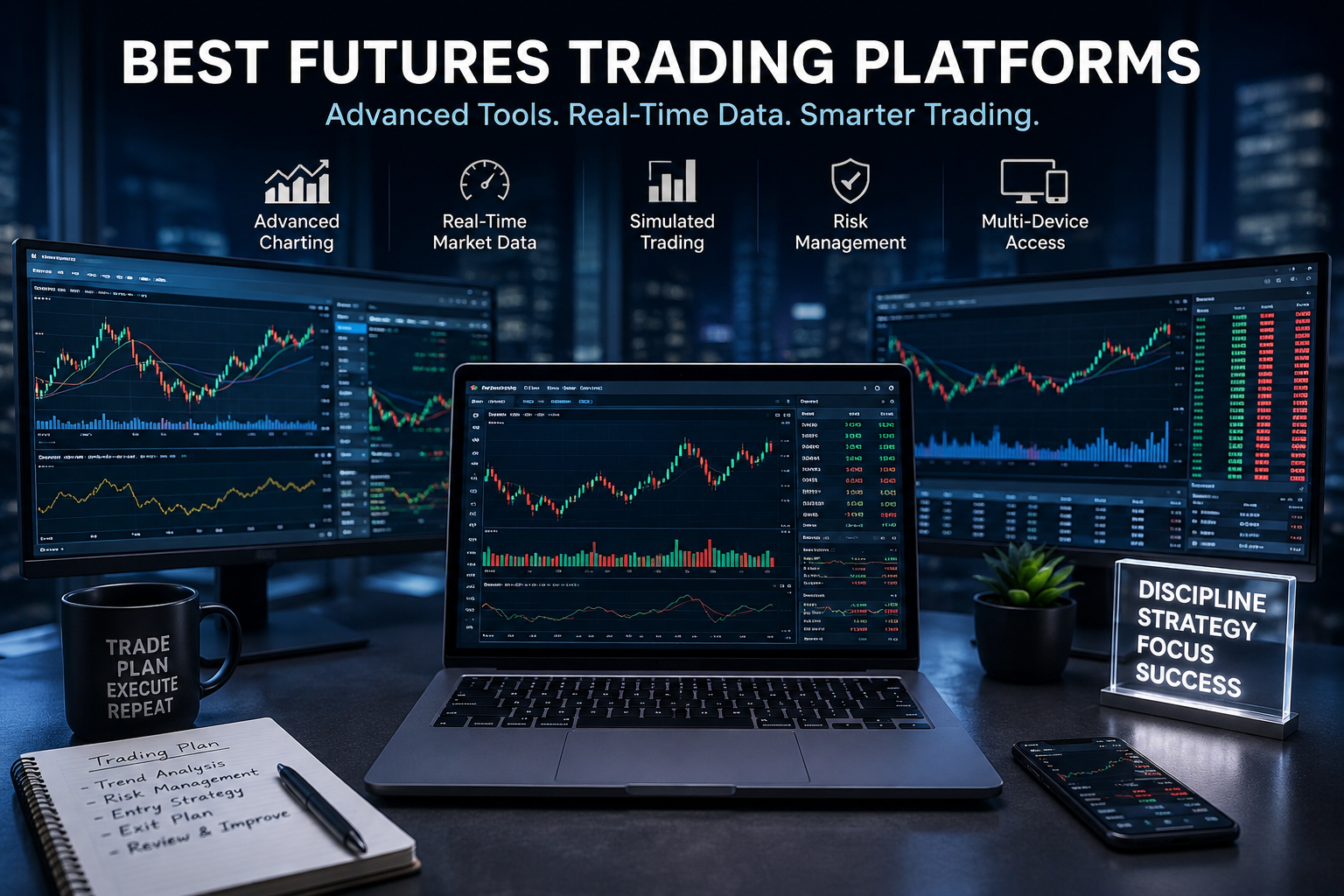
H2 — What to Look for in a Futures Trading Platform
→ charting and analysis
→ simulated trading
→ execution tools
→ commissions and fees
→ market-data availability
→ desktop/web/mobile access
When comparing the best futures trading platforms, traders should consider simulation features, market-data access, commissions, and platform usability
Choosing among the best futures trading platforms requires more than comparing commissions. Active traders should consider charting, order execution, market analysis, simulated trading, platform usability and the total cost of accessing futures markets.
This guide explains the key factors to evaluate in 2026 and highlights tools that can help traders research, test and execute their own futures trading strategies.
What to Look for in a Futures Trading Platform
A strong futures platform should provide reliable charting, flexible order-entry tools and access to the market information needed to evaluate trading decisions. The right choice depends on experience, strategy and trading frequency.
Advanced Charting and Analysis
Technical traders may need customizable charts, indicators, drawing tools and multiple timeframes to analyze futures markets efficiently.
Simulated Trading
Simulation allows traders to practice platform functionality and test ideas without placing trades with real capital. Simulated performance, however, is hypothetical and should not be treated as evidence of future live results.
Trading Costs
Consider more than advertised commissions. Depending on the provider and account, futures trading can involve brokerage commissions, exchange fees, clearing fees, regulatory fees and market-data charges.
Execution and Risk Tools
Order types, position monitoring and risk-management functionality are particularly important in leveraged futures markets, where losses can occur rapidly.
Best Futures Trading Platforms in 2026
| Platform Type | Best For | Key Features |
|---|---|---|
| NinjaTrader | Active futures traders | Advanced charting, market analysis, simulation and futures trading tools |
| Multi-asset brokerage platforms | Traders using several asset classes | Broad market access and consolidated account tools |
| Chart-focused platforms | Technical analysis | Charts, indicators and strategy research |
NinjaTrader: Futures Trading and Simulation Tools
NinjaTrader is designed for active futures traders and provides advanced charting, market-analysis functionality, trade simulation and tools for executing futures strategies.
Its simulated environment can be useful for learning the platform and testing trading ideas before considering live execution. A live brokerage account is separate from simulated access and may involve applicable brokerage, exchange, clearing, regulatory and market-data fees.
Potential fit: Active or technically focused traders looking for professional-grade futures charting, analysis and execution functionality.
Explore NinjaTraderAffiliate disclosure: TradeboticsAI may receive compensation if you sign up through this link.
Simulated Trading vs Live Futures Trading
Simulated and live trading should not be confused. Simulation uses hypothetical trading conditions and does not expose the trader’s capital to actual market losses. It can be valuable for learning software and evaluating a process, but simulated results cannot reproduce every aspect of live execution.
Live futures trading involves real capital and leveraged financial instruments. Market movements, execution conditions, costs and trader behavior can produce materially different results.
Futures Trading Platform Costs Explained
When comparing the best futures trading platforms, evaluate the total trading cost rather than focusing on a single advertised rate. Costs can vary according to the contract traded, platform, brokerage arrangement, market-data requirements and trading volume.
Before opening or funding a live account, review the provider’s current official pricing and fee documentation.
Who Should Consider a Futures Trading Platform?
Dedicated futures platforms are primarily suited to people who specifically want to research or trade futures contracts. Advanced charting and execution functionality can appeal to active traders, systematic traders and users who want to practice their strategies in simulation before considering live markets.
Futures are leveraged products and are not appropriate for every investor. Platform functionality should never be interpreted as a guarantee of trading performance or profitability.
Best Futures Trading Platforms: Evidence-Based Decision Matrix
The best futures trading platforms are not interchangeable: a chart interface, brokerage account, exchange data subscription and order-routing connection can be separate purchases. Compare verified workflows rather than relying on unsupported claims about execution speed or simulated profits. Choose a broker connection first and confirm it supports your contracts, account permissions and intended order types.
| Platform | Best fit to investigate | What to verify before paying |
|---|---|---|
| NinjaTrader | Futures-first desktop, web and mobile workflow with simulation and brokerage plan choices. | Free versus Monthly and Lifetime commissions, CME data, routing charges and desktop-only features. |
| Quantower | DOM and order-flow research through supported futures connections including Rithmic and CQG. | Broker compatibility, enabled modules, license terms and separately billed market data. |
| Interactive Brokers Trader Workstation | Multi-asset and international futures activity with portfolio-level oversight. | Futures permissions, exchange subscriptions, order restrictions and the learning curve. |
| TradingView with a broker | Chart-first research and broker-connected order entry where supported. | The exact futures symbols, order types, data feeds and integration functions enabled by that broker. |
For chart-first trading, the best futures trading platforms may prioritize flexible visualization and reliable broker integration. DOM traders should verify actual market-depth entitlements and the data feed. Multi-asset traders may favor account-level order management over specialist indicators. The best futures trading platforms cannot be compared fairly by chart screenshots alone; no platform guarantees favorable fills.
Best Futures Trading Platforms: Monthly Total Cost Example
Compare the best futures trading platforms using one workload and the same contract: monthly subscription + completed round turns × all-in round-turn fee + separately billed market data, routing and add-ons. Do not double-count exchange, NFA or clearing fees already included in an all-in rate. Margin is collateral, not itself a commission.
Real provider fee inputs; illustrative volume: NinjaTrader’s official schedule dated August 14, 2026 quotes $1.88 per MES round turn on Free and $1.68 on Monthly, with a $99 Monthly plan fee. For an illustrative 100 completed MES round turns, that gives $188 Free versus $267 Monthly ($99 + 100 × $1.68), excluding separately billed data, optional routing, slippage and account-specific charges. The $0.20 per-round saving would offset $99 only after 495 MES round turns in a month, if those fee assumptions held. This is a cost comparison, not a trading performance forecast.
Different best futures trading platforms use different charging models. Quantower says third-party market data are excluded from its licenses. IBKR’s broker-and-platform arrangement should be evaluated alongside market subscriptions and commissions. A TradingView setup requires checking both its chart plan and the selected broker. Our NinjaTrader Fees guide and Futures Data Feeds comparison cover these separate decisions.
Best Futures Trading Platforms: Six Pre-Funding Checks
Before committing to the best futures trading platforms for your workflow, test the complete order lifecycle rather than relying solely on marketing screenshots:
- Exact contract: check your symbol, micro or standard contract, expiration and the next roll month.
- Order protection: test limit, stop and bracket behavior in simulation; ask where stops are held if a device disconnects.
- Data permissions: determine if Level 1, Level 2, historical ticks or market-by-order depth is actually needed.
- True cost: compare the same number of monthly round turns and all separately itemized charges.
- Device restrictions: confirm which functions exist in desktop, browser and mobile versions; test keyboard and small-screen workflows.
- Failure plan: know how to manage orders during a feed outage, volatile margin changes or contract expiration.
A structured review of the best futures trading platforms should include a simulated order and an adverse connectivity scenario. Simulation does not establish future live execution results; leveraged futures can cause substantial losses.
Because the best futures trading platforms change fees and integrations, verify your precise configuration using official sources checked October 19, 2026: NinjaTrader plan and fees; Quantower license; Quantower connections; IBKR TWS; TradingView broker list. This is documentation-based research, not a claim of first-hand benchmarking or personalized financial advice.
Best Futures Trading Platforms: Broker, Routing and Market Data
The best futures trading platforms are not standalone subscriptions. A working setup depends on an approved brokerage account, product permissions, exchange data entitlements, a supported routing connection and the interface used to enter orders. A platform can display a futures chart while its connected brokerage account is not authorized to trade that contract. Identify each component before comparing software prices.
For instance, Quantower documents separate connection workflows for Rithmic and CQG. Its instructions discuss server selection, symbol discovery and exchange data requirements. That documentation does not establish that every connected broker or account offers identical features. When comparing the best futures trading platforms, ask the broker to confirm in writing which connection, order types, historical depth and live products are supported in your specific account.
| Layer | Evidence to request | Typical mistake |
|---|---|---|
| Broker permissions | Exchange approval and an executable contract symbol. | Assuming that a visible chart permits an order. |
| Market data | Real-time status, Level 1 or Level 2, history and active month. | Buying DOM tools without the required depth feed. |
| Routing | Provider, server environment, accepted order types and reconnection policy. | Assuming simulation and live connections behave identically. |
| Device | Desktop, browser and mobile feature availability. | Expecting an advanced desktop tool on a phone. |
The best futures trading platforms for order-flow research should support the specific depth information required by the strategy, not merely display a colorful ladder. Market-by-price and market-by-order data are different products. See our futures Level 2 data guide. Official connection references: Quantower with Rithmic and Quantower with CQG.
Best Futures Trading Platforms: Order Protection and Real Fills
A stop displayed on a chart is not sufficient proof of where the order is held or whether it survives disconnection. Protective stops, stop-limit orders, OCO brackets and locally simulated orders can have different behavior depending on broker, order-routing service and platform settings. Find out whether the instruction is managed locally, by the broker or at the exchange; also ask what happens during a data interruption.
NinjaTrader’s August 2026 support guidance explains that liquidity, order size, spreads and rapidly moving prices affect partial fills and slippage. A stop-market order might execute away from its trigger; a stop-limit order could fail to execute after a fast move. A displayed bid or ask can change before an order arrives. Compare the best futures trading platforms by how clearly they expose order states, cancellations, rejected orders and position reconciliation, not by unsupported promises of perfect fills.
Build an emergency workflow while using a practice account. Submit a test bracket, disconnect the workstation and reconnect. Check whether the platform’s position view and working-order list match the broker’s records. Practice flattening a simulated position and locating the broker support channel. Simulation does not prove what will happen in live markets, but it can expose an operational misunderstanding before money is at risk.
Repeat the test with the order types you expect to use most. If the best futures trading platforms on your shortlist cannot document where their protective instructions are maintained, request an explanation before funding. An elegant interface is no substitute for understanding the execution system. Read the NinjaTrader order and fill guide.
Best Futures Trading Platforms: Session Hours and Contract Changes
Futures products do not share one universal trading session. The exchange, contract, holiday calendar and data feed determine what periods are available; chart templates may deliberately show only part of the electronic session. Volume-based calculations, session VWAP and opening-range studies can consequently differ between two screens using the same symbol. When choosing the best futures trading platforms, make sure the session template matches the intended research and execution rules.
CME Globex normally has a scheduled weekday maintenance interval. NinjaTrader also documents broker-specific intraday and initial-margin timing rules. Do not confuse a market’s trading hours with the time by which a particular account must close a position to meet margin requirements. Overnight positions are exposed to gaps and to periods when positions cannot be adjusted, regardless of how sophisticated the software may appear.
Before expiration, check the active contract month, the symbol used by the order ticket, the upcoming contract’s liquidity and the broker’s liquidation deadline. A continuous futures series can be useful for research but is not itself an executable instrument. Our futures rollover calendar is a starting point for these checks, not a substitute for current exchange rules. These are practical selection criteria for the best futures trading platforms, particularly for traders holding positions through session boundaries.
Official reference: NinjaTrader futures hours and account timing, updated August 2026.
Best Futures Trading Platforms: A Repeatable Trial
Compare competing software using one written scenario. In each platform, locate the same micro futures contract, inspect bid and ask quotes, enter a simulated limit order with a protective bracket, modify an unfilled order, cancel it, export a trade record and restore the workspace after reconnecting. Record whether each step is supported and how difficult it is to complete. The outcome is a workflow audit, not a scientifically controlled execution-speed test.
When evaluating the best futures trading platforms, note the exact application version, brokerage connection, data subscription, practice account and trading session. Distinguish a missing feature from a missing market-data entitlement. Never describe an unsupported app-store claim as a firsthand benchmark. On mobile, repeat the order-cancellation and position-check steps using the actual screen size intended for trading.
For research software, test historical assumptions separately from order entry. Does the platform reproduce entries without future information? Can it model commission and slippage? Can it separate an optimization interval from an untouched validation period? These questions are covered more deeply in our futures backtesting platforms comparison. Simulation is a valuable learning method but cannot replicate every liquidity constraint, live fill or psychological factor.
The best futures trading platforms for beginners should make basic orders understandable. For systematic traders, the priority may be documented data, repeatability, reporting and permissions for automation. The NinjaTrader simulation documentation explains its practice environment and why its assumptions differ from real brokerage execution.
Best Futures Trading Platforms: An Illustrative Scoring Method
Use a weighted scorecard rather than a universal winner for the best futures trading platforms. Give each candidate a score from zero to five against evidence you have personally checked. Multiply by the weighting and divide the total by five to produce an illustrative score out of 100. The following weights are a planning example, not product rankings or trading recommendations.
| Criterion | Weight | What to check |
|---|---|---|
| Broker and contract fit | 25% | Approved symbols, routing and exchange coverage. |
| Order and risk control | 25% | Protective orders, cancellation and outage response. |
| All-in fees | 20% | Software, trading, data and optional connections. |
| Research and records | 15% | Historical data, exports and reproducible testing. |
| Device and accessibility | 15% | Readable interfaces and usable critical actions. |
For example, scores of 4, 3, 5, 3 and 4 across the five criteria produce 76/100: (4 × 25 + 3 × 25 + 5 × 20 + 3 × 15 + 4 × 15) / 5. This is a mathematical demonstration, not a score assigned to NinjaTrader, Quantower or any competing provider. It shows why a lower headline price is not enough if a platform cannot deliver the required order workflow.
For the best futures trading platforms, revisit the score when the broker changes fees, the software updates or the trader’s needs change. A chart-focused trader might weight display and integration more heavily; an order-flow trader might emphasize live depth and connection quality. The best futures trading platforms are those that demonstrably meet the user’s requirements, not necessarily those with the longest feature list. Futures trading remains leveraged and can cause substantial losses.
Frequently Asked Questions
What is a futures trading platform?
It is software that provides tools for analyzing futures markets and, when connected to an appropriate brokerage account, submitting and managing futures orders.
Can I practice futures trading without risking real money?
Platforms offering simulated trading can allow users to practice using hypothetical funds. Simulation does not reproduce all aspects of live trading and does not guarantee future results.
Are futures trading platforms free?
Some platforms provide free tools or simulated environments, but live futures trading can involve commissions, exchange fees, clearing charges, regulatory fees, market-data costs or other account-related expenses.
What should beginners look for?
Ease of use, educational resources, simulation, transparent pricing and clear risk controls are useful starting points. Understanding futures and leverage should come before committing real capital.
What fees should futures traders consider?
Review brokerage commissions, exchange and clearing fees, regulatory charges, market-data subscriptions and any platform or account fees that may apply.
Final Thoughts
There is no single platform that is ideal for every trader. The best choice depends on trading style, required markets, analytical needs, costs and experience.
NinjaTrader is one option worth evaluating for traders specifically interested in futures charting, simulation and active trading tools. Compare the platform’s current features and costs with your individual requirements before deciding whether it is suitable.
Affiliate Disclosure: This page contains affiliate links. TradeboticsAI may receive compensation when eligible users take an action through certain links, at no additional cost to the reader.
Risk Disclosure: Futures trading involves substantial risk of loss and is not suitable for every investor. Simulated trading results are hypothetical and do not represent actual trading results. Nothing on this page constitutes investment, financial or trading advice.
Further Reading: Futures Platform Selection
Explore these related guides for specific decisions beyond this comparison:
- Best Futures Brokers — Compare brokerage services and costs separately from platform features
- Futures Data Feeds — Review market data subscriptions and platform compatibility
- Best Futures Charting Software — Assess charting, depth of market, and analytical tools
- Best Futures Trading Simulators — Review practice environments before risking live capital
- Futures Trading Apps — Compare mobile trading workflows on iPhone and Android
- Best Futures Trading APIs — Evaluate programmatic orders, integration and automation options
- NinjaTrader Fees — Understand platform plans, commissions and market data expenses