Futures Contract Specifications 2026: Tick Size, Tick Value & Contract Guide
Futures Contract Specifications define exactly what one futures contract represents, how small its minimum price movement can be, and how much that movement is worth in dollars. Before trading ES, NQ, CL, GC, BTC, or any other futures market, traders should understand contract size, multiplier, tick size, tick value, expiration, trading months, and settlement rules.
Quick Answer
The most important Futures Contract Specifications are contract size, tick size, tick value, product symbol, listed months, trading hours, expiration rules, and settlement method. Tick value can usually be calculated as tick size × contract multiplier or contract unit. Always verify current specifications with the exchange before trading because products and rules can change.
Explore NinjaTrader for futures trading and simulation
Affiliate Disclosure: TradeboticsAI may earn compensation if you complete a qualifying action through an affiliate link, at no additional cost to you. This does not influence our editorial analysis.
What Are Futures Contract Specifications?
Futures Contract Specifications are the standardized rules published by an exchange for a futures product. They determine the contract unit, quotation method, minimum price fluctuation, symbol, listing cycle, settlement process, and other mechanics. CME Group describes contract size, notional value, tick size, dollar tick value, contract months, price limits, and settlement among the core specifications traders need to understand.
These details matter because a chart move does not have the same financial impact across markets. A 0.25-point move in E-mini S&P 500 futures is worth $12.50 per contract, while the same 0.25-point move in Micro E-mini S&P 500 futures is worth $1.25. The price chart can look similar while the dollar exposure is ten times different.
For that reason, Futures Contract Specifications should be checked before position sizing, stop placement, backtesting, or live execution.
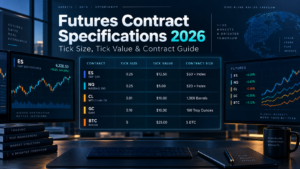
Futures Contract Specifications 2026: Major Markets
The table below is a practical reference for widely traded CME Group futures. It focuses on outright contract increments. Calendar spreads, special settlement transactions, reduced ticks, and broker-specific margin requirements may use different increments or rules.
| Contract | Symbol | Exchange | Contract Size / Multiplier | Tick Size | Tick Value |
|---|---|---|---|---|---|
| E-mini S&P 500 | ES | CME | $50 × index | 0.25 index points | $12.50 |
| Micro E-mini S&P 500 | MES | CME | $5 × index | 0.25 index points | $1.25 |
| E-mini Nasdaq-100 | NQ | CME | $20 × index | 0.25 index points | $5.00 |
| Micro E-mini Nasdaq-100 | MNQ | CME | $2 × index | 0.25 index points | $0.50 |
| E-mini Dow | YM | CBOT | $5 × index | 1 index point | $5.00 |
| Micro E-mini Dow | MYM | CBOT | $0.50 × index | 1 index point | $0.50 |
| E-mini Russell 2000 | RTY | CME | $50 × index | 0.10 index points | $5.00 |
| Micro E-mini Russell 2000 | M2K | CME | $5 × index | 0.10 index points | $0.50 |
| WTI Crude Oil | CL | NYMEX | 1,000 barrels | $0.01/barrel | $10.00 |
| Micro WTI Crude Oil | MCL | NYMEX | 100 barrels | $0.01/barrel | $1.00 |
| Henry Hub Natural Gas | NG | NYMEX | 10,000 MMBtu | $0.001/MMBtu | $10.00 |
| Micro Henry Hub Natural Gas | MNG | NYMEX | 1,000 MMBtu | $0.001/MMBtu | $1.00 |
| Gold | GC | COMEX | 100 troy oz | $0.10/oz | $10.00 |
| Micro Gold | MGC | COMEX | 10 troy oz | $0.10/oz | $1.00 |
| Silver | SI | COMEX | 5,000 troy oz | $0.005/oz | $25.00 |
| Copper | HG | COMEX | 25,000 lb | $0.0005/lb | $12.50 |
| Euro FX | 6E | CME | €125,000 | $0.00005 per euro | $6.25 |
| Bitcoin | BTC | CME | 5 bitcoin | $5/bitcoin | $25.00 |
| Micro Bitcoin | MBT | CME | 0.10 bitcoin | $5/bitcoin | $0.50 |
Important: these Futures Contract Specifications are a research reference, not a substitute for the current exchange rulebook. Specifications, available products, special tick rules, and broker requirements can change. Verify the relevant contract directly with CME Group’s contract-specification resources before placing a trade.
How to Read Futures Contract Specifications: Tick Size vs Tick Value
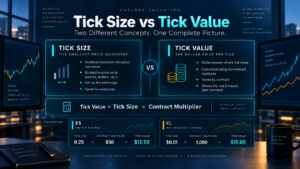
The most common mistake when reading Futures Contract Specifications is treating tick size and tick value as the same thing. Tick size is the minimum permitted price movement. Tick value is the dollar value of that movement for one contract.
Basic formula: Tick Value = Tick Size × Contract Multiplier or Contract Unit.
For ES, the multiplier is $50 per index point and the minimum move is 0.25 points. Therefore, 0.25 × $50 = $12.50 per tick. For MES, the multiplier is $5, so the same 0.25-point move equals $1.25.
For physical commodities, the same logic uses the contract quantity. CL represents 1,000 barrels and trades in $0.01 increments per barrel, so one tick equals 1,000 × $0.01 = $10.
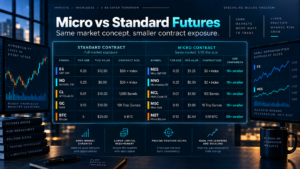
Micro vs Standard Futures Contract Specifications
Micro contracts are useful because they reduce dollar exposure without changing the underlying market concept. CME’s Micro E-mini equity index suite generally uses multipliers one-tenth the size of corresponding E-mini contracts. That makes Futures Contract Specifications especially important when switching between ES and MES, NQ and MNQ, or other standard/micro pairs.
| Pair | Larger Tick Value | Micro Tick Value | Ratio |
|---|---|---|---|
| ES / MES | $12.50 | $1.25 | 10:1 |
| NQ / MNQ | $5.00 | $0.50 | 10:1 |
| CL / MCL | $10.00 | $1.00 | 10:1 |
| GC / MGC | $10.00 | $1.00 | 10:1 |
| BTC / MBT | $25.00 | $0.50 | 50:1 |
Smaller tick value does not make a market safe. It only changes the exposure per contract. Volatility, liquidity, leverage, gaps, and execution risk still matter.
Futures Contract Specifications and Dollar Risk Examples
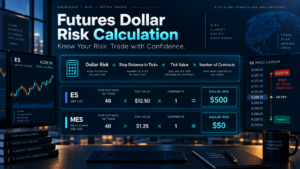
Futures Contract Specifications become useful when converted into actual trade risk. The general calculation is:
Dollar Risk = Stop Distance in Ticks × Tick Value × Number of Contracts.
Example 1 — ES: a 10-point stop equals 40 ticks because ES moves in 0.25-point increments. At $12.50 per tick, one contract risks $500 before fees and slippage.
Example 2 — MES: the same 10-point stop also equals 40 ticks, but at $1.25 per tick the theoretical risk is $50 per contract before fees and slippage.
Example 3 — CL: a $0.50 move in crude oil equals 50 ticks. At $10 per tick, one CL contract changes by $500.
Example 4 — MCL: the same $0.50 move equals 50 ticks, but at $1 per tick the change is $50.
These examples show why traders should never choose position size from margin alone. The Futures Contract Specifications determine the dollar value of the market move; your stop distance and number of contracts determine the planned exposure.
Margin Is Not the Same as Contract Value
Margin is intentionally excluded from the master table because it is not a fixed universal contract specification in the same way as tick size. Exchange performance-bond requirements can change, and brokers may apply their own intraday, overnight, or risk-based requirements.
A low intraday margin does not mean the contract itself has low notional exposure. For example, an index future can control a large amount of market value even when a broker requires only a fraction of that amount as margin. This leverage is one of the main reasons futures losses can accumulate rapidly.
When comparing platforms, review both the current contract mechanics and the broker’s current margin policy. TradeboticsAI’s Best Futures Trading Platforms 2026 guide explains other execution, simulation, charting, and cost factors that matter alongside contract size.
Expiration, Settlement and Delivery Risk
Complete Futures Contract Specifications go beyond tick values. Traders must also know when a contract stops trading, which months are listed, and whether the contract is cash-settled, financially settled, or physically deliverable.
This matters most when a position is held near expiration. Some physically deliverable commodity contracts can create delivery-related obligations if positions are not closed or rolled according to exchange and broker deadlines. Brokers can also impose earlier liquidation or position-management rules than the exchange’s final settlement date.
Bitcoin futures provide a useful contrast: CME states that BTC and MBT are financially settled to the applicable CME CF reference rate rather than resulting in delivery of bitcoin. Product mechanics therefore differ materially across asset classes.
Before holding any futures position into its delivery or expiration window, verify the exchange’s current contract page and your broker’s liquidation policy.
Using Futures Contract Specifications on a Trading Platform
A trading platform should display the correct instrument, contract month, price scale, and order quantity, but the trader is still responsible for understanding the underlying Futures Contract Specifications. A symbol such as NQ does not by itself tell you which expiration month is active, whether liquidity has rolled, or how much risk a given stop represents.
Before placing an order, confirm the root symbol, expiration month, tick size, tick value, stop distance, number of contracts, and whether the session is subject to different margin rules.
If you are evaluating a futures-focused platform, read our NinjaTrader Review 2026 for current platform, commission, simulation, and risk-tool details.
Pros and Limitations of Using a Contract Specifications Table
Pros
- Quickly compares tick value across markets.
- Helps convert chart distance into dollar exposure.
- Makes Micro vs larger contracts easier to compare.
- Useful for position sizing and backtest configuration.
- Reduces symbol and multiplier mistakes.
Limitations
- Does not replace the exchange rulebook.
- Margins can change independently of contract specs.
- Spread ticks may differ from outright ticks.
- Broker liquidation deadlines may be earlier than exchange deadlines.
- Tick value alone does not measure total market risk.
Who Should Use This Guide?
This guide is useful for beginners learning futures mechanics, active traders comparing Micro and larger contracts, systematic traders configuring backtests, and anyone checking dollar risk before placing an order.
It is not a substitute for current exchange documentation, broker margin schedules, or individualized financial advice. Traders who rely only on a static table without checking current contract rules can miss changes in settlement, listing, pricing, or broker requirements.

Futures Contract Specifications FAQ
What are the most important Futures Contract Specifications?
The most important Futures Contract Specifications are contract size or multiplier, tick size, tick value, product code, contract months, trading hours, expiration rules, and settlement method. Margin should also be checked separately because exchange and broker requirements can change.
How do you calculate futures tick value?
Multiply the minimum price increment by the contract multiplier or unit. ES has a 0.25-point minimum move and a $50 multiplier, producing a $12.50 tick value. CL has a $0.01 minimum move per barrel and represents 1,000 barrels, producing a $10 tick value.
What is the difference between tick size and tick value?
Tick size is the smallest permitted price movement. Tick value is the dollar impact of that minimum movement for one contract. Two contracts can share a similar price scale but have very different dollar exposure because their multipliers differ.
Are Micro futures always one-tenth the size?
No. Many Micro E-mini equity index contracts and products such as MCL or MGC are one-tenth the size of a larger counterpart, but this is not universal. Micro Bitcoin is 0.10 bitcoin versus 5 bitcoin for the standard BTC contract, making the standard contract 50 times larger by contract size.
Do Futures Contract Specifications include margin?
Exchange documentation can publish performance-bond information, but broker margin is not a permanent universal specification. Intraday and overnight requirements can change and may differ across brokers. Always verify current margin separately from the fixed product mechanics.
Can futures contract specifications change?
Yes. Exchanges can modify products, tick structures, listing cycles, settlement procedures, or other rules. Use this 2026 reference for research, then confirm current information on the official exchange page before trading.
Final Verdict: Why Futures Contract Specifications Matter
Futures Contract Specifications are the bridge between a price chart and real dollar exposure. Knowing the symbol is not enough: traders need the multiplier, tick size, tick value, contract month, expiration rules, and settlement mechanics before they can size risk intelligently.
The biggest practical lesson is simple: calculate risk from the contract specification and stop distance, not from the broker’s minimum margin. Micro futures can make sizing more granular, but they do not remove leverage, volatility, slippage, or the possibility of loss.
Use the table as a fast reference, then verify the current contract page with the exchange before entering a position.
Explore NinjaTrader for futures charting, simulation and execution tools
Affiliate Disclosure: TradeboticsAI may receive compensation when eligible users complete a qualifying action through certain affiliate links. Affiliate relationships do not determine our editorial conclusions.
Risk Disclosure: Futures trading involves substantial risk of loss and is not suitable for every investor. Futures are leveraged instruments, and losses can exceed the amount expected from a simple margin comparison. Examples on this page are educational and hypothetical. Simulated or backtested results do not represent actual trading results and do not guarantee future performance. Nothing on this page is personalized investment, financial, tax, or trading advice.
“`
**ONE-PASS TOP-10 QUALITY GATE COMPLETATO**