Futures Trading Taxes 2026: 60/40 Rule, Form 6781 & Tax Guide
Futures Trading Taxes 2026 can differ significantly from the tax treatment many U.S. stock traders are familiar with. Many regulated futures contracts are generally treated as Section 1256 contracts under U.S. federal tax rules. That can mean year-end mark-to-market accounting and a 60/40 capital-gain split: 60% treated as long-term and 40% as short-term, regardless of how long an eligible contract was actually held. This guide explains the core rules, Form 6781, broker reporting, unrealized year-end positions, losses, exceptions and practical recordkeeping considerations for U.S. futures traders.
Quick Answer: Futures Trading Taxes 2026
For many U.S. traders, Futures Trading Taxes 2026 involve Section 1256. Qualifying regulated futures contracts are generally marked to market on the final business day of the tax year, and resulting capital gains or losses are generally split 60% long-term and 40% short-term. Form 6781 is used to report Section 1256 gains and losses. Not every derivative or futures-related position receives identical treatment, so traders should verify the exact contract and current IRS instructions before filing.
Explore NinjaTrader for Futures Trading
Affiliate Disclosure: TradeboticsAI may earn compensation when a qualifying action is completed through an affiliate link, at no additional cost to you. Affiliate relationships do not affect our editorial analysis.
Tax Notice: This page provides general educational information for U.S. readers and is not individualized tax, accounting or legal advice. Tax treatment depends on the instrument, activity, elections and taxpayer circumstances. Verify current IRS rules and consult a qualified tax professional when necessary.
Futures Trading Taxes 2026: U.S. Tax Overview
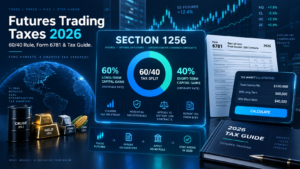
The starting point for Futures Trading Taxes 2026 is identifying what you actually traded. The IRS lists regulated futures contracts among the instruments included in the definition of Section 1256 contracts. Other Section 1256 categories can include certain foreign-currency contracts, nonequity options, dealer equity options and dealer securities futures contracts.
The label “futures” alone should not be used as the tax conclusion. Different derivatives can fall under different sections of the tax code, and hedging transactions, securities futures and mixed straddles can require special treatment.
For ordinary speculative trading in qualifying regulated futures contracts, however, Section 1256 is the central federal framework. It creates two especially important rules: positions can be marked to market at year-end and qualifying capital gains or losses generally receive the 60/40 split.
Read the current official IRS Publication 550 before filing because the IRS can update forms, instructions and guidance.
What Is Section 1256 for Futures Trading Taxes 2026?
Section 1256 is the tax-code framework governing several types of financial contracts. For most readers researching Futures Trading Taxes 2026, the relevant category is the regulated futures contract.
IRS Publication 550 explains that a regulated futures contract generally involves daily mark-to-market through the margin-account system and trading on or subject to the rules of a qualified board or exchange.
That is why major exchange-traded futures contracts can receive tax treatment that differs from ordinary stock positions. Instead of determining long-term or short-term status solely from the number of days the trader held the contract, Section 1256 generally applies a predefined 60/40 split.
This treatment can apply to active day traders even when positions are held only for minutes or hours. The holding period does not by itself change the normal Section 1256 60/40 allocation.
However, Futures Trading Taxes 2026 should never be reduced to “all futures are 60/40.” The exact instrument and transaction purpose matter.
Futures Trading Taxes 2026 and the 60/40 Rule

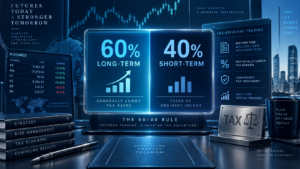
The 60/40 rule is the feature most traders associate with Futures Trading Taxes 2026. IRS Publication 550 states that under the Section 1256 mark-to-market system, 60% of the qualifying capital gain or loss is generally treated as long-term and 40% as short-term.
This treatment applies regardless of how long the position was actually held. A qualifying futures contract opened and closed during the same trading session can therefore still receive the statutory 60/40 character rather than being classified entirely as a short-term capital transaction solely because it was a day trade.
For example, assume qualifying Section 1256 activity produces a hypothetical net capital gain of $10,000 before considering other tax items. Under the basic 60/40 framework:
- $6,000 would generally be characterized as long-term capital gain.
- $4,000 would generally be characterized as short-term capital gain.
This example demonstrates classification only. It does not calculate the actual tax owed. Federal rates, state taxes, other gains and losses, filing status and the taxpayer’s individual circumstances determine the final tax result.
Mark-to-Market in Futures Trading Taxes 2026
Year-end mark-to-market is another defining part of Futures Trading Taxes 2026. Under the general Section 1256 rule, an eligible contract still open at the end of the tax year is treated as if it were sold at fair market value on the final business day of that tax year.
The resulting unrealized gain or loss is therefore recognized for tax purposes even though the trader has not physically closed the position. The contract’s tax basis is then adjusted so that the same gain or loss is not counted twice when the trade is ultimately closed.
Assume a qualifying contract has an unrealized $2,000 gain at year-end. Under the general mark-to-market framework, that amount may be recognized for the tax year as though the contract had been sold at fair market value on the final business day.
If the market subsequently moves after the new tax year begins, only the additional movement relative to the adjusted tax value is considered when the position is later disposed of.
This rule means a trader cannot assume that leaving a qualifying futures position open on December 31 automatically defers the unrealized gain into the following tax year.
Form 6781 and Futures Trading Taxes 2026
Form 6781 is a central reporting document for Futures Trading Taxes 2026. The IRS states that Form 6781 is used to report gains and losses on Section 1256 contracts under the mark-to-market rules, as well as certain gains and losses involving straddles.
The form separates the Section 1256 calculation from ordinary stock-by-stock transaction reporting. After the applicable net result is determined, the long-term and short-term portions flow through the broader capital-gain reporting process.
Use the official IRS Form 6781 page rather than downloading an old version from a third-party website.
As of September 2026, the IRS forms directory still identifies the 2025 revision of Form 6781 among its current published materials. Traders preparing a later return should therefore verify that they are using the revision and instructions applicable to the actual tax year being filed.
Futures Trading Taxes 2026 Example
A simplified Futures Trading Taxes 2026 example can show how realized and year-end unrealized results interact.
Suppose a trader produces $14,000 of net realized gain from qualifying regulated futures contracts during the year and still owns another qualifying contract with a $1,000 unrealized year-end gain.
Under the general mark-to-market rule, that open position can be treated as though it were sold at fair market value on the final business day of the year. The simplified Section 1256 result would therefore be $15,000 before considering any other positions, adjustments, straddle rules or exceptions.
The basic 60/40 characterization would then allocate:
- $9,000 to the long-term portion.
- $6,000 to the short-term portion.
This is a simplified educational illustration, not a completed tax return. Brokerage statements, adjustments, hedging treatment, mixed straddles, prior-year loss elections and other facts can change actual reporting.
Broker Tax Documents for Futures Trading Taxes 2026
Accurate Futures Trading Taxes 2026 reporting starts with reconciling broker records rather than relying only on the platform’s daily P&L screen.
Futures brokers commonly provide year-end tax information covering Section 1256 activity. The trader should compare those records with personal transaction records and verify that transfers, commissions, contract expirations and open year-end positions are reflected correctly.
Do not confuse a platform performance report with an official tax document. Trading software is designed primarily for execution and analysis, while the broker or clearing firm’s year-end statement is designed to support account and tax reporting.
Keep downloadable broker statements even after filing. Historical statements can become important if a tax return is amended, an IRS question arises or you need to reconcile future carrybacks or carryforwards.
How Futures Trading Losses Can Be Treated

Futures Trading Taxes 2026 also matters during losing years. Qualifying Section 1256 capital losses generally retain the same 60/40 long-term and short-term character under the standard framework.
IRS Publication 550 also describes a special election that can allow an eligible net Section 1256 contracts loss to be carried back to earlier tax years, subject to statutory limitations and calculations. The carryback can reach the three preceding tax years under the applicable rules.
This is more complicated than simply subtracting the current loss from any earlier futures profit. Eligibility, limits, prior-year Section 1256 gains and filing procedures all matter.
Traders with significant losses should therefore avoid making a carryback election based only on an online summary. Review the current Form 6781 instructions and obtain professional tax advice when the amounts are material.
Important Futures Trading Taxes 2026 Exceptions
One of the most important points in Futures Trading Taxes 2026 is that the general Section 1256 explanation has exceptions.
Hedging Transactions
The standard mark-to-market rule does not automatically apply to qualifying hedging transactions in the same manner as speculative capital positions. Genuine business hedges can have specialized identification and tax treatment.
Securities Futures
Certain securities futures contracts can be treated differently from the regulated futures contracts most commodity and index traders associate with Section 1256. The exact contract classification matters.
Straddles and Mixed Straddles
Holding offsetting positions can trigger the straddle rules under Section 1092. Mixed straddles combining Section 1256 and non-Section 1256 positions can introduce specialized elections and character rules.
Foreign-Currency Transactions
Currency taxation can involve multiple sections of the Internal Revenue Code. Some qualifying foreign-currency contracts can fall within Section 1256, while other spot or forward transactions can receive different treatment.
Business vs Investment Activity
Whether trading rises to the level of a tax trade or business is a separate issue from whether a contract is a Section 1256 contract. Do not assume frequent futures trading automatically changes the treatment of every trading expense or creates a business-tax election.
Futures Trading Taxes 2026 vs Stock Trading Taxes
The tax distinction is one reason traders compare futures with stocks. Standard stock capital gains generally depend on actual holding period: positions held one year or less are normally short-term, while positions held more than one year can qualify as long-term capital gains.
By contrast, qualifying Section 1256 futures generally apply the 60/40 character regardless of actual holding period. That means a futures day trader can have part of a qualifying net gain classified as long-term under the Section 1256 framework.
Stocks also do not generally use the same automatic year-end Section 1256 mark-to-market treatment for an ordinary investor. An unrealized gain on a normal stock position usually remains unrealized merely because December 31 arrives.
This does not mean futures are always tax-advantaged. Tax rates, losses, state taxes and individual circumstances matter, and the leverage risk of futures is separate from their tax treatment.
For the product comparison itself, read our Futures vs Stocks 2026 guide.
Futures Trading Taxes 2026 vs Options Taxes
Options taxation requires particular care because “options” is a broad category. Some nonequity options can fall within Section 1256, while ordinary equity options generally do not receive the exact same treatment.
This makes blanket claims such as “futures are 60/40 but options are short-term” inaccurate. The underlying instrument and contract classification determine the applicable rules.
Options on broad-based indexes, options on futures and individual-stock options can have materially different characteristics. Exercise, assignment, expiration and straddle rules can also influence the result.
Our Futures vs Options 2026 comparison explains the trading mechanics separately from the tax classification.
Commissions, Data and Trading Expenses
Transaction costs are important for both strategy performance and Futures Trading Taxes 2026 recordkeeping. Futures trading can involve broker commissions, exchange fees, clearing fees, regulatory charges, market-data subscriptions and platform-related costs.
The way expenses are ultimately treated for tax purposes can depend on whether the taxpayer is considered an investor or trader for federal-tax purposes and on the nature of the expense. Do not automatically deduct every trading-related purchase simply because it was used while trading.
Instead, keep a detailed record of commissions, subscriptions, education expenses, software, hardware and professional services and allow a qualified preparer to determine which items receive tax treatment in your specific situation.
This also improves business analysis. Whether or not an expense is deductible, it remains a real cost that should be included when measuring the actual economic performance of a trading strategy.
Futures Trading Taxes 2026 Recordkeeping Checklist
A strong Futures Trading Taxes 2026 process begins long before filing season. Traders should keep records throughout the year rather than rebuilding an account history in April.
- Monthly and annual brokerage statements.
- Year-end futures tax documents.
- Realized and unrealized P&L records.
- Open positions held across the final business day of the tax year.
- Deposits and withdrawals.
- Commission, exchange and clearing charges.
- Market-data and platform invoices.
- Records of any hedging or offsetting positions.
- Prior-year Form 6781 records when relevant.
- Documentation supporting any tax elections.
Trading journals and broker statements serve different purposes. A journal helps evaluate execution and strategy quality. Official brokerage records help reconcile economic and tax results. Keep both.
Traders still learning futures mechanics can review our Futures Trading for Beginners 2026 guide, while smaller-contract traders can use our Micro Futures Trading 2026 guide.
Common Futures Trading Tax Mistakes
A common Futures Trading Taxes 2026 mistake is assuming every instrument displayed inside a futures or derivatives platform receives identical tax treatment. Contract classification matters.
Another mistake is forgetting open year-end positions. Section 1256 mark-to-market means qualifying open positions can generate recognized tax gains or losses even though the trader did not manually close them before year-end.
Traders also sometimes calculate taxes from net account deposits and withdrawals. That is not a substitute for actual gain-and-loss reporting. Funding an account or withdrawing cash does not by itself determine taxable trading income.
Another error is using an outdated Form 6781 or old tax software assumptions. IRS forms and instructions can be revised, so verify the tax-year version before filing.
Finally, do not let favorable tax treatment justify excessive trading. A tax-efficient loss is still a financial loss. Strategy quality and risk management should come before tax optimization.
Futures Trading Taxes 2026 FAQ
How are futures taxed in the United States?
Many qualifying regulated futures contracts fall under Section 1256. Under the general rule, positions are marked to market at year-end and capital gains or losses are generally characterized 60% long-term and 40% short-term regardless of the actual holding period.
What is the futures 60/40 tax rule?
The 60/40 rule generally treats 60% of a qualifying Section 1256 capital gain or loss as long-term and 40% as short-term. It is one of the central rules discussed in Futures Trading Taxes 2026.
Are futures day-trading profits all short-term gains?
Not necessarily. Qualifying Section 1256 contracts generally use the statutory 60/40 character even when the contracts were held for less than one year, including short-term trading activity.
What form reports futures trading gains?
Form 6781 is used to report gains and losses from Section 1256 contracts under the mark-to-market rules and certain straddle transactions.
Are open futures positions taxed at year-end?
Qualifying Section 1256 positions still open at year-end are generally treated as sold for fair market value on the final business day of the tax year under the mark-to-market rule.
Does every futures contract qualify for Section 1256?
No blanket assumption should be made. Regulated futures contracts are a Section 1256 category, but securities futures, hedges, straddles and other derivatives can involve different rules or exceptions.
Can futures trading losses be carried back?
Under certain conditions, an eligible net Section 1256 contracts loss may qualify for a special carryback election to preceding tax years, subject to IRS limitations and filing requirements.
Are Micro futures taxed differently from E-mini futures?
Contract size by itself does not determine federal tax character. If both contracts qualify as regulated Section 1256 futures, the same general Section 1256 framework can apply. Verify the actual instrument and account circumstances.
Are commissions deductible from futures profits?
Transaction charges affect the economic result, but the exact federal-tax handling depends on the nature of the charge and the taxpayer’s circumstances. Use broker tax records and current IRS guidance rather than estimating manually.
Do I need an accountant for Futures Trading Taxes 2026?
Simple accounts may be manageable with appropriate tax software and accurate broker documentation, but professional help becomes more valuable when trading includes large losses, multiple brokers, straddles, hedges, tax elections, foreign accounts or business-related trading issues.
Is the Section 1256 60/40 rule guaranteed to reduce my taxes?
No. The final result depends on your taxable income, capital gains and losses, state of residence and individual circumstances. The 60/40 split describes tax character, not a guaranteed tax saving.
Final Verdict: Futures Trading Taxes 2026
Futures Trading Taxes 2026 can be relatively structured for U.S. traders whose activity consists primarily of qualifying regulated Section 1256 futures. The core framework is straightforward: qualifying contracts are generally marked to market at year-end, and capital gains or losses generally receive the 60% long-term and 40% short-term split.
The complexity begins when traders mix instruments, maintain hedges or straddles, trade securities futures, use several brokers or make specialized elections. That is why correct contract classification and accurate records matter more than memorizing a single tax rule.
Use Form 6781 and Publication 550 as primary IRS references, reconcile your broker’s year-end statements and verify that you are using the correct forms for the tax year being filed. Tax planning should support a sound trading process, not encourage additional leverage or unnecessary trades.
For traders evaluating the platform side of the workflow, our NinjaTrader Review 2026 covers futures commissions, tools and platform costs.