Prop Firm Drawdown Calculator 2026: Free Futures Risk Tool
Use this prop firm drawdown calculator to estimate your current drawdown floor, remaining loss buffer, daily-loss room and distance from a potential account breach. The tool supports static drawdown, trailing drawdown and end-of-day trailing models so futures traders can visualize how different evaluation rules affect account risk.
A prop firm drawdown calculator is especially useful because the advertised account size is not necessarily the amount you can actually lose. A $50,000 evaluation may have only a few thousand dollars of permitted drawdown, and a trailing threshold can move upward as the account reaches new highs.
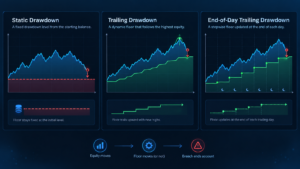
Quick Answer
The prop firm drawdown calculator converts account rules into dollar levels. For a static model, the floor normally remains fixed relative to the starting account. For a trailing model, the floor can rise as a high-water mark increases. An end-of-day model updates from qualifying closing balances instead of every intraday equity high. Enter your firm’s actual rules rather than assuming every prop firm calculates drawdown the same way.
Affiliate Disclosure: TradeboticsAI may receive compensation when readers complete qualifying actions through certain links. NinjaTrader buttons on this page are affiliate links. Calculator outputs are based solely on the values entered into the tool.
Prop Firm Drawdown Calculator
This interactive prop firm drawdown calculator lets you model the rules published by your evaluation or funded-account provider. Start with the account size, current balance and permitted drawdown. For trailing models, enter the relevant high-water mark. If the firm has a daily loss rule, enter that separately.
Calculate Your Prop Account Drawdown Buffer
—
—
—
—
—
—
Educational estimate only. Prop firms define balance, equity, unrealized P&L, session boundaries, high-water marks, trailing methods and breach conditions differently. Always compare the result with your firm’s current official rules and dashboard.
How a Prop Firm Drawdown Calculator Works
A prop firm drawdown calculator answers a different question from a normal trading P&L calculator. Instead of estimating the profit or loss of one trade, it estimates how close the entire account is to a rule-defined loss threshold.
The calculation starts with the firm's permitted drawdown and the rule used to anchor that drawdown. A static rule can remain tied to the original starting balance. A trailing rule can move upward behind a high-water mark. An EOD trailing rule typically uses a qualifying end-of-day value instead of following every intraday peak.
The distinction is critical because two $50,000 accounts with identical current balances can have different remaining buffers if their drawdown floors were calculated differently.

Static Drawdown in a Prop Firm Drawdown Calculator
Static drawdown is the simplest model. If a hypothetical $50,000 account allows $2,000 of static drawdown, the calculated floor is $48,000 and does not move higher simply because the trader makes a profit.
The simplified formula is:
Static drawdown floor = starting balance − maximum allowed drawdown
If the account grows to $54,000, the original $48,000 floor remains unchanged under a truly static model. This creates more cushion as profits accumulate.
A prop firm drawdown calculator should nevertheless allow traders to enter the firm's actual numbers because some programs use percentages, dollar amounts, equity rules or other definitions that change the calculation.
Trailing Drawdown in a Prop Firm Drawdown Calculator
Trailing drawdown behaves differently. Instead of remaining fixed, the risk floor moves upward as the account establishes new qualifying highs.
A simplified formula is:
Trailing floor = high-water mark − maximum allowed drawdown
Suppose a $50,000 account allows a $2,000 trailing drawdown and reaches a qualifying high-water mark of $52,000. A simplified trailing calculation places the floor at $50,000.
If the account then falls to $51,000, the floor normally does not fall with it. This asymmetric behavior is what makes trailing drawdown important: profits can move the floor upward, while later losses may reduce the available cushion.
The prop firm drawdown calculator therefore asks for both current account value and high-water mark when a trailing model is selected.
End-of-Day Trailing Drawdown Explained
An end-of-day trailing model can reduce one source of complexity because the qualifying high is based on an account value recorded at a session boundary instead of continuously following every intraday unrealized gain.
For example, if an account temporarily trades much higher during the session but closes below that peak, an EOD rule may calculate the next threshold from the qualifying closing value rather than the temporary intraday high. The exact definition depends on the provider.
NinjaTrader Prop currently distinguishes between EOD trailing max drawdown and real-time trailing max drawdown in its account-level risk settings. Real-time trailing reacts as account equity reaches new highs, including unrealized gains, while EOD trailing is based on end-of-day closing balance behavior.
This is why a prop firm drawdown calculator cannot safely assume that every trailing account works the same way.
Prop Firm Drawdown Calculator Formulas
The main formulas used by this prop firm drawdown calculator are intentionally transparent.
Static Drawdown
Floor = Starting Balance − Maximum Drawdown
Trailing Drawdown
Floor = High-Water Mark − Maximum Drawdown
Remaining Buffer
Remaining Buffer = Current Equity − Drawdown Floor
Daily Loss Floor
Daily Loss Floor = Start-of-Day Balance − Daily Loss Limit
Remaining Daily Room
Remaining Daily Room = Current Equity − Daily Loss Floor
The optional personal safety reserve deliberately subtracts an additional amount from the calculated buffer. It is not a prop-firm rule. It simply lets a trader visualize a more conservative personal boundary before the official threshold.
Prop Firm Drawdown Calculator Example
Consider a hypothetical $50,000 futures evaluation with a $2,000 trailing drawdown. The account reaches a qualifying high-water mark of $51,500.
The simplified floor becomes:
$51,500 − $2,000 = $49,500
If the current account equity is $50,500, the remaining drawdown buffer is:
$50,500 − $49,500 = $1,000
The trader has used half of the original $2,000 cushion under this simplified example.
Topstep's current Maximum Loss Limit provides a useful real-world example of why the moving floor matters. Topstep states that its MLL rises as end-of-day balance grows, never moves downward, and locks once it reaches the starting balance. Its current published MLL amounts are $2,000 for a $50K Trading Combine, $3,000 for $100K and $4,500 for $150K.
See the
official Topstep Maximum Loss Limit documentation
before applying any Topstep-specific assumption.
Daily Loss Limits vs Maximum Drawdown
A maximum drawdown threshold and daily loss limit protect different boundaries. Maximum drawdown measures how far the account can fall relative to the rule-defined floor. A daily limit measures how much the account can lose during the relevant trading day or session.
A prop firm drawdown calculator should therefore display both when the account has both restrictions.
For example, an account could have $1,800 of remaining maximum drawdown but only $400 of daily-loss room. In that case the daily rule is the closer constraint.
Definitions also vary. Some firms include unrealized P&L in certain calculations, while others use specific session reset times or end-of-day values. Always use the provider's current definition rather than assuming “daily loss” has one universal formula.
Use Drawdown With a Futures Position Size Calculator
The prop firm drawdown calculator tells you how much account-level cushion remains. It does not tell you how many futures contracts should be traded.
That second calculation requires stop distance and contract economics.
For example, suppose the remaining account cushion is $1,000 but your personal risk plan allows only $200 on one trade. Position sizing should use the $200 personal budget rather than treating the entire $1,000 drawdown buffer as available risk for a single position.
Use our
Futures Position Size Calculator 2026
to convert a defined risk budget, stop distance and tick value into a maximum whole-contract quantity.

Prop Firm Drawdown Calculator for Multiple Accounts
Multi-account traders should calculate the risk state of each account separately. Two accounts with the same nominal size can have different balances, high-water marks, trailing floors and daily-loss room.
Do not assume that copying one leader position across several accounts produces identical risk utilization. An account that is only $300 above its drawdown floor is in a very different position from another account with $2,000 of remaining cushion.
A prop firm drawdown calculator can therefore be used before configuring follower quantities in a trade copier. The safest quantity may differ from one account to another.
For account-copying infrastructure, see our
Best Futures Trade Copiers 2026
comparison.
Risk Controls Beyond the Prop Firm Drawdown Calculator
The prop firm drawdown calculator measures risk boundaries, but calculation alone does not enforce them. Account-level controls can help prevent a trader or automated strategy from continuing after a predefined threshold is reached.
NinjaTrader Prop currently describes configurable daily and weekly loss limits, profit targets, EOD trailing max drawdown and real-time trailing max drawdown controls. These settings illustrate the difference between monitoring a limit and technically enforcing a limit.
Useful control layers include:
- Personal per-trade risk budgets.
- Maximum contract limits.
- Daily loss caps.
- Weekly loss caps where supported.
- Account lockouts.
- Automated flatten rules.
- Copy-trading follower limits.
- Trade journaling and post-session review.
See the
official NinjaTrader Prop risk-settings overview
for an example of account-level risk controls.
For performance review, our
Best Futures Trading Journals 2026
guide compares tools for drawdown, expectancy, MAE/MFE and multi-account analytics.
Common Prop Firm Drawdown Mistakes
Using Account Size as Available Risk
A $50,000 account label does not mean the trader can lose $50,000. The actual allowable loss may be only a fraction of that figure.
Ignoring the High-Water Mark
For trailing models, the current balance alone may be insufficient. The highest qualifying balance or equity can determine the current floor.
Confusing Intraday and EOD Trailing
A real-time threshold may react to unrealized intraday gains, while an EOD model may update from qualifying session-end values. This can materially change the buffer produced by a prop firm drawdown calculator.
Assuming the Floor Moves Back Down
Many trailing structures move the threshold upward as qualifying highs increase but do not lower it when the account subsequently loses money.
Ignoring Daily Loss Rules
The maximum drawdown could show plenty of room while a separate daily loss rule is close to being breached.
Using One Calculation for Every Prop Firm
Firms can define equity, balance, daily resets, unrealized P&L, high-water marks and floor locks differently. Always verify the current rulebook.
Risking the Entire Remaining Buffer
A remaining drawdown buffer is not automatically a recommended per-trade risk amount. A single adverse fill, slippage event or multiple-account error could consume more than planned.
Prop Firm Drawdown Calculator FAQ
What is a prop firm drawdown calculator?
A prop firm drawdown calculator estimates the account level at which a maximum-loss rule may be breached and shows the remaining dollar cushion between current equity and that calculated floor.
What is static drawdown?
Static drawdown uses a fixed loss floor based on the relevant starting value. In the simplest version, profits do not cause the threshold to move upward.
What is trailing drawdown?
Trailing drawdown moves a loss floor upward when the account reaches new qualifying highs. The floor normally does not move back downward when the account later loses money.
What is EOD trailing drawdown?
End-of-day trailing drawdown updates from qualifying session-end account values rather than necessarily reacting to every intraday high. Exact calculation and session timing vary by provider.
Does unrealized P&L affect drawdown?
It can. Some account rules evaluate equity and unrealized gains or losses, while other calculations are based on balances or end-of-day figures. Check the exact rules of your account.
Can this calculator tell me whether my prop account is safe?
No. The prop firm drawdown calculator produces an educational estimate from your inputs. The firm's official dashboard and current contractual rules remain authoritative.
What happens when a drawdown floor locks?
In some trailing models, the floor eventually reaches a specified lock level and stops following additional profits. The exact lock threshold is firm-specific.
How does Topstep's Maximum Loss Limit currently work?
Topstep currently states that its Maximum Loss Limit rises as end-of-day balance grows, does not move downward, and permanently locks after reaching the starting account balance.
Should I use my entire remaining drawdown as trade risk?
No general rule says you should. The remaining drawdown is an account constraint. Per-trade risk should be determined separately according to your trading plan and the contract's stop-distance economics.
Can I calculate several prop accounts?
Yes. Run the prop firm drawdown calculator separately for each account using that account's current balance, high-water mark and rules.
Final Verdict: Prop Firm Drawdown Calculator for 2026
A useful prop firm drawdown calculator should make invisible account rules visible. Instead of thinking only about a $50K, $100K or $150K headline account size, the trader can see the estimated floor, current buffer and daily-loss room in actual dollars.
The most important distinction is the drawdown model. Static, real-time trailing and end-of-day trailing rules can produce different thresholds from the same starting balance. High-water marks, unrealized P&L and floor locks can change the calculation further.
Use this tool as one layer in a broader futures risk process: calculate the account buffer, define a smaller per-trade risk budget, calculate appropriate contract size, monitor execution, and record the result in a journal.
The prop firm drawdown calculator cannot replace the current rules displayed by the account provider. Prop-firm programs change, and a simplified calculator should never be used to override an official risk dashboard.